Взгляд, который смотрит
Как менялась роль глаз в изображении лица от I до XIV века
When we look at a piece of art, our gaze is inevitably drawn to the depiction of the eye. Eyes can often communicate more than any textual description. On some images, they look directly at the viewer; on others, they gaze into the void or toward another character in the scene. As part of my visual research, I wanted to examine the meanings ancient artists embedded in the image of the eye and how those meanings have evolved over time.
I. The Gaze as «Here I Am» (1st–4th Centuries)
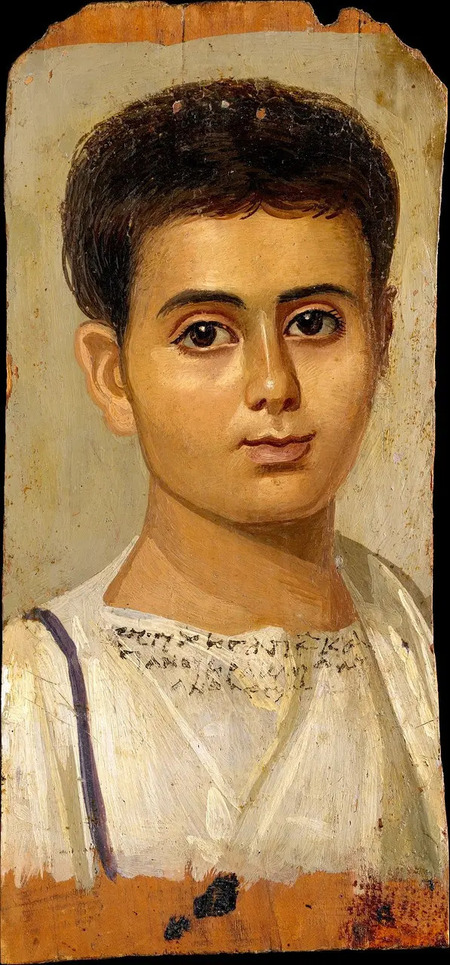
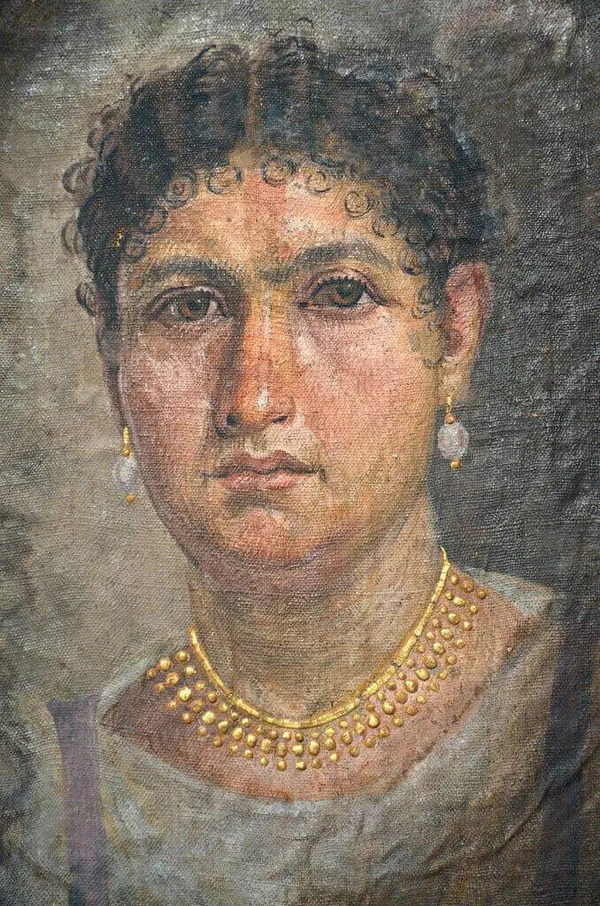
Faiyum Portrait. Roman Egypt, 1st–3rd centuries.
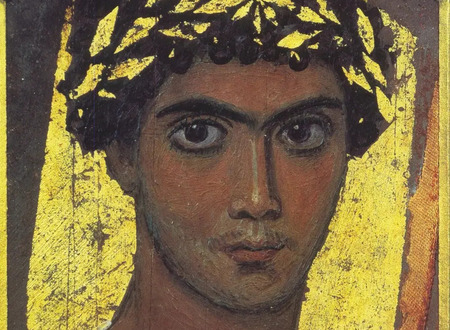
The first thing that draws the eye when viewing Fayum portraits is the eyes. They are large, dark, wide open, and stare directly at the viewer. Often, the eyes are emphasized by dark lines along the lids and deep shadows, and light highlights can be seen in the pupils, making the eyes seem particularly alive.The face is typically centered in the composition, the head is depicted frontally or with a slight turn, and the gaze is directed at the viewer or with only a minimal deviation. The background is simple and neutral, lacking any details that might distract from the individual.These portraits were placed on the mummies of the deceased, covering their faces. Therefore, the direct gaze can be interpreted as a sign that the person continues to be present among the living.Nevertheless, the faces in Fayum portraits are highly varied. The artist strove to preserve the individual characteristics of each person.
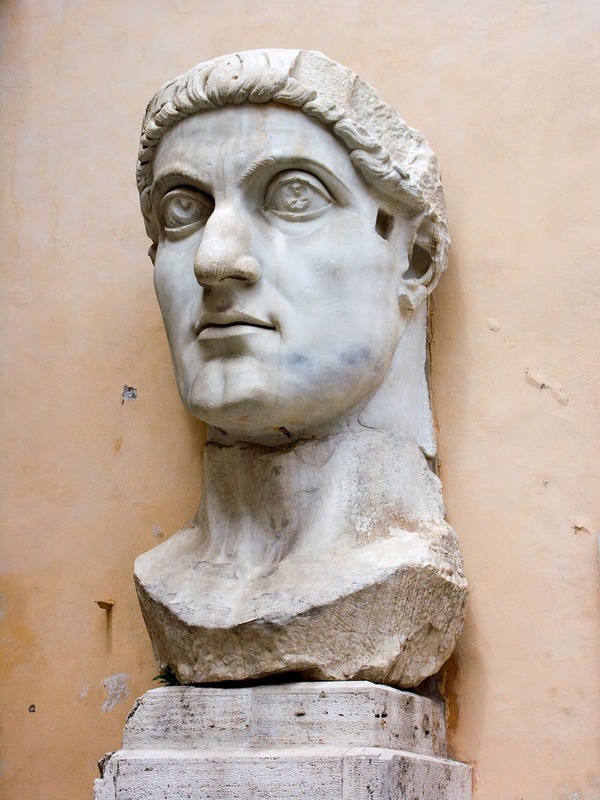
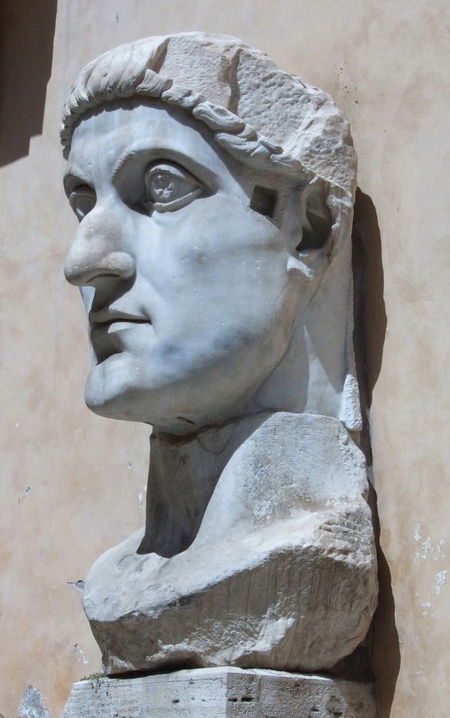
Colossus of Constantine. 312–315, or c. 325 AD.
The emperor Constantine’s head is structured quite differently. It is very large, and judging by the scale, it is clear this is not a private portrait. The face is placid, almost devoid of expression, and the features are generalized.
The eyes are enlarged and emphasized, and the gaze is directed upward and into the distance, beyond the viewer. It is impossible to meet his eyes; the emperor looks past those standing before him.
If the two images are placed side by side, the difference is immediately apparent. In the Fayum portrait, the eyes are directed toward us, creating a sense of intimacy. With Constantine, the gaze drifts away, establishing distance.
In early examples, the gaze conveys the figure’s status. For a private individual, it speaks to presence; for an emperor, it signifies supremacy. The direction of the gaze is more important than the facial expression here.
II. Gaze as a Sign of Contact (6th–9th Centuries)
Here, the gaze does more than simply indicate that a person is present; it begins to function as a connection between the image and the viewer.
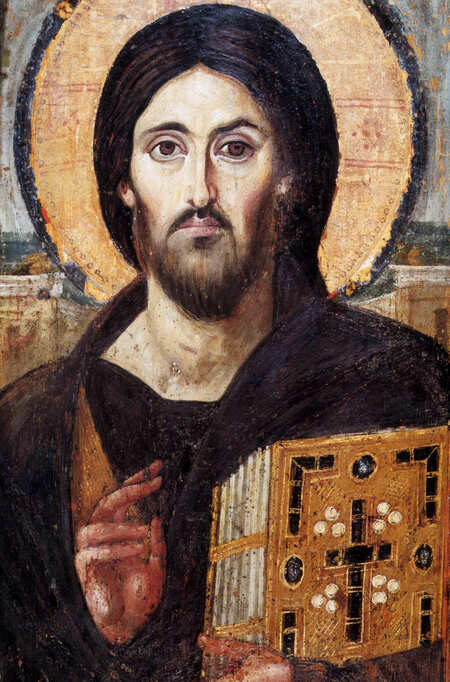
In the icon of Christ Pantocrator (Sinai, Saint Catherine’s Monastery, 6th century), Christ is depicted from the waist up. The face is large, occupying almost the entire plane of the board, and is directed straight toward the viewer. The right hand is raised in a gesture of blessing, and in the left hand is a book. The figure is not integrated into a scene; it exists solely for the person standing before the icon.The face is constructed unevenly. If one mentally closes one half, two different moods emerge: one side is softer, the other more severe. The eyebrows, eyes, and line of the mouth are positioned at different heights. Because of this, the gaze appears alive and slightly anxious, even though it is directed straight ahead. The dark eyes stand out against the light skin, and the cross-adorned halo draws attention around the head.
Emperor Justinian with his entourage. Mosaic from the Church of San Vitale, Ravenna, circa 547 AD.
Empress Theodora with her entourage. Mosaic from the Basilica of San Vitale, Ravenna, circa 547 AD.
In the mosaics of San Vitale, the figures stand in a row, facing the viewer. They are elongated and slender, their faces very similar, and their eyes are large, almond-shaped, and stare directly forward. There is almost no facial expression; the gestures are restrained. Justinian and Theodora stand in the center of their panels, surrounded by courtiers and clergy, and all repeat the same pattern of turning and gaze.
The spatial organization is also important. The figures are positioned close to one another, one behind the other, and many of their feet seem not to touch the ground. Because of this, the scene appears solemn and motionless, like a procession halted before the viewer.
Comparing the two works, one can notice different approaches. In the Sinai icon, the gaze is individual and directed toward a single worshipper. In San Vitale, the gaze is collective—the same for everyone—and emphasizes order and solemnity.
The gaze becomes a means of connection between the depicted and the viewer. It contains few emotions, yet it asserts status and draws the viewer into a ritual.
III. Vision as Experience (11th–14th Centuries)
During this period, the gaze begins to express emotion for the first time. It connects not only the protagonist with the viewer but also the characters with each other.
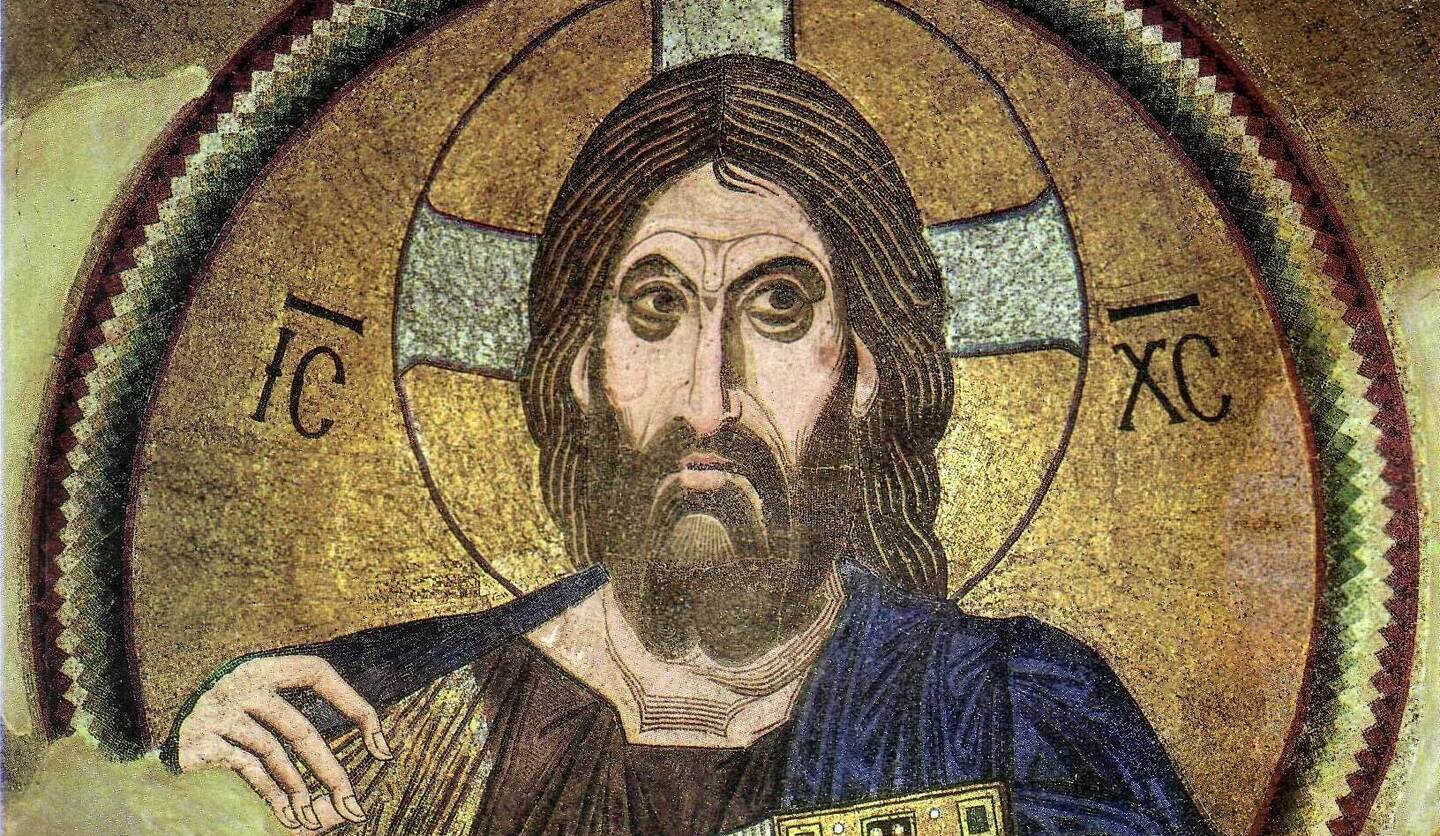
Christ Pantocrator. Mosaic from Daphni Monastery, circa 1100.
Christ from Daphne stares directly and sternly, but his face is no longer as dry as in earlier examples. His eyes are large, his eyebrows are curved and accentuated, and his countenance appears more volumetric and expressive. His gaze remains severe, yet it takes on a shade of inner depth.
«Mourning.» Fresco from St. Panteleimon’s Church in Nerezi, 1164.
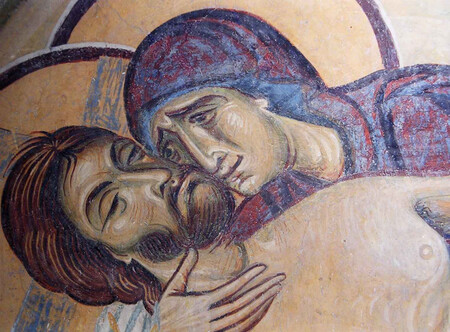
In «Lamentation,» the main change from the Neresi version is that the figures look at each other and at the body of Christ. Heads are bowed, and the lines of sight and the inclination of the bodies converge toward the center. The viewer is no longer the addressee of the image; instead, they observe someone else’s grief from the outside, watching the scene unfold.
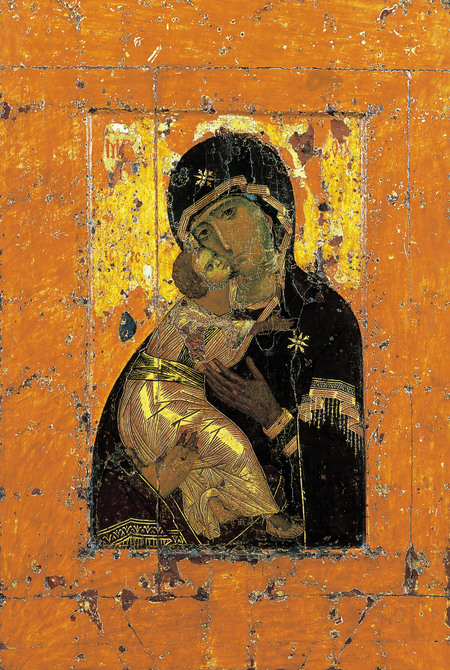
The Vladimir Mother of God. Constantinople, early 12th century.In the Vladimir Icon, the Mother of God looks toward the viewer, yet her head is inclined and the Infant’s cheek is pressed against hers. Her eyes hold a subtle melancholy, and her expression is gentle. This direct gaze adds a sense of mood, making the image feel less like a symbol and more like a lived experience.
The gaze ceases to be merely an address to the viewer. It connects characters to one another, conveys their emotional states, helps build the scene, and makes the viewer a witness to the action.
Conclusion
I wanted to understand how the role of the gaze in facial depiction evolved from Roman Egypt to Byzantine painting of the 14th century. The comparison showed that a direct gaze toward the viewer remained a nearly constant technique, yet its meaning shifted. In the first group of works, the gaze signifies presence and status: a person nearby, an emperor above us. In the second, it becomes a sign of connection between the image and the supplicant. In the third, emotion is added to it, and the gaze links the characters together. The viewer gradually transforms from being addressed to observing the scene. These changes are clearly visible in form—in the size and structure of the eyes, the symmetry of the face, the direction of the pupils, and how the gazes organize the composition. Of course, my selection is small, and one cannot conclude from it that this was the case everywhere and always. But within the material I chose, this progression is quite clear: from an image that asserts presence to an image that conveys experience.
Lazarev, V. N. The History of Byzantine Painting / V. N. Lazarev; prepared for publication by G. I. Vzdornov. — Moscow: Iskusstvo, 1986. — 329 pages, [2] illustrations and plates. (13, [1] page, [209] illustration sheets).
Belting, H. Image and Cult: The History of the Image Before the Age of Art / H. Belting; translated from German by K. A. Piganovich. — Moscow: Progress-Tradition, 2002. — 752 pages, with illustrations.
Doxiadis, E. The Mysterious Fayum Portraits: Faces from Ancient Egypt / E. Doxiadis. — London: Thames & Hudson, 1995. — 247 p.
Demus, O. Byzantine Mosaic Decoration: Aspects of Monumental Art in Byzantium / O. Demus. — London: Kegan Paul, Trench, Trubner & Co., 1948. — XIII, 97 pages, [64] pages of plates.