Poisonous Herbarium of the Middle Ages: Botanical Symbolism and the Functions of Toxic Plants in Western European Book Miniatures and Monumental Painting of the 12th–14th Centuries
My project focused on the visual solutions used to depict poisonous plants in Western European culture during the Middle Ages. I studied how, in an era lacking photography and artistic realism, medieval masters visually encoded the toxicity and danger of plants, often imbuing them with symbolism and religious allegory.
A key question of my research is: What visual, compositional, and graphic techniques did medieval artists use to endow real plants with a quality of toxicity? During this period, the perception of nature was dualistic: on one hand, plants were viewed as God’s creation and a source of healing (monastery gardens); on the other, they were seen as instruments of diabolical temptation, witchcraft, and hidden danger. Therefore, the most effective way to warn people about their peril was to represent the plants metaphorically, allowing an allegory of sin to be perceived within them. It is hypothesized that toxic plants were coded through the exaggeration of their natural anatomical features (gnarled roots, thorns, a somber color palette), as well as through their marginal placement on manuscript pages and frescoes, which compelled the viewer to register them at the level of subconscious religious fear.
In Western European art of the 12th–14th centuries, poisonous plants were depicted not as neutral botanical details, but as semantically charged symbols connected to concepts of sin, temptation, suffering, death, and the dual nature of creation; in manuscript illumination, their function was often related to narrative and allegorical precision, whereas in monumental painting—to heightening the overall spiritual and emotional expressiveness of the scene.
The Medieval Conception of the Plant as a Sign: Between Medicine, Poison, and Sacred Meaning
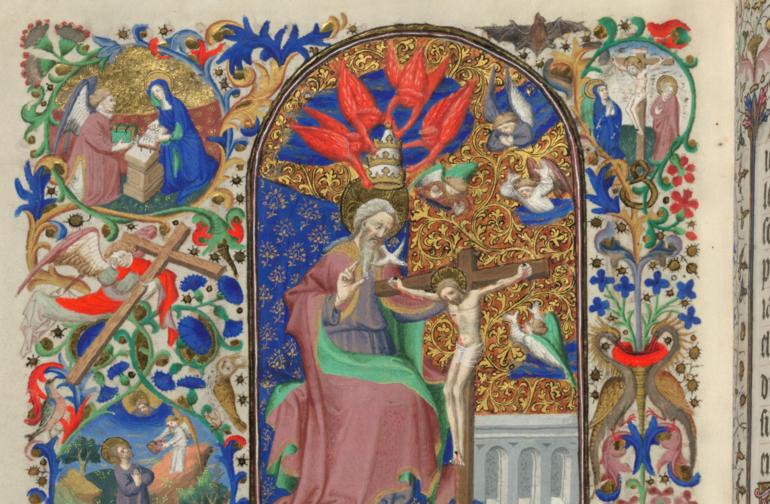
«Christ and the Mother of God»
Comparing Christian figures with illustrations of plants within a single medical compendium raises questions about the intersection of religious and natural science knowledge. Particular attention can be given to the fact that images of Christ and the Virgin Mary are present in a manuscript whose main content is dedicated to plants and their properties. However, this fact alone does not imply that the plants shown alongside them possess specific religious symbolism. Botanical illustrations existed in a cultural context where practical knowledge of nature could coexist with Christian narratives.
Between Medicine and Poison: The Dual Nature of Plants
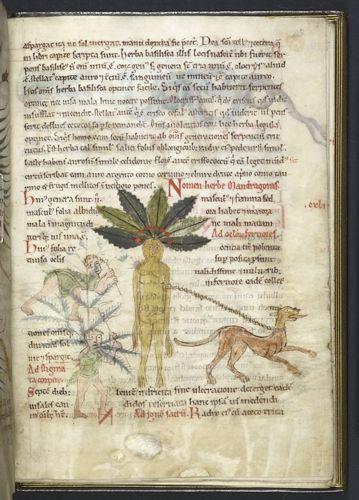
«Mandrake» from Pseudo-Apuleius
Anthropomorphism makes the invisible and unusual power of a plant visually tangible. Its depiction combines botanical facts with notions of nature’s extraordinary properties.
«Mandrake» from the Sloane MS 1975 medical collection
A plant’s toxicity wasn’t always expressed through a fearsome appearance. Sometimes, the visual signifier of danger was built upon a mythological narrative, the plant’s unusual form, or the nature of its interaction with humans.
Botanical illustration: between observation and artistic convention
Medieval artists did not always strive for botanical accuracy. A depiction of a plant could combine actual natural characteristics with conventional, symbolic, and fantastical elements.
«Mandrake» from «Taquinum sanitatis»
In this work, the artist combines a more attentive depiction of the natural environment with a figurative, anthropomorphic rendering of the root. Research into the botanical iconography of Tacuinum Sanitatis confirms the presence of both recognizable botanical features and deliberately fantastic details.
The development of naturalistic techniques in the 14th century did not necessarily lead to the disappearance of traditional, conventional representations of plants. Natural observation and legendary iconography could coexist within a single composition.
Plant as a vessel of wondrous and supernatural power
Images of male and female mandrakes
In medieval visual thought, the unusual properties of a plant could be explained not only by medical understanding but also by legendary or religious beliefs.
In this section, I propose to demonstrate how the depiction of a plant transforms from a botanical illustration into a complete narrative.
The anthropomorphic form transforms the plant into a being situated on the border between the natural and human worlds. Through this convention, the artist conveys conceptions that cannot be expressed by a standard botanical illustration.
Representing a plant as a way to convey knowledge: between the text and the thumbnail
Illustrations from the medical compendium Harley MS 5294
The significance of a plant in a medieval herbarium is formed not only by its illustration but also by its interaction with the text, name, and surrounding compositional elements.
book miniature could simultaneously serve справочная, educational, and narrative functions. Therefore, even the fantastical depiction of a plant should be considered within the context of the entire manuscript’s purpose.
In the Western European Middle Ages, spanning the 12th–14th centuries, the depiction of a plant could merge practical botanical knowledge with traditional beliefs about its unusual properties and artistic convention. This is particularly vivid in the iconography of the mandrake, where actual botanical features combine with human forms and narrative details. Comparing manuscripts from the 12th and 14th centuries allows us to trace the persistence of this visual system despite shifts in artistic language.
Nevertheless, the unusual form of a plant should not be automatically interpreted as a symbol of sin or death. To substantiate such meanings, one must consider the text’s content, the manuscript’s purpose, and its iconographic context.
Toxic Plants in Western European Book Miniatures of the 12th–14th Centuries
In Western European book culture during the 12th–14th centuries, depictions of plants held a significant place in medical and natural science manuscripts. However, their importance was not limited to conveying information about the external appearance of the plant world. Medieval botanical miniature constituted a unique system of visual knowledge, where observations of nature intersected with ancient traditions, medical understandings, and artistic conventions.Images of toxic plants are particularly interesting in this context. Their hazardous properties were not always directly reflected in the artistic form: a plant might be depicted with the same compositional clarity and decorative quality as any other. In certain instances, artists, conversely, employed unusual visual solutions that emphasized the exceptional nature of the subject being portrayed.
Paslon: A poisonous plant without a threatening appearance
The image of the deadly nightshade allows us to examine a different principle of representing a potentially hazardous plant: its toxic properties do not necessarily require a distinct visual marker. Unlike the anthropomorphic mandrake, the nightshade is incorporated into the tradition of botanical illustration, which focuses on presenting the plant as a recognizable natural object. Its danger is primarily revealed through the accompanying medical information. Consequently, in medieval book culture, toxicity could remain an invisible attribute, knowledge of which was conveyed through the interplay between text and miniature.