Visual Research Structure
ConceptLife as Spectacle: Reality ShowThe Viewer Becomes a Participant: StreamingSurvival as Entertainment: DystopiaConclusionBibliography Image Sources
Concept
Observing the lives of others has become a commonplace part of media culture. Reality shows, live streams, and social media allow us to monitor the daily lives, relationships, experiences, and decisions of other people. Increasingly, viewers are interested not in fictional characters but in real individuals. Their private lives are transformed into entertainment content, gradually losing their privacy.
The theme of this study relates to the shifting role of the viewer in media culture. Whereas television primarily allowed observation from a distance, digital platforms have given the audience the ability to intervene: to comment, vote, financially support, and even dictate their subsequent actions. This forces us to consider where curiosity about other people’s lives ends and influence over them begins.
The visual basis of this investigation consists of three films where human life becomes part of an entertainment system, although the degree of viewer intervention differs across them.
The goal of this research is to trace how the spectator’s position evolves: from a detached observer to an active participant capable of influencing others' decisions and controlling the unfolding events.
The research is divided into three chapters, each exploring a new dimension of audience influence. The first chapter, «Life as Spectacle, ” focuses on observing the everyday lives of others, using examples such as early reality shows and the film The Truman Show. The second chapter, „The Spectator Becomes a Participant, ” addresses the digital environment where the audience can already affect events, as seen in the film The Nerve. The third chapter, „Survival as Entertainment, ” is dedicated to The Hunger Games. The theoretical foundation of the research is based on the works of Marshall McLuhan and Andre Bazin, as well as the ideas of other writers in this field. The key question of the research is: How does the development of media change the role of the viewer, and at what point does observing someone else’s life transform into interference and control? The research hypothesis is that new media technologies not only change the ways we observe people but also expand the audience’s capacity for influence. This study will examine how, alongside media development, the relationship between the viewer and the participant changes, as well as conceptions of personal boundaries, freedom, and the permissibility of interfering in someone else’s life.
Life as Spectacle: Reality TV
Interest in the daily lives of others existed long before the advent of reality TV, but television transformed the observation of ordinary people into a standalone format of mass entertainment. The viewer no longer needed a fictional plot or professional actors: family conflicts, personal experiences, and everyday conversations themselves became the content of the show. The appeal of such a format in many ways rested on the feeling of authenticity in what was happening.
One of the early examples of a reality show was the American series «The Brady Bunch» (1973), which centered on the life of the Loud family.

«The American Family,» directed by Craig Gilbert, 1973
«American Family,» directed by Craig Gilbert, 1973—the very first reality show on television
Over several months, the film crew documented events within a family. Unlike conventional television stories with a pre-written script, viewers were presented with real people whose lives unfolded independently of the audience’s expectations. Despite hundreds of hours of shooting, this was condensed into twelve episodes, meaning even the documentary portrayal of daily life remained the result of the author’s selective editing and montage.
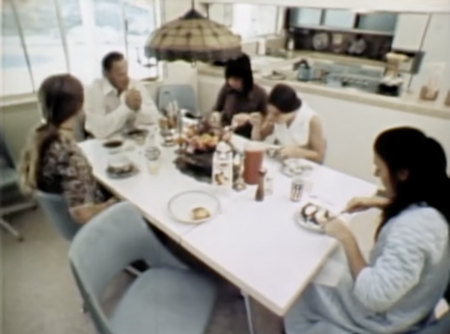
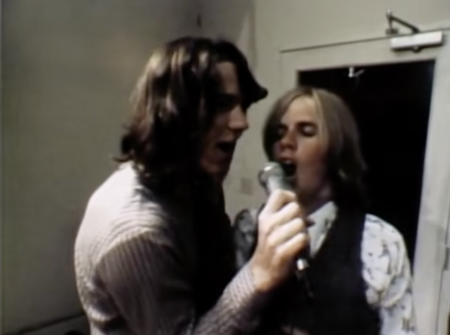
«The American Family,» directed by Craig Gilbert, 1973. Scenes of ordinary family life from Episode 1.
The characteristic of such formats lies in the tension between naturalism and staging. The viewer observes genuine emotions and relationships, yet the circumstances under which they arise are predetermined by the show’s creators. Cameras, editing, participation rules, and limited space construct a specific reality existing for the television broadcast.
«The Truman Show»: Life Without the Right to Privacy
«The Truman Show, ” directed by Peter Weir, 1998
In the film «The Truman Show, ” the visual design emphasizes the disparity between the hero’s perception and that of the audience. Distorted angles from hidden cameras, observation from unexpected vantage points, and images shot with a wide-angle lens create a sense of constant presence from an unseen observer. The viewer feels as if they are spying on the hero from a car dashboard, a bush, or a window.
«The Truman Show, ” directed by Peter Weir, 1998, Television Show Control Center
The role of the show director, Christoph, is particularly significant. He manages Truman’s environment from the technical center. He determines the weather conditions, directs the actors' actions, and intervenes in events when the protagonist’s behavior threatens the established script. In this way, Truman’s life becomes not merely an object of observation, but a product created and controlled by a media system.
«The Truman Show, ” dir. Peter Weir, 1998, Observation of the protagonist on television
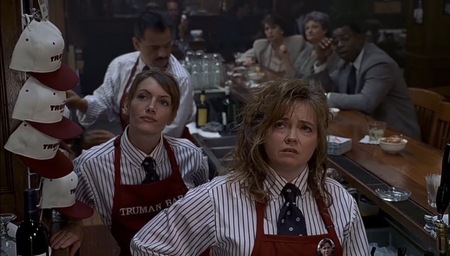
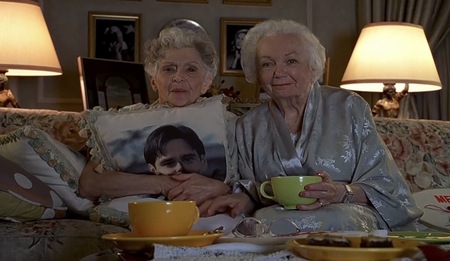
«The Truman Show, ” directed by P. Weir, 1998, Viewer Reaction to Broadcast
The film also shows the viewers themselves—people who observe Truman at home, at work, and in public. For them, his life becomes a familiar part of daily routine, and the experiences of a real person are perceived as dramatic events on a beloved show. Only one person truly wants to save Truman.
«The Truman Show,» directed by Peter Weir, 1998, Observing the main character through a hidden camera
Technology fundamentally alters human perception. «The Truman Show» exposes the central contradiction of this format: the more access the viewer gains to another person’s life, the sharper the question of an individual’s right to privacy becomes.
«The Truman Show,» dir. P. Weir, 1998, Observation of the protagonist through a hidden camera
Truman does not know his real parents; his wife is an actress who films her husband through a camera hidden in her pendant. Even his anger is broadcast to the audience. Not a single emotion escapes the lens. The protagonist lives a Sisyphus-like existence, trying not to think about it, but everything has its limits.The film portrays the contradiction of television culture: the viewer gains access to someone else’s daily life, yet behind the appearance of naturalness lies staging and control. The more someone else’s life becomes public, the less personal space is left for the character, who loses their privacy.
«The Truman Show, ” dir. P. Weir, 1998, The Hero is selected from the soundstage.
The viewer becomes a participant: Streaming
With the rise of social media and streaming platforms, observing other people’s lives has taken on new forms. The viewer is no longer limited to just watching—they can comment on what is happening, send donations, participate in polls, and suggest actions for the content creator. For instance, on the Twitch platform, viewers can influence specific streamer decisions through polls and interactive rewards. Streamers earn a living or entertain the audience this way.
Live stream of streamer Buster featuring singers VILLIAN and madk1d