Heraldic Description
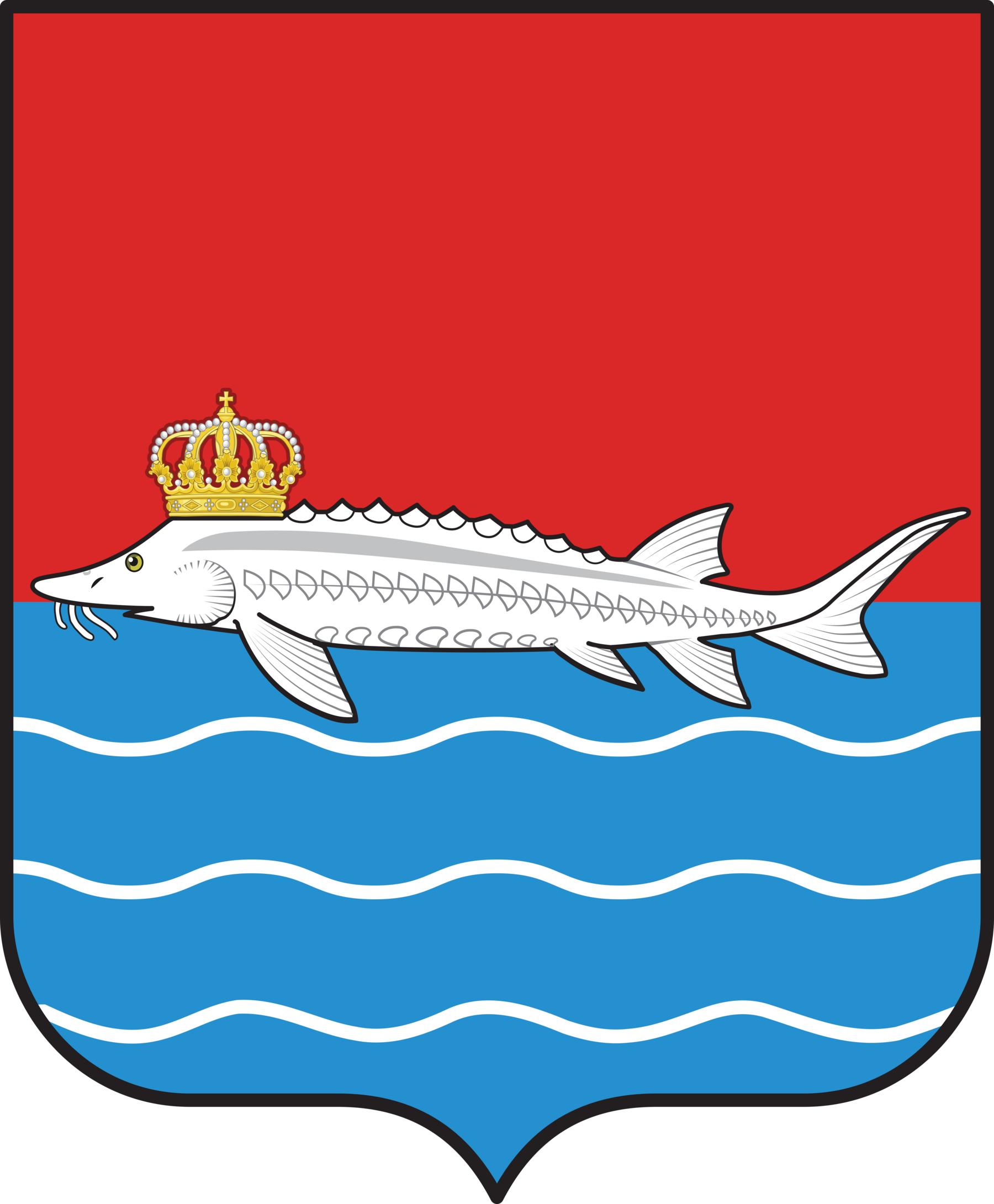
In the crimson field, a silver sturgeon floats, its azure (blue) fins crowned with a golden royal crown adorned with amber.
Coat of Arms Symbolism
Ossetr—the maritime wealth of the Baltic and the prosperity of the city, referencing the rich fishing industry of the region.Crown—glory, honor, and pride; furthermore, the amber in its design emphasizes the significance of amber deposits to the region.The shield’s colors—red symbolizes the labor of sailors and naval servicemen, while blue represents the Baltic Sea.
From the History of the Coat of Arms
The history of the coat of arms of Baltiysk (Pillau before 1946) began on January 18, 1725, when the settlement received city rights from the Prussian King Frederick William I. The original coat of arms depicted a silver sturgeon crowned. In 1916, the coat of arms was adapted to comply with new German heraldic regulations: the sturgeon remained in a gold crown, but the background was changed to a combination of red on top (representing the sky) and blue below (representing the water). In 1993, the Council of People’s Deputies approved a new version, which was further embellished with an image of a fortress tower and the date «1725.»The final version of the coat of arms was approved by the Baltiysk City Council in 2011. Thus, the current coat of arms of Baltiysk is a restored historical version of the Pillau coat of arms with minor modern adjustments.