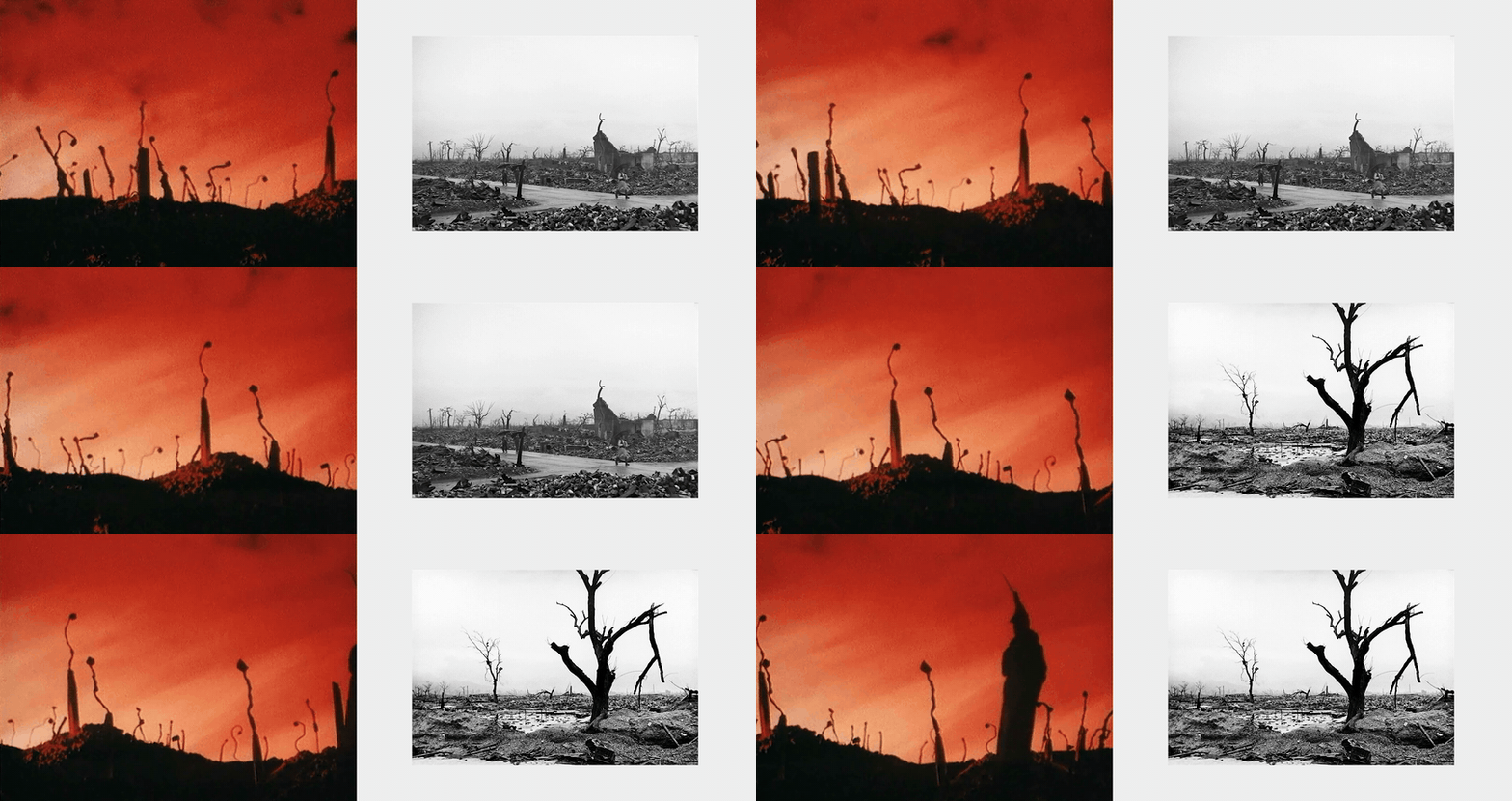
CONCEPT
Victory only has meaning if you can envision what comes next. During the latter decades of the Cold War, this condition ceased to feel self-evident. The USSR and the USA ramped up their arms race based on the premise that the threat of a retaliatory strike would deter the opponent from attacking. However, security became increasingly dependent on weaponry whose use could destroy not only the enemy but also those it was meant to protect.
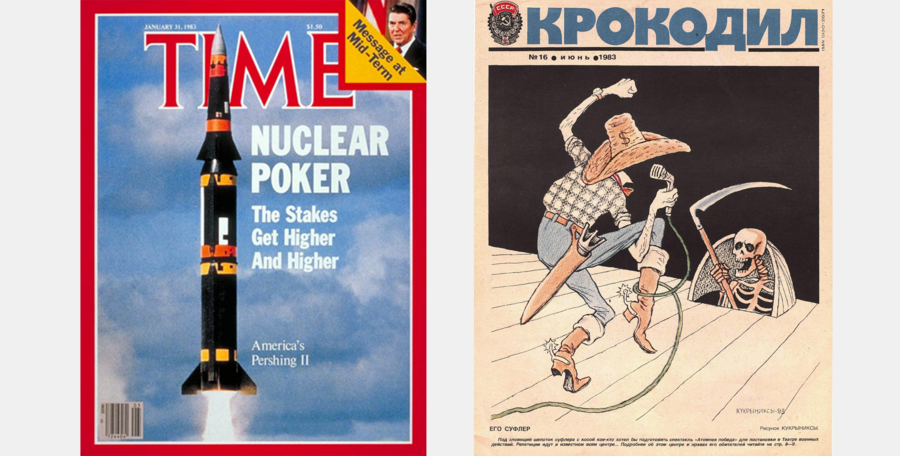
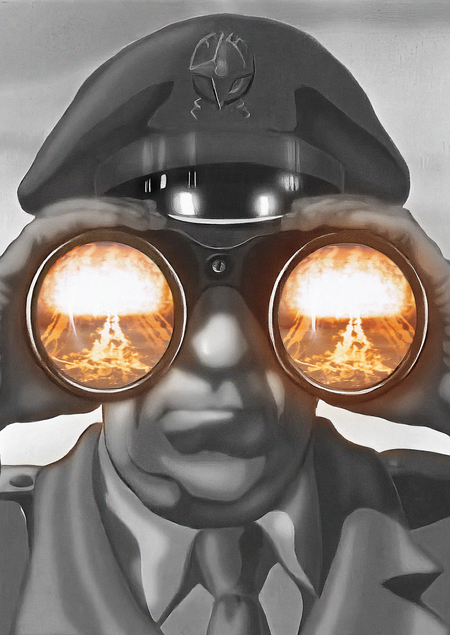
«Nuclear Poker» and «Atomic Victory.» Covers from American Time and Soviet Crocodil, 1983. Two images of anxiety preceding potential nuclear war.
War was no longer merely a clash of armies, after which one side would return to peaceful life. The very possibility of such a return was under threat. This fear was not confined to the realm of high politics. The notion of nuclear catastrophe permeated culture, becoming fodder for science fiction, video games, and animation. What was particularly alarming was the possibility that the world could perish without a protracted war or even without the conscious decision to start one. A mistaken order, a misconstrued threat, or yet another attempt to achieve military dominance was enough to trigger the catastrophe. In the early 1980s, as the relations between superpowers once again grew tense, these apprehensions gained concrete historical grounding.
By the end of the decade, disarmament talks shifted the political climate, but they did not dismiss the question of how people ever learned to treat the threat of annihilation as a precondition for their own security. In Soviet culture, this issue carried a unique contradiction. Official calls for peace coexisted with the concept of a just war and the necessity of armed defense. The threat could be attributed to an adversary, one’s own weapons presented as a means of deterrence, and military superiority justified as a concern for the future.
The more distinct the potential consequences of nuclear conflict became, the harder it was to maintain that distinction. Even when we know who started the war and why, what changes for a world where, after victory, no one might remain? Animation proved to be a particularly suitable art form for discussing this anxiety. Unlike video games, it could depict a destroyed city, animated weapons, or an entire dead planet without extensive production resources. Its artificiality allowed it not only to represent the impossible but also to alter conventional relationships between objects. The small became more dangerous than the large; an innocuous object transformed into a war machine, and reliable walls ceased to separate a person from catastrophe.
However, the status of animation as an art form traditionally associated with young audiences sometimes granted directors greater freedom for heavy and ambiguous subject matter. This is especially noticeable in the science fiction films produced at republican studios in the 1980s. In this study, I examine six Soviet short films released between 1977 and 1988. I am interested in how the perception of war and its justifications changes within them as the true cost of armed confrontation becomes clear. Anti-militarism here does not necessarily mean the rejection of all war. More often, it arises from doubt in the very military logic that claims weapons can ensure security and that victory justifies their use.
The research is divided into three chapters. The first, «The Logic of Confrontation, ” examines how the attempt to achieve superiority turns weapons into a threat to the participants in the conflict themselves. In the second, „Post-War World, ” it is crucial to understand what remains of everyday life after a catastrophe and why the restoration of peace does not guarantee harmony among people. The final chapter, „War Without a Front, ” addresses the disappearance of the safe distance between war and daily life. These three issues are interconnected. First, war loses its manageable outcome; then, it becomes clear what life it destroys; and finally, the space where one might have sought refuge vanishes.
LOGIC OF RESISTANCE
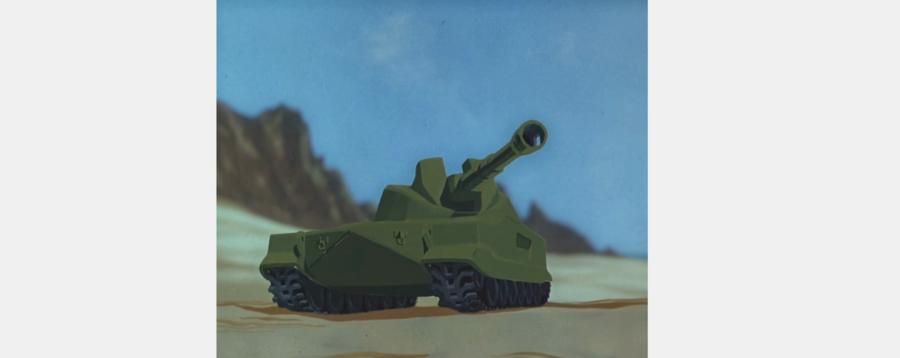
The military standoff is built on the certainty that force can be directed against a specific enemy and stopped once the objective is reached. However, the more sophisticated the weapon, the harder it becomes to keep its action within the intended limits. The means of defense transforms into a new threat, and the distinction between attacker and defender no longer guarantees righteousness or safety. In «The Proving Ground» (1977) by Anatoly Petrov, the tank tests are initially shown from the observers' perspective. The reticle transforms the island into a shooting range, and the military personnel watch the machine from afar, confident that they can control its destiny.