Navigation
[1] Concept [2] The Middle Ages: Music as the Voice of the Institution [3] The Renaissance: The Birth of Acoustic Design [4] The 18th Century: Salon Culture and Glass Harmony [5] The 19th Century: The Bourgeois Living Room and the Birth of the Concert Hall [6] The 20th Century: Phonographs, Radio, Walkmans, and Stadiums [7] The 21st Century: AirPods and Phones [8] Conclusion
Concept
In this visual investigation, I examine the evolution of musical instruments not as a history of acoustics or musicology, but as a history of design and architecture. The musical instrument is presented not merely as a device for sound extraction, but as an object that organizes the space around it and shapes human bodily practices. This approach allows for a simultaneous consideration of engineering innovations, ergonomics, and the visual representation of the instruments, revealing points of tension between the sacred monumentality of the past and the total digital miniaturization of modernity.The objective of my research is to reconstruct the logic of the evolution of «sonic architecture"—from the colossal cathedral organs of the Middle Ages to the wireless headphones of the 21st century—and to determine the specific mechanisms through which the instrument commands the listener’s attention and body. The key problem is that established historiographical tradition views musical instruments through the lens of their acoustic properties and materials, or as objects of decorative arts. In both cases, their spatial and disciplinary function—how the instrument physically structures hierarchy around the human—is underestimated.
Because of this, it goes unnoticed that the history of tools is a history of scale inversion. Understanding this gap necessitates a critical re-examination of visual sources and their comparison. The timeliness of this work is determined not only by the academic interest in design history but also by a broader circumstance—namely, how modern digital technologies manage human attention and isolate the individual. Today, a person with headphones creates an invisible cocoon around themselves, completely separating from the outside world, which is a direct consequence of tool evolution. My research hypothesis is that the «architecture of sound» has undergone a complete inversion: if once a giant instrument built space around the person, subordinating them to a collective ritual, now a tiny gadget constructs an invisible space inside the person, granting them the illusion of total control while isolating them from reality. The sacred has not disappeared; it has simply moved from the cathedral to the personal digital playlist.
The research methodology relies on selecting and subsequently performing a comparative visual analysis of imagery. During this work, a targeted search and curated selection of photographs, archival images, and mockups were conducted, illustrating the evolution of scale and ergonomics in musical instruments—from cathedral interiors to macro photographs of modern gadgets.
The Middle Ages: Music as the Voice of the Institution
The great organ and the western rose window of Notre Dame Cathedral
The organ of Notre Dame Cathedral is one of the world’s most famous instruments, representing the visual quintessence of medieval «architectural sound.» A compositional tension unfolds here: the colossal organ literally overshadows the lower portion of the famous rose window. The light, which symbolizes divine grace in the Gothic sanctuary, is obscured by the heavy, material structure of wood and metal. The instrument itself is physically integrated into the architecture—its massive, carved wooden casing merges with the stone vaults, and thousands of silvery pipes are arranged in strict order.
Music ceases to be mere sound and becomes the very voice of the Church institution. The scale of the instrument is overwhelming; if you envision the figure of the organist behind the console, they appear as a tiny grain of sand against the backdrop of this sonic machine. The instrument is not here for entertainment or comfort. Instead, it transmits divine order from top to bottom, compelling the individual to submit both physically and acoustically.
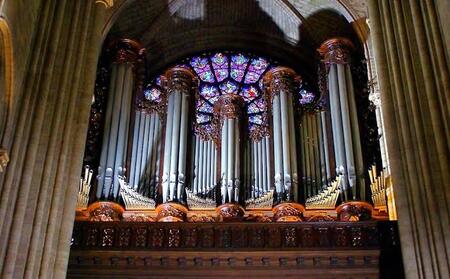
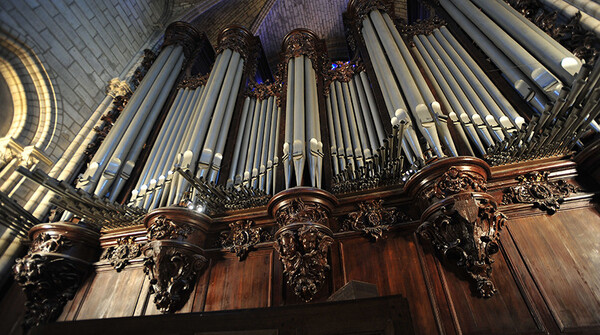
Facade of the Great Organ against the backdrop of the western rose window of Notre-Dame Cathedral / Carved wooden casing and pipes of the Great Organ of Notre-Dame Cathedral (view from below)
The organ is completely integrated into Notre Dame, woven into the very tectonics of the Gothic cathedral. The stone arches and pilasters literally embrace the instrument, making it an inseparable part of the structure itself. Here, the cathedral and the organ function as a unified acoustic resonator: the stone, the vaults, and the pipes create the perfect environment for multiple reflections and sound amplification, generating that resonant, majestic echo that fills the entire nave. In the Middle Ages, music did not exist separately from its space. Sound did not merely pour from the pipes; it permeated the entire cathedral, reflecting off the stone walls, making the instrument the central point of gravity for the entire interior volume.Of particular note is the rich, almost grotesque wood carving at the base of the organ: an intricate interweaving of vegetal motifs, faces, and figures. This visual opulence and the sheer weight of the material demonstrate the power and wealth of the institution. A person standing at the base feels physically overwhelmed by this immensity. This perspective emphasizes the strict verticality of power: sound and architecture are designed to evoke awe. This is not an intimate listening experience—it is an act of collective submission, where the organ acts as a formidable voice proclaiming truth in the name of God.
A page from the medieval musical manuscript «Codex Montpellier» (late 13th — early 14th century).
This spread from the Montpellier Codex is a clear example of how medieval musical notation transformed into an instrument of institutional order. It is a visual regulation: the text and music are organized into perfectly aligned columns, subservient to a rigid geometric grid. Square mensural notation fixes not only the pitch but also the duration of the sound, turning a live performance into a strictly measurable process. Music here ceases to be improvisation; it becomes a written law that must be reproduced accurately and uniformly.At the top of the pages, illuminated initials depict scenes of courtly love. These images underscore the strange contrast that music devoted to earthly, courtly love is recorded by the same rigid institutional rules as sacred chants. Ornate borders featuring floral and zoomorphic motifs serve as a visual frame, separating the sacred space of the notes from the secular context. The Codex was akin to an architectural blueprint for sound—it established the standard by which both sacred and secular motets were to be performed.
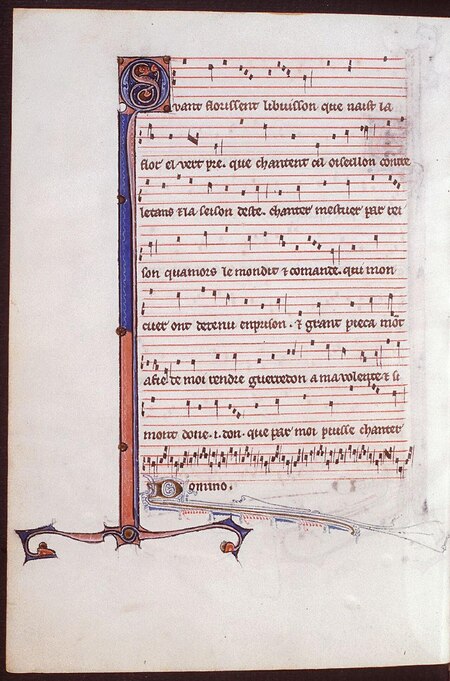
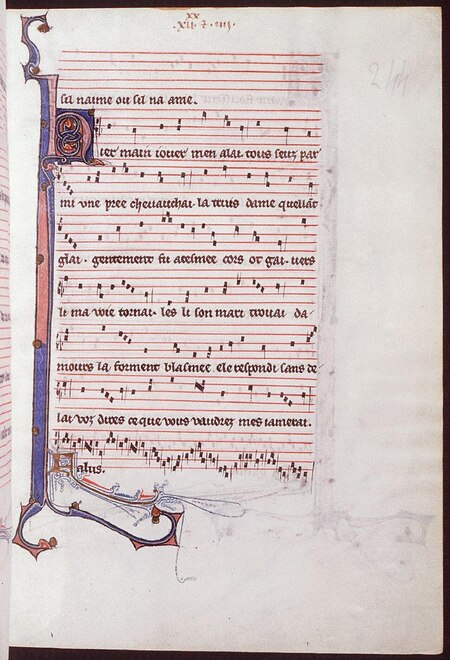
Notation of the motet «Quant florissent li buisson / Domino» in mensural notation from the Montpellier Codex (late 13th — early 14th century) / Notation of the two-voice motet «Hier main jouer m’en alai, tous seuz / Latus» from the Montpellier Codex (late 13th — early 14th century)
On these pages, the same principle is visible: the staff and the text form two symmetrical lines. This layout is crucial because the singer holding this codex was obligated to follow a strictly defined visual path—top to bottom, left to right, without deviation. This disciplined the body and voice just as a metronome in the nineteenth century would discipline a pianist. Music here appears as a text to be decoded and performed, rather than as a free emotional expression.
This is the visual analog of infinite reading. In the cathedral, sound does not develop according to the laws of drama; it repeats cyclically, returning to the same sacred formulas. The manuscript fixes this cycle, making it reproducible in any church and in any century. Long before the advent of the phonograph and radio, music was already striving to separate itself from the living moment and become a reproducible object for any person.
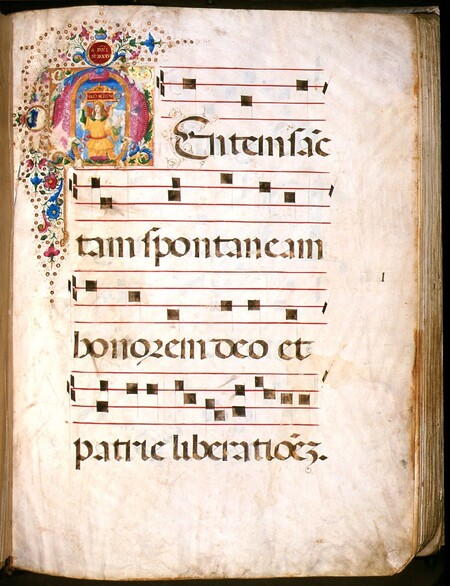
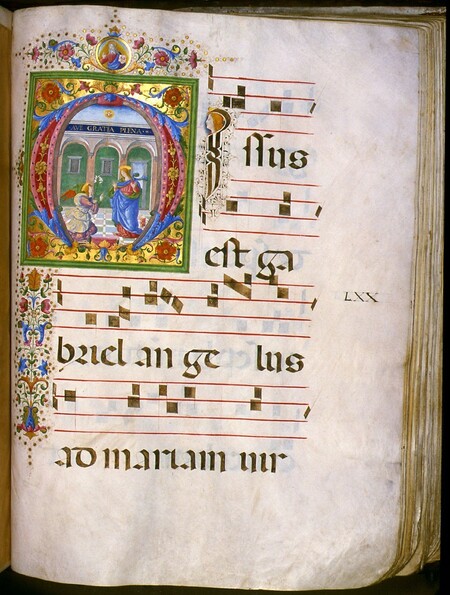
Antiphonal chant «Mentem sanctam spontaneam» in square notation from Antiphonary M, No. 25 of the Santa Maria del Fiore Cathedral (Florence, 1526).
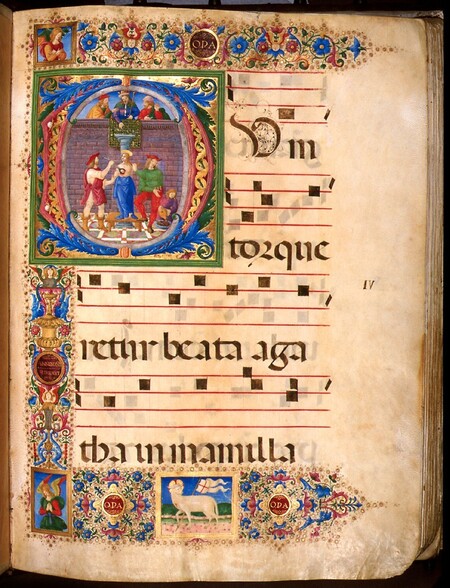
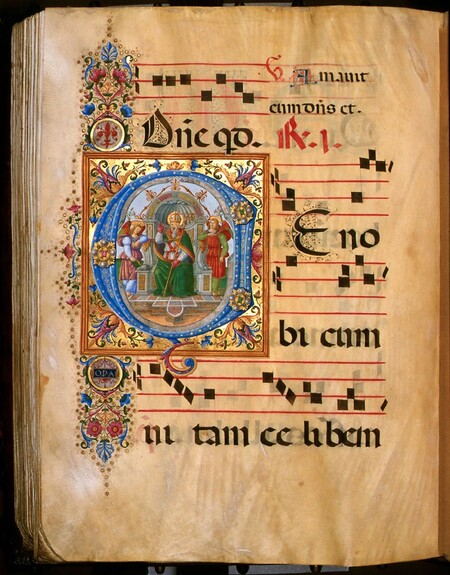
Antiphon «Mentem sanctam spontaneam» in square notation from Antiphonary M, No. 25 of the Basilica of Santa Maria del Fiore (Florence, 1526)
These are pages from the Renaissance chant book, «Antiphonary M, No. 25.» The featured leaves showcase a defining characteristic—square or Roman notation, which clearly illustrates a different stage in musical notation development compared to earlier manuscripts.As mentioned previously, the square shape of the notes with their distinct outlines immediately captures the eye. In this notation, there are almost no conventional strokes, although some can still be noticed on certain leaves (the so-called virga). However, these «tails» do not establish a rhythmic pattern or indicate precise duration, unlike later mensural notation. This is choral notation, which was used to transcribe Gregorian chant. Its primary feature is that it conveys pitch and melodic direction but does not fix an exact mathematical rhythm. Duration in this notation depends on the text and the liturgical tradition, rather than on the note shape itself. This type of notation establishes spatial height, leaving temporal rhythm up to the discretion of the performer.Every page adheres to a strict geometry: the notes are arranged like soldiers in formation. This visual discipline prepares the singer for collective, unison performance without individual rhythmic deviations. We also see miniatures on the leaves that open and envelop the chants. Inside the initial capital letters are scenes from the lives of saints or Biblical narratives directly connected to the chant text. For the singers, these initials served as visual markers, helping them quickly locate the desired section in the voluminous book.The colors and gilding in these miniatures held paramount significance. The masters used gold leaf, which symbolized divine light and eternity. When light fell upon the page during a service, the gold would shimmer, creating an effect of mystical presence. Precious pigments, such as ultramarine from lapis lazuli, lent depth to the images and symbolized the heavens. The illusory gemstones in the ornamentation emphasized the book’s extraordinary value, transforming it from a simple text carrier into a sacred treasure.
Medieval sound architecture unifies music and space. The prime example of this is the organ of Notre Dame Cathedral in Paris, which reflects a broader European dynamic. It is built into the sanctuary, overshadows the stained glass, and overwhelms the individual with its sheer scale. Sound becomes the voice of the institution, not the person. A similar rigorous discipline governs musical manuscripts. In the Montpellier Codex, mensural notation transforms music into a measurable law, subordinating the body of the singer. This strictness is complemented by lavish miniatures within the initials. Leaf gold and costly pigments symbolize divine light and will, turning the book into a treasure of the church rather than the property of any specific individual, thereby subjecting it to divine order.
Rebirth: The Birth of Acoustic Design
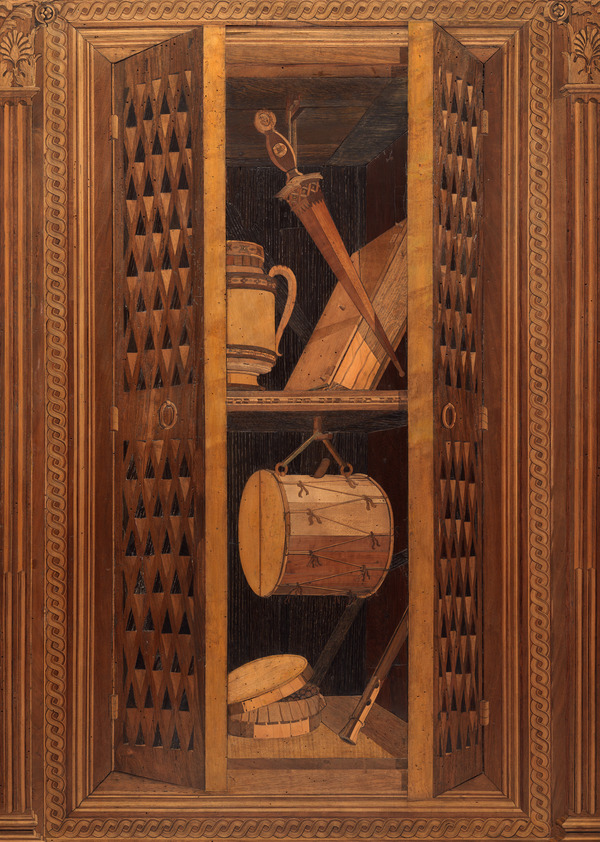
Wooden panels with inlays from the Herzog Palace studio in Gubbio (c. 1478–1482, Metropolitan Museum of Art)
What we see here are not actual instruments, but masterful wooden inlays from the Studio of Duke Federico da Montefeltro. At first glance, these might appear to be mere decorative motifs on cabinets, but in reality, they represent one of the most crucial stages in the evolution of sound architecture. Unlike the cathedral organ, which physically filled the space and overwhelmed the observer, here the musical instrument becomes an integral part of the intellectual and visual landscape. The inlays create an illusionistic effect: flat wooden panels mimic voluminous cabinets, open doors, and shelves holding actual objects. This is not simply ornamentation; it is an attempt to construct an ideal, controlled environment for contemplation and the display of the Duke’s encyclopedic knowledge.The optical illusions are so potent that the space seems larger than it truly is. Here, musical instruments coexist with scientific apparatus, books, and weaponry, crafting the image of the ideal Renaissance ruler—both warrior and intellectual. In this architecture of sound, the instrument is no longer a source of loud, dominating noise, but rather a component of a quiet, contemplative world. This is the first step toward the general intimacy of sound, which ultimately leads us to headphones.
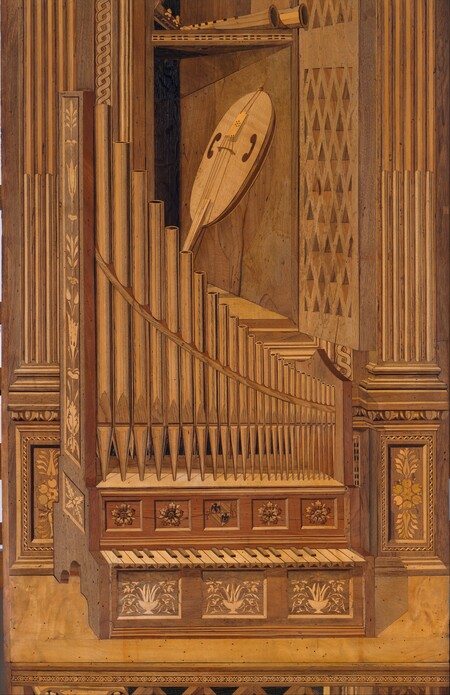
Portative organ, xylophone, and flutes. Inlay from the Ducal Palace studio in Gubbio (c. 1478–1482, The Metropolitan Museum of Art, New York)
On one of the panels, we see a drum and a trumpet—instruments traditionally associated with war, power, and public ceremonies. However, here they are «locked» in a virtual cabinet, transformed into an object for contemplation. This is a crucial shift: whereas before the sound of a trumpet or drum would carry over a battlefield or city square, gathering and commanding people, now it can be muted, museumified, and integrated into a study’s interior. The instrument becomes a visual sign, a symbol of valor, but its sound is no longer part of everyday experience.
We can examine the keyboard instrument, which strongly resembles an organ, and the lute hanging on the wall in more detail. The organ, which in cathedrals was a gigantic, wall-mounted machine, is here scaled down to the size of an elegant wooden panel. It no longer commands the space; it becomes part of the décor. The lute, a symbol of courtly love and sophisticated music-making, is also transformed into a wall object. These inlays create the illusion that the instruments are in the room, yet they are immaterial. They are the visual projection of sound—its ideal, acoustically purified form.
Wooden panels with inlays from the Duchy of Gubbio Studio (c. 1478–1482, The Metropolitan Museum of Art)
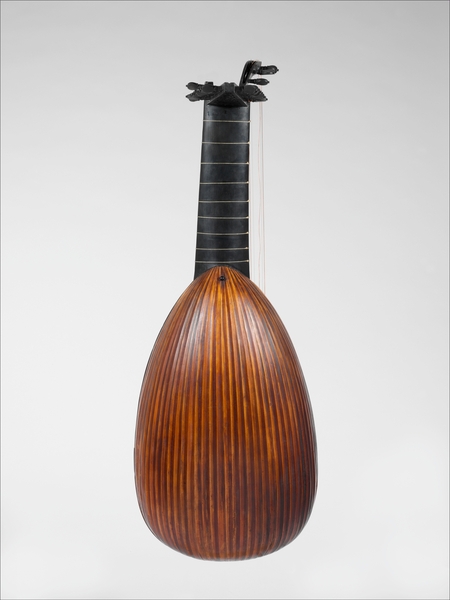
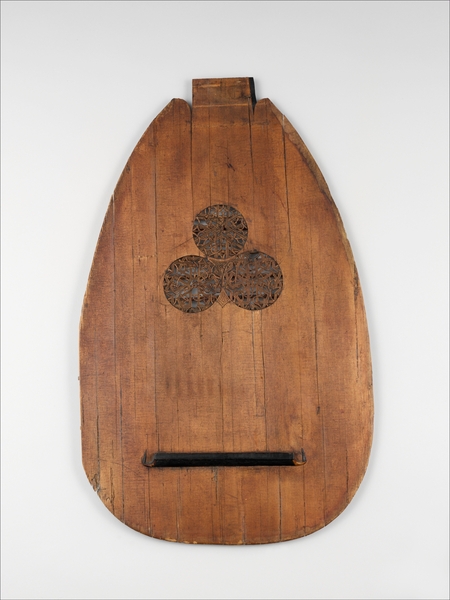
Multi-layered box made of yew and neck made of ebony from the late 16th century (Workshop of V. Tiffenburger, Metropolitan Museum)/Original top plate of a late 16th-century lute (Padua, Italy; The Metropolitan Museum of Art, New York)
Here is a lute—one of the defining instruments of the Renaissance era. Its pear-shaped body, constructed from thin wooden blocks, and its long neck with frets sharply contrast with the massive instruments of previous centuries. This instrument embodies the shift toward an intimate, chamber-like sound. It was not created to fill a vast cathedral or overwhelm a crowd, but rather for individual performance in a salon or at a feast. Its ergonomic shape practically «fits» the musician’s hands, marking a crucial step toward a personal scale of sound.
We see the lute’s soundboard featuring a characteristic carved sound hole. This is not merely a decorative embellishment, but the result of precise acoustic calculation. During the Renaissance, craftsmen began to understand that geometry and proportion directly influence sound quality. The complex ornamentation of the rosette and the delicate wooden stand demonstrate how the instrument transforms into an object of scientific design. Unlike the organ, where sound is generated by immense air pressure within pipes, here the sound originates from the subtle vibration of the strings and the resonance of the wood, calibrated for close, attentive listening.
Titian Vecellio and Workshop. «Venus and the Lutenist.» c. 1565–1570. The Metropolitan Museum of Art, New York
This canvas depicts an unveiled goddess of love reclining in an outdoor couch while a young man plays her a lute. This is a mythological subject, yet it illustrates a crucial shift in the history of music. The music of a single musician creates an intimate, sensual, and almost magical atmosphere.
The painting beautifully demonstrates the birth of chamber music. The sound of the lute is physically calibrated for a small room and a single listener. The musician is not playing for a crowd, but for the goddess. This is the first significant step toward the privatization of sound—music becomes a personal experience here.
During the Renaissance, music-making transforms into a component of intellectual and aesthetic pleasure. Music no longer serves solely for prayer; it delights the ear and awakens the senses. The ancient myth of Venus is employed here to legitimize secular art. It is from such intimate scenes, where sound is directed at one person, that the culture of salons will eventually grow.
Lorenzo Costa. «Concert.» Circa 1488–1490. National Gallery, London
The canvas depicts a domestic scene. Three people, dressed as wealthy townspeople, sing and play the lute together. On the table before them lie a small bowed instrument and an open sheet music book. This is at-home music-making, where music becomes part of daily life, simple human leisure, and shared relaxation.Music and entertainment existed in the Middle Ages, but during the Renaissance, they became much more accessible. Thanks to the growth of cities, the development of crafts, and most importantly, the dissemination of printed music, music ceased to be solely the domain of the church or traveling performers. The open book lying on the table symbolizes this significant shift. Music becomes more literate and reproducible—now ordinary people can gather and perform it according to the notes for their own pleasure.The musician here holds the lute directly in front of him, creating sound for a small circle of people nearby. It is an intimate sound that does not attempt to fill the vast space of a cathedral. The instrument becomes part of the human body and domestic life, losing its former architectural grandeur.