
Contents
Concept Sony Walkman Advertising Campaign iPod Advertising Campaign Beats Advertising Campaign AirPods and AirPods Max Advertising Campaign Conclusion Bibliography Image Sources
Concept
From the 1980s to 2026, headphones have evolved from a mere technical device into a significant element of visual culture. The rise of portable players transformed daily music habits. Furthermore, advertising gradually began associating headphones not only with quality but also with a specific lifestyle.
Today, headphones are worn on the subway, at the gym, in the office, in a coffee shop, and so on. People now associate them as part of their overall look. Everyday objects increasingly function as signs—through them, a person communicates their status, lifestyle rhythm, and cultural affiliation [1]. Examining advertising examples of headphones reveals how a functional item acquires specific meanings. Since headphones constantly surround us, few people ever consider where the meanings we perceive in them originated.Research Question: How have the advertising campaigns of Sony Walkman, iPod, Beats, and AirPods changed the perception of headphones, transforming them from a technical device into a cultural sign and accessory?The Hypothesis is that large-scale advertising campaigns—each with a different character but often centered on a lofty idea (freedom of movement, privacy, versatility, belonging to music culture, freedom from wires)—have established persistent associations that we now consider natural. Advertising does more than sell products; it shapes desires and directs consumer behavior [2, p. 83]. Consequently, headphones are perceived as an attribute of modernity, productivity, efficiency, and an athletic lifestyle, and choosing a specific model has become a marker of following trends. Against this backdrop, older or niche models signify a different, less relevant affiliation. Nevertheless, headphones remain a common part of almost everyone’s life, and many wear them without consciously realizing the meanings attached to them.
The Object of the study is the advertising campaigns for the most popular headphones and players of their time.The Subject of the study consists of the ways in which color, shape, logo, frame composition, character imagery, and narrative connect the product with specific cultural associations.The sample includes four campaigns, each reflecting a distinct phase. Sony Walkman posters from the 1980s and the 1988 monkey video illustrate the birth of the idea of mobile and private music [3]. The iPod Silhouettes series from 2003–2008 makes the white wire and player an icon recognizable without a face or words [4]. Beats, from 2008–2016, transforms large headphones into a noticeable element of style through music videos, celebrities, and athletes. The AirPods and AirPods Max campaigns from 2017–2020 unite themes of freedom, dance, and the intimate sonic space.To compare with the advertising, photographs of young women wearing headphones in everyday settings were added: it is often female social media accounts that showcase headphones as part of a style, whether professional, athletic, or urban. These photos illustrate how advertising meanings become embedded in daily life.The theoretical foundation is built upon works explaining how objects and images generate meaning. Roland Barthes' approach allows for the reading of an advertising frame as a system of signs [5, pp. 297–318]. The Walkman Effect study describes how personal audio changed the perception of the city and public space [6], while the article by Jaramillo Arango and colleagues traces how headphones evolved into a stylized fashion accessory [7].
Sony Walkman
The introduction of the Sony Walkman made listening to music a daily practice. However, in early advertisements, the player itself was not the only focus. The device was shown next to people walking, relaxing, or exercising. Music was no longer confined to a room; it began to accompany the person wherever they chose to be. This is how the headphones began transforming into an essential element of the modern individual’s lifestyle.
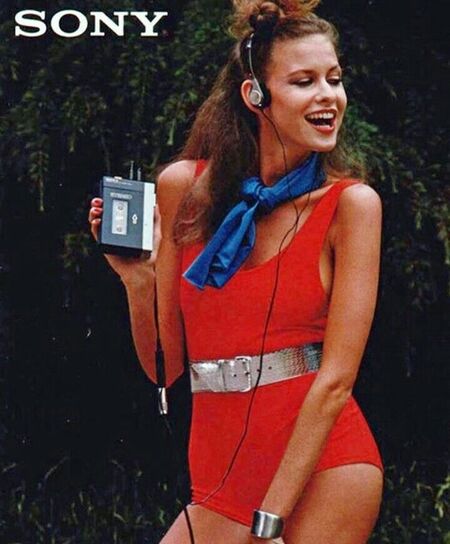
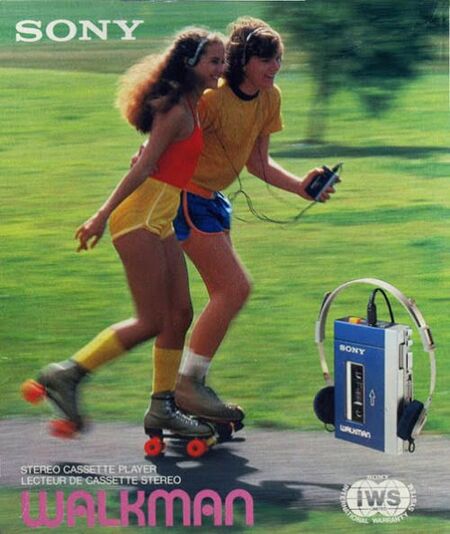
1. Sony. Walkman advertisement poster. 1980s. 2. Sony. Walkman TPS-L2 advertisement poster. Circa 1980.
In early Walkman advertisements, human movement became as important as the device itself. Videos and street scenes conveyed the idea of freedom of choice.
Sony. Meditating Monkey. Walkman advertising campaign. 1988.
The advertisement featuring the monkey is structured differently. There is almost no movement here. Instead, the brand presents ads whose meaning is directed toward the listener’s state of mind. The main idea is to illustrate the boundary between the external world and internal feeling. The video shows an important characteristic of personal audio—the same object can be associated with activity or with the possibility of insulating oneself from the outside world.
iPod
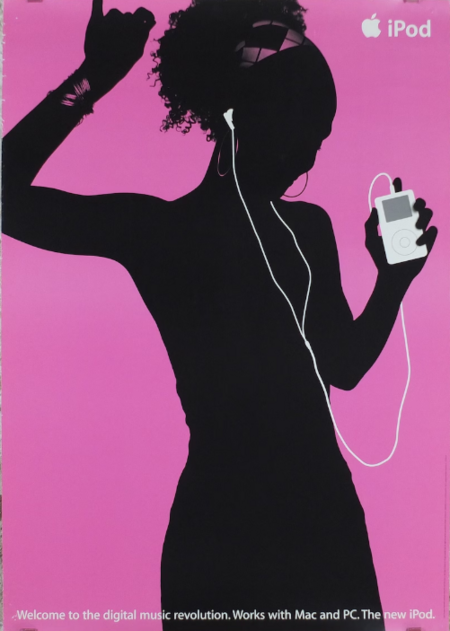
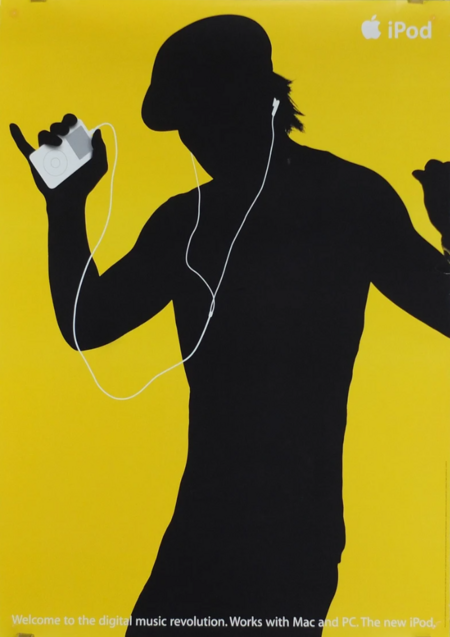
Apple. iPod Silhouettes. Advertising Posters. 2003.
There was a noticeable shift in Apple’s iPod advertising. They stopped showing detailed shots of people. Faces, bright clothing, and urban environments were replaced by dark silhouettes of people dancing against a vivid background. This contrast effectively highlights the white player and wired headphones.The absence of a face makes the dancing protagonist almost universal. Viewers can see themselves in the image because the figure is not tied to a specific profession, age, or style of dress. The headphones, meanwhile, become a shared detail that unites the different characters in the campaign.
Apple. iPod Silhouettes. Advertising Poster Series. 2003–2004.
The absence of a discernible face renders the dancing protagonist nearly universal. Viewers can see themselves in the character because the image is unbound by age, clothing style, or profession. Headphones become a shared detail that unites these diverse characters. An Apple advertisement from 2003–2004 demonstrated that music belongs to everyone, and the device fits any rhythm of life.
Apple. iPod, and U2. Advertising Series. 2004.
The character of the movement changed. Instead of club dancing on the posters, silhouettes with electric guitars, microphone stands, and in characteristic rocker jumps appeared.But the white devices still stand out against the background. Apple connects two ideas. On the one hand, music remains something personal. On the other hand, through the well-known iPod group, it becomes part of a shared musical culture.
Apple. iPod shuffle. Advertisement poster. 2005.
This poster was created to promote the iPod Shuffle in 2005 and became one of the recognizable symbols of 2000s mass culture.The bright green background, the silhouette of a dancing girl, and the white player still emphasize the freedom of movement and the idea of random music selection. This concept was reflected in the slogan, «Life is random.»
Apple. iPod + iTunes. A frame from an advertisement featuring The Fratellis. 2007.
Apple. iPod nano. Nano-Chromatic Campaign. 2008.
The Silhouettes campaign made visible headphones one of the key elements of the music device’s advertisement.The white wire became recognizable beyond the poster.
Beats
If the thin white cord was the defining visual element in iPod advertising, Beats offered a starkly opposite image. Large headphones, an accent logo, and saturated colors don’t conceal the device—they integrate it into the aesthetic.These headphones can be worn over the ears or simply around the neck. This makes them visible to those around them, drawing attention both to the look of the headphones and to the person wearing them.
Lady Gaga. Poker Face. Frame from the music video. 2008.
The appearance of Beats in music videos is important not just because of the product itself. The headphones begin to become associated with popular music and global superstars.


Author unknown. Eminem with Beats headphones. Year unspecified. Author unknown. Justin Bieber with Beats headphones at Heathrow Airport. 2012.