Navigation
- Concept
- Disinterested Pleasure
- Ideal of Beauty
- Aesthetic Idea
- Conclusion
Concept
William-Adolphe Bouguereau—a celebrated 19th-century French academic painter who was hugely popular and admired during his lifetime, yet became one of the most reviled artists after his death. The root of the debate surrounding his work stems from the question of whether art needs only to be beautiful or if it must also convey meaning. This theme remains highly relevant today, given that his paintings are once again prized and sold for high prices. Through this study, I do not aim to resolve the question of whether Bouguereau is a «good» or «bad» artist, but rather to draw a boundary, in the Kantian sense, between the merely «beautiful» and «high art.»
«Nothing appeals to the peaceable bourgeoisie like a painting without originality. He will immediately understand such a painting, and it will give him pleasure; whereas the bold attempts of beginners thoroughly frustrate the bourgeoisie.» [3, p. 4]
When selecting visual material, I incorporated works by William Bouguereau from various aspects of his painting, including his depictions of Venus and Madonnas. I focused more closely on his peasant women. This selection method illustrates the ideal of beauty—from the sublime image to the most everyday scenes. To visually demonstrate the idealized nature of his works, I compare the peasant women to the paintings of his contemporaries, and to better understand the Modernist reaction, I include early Impressionists.
The work is organized according to Kant’s concepts, starting with disinterested pleasure, followed by the ideal of beauty, and concluding with the aesthetic idea—culminating in the question of art’s greatness. Each section features a brief theory and its application to William Bouguereau’s works, along with the tension that arises from the comparison. This structuring method immerses the reader sequentially and tangibly into philosophical theory and its realization through the example of the chosen artist.
The study is grounded in Immanuel Kant’s text, Critique of Judgment (1994). The key sections from the work for this study are «Analytic of the Beautiful, ” „Ideal of Beauty, ” and „Aesthetic Idea.“ I also studied a monograph on V. A. Bouguereau’s oeuvre, from which I sourced information about the artist’s contemporaries and critics, as well as the artist’s own words. Most notably, he was accused of immorality, so I analyzed the tradition of depicting the nude form using the book by M. A. Shakhov. This approach allowed me to approach the chosen topic from multiple perspectives and explore it to its fullest extent within the scope of the research.
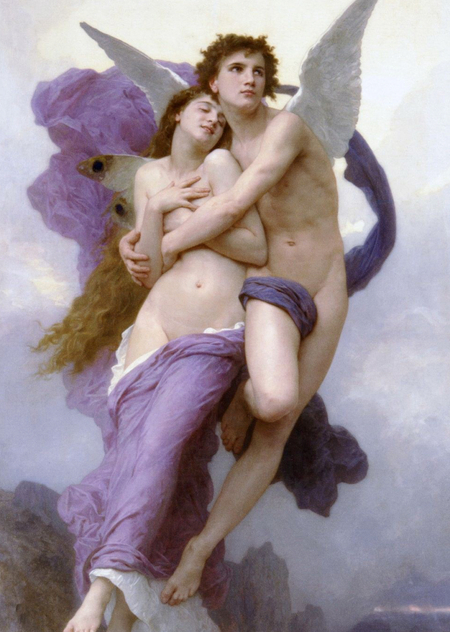
William Adolf Bugro, «The Birth of Venus, ” 1879, fragment
Consequently, the key question is: is beauty alone sufficient for art—or is something more needed, what Kant called the «aesthetic idea»? A painter’s work undeniably embodies the formal qualities of beauty, but it is precisely this immaculate purity, divorced from truth, that shows the limit of this aspect. Such a beauty, lacking truth, seems hollow. William Hogarth is proof that beauty is a necessary, but insufficient, quality for great art.
Uninterested enjoyment
«Taste is the faculty of judging an object or a method of presentation through approval or disapproval, free from any interest. The object of such approval is called beautiful.»
[1, p. 48]
For Kant, beauty appeals «disinterestedly,» meaning we enjoy the mere act of contemplating an object. This selfless pleasure distinguishes the beautiful from the pleasing—which indulges—and the good—which is correct or useful.
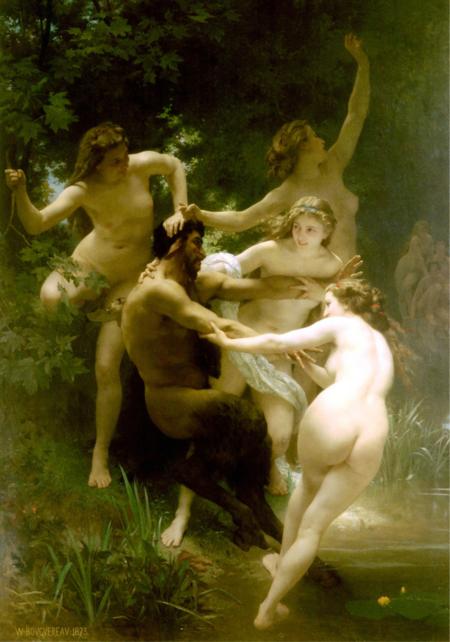
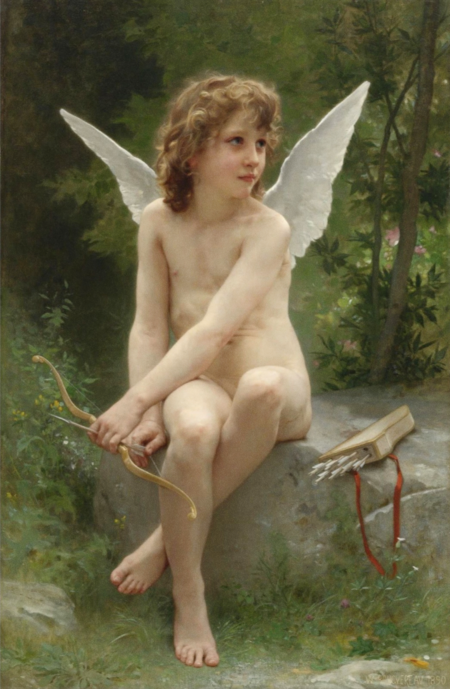
William Adolf Bugro, «Nymphs and Satyrs,» 1873 / William Adolf Bugro, «Amor in Search of His Goal,» 1890
Nymphs and Venuses by Bugro—a serene contemplation. They carry neither narrative significance nor moral weight. This is the perfect instance of beauty appreciated for its own sake—for the pleasure of disinterested viewing.
William Adolph Bugro, «Nymphaeum, ” 1878
Kant outlines three categories of «liking»: the pleasant (which pleases the senses), the good (which is valued by reason), and the beautiful (which is simply pleasing). William Bugro operates in the third register.
William Adolf Bouguereau, «Madonna and Child with Musical Angels, ” 1891.
This approach to work is also reflected in religious subjects. The dominant element is not dogma, but form—the harmony of lines and figures.
William Adolph Bugro, «Youth of Bacchus,» 1884
«He generously gifted viewers the image of a perfect world where optimism, nobility, and humanity triumphed, and the poverty, cruelty, and indifference characteristic of bourgeois society were subject to an unspoken ban.» [3, p.4]
The conflict-free nature of his paintings is interpreted as an escape from reality and has become the source of criticism directed at the artist.
The Ideal of Beauty
Kant discusses the possibility of the ideal of beauty only for humankind, composing it from two elements: the «idea of norm» and the «idea of reason.» In other words, the ideal must reconcile correct form with internal substance. Without the latter, beauty remains flawless, yet empty.
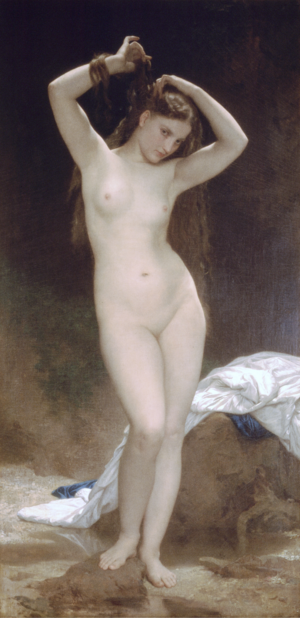
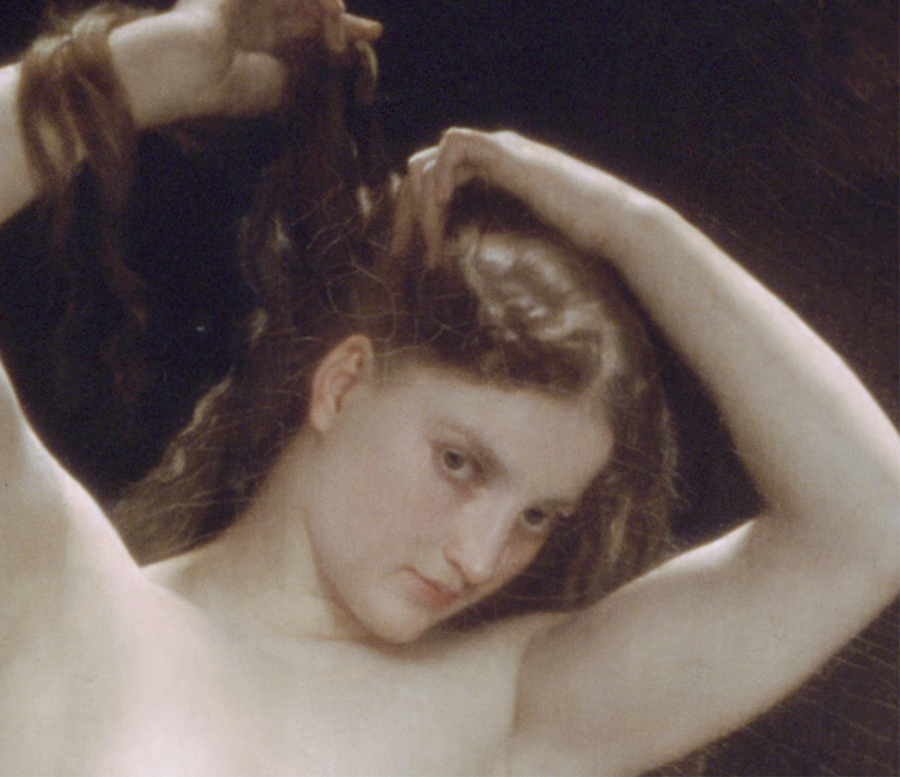
William Adolph Bugro, «Bather Woman, ” 1870, fragment
The artist constructs such an ideal from flawless proportions, correct features, and the portrayal of the characters' innocence and purity.
William Adolf Bogrow, «Gabriel Kot, ” 1890, fragment / William Adolf Bogrow, „Girl Weaving a Wreath, ” 1874, fragment / William Adolf Bogrow, „Italian Woman with a Tambourine, ” 1869, fragment
«The Idea of Normality» is evident at a glance: the faces in William Bugro’s paintings are not coincidental. He averages nature, bringing it closer to an idealized form rather than providing a realistic portrait of a specific person.
William Adolf Bougre, «Broken Pitcher, ” 1891.
The refinement of form is most clearly visible in his peasant women. They are in perfectly clean dresses, with smooth skin, as if they are unfamiliar with farm labor. The harsh village toil is transformed into an idyll by his brush.
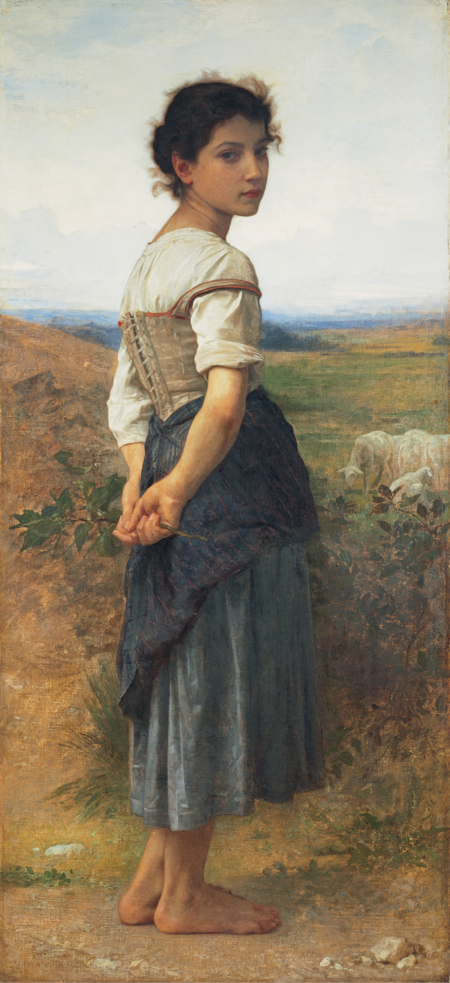
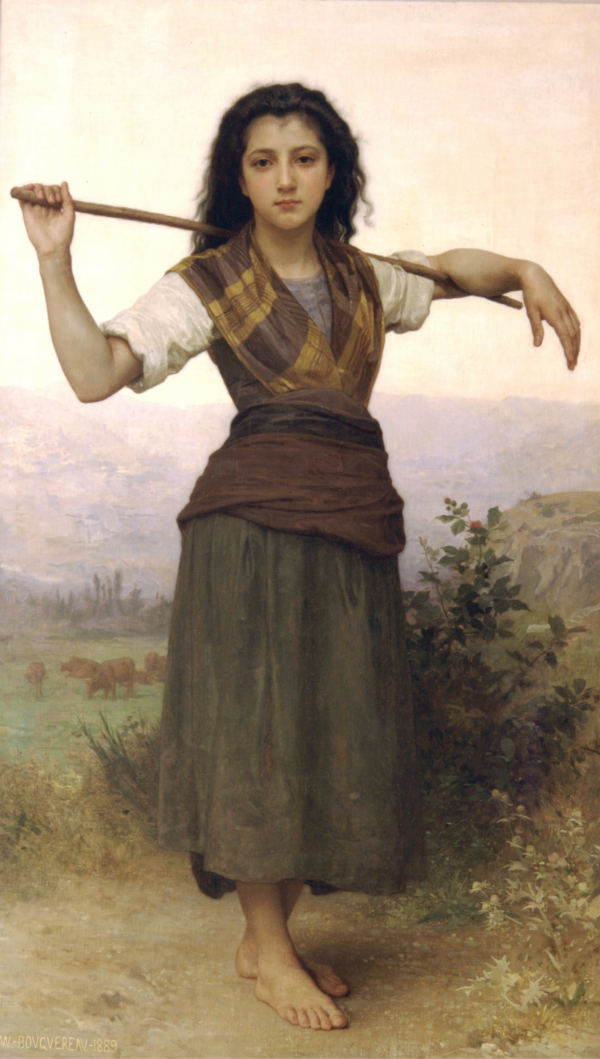
William Adolph Bugro, «Young Shepherdess,» 1885 / William Adolph Bugro, «Youthful Shepherdess,» 1889
«As a realist, Millet depicted the arduous peasant labor without the fanciful 'prettiness' typical of salon art masters» [3, p. 16].