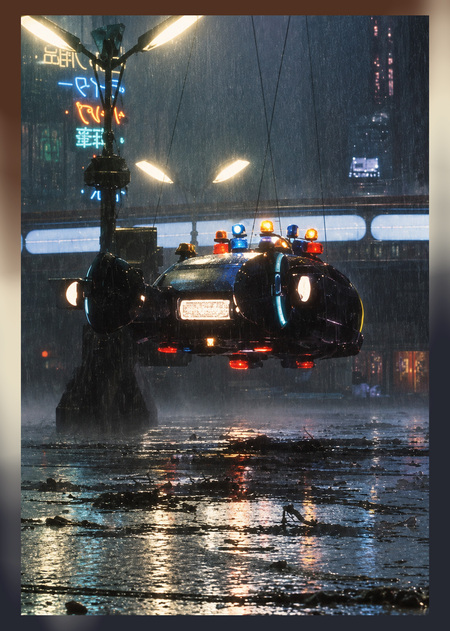
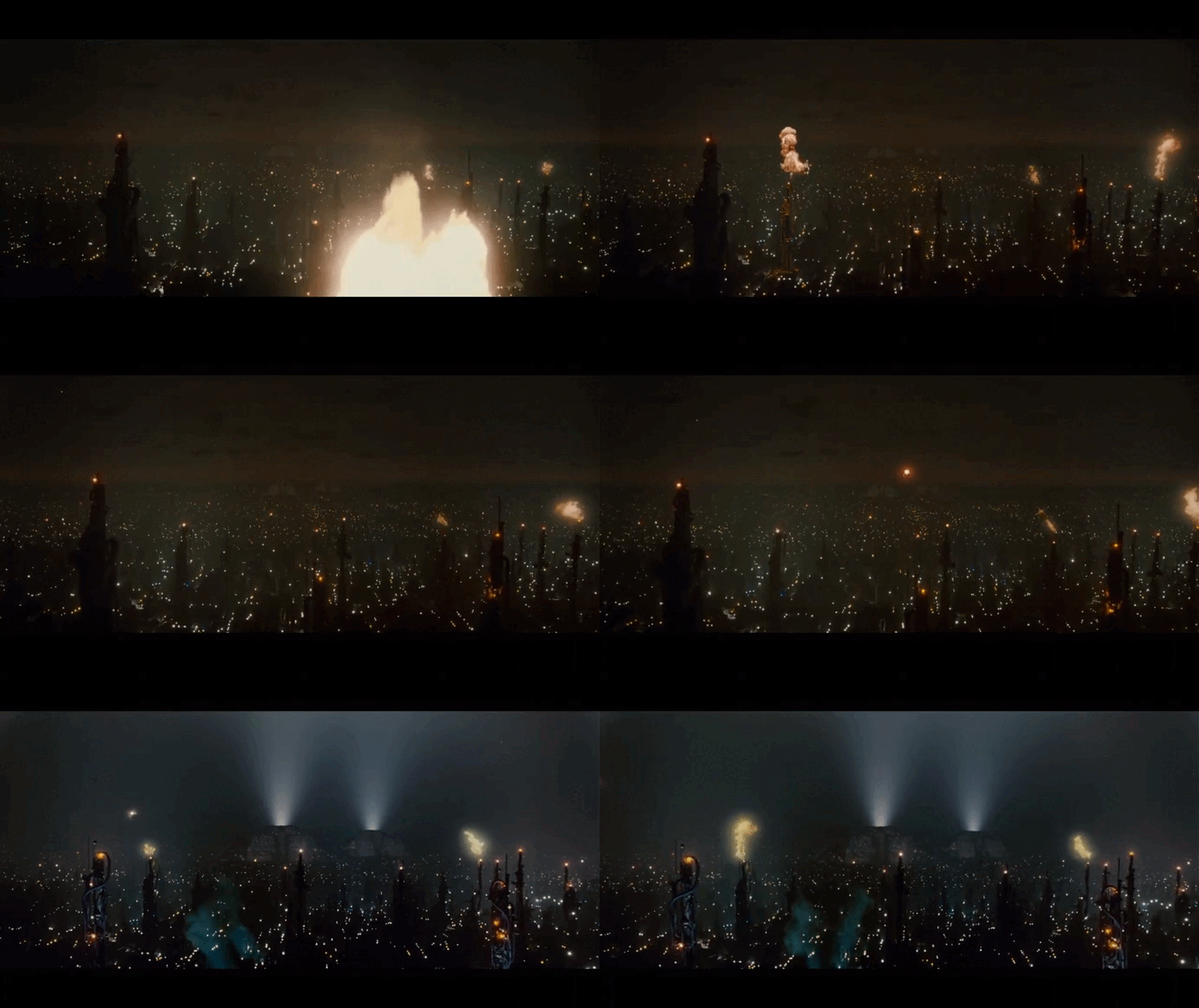
Ridley Scott. Shot from Blade Runner (1982)
Concept
Filmmaking Effect—it is not merely a trick. It is an invitation to a game. The creator presents the viewer with a directive: «Believe it is real.» The viewer sets a task for themselves: «Figure out how it was made.» People love mysteries—and the magic of cinema is born from this mutual pleasure of solving them. Visual Effects (VFX) represent the most concentrated form of this game: it is a technologically organized deception in which the viewer participates voluntarily. They agree to be deceived just as much as the creator can make the deception convincing. It is in this dual motion—in posing the question and solving it—that cinema exists as the art of managed illusion.
The core of this study is to traverse time—to examine and compare the visual effects technologies in cinema using the film duology Blade Runner (1982, directed by Ridley Scott) and Blade Runner 2049 (2017, directed by Denis Villeneuve). This material beautifully illustrates how cinema immersed the viewer into fictional worlds in the past and how it achieves that now. There is a thirty-five-year chasm between the two films, a period during which visual effects technology underwent a radical transformation: moving from practical effects, analog optics, and miniatures to digital technologies, CGI, and virtual production. Despite this technological gulf, both films belong to the same fictional world, the same aesthetic, and the same philosophy, which allows for a clean comparison: how the tools have changed while the artistic objective has remained constant.
Relevance:
The topic is highly relevant in the context of the industry’s contemporary shift toward virtual production and total digitalization. What makes an effect compelling: technological perfection or artistic necessity? The Blade Runner case offers a rare opportunity to see both extreme ends of this spectrum within a single fictional world. It is telling that even in 2017, the director deliberately retained one or two scenes with physical models, despite the availability of CGI, which confirms the hypothesis that «tangibility» remains an artistic value.
Secondary Issue:
The issue lies in the contradiction between technological progress and artistic continuity: digital technologies have provided nearly limitless possibilities, but at the same time, they raise the question—is the impact losing its conviction and «tangibility» as the need for a physical trick disappears? How do the «honest deception» of practical effects and the «total illusion» of the digital age relate to one another?
One of the last films before the digital age.
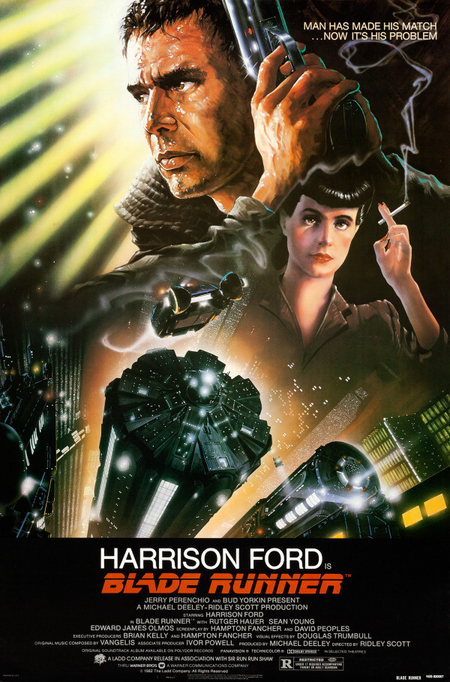
Blade Runner (1982)Director: Ridley ScottSpecial Visual Effects Supervisor: Douglas Trumbull1982 film poster
Block I.I: Creating Large-Scale Environments
Ridley Scott. Shot from «Blade Runner» (1982)
Eid’s Gate — this is what film supervisor Douglas Tramball named the scene.
It is this scene that greets us into the film’s world after the opening credits. The endless darkness of the sky, the boundless jungle of a futuristically functional city, and chthonic bursts of flame from the summits of sharp industrial towers.
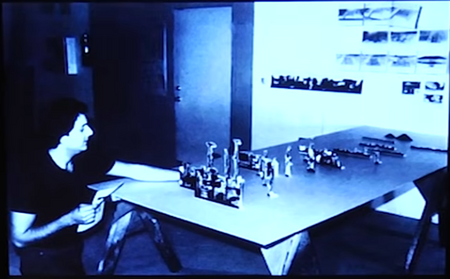
From the very first frame, we are greeted by an illusion. The soundstage isn’t limitless, so the film crew had to get creative for such a massive set.
Photo taken from Douglas Tramble’s 2010 presentation at TIFF (Toronto International Film Festival)
The solution was the forced perspective technique. In the rough draft, photographs of oil derricks and buildings were arranged. They were displayed starting from the largest objects in the foreground to the smaller ones in the distance, thereby creating an unreal sense of depth in the scene.
Mockup Assembly Photo taken from Douglas Tramble’s 2010 talk for TIFF
Subsequently, the details were refined based on the test: camera-like shapes were replaced with three-dimensional models, often the same ones viewed from different angles, and the back rows were substituted with brass plates, as this material maintained the silhouette shape well for fiber optic illumination.
Mockup Assembly Photo taken from Douglas Tramble’s 2010 presentation for TIFF
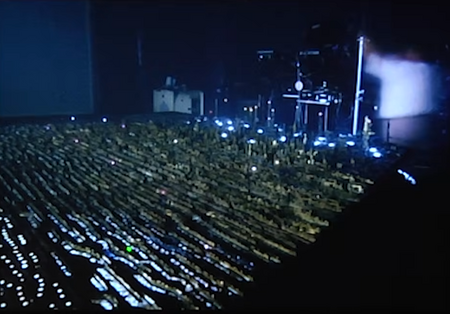
But this mockup is just one layer that contributed to the final scene composition.
Ridley Scott. Shot from Blade Runner (1982) frame from the film filming with the «Tirell pyramids» models
I also want to mention how one of the film’s most grotesque symbols—the pyramid—was realized. One model (specifically, two of its faces) was constructed for filming, standing 60 cm high with a base side length of 2.7 meters, at an approximate scale of 1:1000. In the shot, this was meant to be a building 800 meters tall. Therefore, in moments featuring two pyramids, the same structure was actually shown, filmed from different angles.
the «Tirrell Pyramid» model
But how did they place her in shots overlooking Los Angeles?
It was ridiculously simple. At the spot where those buildings are in the distance, the model maker placed two acrylic panels onto which photos of the original model were affixed.
Block I.II: Adding Non-Existent Details
Contrary to popular belief, the «Hell’s Gate» scene was not created solely through optical printing (re-exposure). Special effects supervisor Douglas Tramball and miniature artist Mark Stetson employed a more complex technique—miniature projection. To create the illusion of flames bursting from the pipes, they used not simply layered frames, but physical projection screens.
Red — 35 mm Projector Blue — Camera
On the rooftops of the towers, a cardboard screen was erected, onto which a projector positioned away from the camera displayed footage of methane balloon explosions.
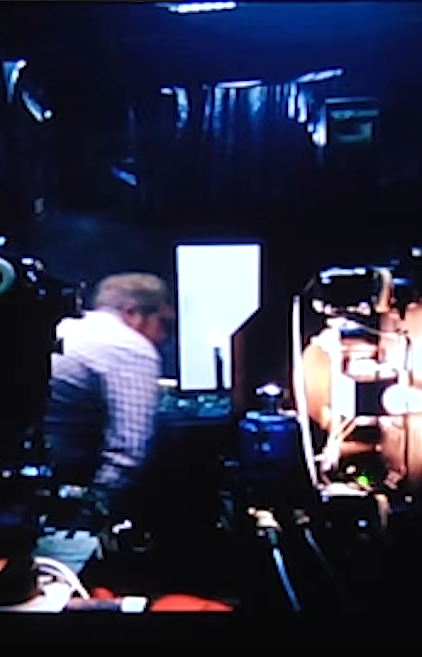
To ensure the explosions occurred at the right moment, an LED lighting system was implemented. The explosions were meant to synchronize with the lights turning on. In reality, this was a difficult and meticulous process. Unfortunately, the original footage is hard to call successful, and with the introduction of CGI in the final 2007 edit, flaws were corrected using the computer.
Filming with a screen. The projector is on the right, and the camera is on the left. Photo taken from Douglas Tramble’s 2010 performance for TIFF