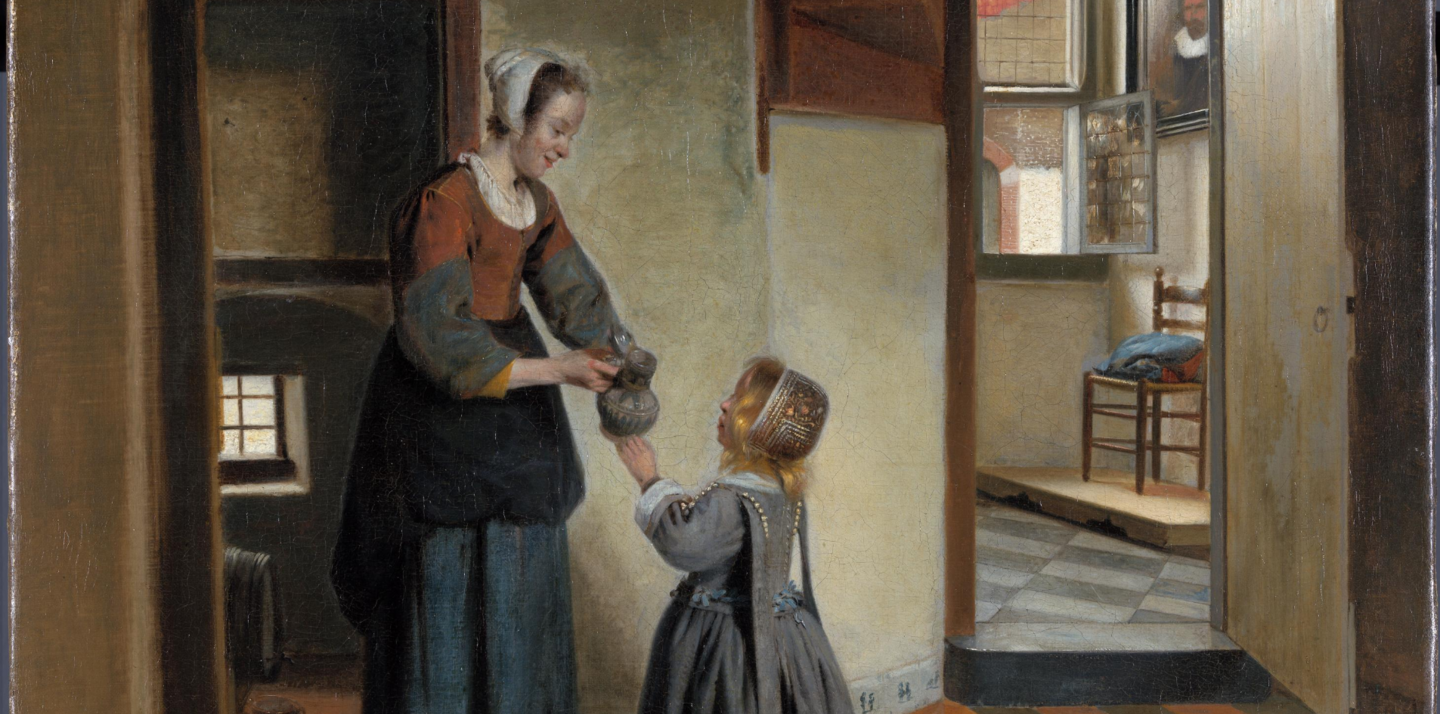
Иллюзия в Голландской живописи XVII века
Illusion in 18th-Century Dutch Painting
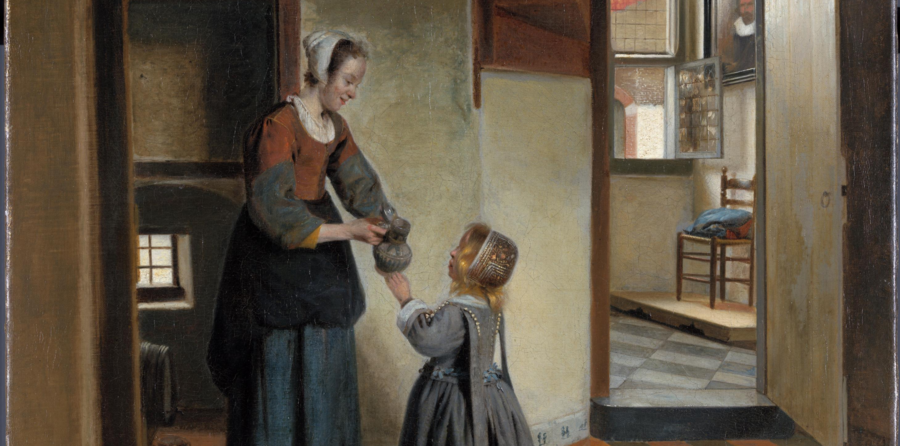
Peter de Hooch, «Mother Removing Lice from the Child,» 1660, Rijksmuseum
Contents
- Concept
- Trompe-l'œil 2.1. Samuel van Hoogstraten 2.2. Johannes Lemans
- The Motif of the Doorway (Doorkijkje) 3.1. Pieter de Hooch 3.2. Nicholas Maas
- Comparison
- Conclusions
Concept
In 17th-century Holland, land was quite expensive. Consequently, Dutch homes tended to increase in stories, while the interiors themselves remained relatively small. Due to the lack of free space, one room often functioned as several rooms simultaneously. To make the house feel more spacious, the Dutch frequently decorated the small sections of wall between the windows. They adorned these areas with small mirrors, maps, or paintings. For this reason, painting emphasized the detailed rendering of perspective and multi-layered space. Paintings served as a means to create the illusion of more space than actually existed. Artists were tasked with continuing the architecture of the dwelling—imagining rooms and household objects to create the illusion of ample space within the home. A crucial source of knowledge regarding spatial construction in painting for the Dutch artists of that era was the treatise «Perspectiva» by art theorist Hans Vredeman de Vries, which was published in Antwerp in 1604. His illustrations of the laws of perspective, using examples from church architecture, initiated the study of this subject by 17th-century Dutch artists. Subsequently, the study of perspective and its integration with knowledge of chiaroscuro led to the emergence of a distinct genre of pictorial illusion known as trompe-l'œil (from French trompe-l'œil — «deception of the eye»).
Within the scope of this visual investigation, we propose to examine illusion not only as an artistic technique but also in terms of how the illusion itself interacts with the viewer. Special attention will be given to how 17th-century Dutch masters created visual spaces that extended beyond the physical reality of the interior. The research focuses on techniques of perspective construction, the handling of chiaroscuro, optical distortions, reflections, and illusory depth. Through the analysis of works by the Dutch Golden Age painters, we aim to uncover how the picture plane was transformed into something resembling real space, blurring the boundary between the actual and the imagined.
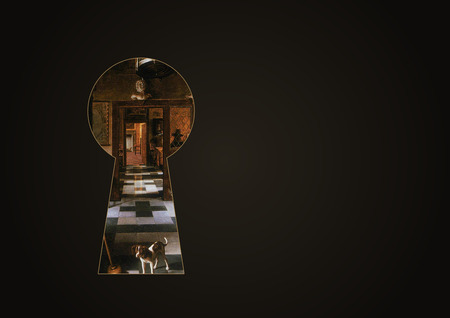
A distinct area of study will involve examining Trompe-l'œil as an artistic technique founded on the deliberate deception of the viewer. Alongside the depiction of objects and architectural elements that create the illusion of breaking free from the picture plane, the «motif of the open doorway» (doorkijkje (a Dutch diminutive of doorkijk, meaning «view through»)), characteristic of 17th-century Dutch interior painting, will be considered. The depiction of doorways, open spaces, and galleries allowed for the creation of the illusion of interior continuation, visually expanding its boundaries and forming additional spatial planes. Such techniques blurred the line between real architecture and pictorial representation, transforming the wall into a figurative window into another space. Consequently, the painting ceased to be perceived solely as an independent image and became an extension of its surrounding environment.
Trompe-l'œil
Samuel van Hoogstraeten, «Trompe-l'œil Still Life, 1664, Museum Dordrecht, Dordrecht, Netherlands.»
One of the developments in illusionistic techniques in 17th-century Dutch painting was the emergence of a specific type of trick painting known as trompe-l'œil. Unlike perspective paintings, whose main goal was the visual expansion of space, trompe-l'œil artists aimed to create the illusion of the actual presence of the depicted objects. To achieve this, they illustrated various everyday items: letters, books, mirrors, towels, and musical and writing implements. Such paintings were often placed on cabinet doors or small wooden panels, becoming an integral part of the interior design.
Samuel van Houten
One of the most renowned artists who worked in this direction was Samuel van Hoogstraaten, a student of Rembrandt. In his works, he strived to convey the form, texture, and volume of the depicted objects with maximum accuracy. Great importance was placed on the natural scale of the objects, the correct placement of the light source, and the meticulous rendering of cast shadows. Thanks to these techniques, the depicted items appeared real, as if stepping out from the surface of the painting.
Samuel van Hoogstraaten, «Still Life Deception with Letters, Rackets, and Playing Cards, ” 1651, Prague Castle Art Gallery, Prague
In this work, attention should be paid to how the artist creates the illusion of a real, tactile surface. Before the viewer is a board displaying various objects that appear to be fixed to it or nestled in a specific compartment. Letters, playing cards, and prayer beads are depicted with such precision that at first glance, they might be mistaken for real objects.
The interaction between the picture plane and the viewer’s space becomes particularly important. The artist does not aim for deep perspective; rather, the objects are positioned as close as possible to the image surface. This creates the sensation that they are right in front of us and could be picked up. The illusion is built upon the realistic rendering of textures, shadows, and subtle variations in lighting.
Samuel van Hoogstraten, «Trompe-l’oeil. Still Life, 1664, Dordrecht Museum, Dordrecht, Netherlands.»
In this work, an illusion is created from images of objects related to the artist’s personal life and activities. Before us is a small board with leather strips, behind which letters, documents, and various personal items are placed. At the center of the composition is a sealed letter on which the artist has left their signature and the date of the work’s creation.The rendering of material textures and lighting plays a special role. The objects differ in density, thickness, and surface quality, and the shadows help define their position relative to the wooden base. Because of this, even small details gain visual conviction.It is important to note that Hogstraaten does not merely depict objects with a high degree of realism; he also creates a sense of their random, natural arrangement. It feels as if we are looking at an actual board to which the owner has pinned items important to them. The image takes on the character of a fragment of daily life, as if the viewer has accidentally come across a part of someone else’s private space.This work demonstrates how an illusion can create not only the physical presence of objects but also the feeling of a real human space. The painting becomes a peculiar fragment of an interior, preserving the traces of human daily life.
Samuel van Hoogstraten, «Board with Letters and Objects,» 1666–1668, Karlsruhe State Art Gallery, Karlsruhe
This work presents a more complex development of the motif. The artist depicts a wooden board upon which various everyday objects are fastened using leather straps. They are arranged close together, partially overlapping, and creating the impression of a real surface used for storing letters and personal belongings.
Here, the principle of the painting’s interaction with real space is particularly important. Hogstraaten deliberately chooses objects that are typically found in close proximity to a person and possess forms and textures familiar to the viewer. Because of this, the image is perceived as an extension of the surrounding environment.
Johannes Lemans
Lemanis was a 17th-century Dutch artist specializing in trompe-l’oeil paintings. Unlike Samuel van Hoogstraaten, who often depicted letters, documents, and personal belongings, Lemanis primarily focused on hunting themes. He created compositions where various hunting accessories appeared to be hung on a wall, positioned directly in front of the viewer.In his works, the depiction of volume and the material properties of objects is particularly significant. The artist meticulously renders metallic, wooden, and leather surfaces, employing cast shadows to indicate the distance between the items and the wall. As a result, the objects do not appear to be part of a flat image but are perceived as tangible objects affixed to a vertical surface.
Johannes Lemans, «Trompe-l’oeil with Hunting Implements, ” 1669, Private Collection
In this piece, Lemans depicts hunting paraphernalia, including a bag, a horn, various accessories, and a cage with a bird. The objects are arranged against a neutral background, appearing as if they are suspended on a wall. The composition is quite orderly, leading the viewer to perceive it not as a typical still life, but rather as an actual wall displaying stored items.The depiction of shadows plays a particularly vital role; these shadows fall behind the objects, helping to define their position relative to the surface. This creates a sensation of physical space between the wall and the depicted objects. The artist seems to invite the viewer to examine a genuine collection of hunting gear, even though before them is only a painted canvas.
«Trompe-l'œil with Hunting Gear, ” 1676, Private Collection
In his 1676 work, Lemans employs a similar principle but depicts a larger composition featuring various hunting paraphernalia. The rifle, cage, hunting horn, and other accessories are arranged against a background resembling a wooden or plastered wall.Here, the illusion is created not only by the precise rendering of individual objects but also by their spatial arrangement. They partially overlap, cast shadows, and seem to occupy a specific place in real space. The viewer can imagine that what they are seeing is not just a painting, but a section of a room where hunting gear is stored.
Thus, Lemans illustrates another way the trompe-l’oeil technique was employed in 17th-century Dutch painting. While Hogarth’s illusions often revolve around personal objects and documents, Lemans’s are connected to items of hunting life. In both cases, the artists utilize realistic depictions of familiar objects to momentarily make the viewer perceive the painted surface as part of a real interior.
The Motif of the Doorway (Doorkijkje)
Unlike trompe-l'œil, where the artist aimed to create the illusion of real objects on the pictorial surface, the doorkijkje motif was intended to evoke a sense of spatial depth. By utilizing open doorways, windows, and passages, artists displayed several rooms simultaneously, establishing a sequence of spatial planes. As a result, the viewer saw not just an individual room, but an entire system of interconnected interiors that seemed to extend beyond the depicted space.One of the artists who most characteristically employed this technique was Pieter de Hooch. In his interior compositions, door openings become crucial elements in structuring space. They guide the viewer’s gaze into the depth of the painting, connect the foreground and background, and allow for the depiction of how light transitions from one room to another. Because of this, even a small interior appears more expansive and complex than it might seem if only a single room were depicted.
Peter de Hooch