Key Premise of Visual Research
The ceiling is conceived as a distinct architectural surface that not only completes the interior but also shapes its image, scale, and emotional perception. The focus is on how the ceiling, throughout history, has depicted the sky, expressed views of the cosmos, and denoted the status of the space and its owner.
The ceiling is one of the least noticeable elements of interior design, yet it is often what dictates how a person perceives a space—whether it feels grand or intimate, enclosed or infinite. Across different cultures, the ceiling has served as a symbol of the celestial vault, a location for sacred imagery, a display of wealth and technical capability, or, conversely, a neutral surface concealing the building’s structure.
The main objective of the research
Trace the evolution of the ceiling’s function and artistic language—from the symbolic imagery of cosmos and celestial order to a expressive element of secular interior design and a functional architectural surface.
Task
Consider the ceiling not as a neutral architectural element, but as an independent visual plane connected to religious beliefs, power, social status, and the viewer’s experience.
Theory
The ceiling is not a secondary surface in the interior, but an active instrument for controlling the perception of space. Its form and design set a specific orientation for the viewer: they can evoke the feeling of being under a celestial vault, emphasize hierarchy and authority, or, conversely, eliminate the decorative distance between the person and the architecture. Furthermore, the shift in artistic styles did not merely change the appearance of the ceiling—it reflected the transformation of ideas about sacred, public, and personal space.
Contents
- How Illusions Work: Key Terminology.
- The Roman Pantheon: Dome, Light, and the Passage of Time.
- Hagia Sophia: The Sensation of a Dome Hovering Above the Structure.
- Medieval Church Mosaics: Heaven as a Sacred Image.
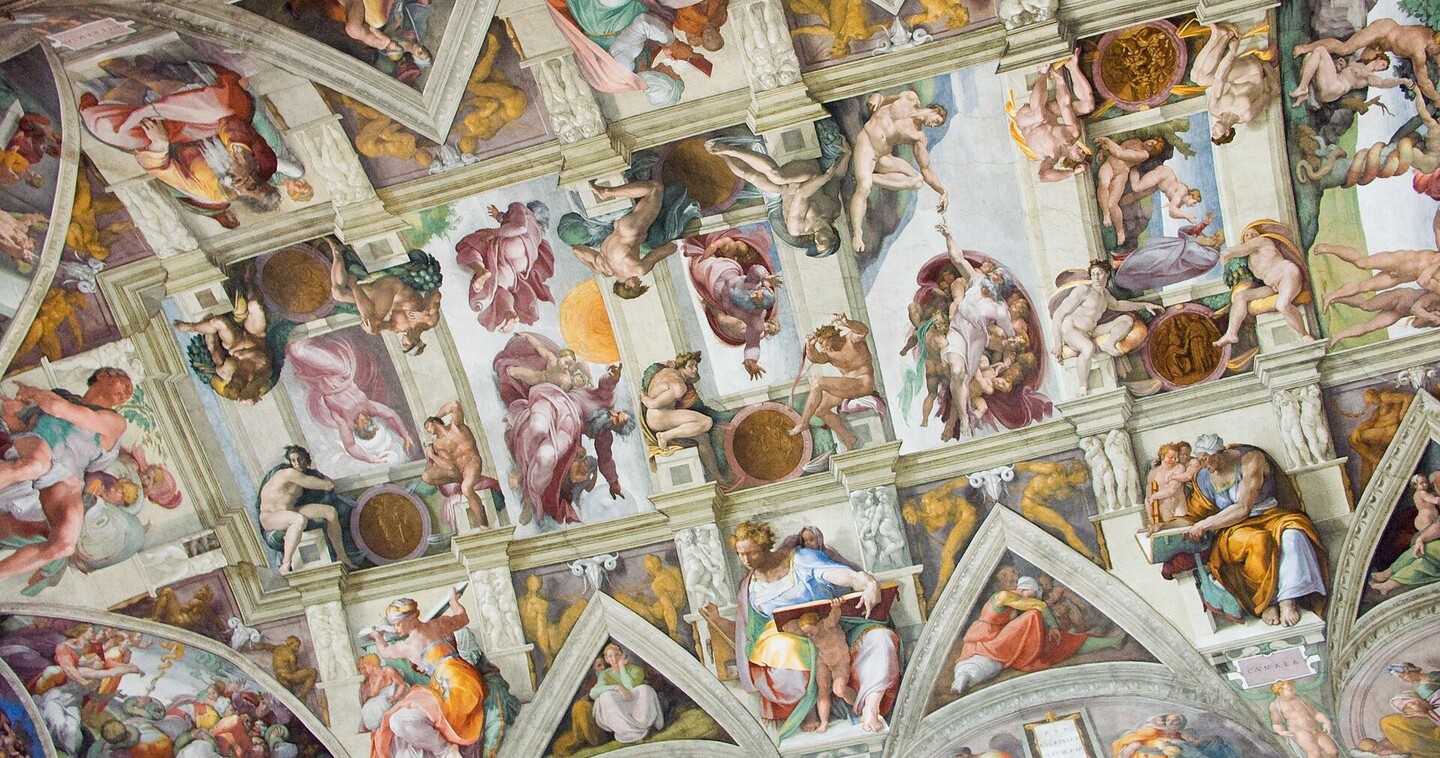
- The Renaissance: The Ceiling Opens to the Viewer.
- Baroque: Painted Architecture and the Illusion of Infinite Space.
- The Baroque Ceiling as Political Spectacle.
- The 18th Century: A Fresco Experienced in Motion.
- Conclusion.
- Image Sources.
The Mechanism of Illusion
Dome
A ceiling or structure shaped like a hemisphere or closely resembling one.
Sails
Curved triangular surfaces allowing the transition from the building’s square base to the dome’s circular base.
Perspective Reduction
A method of depicting objects from an unusual angle, such as from a low viewpoint looking upward.
Bottom up
Literally «from bottom up»: a technique where figures and architecture are depicted as if the viewer is looking up at them from the floor.
Area
Illusionistic architectural painting: columns, cornices, arches, and openings that appear real, though they exist only on a flat ceiling.
Trompe-l’oeil
Visual illusion; in this case—an image that creates the impression of a real space.
The Beginning of Our Era
Pantheon, Rome, 2nd Century AD
The oculus is an open circular opening at the apex of the dome. It allows natural light to enter the building. Since there are no conventional windows in the walls, visitors keenly notice the moving beam of sunlight across the interior.The coffers create rhythm and visually lighten the surface of the dome. They direct the gaze toward the oculus, as if drawing it into the center of the composition. At the same time, the space does not feel completely enclosed—the dome seems connected to the sky.
Weightless Dome from the 6th Century AD
Hagia Sophia, Constantinople — present-day Istanbul, 532–537