How does photography of the 20th–21st centuries help us see beauty in the aging process, and in what instances does such an image become artistic?
Navigation
— Concept — Chapter I. The Face Beyond the Ideal — Chapter II. Beauty Without Perfection — Chapter III. Aging and the Art of Depicting Time — Chapter IV. The Body Beyond the Ideal — Chapter V. Who Defines Beauty? — Chapter VI. Imagined Aging — Conclusion
Concept
What makes a face beautiful: conformity to an ideal or its unique features? In photography, age has often been hidden through retouching and staging. However, some photographers, conversely, showcase wrinkles, graying, and changes in appearance as part of the human experience.
The research draws upon Immanuel Kant’s ideas regarding the beautiful and the sublime. Kant distinguished between aesthetic pleasure and conformity to a given ideal, but he considered human beauty a special case connected to the notion of how a person ought to be. This contradiction helps us understand why appearance is often judged by standards of youth and perfection.
The research is founded on Immanuel Kant’s ideas from «Critique of Judgment» (1790). Kant emphasizes that beauty is not reducible to perfection or conformity to a set pattern (§ 15). However, we often evaluate human appearance based on the concept of what a person ought to be (§ 16). Yet, correct proportions alone are insufficient—the ideal of human beauty is also connected to the expression of moral ideas (§ 17). Section 48 is also particularly important for this study, as Kant distinguishes between the beauty of the object itself and the beauty of its artistic representation. This allows for a separate examination of a person’s appearance and the expressiveness of their portrait.
It’s not about age always being beautiful, but about how photography makes it aesthetically expressive.
Research Objective — to identify the visual means photographers use to represent aging faces and bodies, and how these choices can be interpreted through Kantian categories of beauty, perfection, the ideal, and artistic representation.
Chapter I. The Face Beyond the Ideal: From Norm to Individuality
Kant views the aesthetic idea of the norm as a generalized image that arises from comparing numerous representatives of the same type. However, conformity to this norm does not automatically mean that a person is beautiful or expressive. A face with conventionally pleasing features might appear ordinary if it lacks individual characteristics.
This raises a question: can the very features that distinguish an individual from others make their portrait artistically expressive?
August Sander. «Bäuerin aus dem Westerwald» («Peasant Woman from the Westerwald»), 1912. Source: The Walther Collection
August Sander portrays an elderly woman dressed in dark clothing. The light allows one to observe her wrinkles and the expression in her eyes, while her attire, posture, and setting reveal much about her social environment. However, the photographer does not emphasize age merely for a strong impression: the woman is presented not simply as old, but as a specific individual with her own history and social standing. Age is only one aspect of this portrait, alongside other traits of individuality—facial expressions, the depth of her eyes. This can be connected to Kant’s ideas: a person cannot be reduced to an averaged concept of appearance, because everyone possesses unique characteristics.
«Queen Elizabeth, Queen Mother.» Victoria and Albert Museum
In the 1970 portrait of Queen Elizabeth, Cecil Beeton crafts an image distinct from the documentary portraits of August Zander. The Queen sits in a lavish chair; her light gown, pearl necklace, and rich interior emphasize her elegance and high status. Beeton carefully constructs the composition: the clothing, light, and setting work in concert to create an idealized portrait. While signs of age and graying hair remain visible, they become part of an image of dignity and royal elegance. However, they are integrated into a portrait of royal elegance, where harmony and a meticulously arranged visual environment play the most crucial roles. Thus, the photograph does not so much aim to document the specifics of aging as it presents an elderly woman through the idealized image of a public figure.
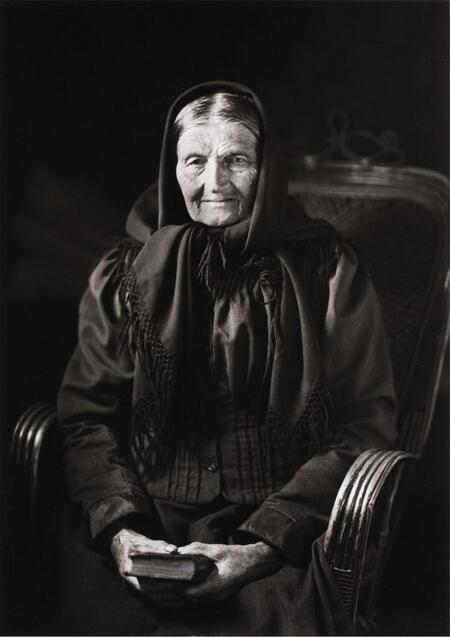
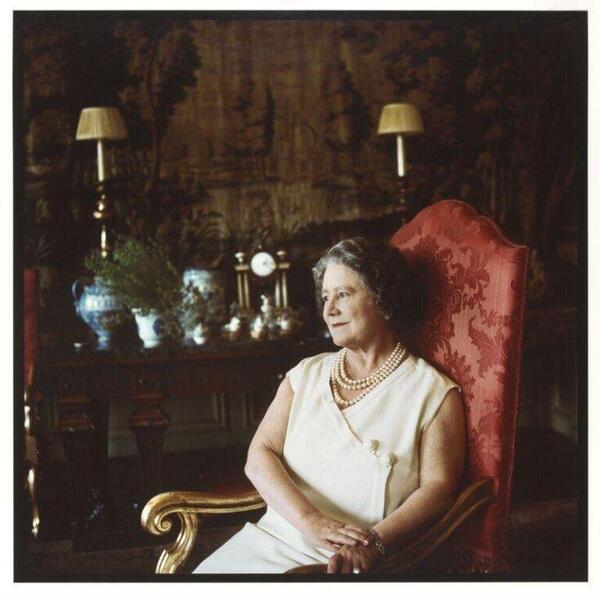
Berenice Abbott. «Eugène Atget, ” 1927. Metropolitan Museum of Art / „Queen Elizabeth, the Queen Mother.“ Victoria and Albert Museum
In contrast to photographs by August Sander and Cecil Beaton, the works demonstrate that an aging individual can be presented in various ways. Sander emphasizes the model’s individuality, while Beaton creates a more staged portrait by using costume, color, interior, and composition to highlight the elegance and high status of the Queen Mother. Yet, Sander’s portrait cannot be called entirely objective, nor Beaton’s photograph simply artificial—both photographers choose how to represent the person. This comparison can be linked to Kant’s ideas from «Critique of Judgment.» Kant argued that beauty is not reducible to perfection or adherence to a predefined standard, and he distinguished between the beauty of the person themselves and the beauty of their artistic depiction. Therefore, the value of these portraits is not determined by how closely the models match the ideal of youth. In Sander’s work, expressiveness arises from attention to facial features, while in Beaton’s, it stems from a carefully constructed image. Both approaches show that aging can become part of artistic beauty rather than an impediment to it.
Chapter II. Beauty Without Perfection: Age, Character, and Artistic Image
Chapter One illustrated that the artistic depiction of an aging person can be based on various aesthetic principles: either preserving individual age characteristics or incorporating them into an idealized image. Now, a question arises: how does photography transform human appearance into an artistically expressive image? In § 43, «Critique of Judgment, ” Kant views art as the result of conscious human activity. In § 48, he distinguishes between the beauty of the depicted object and the beauty of its artistic representation. Therefore, when analyzing a portrait, it is important to consider not only the model’s appearance but also the means by which the artist organizes its depiction. This distinction can be traced using the examples of portraits of Winston Churchill, created by Yousuf Karsh, and the writer Colette, photographed by Irving Penn.
Yusuf Karsh. «Winston Churchill, ” 1941. Source: Yusuf Karsh Archive
In Yusuf Karsh’s portrait of Winston Churchill (1941), a strict and monumental image is created. Its expressiveness stems from the interplay of lighting, posture, and facial expression. The contrasting light emphasizes the volume of the face, the shape of the brow, and the intense gaze. The dark suit visually unifies the figure, and the placement of the hands reinforces the impression of stability and resolve. The absence of a smile plays a crucial role—the severe facial expression upholds the image of political authority. However, the photograph’s expressiveness is not solely dependent on the model’s expression. It arises from the compositional choices—the direction of the light, the figure’s placement, and the ratio of light and dark areas. The distinction Kant proposed in $\S 48$ allows us to view monumentality not as an inherent quality of Churchill’s appearance, but as an effect of artistic representation. The photograph does not merely capture a person’s likeness; it actively shapes their expressive public image.
Irving Penn. «Colette, Paris,» 1951. Source: Christie’s
In Irving Penn’s portrait «Colette, Paris» (1951), he adopts a different approach. The close-up framing, the placement of the hand, the hair, and the skin texture direct attention toward the writer’s individual characteristics. Unlike the monumental portrait by Cartier-Bresson, expressiveness here is built upon the delicate interplay of form, light, and the model’s individual features. The placement of the hand guides the eye toward the face, while the hair, the folds of the clothing, and the skin’s texture form a complex system of visual accents. Moreover, the photograph does not merely aim to capture external resemblance. Penn organizes the image so that every detail contributes to the creation of a cohesive artistic vision. In § 45, Kant views fine art as the result of conscious creativity that is perceived as free from visible constraint by rules. This idea helps to understand the apparent immediacy of Penn’s portrait: the impression of naturalness is achieved through carefully selected angles, lighting, and composition. The distinction between the beauty of the subject and the beauty of its artistic representation, explored in § 48, allows one to separate the model’s individual traits from the aesthetic organization of the work.
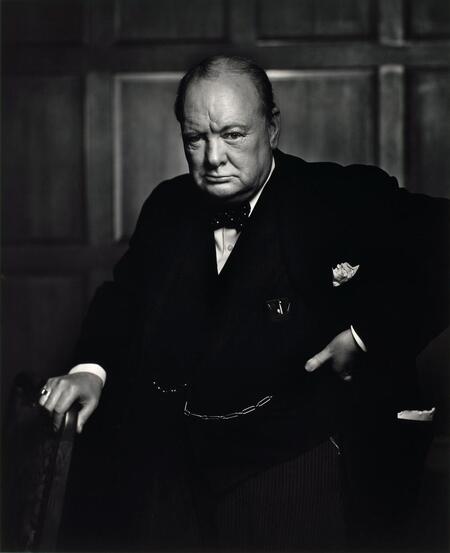
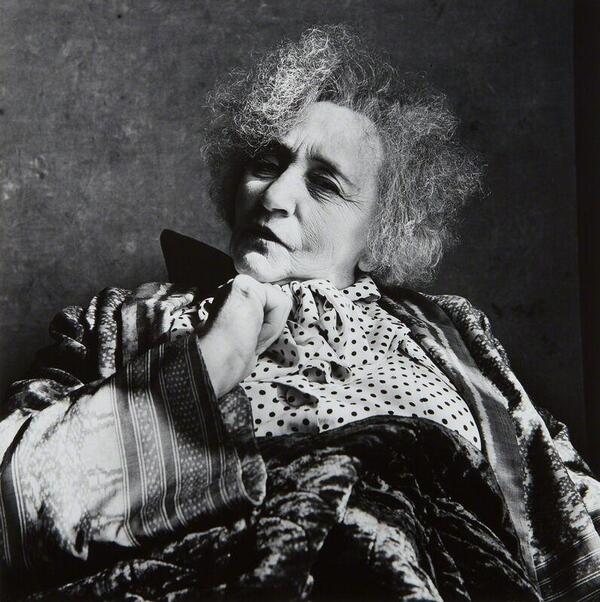
Yusuf Karsh. «Winston Churchill, ” 1941. Source: Yusuf Karsh Archive / Irving Penn. „Colette, Paris, ” 1951. Source: Christie’s
Both photographers do not conceal the age of their models, but they assign it different meanings. Kant distinguished between the beauty of the subject itself and the beauty of its artistic representation. This difference is visible in the portraits by Karsh and Penn: the photographers are not merely showing the models’ appearances; they are organizing them in distinct ways. Karsh employs dramatic lighting, rigid posing, and a dark suit to present Churchill as a powerful and resolute man. Penn constructs Colette’s portrait through close cropping, the placement of her hand, and the texture of her face and hair, emphasizing the model’s individuality. Consequently, in both cases, expressiveness is created not only by the person’s appearance but also by the means chosen by the photographer. It is this artistic representation, which Kant discusses, that transforms the portrayed individual into a specific image.
Chapter III. Aging and the Artistic Depiction of Time
The previous chapter demonstrated that the artistic expressiveness of a portrait largely depends on how the artist organizes the image. Photography, however, can not only create an image of a person but also illustrate their changes over time. Let us examine how a series of photographs allows us to present aging not as a discrete state of appearance, but as a process unfolding throughout life. For this analysis, we will turn to the works of Richard Avedon and Nicholas Nikon.
3.1. Richard Avadon: Aging and the Finitude of Life
Richard Avedon. «Jacob Israel Avedon, Sarasota, Florida, ” portrait of the father from the 1969–1973 series. The Jewish Museum
Between 1969 and 1973, Richard Avedon created a series of portraits of his father, Jacob Israel Avedon, who was seriously ill in his final years. The bright background, close-up framing, and lack of environmental detail focus attention entirely on the subject’s face and gaze.
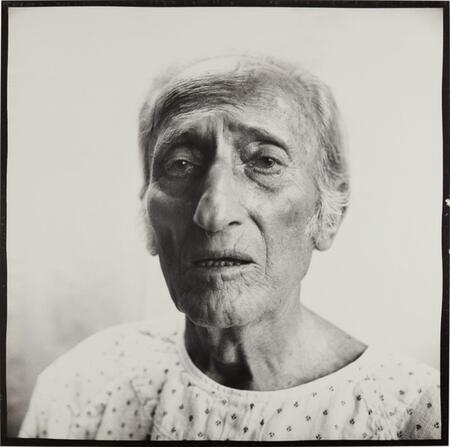
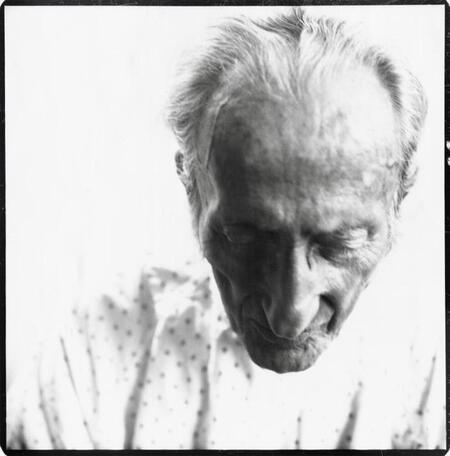
Richard Avedon. «Jacob Israel Avedon, Sarasota, Florida, ” December 19, 1972. MFA Houston