I. Introduction
A phrase on a randomly opened page of a book can capture attention if it resonates with a question the reader is already pondering. They reread it, relating it to their own situation. Thus, a chance coincidence becomes a prompt for interpretation. A similar process can be observed in card divination, where a person seeks a connection between the drawn image and a posed question.
The first known tarot decks appeared in Italy in the 15th century and were used for card games. Later, tarot began to be used for fortune-telling. In a game, the random deal establishes the conditions under which participants make decisions. In a divinatory spread, the drawn card is interpreted taking into account its image, its position among other cards, and the question asked. This distinction leads to the main research question—under what conditions is a randomly drawn card perceived as a sign, and what role does its image play in this process?
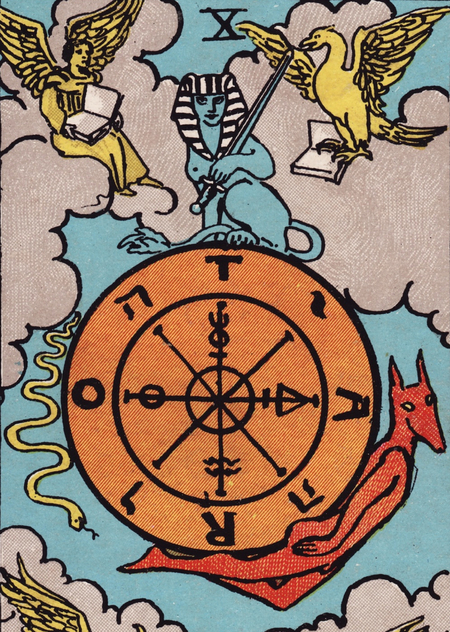
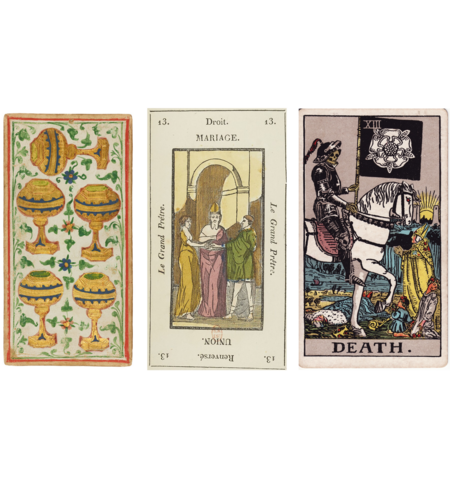
The basis for the visual analysis rests on three decks: Visconti–Sforza, Grand Etteilla II, and Rider–Waite–Smith. I am comparing the images associated with The Lovers, The Wheel of Fortune, and Death, paying close attention to composition, character gestures, objects, and inscriptions. This comparison allows me to trace which elements persist across different decks, how the emphasis shifts, and which visual details a person might rely on when connecting a card to their question.
II. Concept
Tarot is interesting for the philosophy of play because similar actions with the cards can lead to two different outcomes. In the game, shuffling and dealing determine which cards each participant receives. In divination, the shuffled deck provides images that are interpreted in relation to a person’s life. In both cases, the participant confronts something they did not choose beforehand and subsequently acts according to the rules. This raises the research question: How does a randomly selected tarot card begin to be perceived as an omen of fate, and what role do its imagery and position in the spread play in this process?
I am examining three subjects—The Wheel of Fortune, Death, and The Lovers. Regarding the Wheel of Fortune, I am interested in how the card depicts a change in state. Death allows me to compare what is visible in the illustration with how that image explains guidance. The Lovers help track how the perception of the connection between two people changes. For each subject, I first examine the composition and details, then I compare the inscriptions on the cards themselves with the interpretations found in sources. After that, using the «Celtic Cross» as an example, I investigate the role position plays in reading the spread.
By random selection, I mean drawing a card from a shuffled deck whose face is initially unknown. By omen of fate, I mean a card interpreted as relating to a person’s past, present, or possible future. My hypothesis is that the divinatory meaning is formed from the image, the cues for its reading, and the card’s placement within the spread. Symbols suggest specific themes, while the question and the spread connect those themes to the person’s circumstances.
The sources serve different purposes. Museum and library catalogs help establish the origin and dating of the images. A contemporary French regulation offers a specific example of a trick-taking card game. From Roger Caillou’s book, I adopt the concept of alea to describe what is received by the participant by chance and where their own decisions emerge. The Waite Guide helps examine how one specific divinatory system is structured. Together, these materials allow one to trace the path from a random deal to the interpretation of an image within a personal situation.
III. The History of Tarot
The earliest documented evidence of tarot dates to 1440–1450 and is associated with Northern and Central Italy. In courtly circles, painted decks were created for playing. One such deck, the Visconti–Sforza, is housed in several collections. The cards I am analyzing are located in the Morgan Library & Museum and date from approximately 1450–1480.
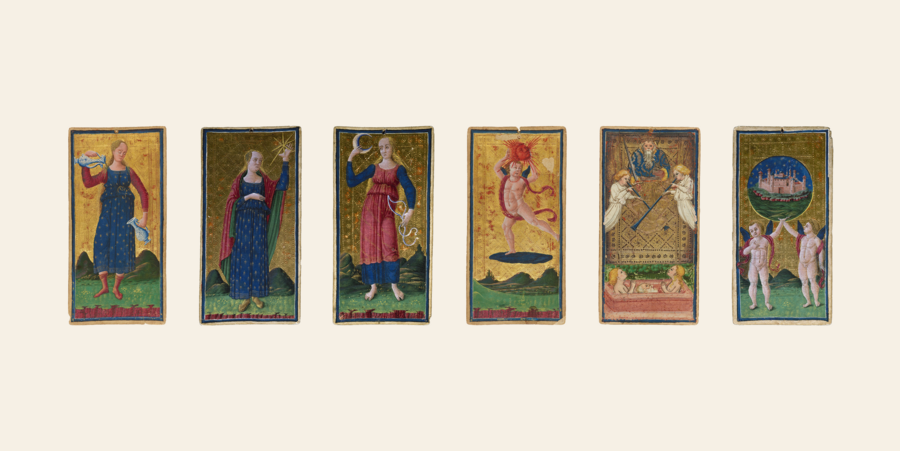
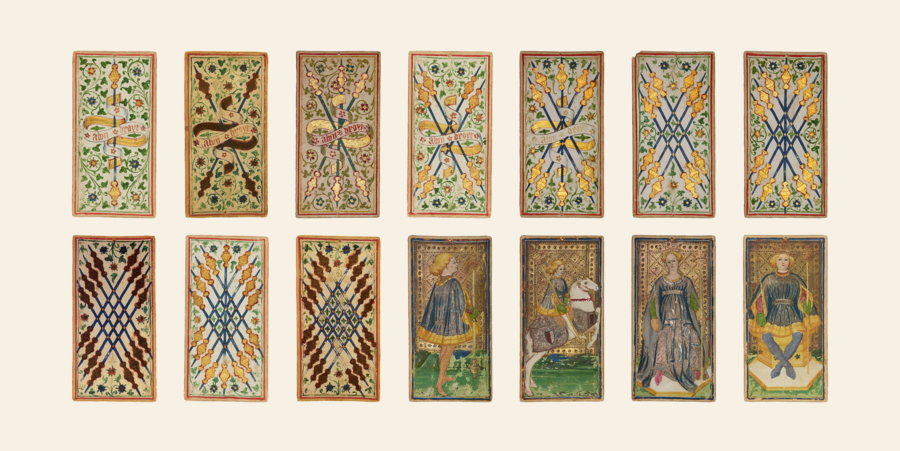
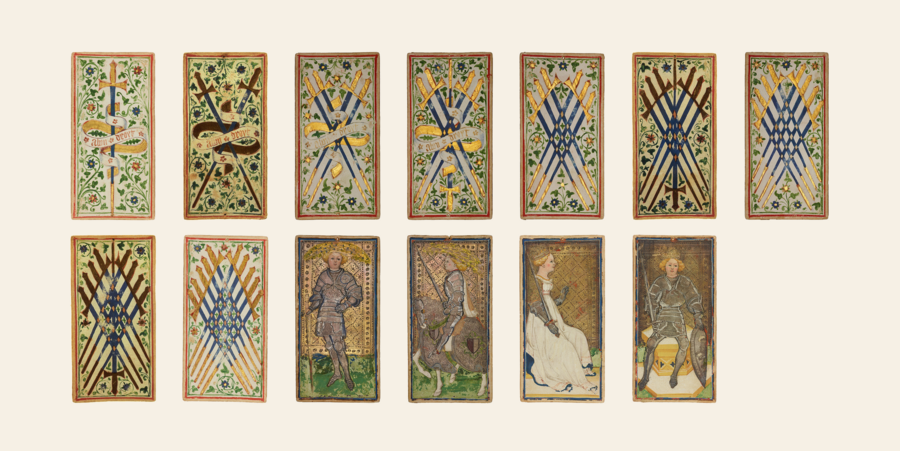
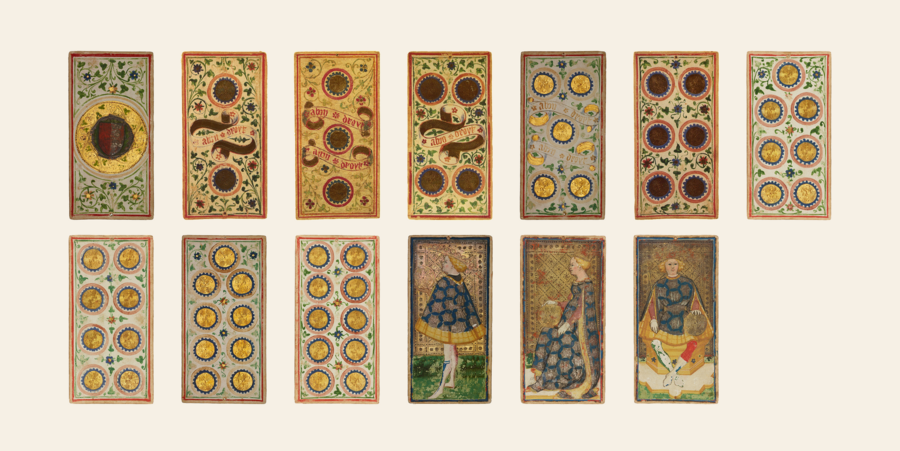
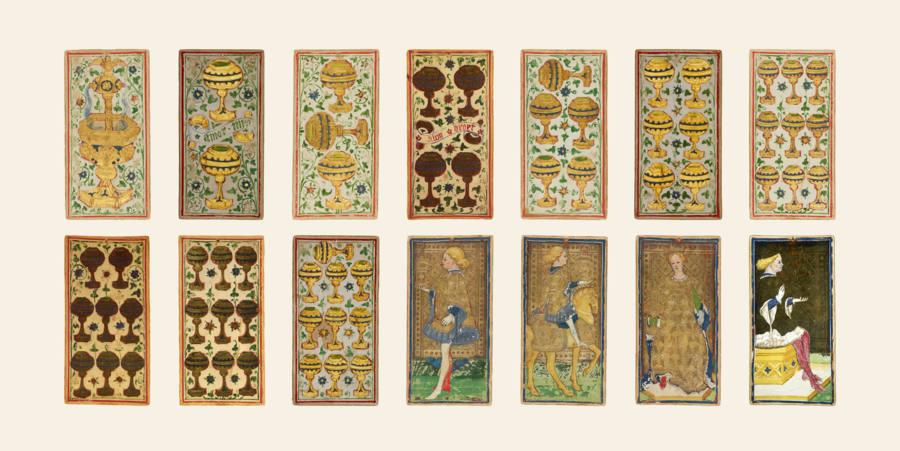
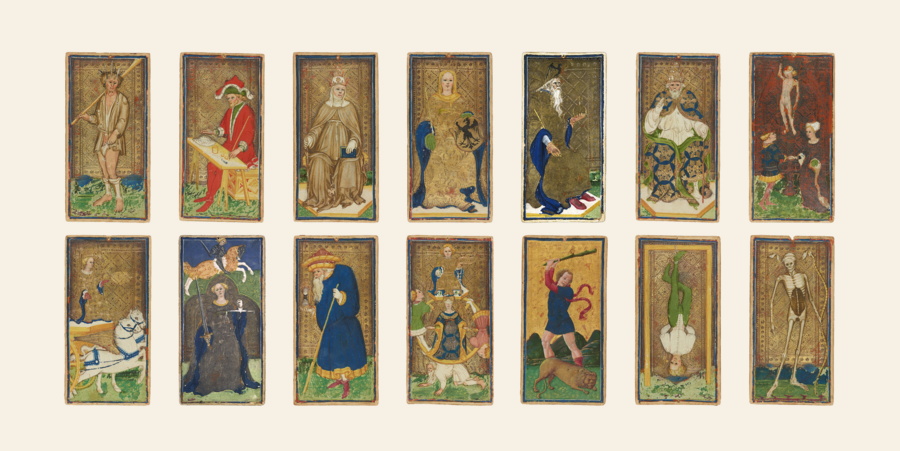
Visconti—Sforza. The Morgan Library & Museum, M.630.7 and M.630.12.
The earliest documented evidence of Tarot dates to the 1440–1450s and originates from Northern and Central Italy. In courtly circles, painted decks were created for gameplay. One such deck, the Visconti–Sforza, is held in several collections. The cards I am examining are housed in the Morgan Library and Museum and date from approximately 1450–1480.The four-suit Tarot—cups, swords, wands, and coins—was augmented with special trumps and the Fool. Imagery of power, love, time, and death coexisted within the deck. This helps explain why early Tarot cards can be interpreted from two perspectives: as game pieces and as illustrations referencing the culture of their time.Different cities developed their own methods for printing, coloring, and designing cards. One early example of what would later be called Marseille Tarot is the deck by Philippe Vauban, produced in Marseille in 1639. It was printed using wooden blocks and colored using stenciling. This example illustrates how the appearance of Tarot evolved alongside its mode of production.In the late 18th century, new theories emerged regarding the origin and purpose of Tarot. In 1781, Antoine Court de Gébelin published a theory about its ancient Egyptian origins. For this work, his version is significant as an example of occult interpretation: he explained familiar images as expressions of hidden knowledge. However, the earliest documentary evidence pertains to the Italian card game.
In the 1780s, Jean-Baptiste Alliette, known as Etteilla, published a guide to tarot divination and developed his own system. Grand Etteilla II, in my view, is a later iteration of this tradition, from around 1850. His cards feature printed text next to the illustration, indicating both upright and reversed positions. This allows the card’s function to be understood simply by observing the organization of its face.
In 1909, the deck now known as Rider–Waite–Smith was released. Pamela Colman Smith created its illustrations in collaboration with Arthur Edward Waite. For my research, I am using scans of the 1910 Pam-A edition and a digital copy of Waite’s 1922 printed guide. This comparison enables me to examine the artwork separately from what the guide’s author perceived within it.
The game use of tarot has endured, and alongside it, divinatory traditions have emerged. Therefore, I will proceed by comparing two specific practices: the contemporary French game and Waite’s divinatory method.
IV. Play and Divination