Research Concept
In a game, randomness rarely means the player has no influence. Even if the outcome depends on a die roll or a randomly drawn reward, the participant knows the rules, chooses the moment to act, and decides what to do after the result. Therefore, this research interests me not just in what determines the outcome, but also in how the game presents the player with the boundary between their choices and luck.

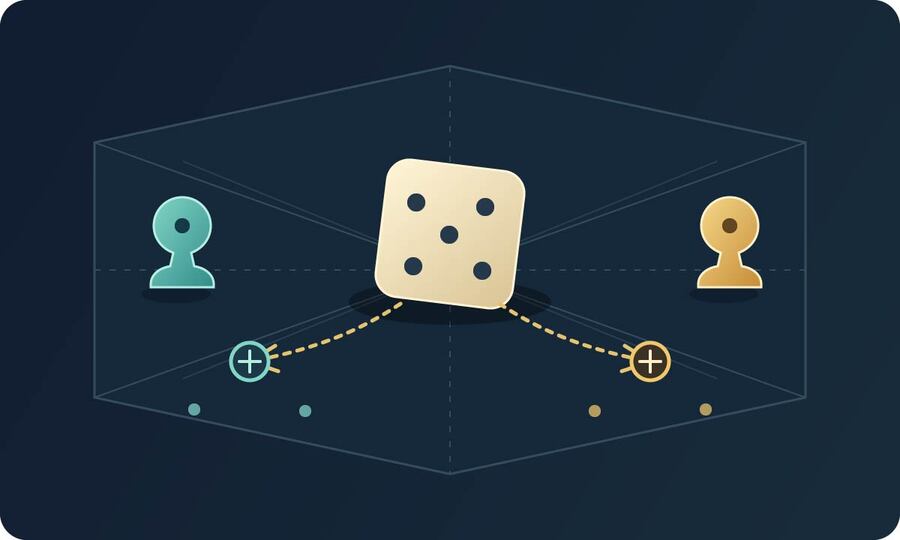
The theoretical foundation of this work will be Roger Caillois’s classification. He identifies four types of play.
agon — contest
alea — chance
mimicry — imitation and role-taking
ilinx — dizziness and disruption of habitual perception
The core of my research will focus on alea: games or game situations where the outcome depends on chance rather than solely on skill. For readers unfamiliar with this classification, it is important to clarify: alea does not necessarily exclude mastery. A player might not choose the number that is drawn, but they often choose how to utilize that result. Therefore, randomness can coexist with contest—agon.
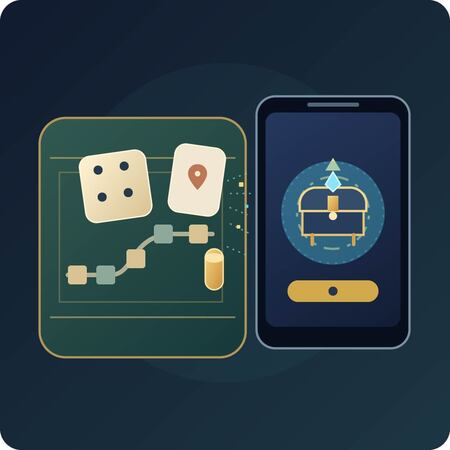
In board games, randomness typically takes on a visible, material form. A die falls onto the table, a card is revealed, or a token moves across the board. These objects make the result visible to participants and link it to a specific action. In a digital game, a random outcome can be presented differently: the interface might display a spinning animation, a treasure chest opening, a change of images, or the appearance of a reward. Here, visual effects can dictate the pacing of anticipation and draw attention to individual results. However, the image of a rare reward, in itself, does not communicate how likely it is to obtain.
Relevance of the Topic
The relevance of this topic stems from the fact that randomized rewards and methods for presenting them to the player are subjects of contemporary research in digital games.
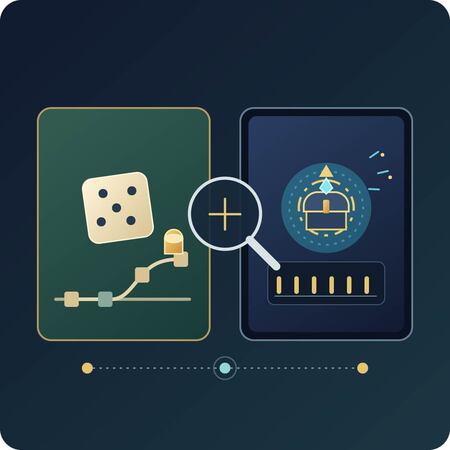
The practical significance of this work lies in how a careful analysis of the interface helps distinguish the actual probability of an outcome from the impression created by its visual presentation. The theoretical objective of this research is to compare how randomness becomes visible in a physical board game versus a digital interface. In this paper, I am not aiming to describe every game that incorporates elements of chance. Instead, I am examining several examples to trace which elements display the result, which convey the consequences, and which represent the anticipation.
The main research question:
What visual means do board and digital games use to depict randomness, and how do these means demarcate the boundary between luck and player control?
The working hypothesis is that visual form does not necessarily alter the actual probability of an outcome, but rather influences how the player perceives their involvement—whether it’s a throw, movement along a game path, or anticipation of a reward staged by the interface.
Cube: Chance as a Physical Event
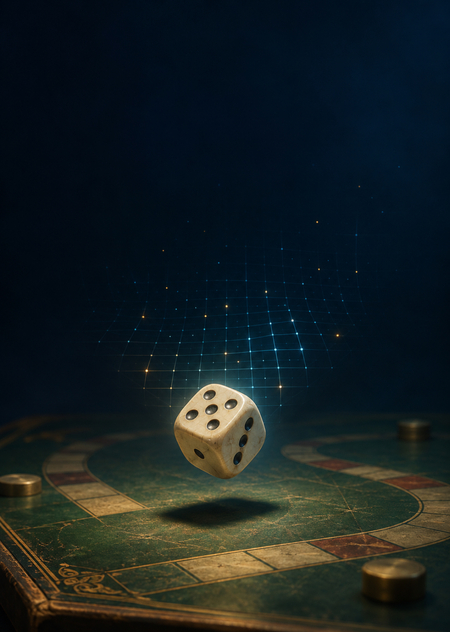
The die transforms randomness into a tangible object that can be held, thrown, and observed. Before the roll, the player sees several possible outcomes, none of which have yet been realized. After the die lands, uncertainty vanishes temporarily—the top face displays a number that the game’s rules translate into a specific action. In this sense, the die doesn’t merely signify luck—it makes it visible to all participants.
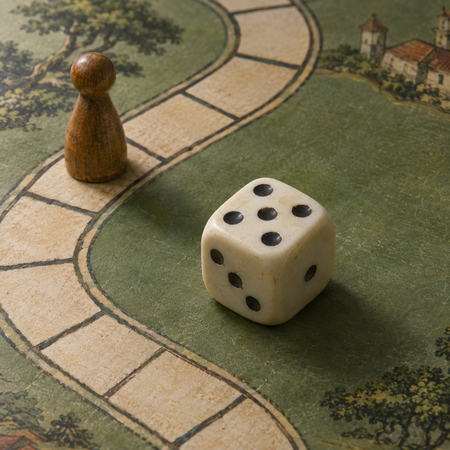
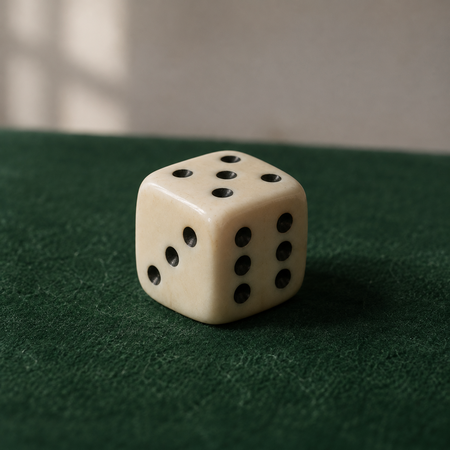
A throw can be considered a short, three-part gameplay episode: player action, anticipation, and the emergence of a result. While the die is rolling or spinning, the outcome remains undecided for the participants; when it stops, anticipation gives way to a number. This moment often focuses players' attention on a single object. They watch the throw, check the landed value, and relate it to the rules.
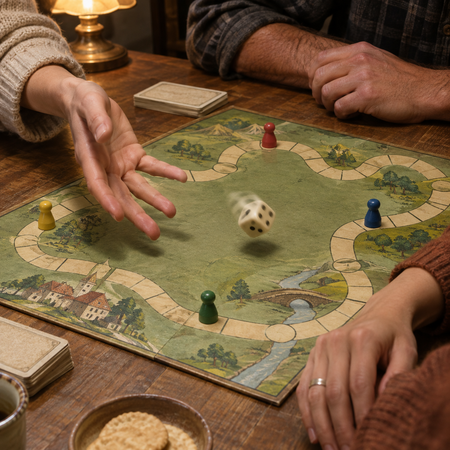
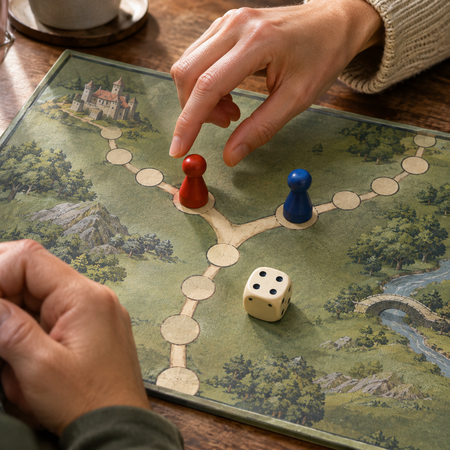
However, the number on the die does not always completely determine what happens next. It may limit the available moves, but the player still has the discretion to decide how to utilize them. For example, the result of the roll might allow the player to move one of several tokens or choose one of several possible paths. Therefore, randomness and skill are not mutually exclusive: the die sets the conditions, and the player makes decisions within those conditions. For Kaihua, a random start to the game is called alea; in a specific turn, it can combine with a competitive start—agon.
Game Field: Randomness as a Route
In the game of Goose, the die roll gains a spatial extension: the rolled number becomes the number of spaces the token moves along the board. While the player rolls the die, various outcomes are possible; yet, as they move the token, one result is already converted into a specific position on the path. Therefore, the value of the roll depends not only on the number but also on the space it leads to.
«The Pleasant Game of the Goose» (Il Dilettevole Gioco di Loca), after 1640. Printed field with a route to the goal. Source: The Metropolitan Museum of Art. The museum notes the image as public domain.
The game board pre-organizes this path. Its cells divide it into individual stops, and specific images or rules can link certain stops to additional outcomes. The route shows the player where they can go, but the roll itself doesn’t always allow for pre-selecting the final cell. Thus, randomness becomes part of the designed space: the dice determines progression within the boundaries set by the board and the rules.
Game board, Germany, late 17th — early 18th century. The center of the board features the rules for the game of Goose. Source: Metropolitan Museum of Art. The image is also noted by the museum as public domain.
This is evident in two printed game boards from the Metropolitan Museum collection. The first—“Happy Goose Game”—dates to the period after 1640. The second board, which is German, dates to the late 17th—early 18th century; the museum notes that the center of the image features text explaining how to play. In the first case, one can examine how the game path is visually organized; in the second, how the instructions are integrated into the board itself. Comparing the two helps reveal that the game image does more than just decorate the game—it shows the path and connects it to the rules.
Digital Interface: Randomness as Anticipation of Reward
In a digital game, the player often does not see the mechanism that determines the random outcome, but rather its on-screen representation.
Between pressing a button and the reward appearing, there might be animations, image changes, flashes of light, or the spinning of a wheel. These elements extend the waiting moment and transform receiving a result into a distinct gameplay episode. The player watches the screen, even if their actions do not necessarily influence which reward will appear.
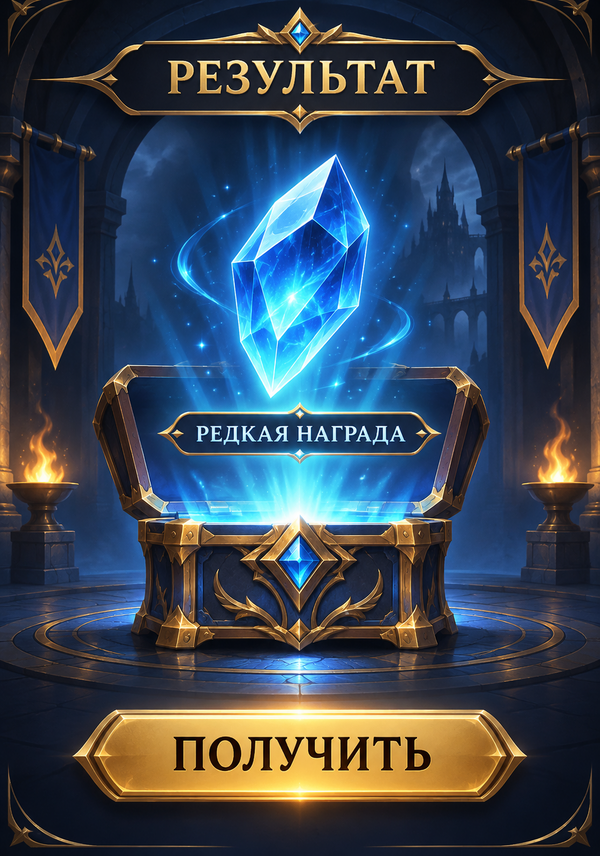
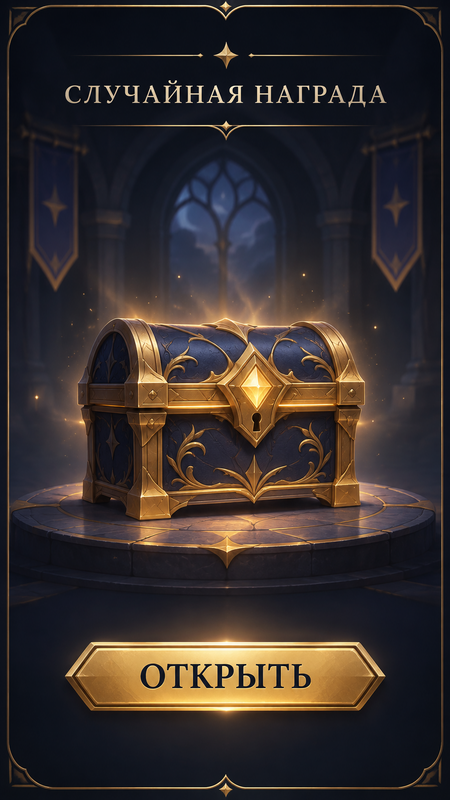
The interface also indicates which results are considered significant. Rare rewards may be highlighted with a bright color, an enlarged image, or a special glow. This presentation affects how a player notices and evaluates a result, but it does not inherently prove that its drop rate is higher. Therefore, it is important to consider the visual presentation of the reward separately from the probability information regarding its acquisition.