Navigation
- Introduction.
- Main Body. a. Inheriting Pre-Digital Formats — Why Does It Work? b. Parkour: A Genealogy of Movement. c. The Genealogy of Duels and Combat Systems. d. The Save Point — Ritual and Mode of Instruction. e. You Are the Protagonist of the Story. Mimicry.
- Conclusion.
1 | Introduction
In the past and in the present, play holds a significant place in a person’s life. In early childhood, play is a means of understanding and exploring the world; in kindergarten and school, it provides an opportunity to make new friends and integrate into society; and in adulthood, it often becomes a way to escape daily worries and responsibilities by immersing oneself in completely different, reality-separate circumstances.
No matter how the role and importance of play change throughout a human life, it can be confidently said that everyone has participated in various activities or another way, ultimately to experience joy.
With the development of digital technologies, games have evolved and acquired new formats. Today, we can see their immense diversity: ranging from various sports games to board and computer games. However, the primary quality that unites them remains unchanged: people play for the pleasure they achieve during the game, and this is precisely why they keep returning to them again and again.
I would like to focus my visual research on video games, as they are currently one of the most pervasive and popular formats.
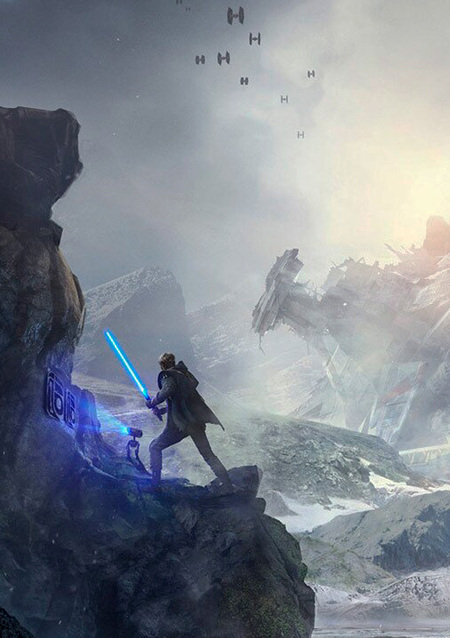
There is a wide array of diverse genres: from high-stakes narrative horror games with choices to simple adventure games involving open-world exploration. Every game possesses its own set of mechanics and practices essential for the player to succeed. Even though games have taken on a digital form, all the techniques and mechanics were rooted in the fundamental essence of games long ago.This is why I want to investigate the source of people’s genuine interest in games and how closely and intimately video games intersect with pre-digital practices, using the adventure action game Star Wars Jedi: Fallen Order as an example.
Relevance:
Video games frequently become subjects of philosophical analysis. However, they are often reduced to mere interactive cinema because only a small fraction of people consider how the mechanics and different game structures influence engagement in the gameplay, and where those structures originate. The study examines how combat, labyrinths, save points, and respawn rituals—as well as other forms derived from physical and tabletop games—are reflected in the digital realm.
Key research questions:
Are the mechanics used in creating adventure action games fundamentally new, or are they a transformation of earlier pre-digital practices?If they inherit from pre-digital forms, how are they integrated into the lore and interface of the computer game?Why do they work?
Research hypothesis:
Video games, for the most part, translate established, functional forms from physical and tabletop settings into the interface level. Nevertheless, this is not mere copying; it is a meaningful transformation that allows the player to experience the same satisfaction from playing a video game as they do from participating in board games or physical competitions.
Research objective:
To identify and describe the human genealogy of mechanics in the game Star Wars Jedi: Fallen Order, and explain how pre-digital formats are inherited within it.
material selection principle:
For the introduction, to explain the fundamental reason why games are an indispensable part of human life, and to comment on the main body, I utilized literature studied within the course (Heijzinga, J. «Homo ludens: The Playful Human»; Fink, E. «Basic Phenomena of Human Existence»; Kaiua, R. «Games and People»; Parlett, D. S. «The Oxford History of Board Games»), as well as supplementary sources that explain the mechanics and video walkthroughs related to the game Star Wars Jedi: Fallen Order.
2 | Main Body
Inheriting Pre-Digital Formats — Why Does It Work?
Johan Huizinga, in his work Homo ludens, argued that play is primary to culture—a fundamental basis that humanity establishes in other spheres of life: science, poetry, religion, and law. [1, pp. 19–21, 22–27]
Games have often been perceived as something «unserious»; they lack the defined objective of an action directed toward a specific goal. Play is, instead, a pleasure and a process that is engaged in voluntarily. It is voluntary because this process offers an «escape from the mundane, ” which people are forced to navigate day in and day out.Nevertheless, despite the points above, it is incorrect to assert that the gaming process cannot be taken seriously—a person can become completely absorbed by it to the point of oblivion.
Thus, the author formulates the key characteristics of a game: it is a free activity directed toward achieving joy and pleasure from its execution; it is not tied to material gain; it takes place within established boundaries of space and time according to set rules; and it also fosters the formation of social groups based on shared interest.
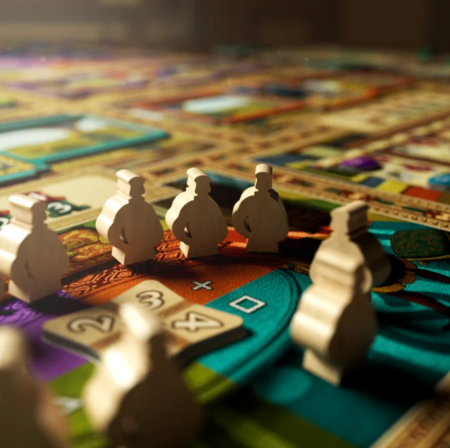
Each game establishes a unique space governed by its own internal logic, which participants accept as truth. There is a kind of magic in this—all the experiences and emotions that governed the player before the game begins cease to exist within the new circumstances.It is no surprise that games are so popular: the diversity of genres, plots, and stories is endless, allowing one to dive into unique worlds time and again.
To capture and hold a person’s attention, a game must also contain tension and unpredictability, as this is what compels us to return to the gameplay. There can be a fixed number of outcomes and resolutions, or the opposite—the very fact that the game’s outcome is undetermined makes it unique and secures it in memory as a spiritual value.
Play is a kind of «oasis of happiness, » as formulated by E. Fink in his work «Fundamental Phenomena of Human Existence.»
The fundamental concern of human life is the achievement of happiness, which is sometimes difficult or entirely impossible to attain. The play process, in turn, pauses this race and creates that very «oasis of happiness”—limited in space and time. [2, p. 2]
A video game, even as a proprietary commercial product, adopts the listed characteristics and does not invent anything new. D. Parlett, in his work «The Oxford History of Board Games, ” classifies this inheritance by purpose: racing, spatial games, pursuit, and so on. This illustrates that the same techniques and mechanics continue to live on, merely changing the material medium. [4]
Star Wars Jedi: Fallen Order combines a vast diversity of these structures—for instance, the spatial logic of available zone placement, the logic of racing games with return routes, and the logic of displacement in combat.Genealogy in this example helps reveal functional, enduring pre-digital forms that continue to be reproduced in video games.
Parkour: A Genealogy of Movement
In the game Star Wars Jedi: Fallen Order, parkour refers to a specific set of movement mechanics: wall running, sliding across various surfaces, jumping and double jumping, swinging on ropes, and climbing objects and the natural environment.The primary function of these mechanics is to facilitate planet exploration and allow access to previously unreachable areas.