Navigation
- Head of the Household and His Family
- The Servants as Named by the Museum Itself
- Probable Servants
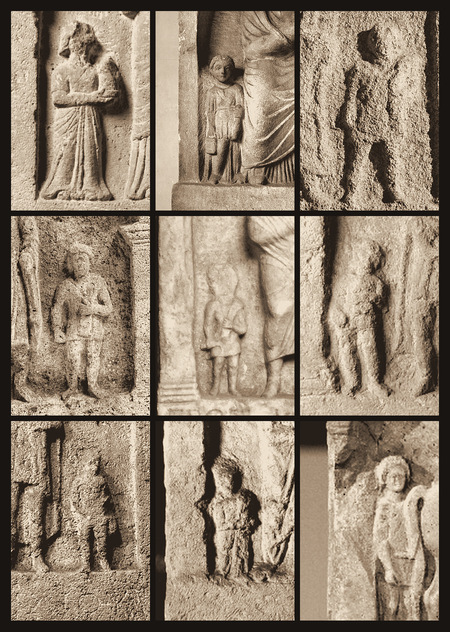
- Nameless Small Figures: Servant, Ward, or Child?
- Dependencies in Inscriptions
- For Comparison: Athens
- Scale and Name: The Core Principle
- Conclusions
- Sources
Theme, area, time and geography, object, subject
Topic: How the structure of the home is depicted on the tombstones of the Bosporan Kingdom: who is the head of the household, who is a family member, and who is dependent on the head, and why some figures are depicted large while others are small. Area of Study: The tombstone as a form of communication. The stele illustrates not only the deceased to the city but also their home—the people who were near them and their place relative to the head of the household. Time and Geography: The Bosporan Kingdom (Pantikapei, present-day Kerch), 1st century BCE — 2nd century CE. Two Athenian tombstones are included for comparison. Object: Tombs on the stele from the Bosporan Kingdom. Subject: The depiction of individuals with different statuses within the household: the size of the figures, their placement in the composition, posture, clothing, objects held, and whether they are named in the inscription.
Goal and Objectives
Goal: To demonstrate how the hierarchy of the household was depicted on Bosporan stelae and what visual indicators allow us to distinguish the head of the household, family members, and dependent individuals.
Objectives:
- To collect stelae featuring multiple figures alongside the main person, including inscriptions about dependents.
- To provide a detailed description of each figure using a unified visual analysis scheme.
- To compare how named family members are depicted versus the unnamed smaller figures.
- To categorize the smaller figures into indisputable servants, probable servants, and ambiguous cases.
- To identify the main principle governing the household hierarchy on the stela and trace its origin.
- To confirm or refute the working hypothesis.
Research Concept
When I studied the Bosporan tombstones, I noticed that on almost every stela, aside from the main figure, there were small people: a girl with a casket, a boy next to a man, a figure by a horse. Usually, people overlook them because the tombstone wasn’t made for them. But that is precisely why they are interesting—servants and other dependent people rarely left written traces, making the stela one of the few ways to see their place in society. Then I noticed something else. A wife, a mother, or an adult son, if they were named in the inscription, were depicted almost as prominently as the head of the household. Those who were not mentioned in the inscription were almost always depicted as small. It seems the stela illustrates an entire hierarchy within the household: the head, his family, and his dependents. I wanted to understand how this hierarchy was structured and what visual means were used to construct it.
Material Selection Principle
I sourced the material from the online collections of the State Hermitage Museum and the British Museum. Selection criteria included:
- Stelae from Panticapeia and its surroundings, dating from the 1st century BCE to the 2nd century CE, which feature other people alongside the main figure.
- Only items with a photograph, museum catalog number, and date of creation.
- Stelae where details are most clearly visible: figure size, clothing, objects, and poses. From many similar stelae, I selected three or four of the most illustrative for each section.
- Stelae with inscriptions to verify if the depicted individuals are named.
- Inscriptions that explicitly mention dependent people, such as «ward» or the manumission of a slave.
- Two Athenian tombstones to show the origin of the sample.
Research Categorization Principle
The research is structured like descending through a house: from the head of the household to the dependent members, and finally to the overarching principle. Each section follows the same structure: first, I describe the stelae, then I identify a pattern, and finally, I draw a conclusion about the place of these individuals within the household.
Principles for Selecting and Analyzing Textual Sources
V. F. Gaydukevich’s books, The Bosporan Kingdom (1949) and Ancient States of the Northern Black Sea (1984), provide a comprehensive view of Bosporan society and the status of dependent populations. T. D. Ravdonikas’s article, «Provisioning in the Bosporus» (1981), clarifies the term «vospitannik» found in Bosporan inscriptions; this term could refer to both free children sent for upbringing and domestic slaves. I verify the meaning of the Greek word «pais, ” which translates to both „child“ and „servant, ” using I. Kh. Dvoretzky’s Ancient Greek-Russian Dictionary. A. P. Ivanova’s and E. A. Savostina’s works are necessary to understand which themes originated from Greek art. I cross-reference the inscriptions against the Corpus of Bosporan Inscriptions (1965).
Key Question and Hypothesis
Key question: What does the small size of the figure on the Bosporan stele indicate, and how is the hierarchy of the household structured through size, placement, and name? Hypothesis: The small size on the Bosporan stelae signifies unnamed dependent members of the household—servants, and sometimes possibly trainees or children. Named family members, even adult sons, are depicted in full figure. A person’s place within the household is indicated by two factors: figure size and whether they are named in the inscription.
The Head of the Household and His Family
Stele of Feagen, son of Hermogen, and his wife Kulia. Pantikapeia, 1st century BCE. Limestone, Ht. 163 cm. State Hermitage Museum, Inv. T.1870-71.
• Size and Placement: Feagen on horseback is in the center, standing taller than everyone else. Culia sits to the left; her figure is almost the same scale. • Pose: He is riding; a quiver (for a bow) burns by his hip, and she is seated under a blanket by the table. • Small Figures: There are three figures in the background, much smaller than both spouses. • Name: «Feagen, son of Hermogen, and his wife Culia, farewell.» The small figures are unnamed.
Stela of Gai, son of Gai, and his mother Basilindyna. Kerch, 50 BCE — 50 CE. Limestone, height 93 cm (including base). British Museum, 1856,0710.26.
Stele of Dioscurides and his wife Callia. Kerch, 100 BCE — 50 CE. Limestone, 93 cm high. The British Museum, 1856,0710.25.
Stela of Argon and Ma. Pantikapei, 1st half, I century CE. Marble, height 69 cm. State Hermitage Museum, Inventory No. PAN.-1621.
The stele of Gaius, son of Gaius, from the British Museum is similarly structured: the adult son shakes his mother Basilindina’s hand. Both are named and depicted full-length, and a small, unnamed figure stands nearby. On the stele of Dioscurus and Calliope, a husband and wife hold hands and are depicted at the same height, while a small maid with a casket remains unnamed. On the stele of Argonus and Ma, the couple is also the same height, and two small figures on either side are unnamed; below, there are verses from their son Antipas. The pattern is this: everyone who is named is depicted prominently. But even among those who are named, there is a distinction. The man is named by his father, while the woman is named through her husband («wife of Calliope»), and he rides while she sits. This suggests that the wife and adult children have their own secondary status within the household.
The Servants as the Museum Itself Calls Them
Tombstone of Artipus, daughter of Alkym. Kerch, 50–150 CE. Marble, 124 cm high. British Museum, 1856, 0710.47.
• Size: Noticeably smaller than the seated lady. • Placement: Stands next to the lady, to her side. • Attire: A chiton and a belted mantle. • Objects: A handled casket and likely an oil vessel. • Name: The inscription names Artipus and Alkim; the attendant is unnamed. The museum refers to her as an «attendant.»
Stele of Isigone, wife of Heraclides. Kerch, 50 BCE — 100 CE. Limestone. British Museum, 1856, 0710.8.
Stela of Gellada, wife of Menodorus. Kerch, 30 BCE — 50 CE. Limestone, height 152 cm. British Museum, 1856,0710.21.
Stele of Artemidor, son of Diog. Kerch, 50 BCE–150 CE. Limestone, H 67.5 cm. British Museum, 1856,0710.23.
Museum label translation from photo: «664. Fragment of a limestone relief with two tiers. The upper tier depicted a horse, a dog, and a male figure. The lower tier features a rider with a bow, sword, and spear, alongside a foal. Inscription: „Artemidor, son of Dioge, keeper of the list (tablet), farewell!“»