Concept
Fur in 15th-century European culture served not only a functional purpose but also acted as a symbol of wealth. There was a system in place where each type of fur (marten, sable, stoat, squirrel) held a strictly defined social significance. In 15th-century European society, fur became a component of the visual language of luxury: it was present in the clothing of rulers, nobility, and individuals of high social standing.This study examines fur through the works of 15th-century European painting. Fur becomes a noticeable part of the clothing—it contrasts with the fabric color, emphasizes the silhouette, or draws the viewer’s eye with its texture.The hypothesis of this research is that the meaning of fur as a symbol of social status in 15th-century painting was established not only by depicting the material itself but also through its visual characteristics: color, texture, size, and placement on the garment, as well as its combination with other fabrics. It is hypothesized that these specific features allowed artists to convey an impression of luxury and indicate the depicted person’s status.Initially, I examine fur as a social sign and a costume element, then its visual characteristics and modes of depiction in the works. In the concluding section, I analyze how fur influences the image of the person and what meanings it acquires in different pieces.
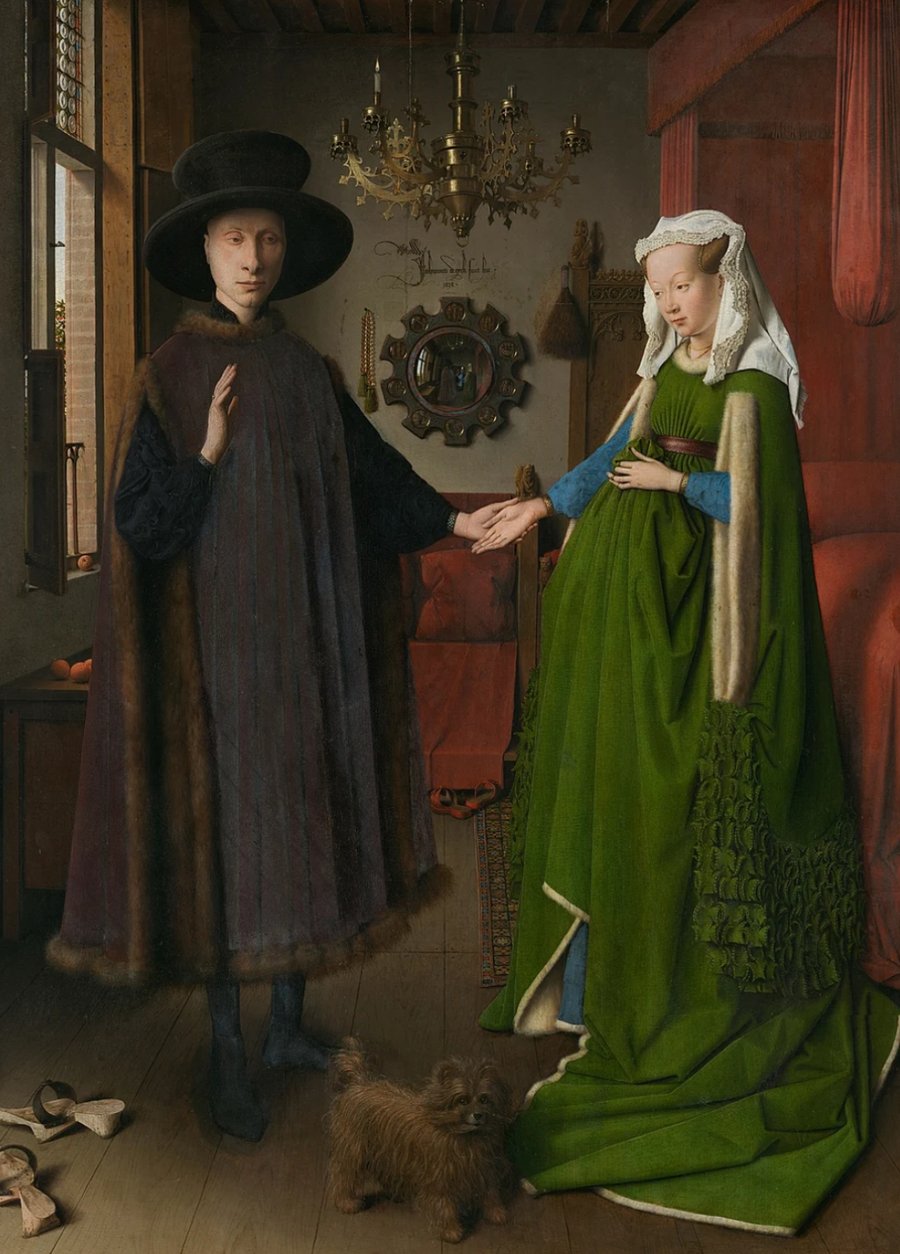
Jan van Eyck. «The Arnolfini Portrait, ” 1434
In Jan van Eyck’s painting, fur appears on the clothing of both characters. The man’s outerwear features a dark fur trim, while the woman’s green dress is complemented by light fur.
The fur does not cover the entire suit, but its light color and placement make it a detail that is difficult to miss. Combined with the expensive fabrics and complexity of the garments, the fur enhances the impression of wealth.
The depicted clothing also looks very warm, even though the painting contains details that suggest a warmer season. This proves that the fur here is not portrayed as a practical material, but as a demonstration of wealth.
Hans Memling. «Portrait of a Young Man»
The portrait of Hans Memling depicts a young man wearing a fur trim on a velvet tunic. The soft texture of the fur contrasts with the smoother surface of the velvet tunic. This interplay of textures makes the clothing appear as a combination of various luxurious materials to us.
Unlike Arnolfini’s work, where the fur is noticeable due to color contrast and placement area, in Memling’s piece, the accuracy in rendering the fabric’s texture takes on greater significance.
Rogier van der Weyden. «Reading Mary Magdalene, ” c. 1435
Magdalene is depicted sitting on the floor of a room, completely engrossed in reading. Her figure forms a semicircle, and her head and legs curve around her bent knees, emphasizing her detachment.
Fur is present in this work, but its role differs from that in previously analyzed portraits.
Magdalene is dressed in a lavish, fur-trimmed gown; however, this fur is not depicted with the opulence we see in Van Eyck’s «Arnolfini Portrait.» Here, the fur serves as an attribute of the past. According to Western tradition, Mary Magdalene was associated with the unnamed sinner, and her rich attire—including a skirt made of jeweled gold brocade—is a reminder of her former, worldly life.
Albrecht Dürer. «Self-Portrait in Fur Garment, ” 1500
Dürer portrays himself in a strictly frontal pose, with long, symmetrically unbound hair and a raised right hand, whose fingers touch the fur collar in a gesture reminiscent of a blessing, echoing depictions of Christ from that era.
Dürer, as an artist—that is, a craftsman—depicts himself wearing fur, a material intended for the nobility and affordable only to the highest social elite.
«He touches the marten fur, which, according to the fashion code of that era, was a hallmark of high society, and as an artist and a person of manual labor, he was forbidden to wear it. Thus, we can view this gesture as an intention to elevate his social standing.»
Thus, Dürer asserts his right to a place in the highest social hierarchy not through his birth, but through his talent.
Leonardo da Vinci. «Lady with an Ermine, ” circa 1489–1490
In this piece, we do not see an image of fur, but we can observe a stoat—an animal whose pelt was imbued with multiple meanings in Renaissance culture. The portrait depicts Cecilia Gallerani, a young mistress of the Milanese Duke Lodovico Sforza (Lodovico Moro).
The presence of a stoat in the favored subject’s portrait can be explained by several factors.
Ludovico Sforza, since 1488, was a member of the Order of the Ermine and included the image of the animal in his personal emblem. Therefore, the animal directly refers us to the commissioner of the portrait and also confirms Cecelia’s status as Ludovico’s favorite.
The white fur of the stoat is associated with purity and innocence. For the duke’s mistress, who bore him a son, it was a way to whitewash her transgression.
Unlike Van Eyck and Dürer, where fur was a material of clothing or a statement of status, in Leonardo, fur embodies social representation, courtly politics, and intimacy.
Rogier van der Weyden. «Saint Luke Painting the Madonna, ” 1435–1440
Saint Luke, patron of artists, is depicted painting the Madonna. He is wearing a reddish-pink cloak with fur trims and a collar.
On the one hand, the fur indicates that Luke is a craftsman of high rank; on the other hand, sanctity is associated with humility. However, in the context of the 15th century, «worthy» clothing was part of representing socially acceptable sanctity. The fur did not contradict humility; rather, it signified the reverence that Luke, as an evangelist and an artist, commanded.
In both works, Van der Weyden’s furs are present but serve opposing functions. In the painting of St. Luke, the fur on the cloak signifies professional dignity. For Mary Magdalene, the fur, conversely, marks wealth and worldly status—the trappings she renounced. It belongs to her past and illustrates the path of spiritual transformation.
Petrus Christus. «Portrait of a Young Woman,» c. 1470
The portrait depicts an unknown young woman in burgundy fashion, popular around 1470: featuring a deep V-neckline and a tall headdress. Her blue dress is trimmed with white fur, which is rendered with such detail that it can be identified as stoat fur.
The woman is depicted with a porcelain and serene face, which creates an image of unattainable, idealized beauty; therefore, the fur here signifies high social status—not through position, but through refined taste and impeccable style.
Jan van Eyck. «The Chancellor Rolin’s Madonna, ” 1435