Categories
1. Concept 2. Historical and Archaeological Context: Pompeii in the 1st Century CE 3. Urban Space and the Visual Language of Wall Inscriptions 4. Public Communication: Political Agitation and Spectacle Advertising 5. Private Communication: Personal Messages, Love Notes, and Domestic Graffiti 6. Iconographic Motifs, Museum Artifacts, and Contemporary Research Methods 7. Conclusion
CONCEPT
When we speak of Pompeii, we most often recall the eruption of Vesuvius, the ruined buildings, and the preserved works of ancient art. However, I became interested in a slightly different aspect of the city’s life—the inscriptions and drawings that its inhabitants left directly on the walls. Among these were political announcements, declarations of love, jokes, appeals to others, and even small depictions of gladiators. It struck me as fascinating that such seemingly insignificant things can tell us as much about the daily life of the people as famous architectural monuments.
In my research, I aim to view the walls of Pompeii as a unique space of communication where the personal and the public intersected. I am particularly interested in tracing how the meaning of a message changed depending on where it was located. For instance, an election slogan on the facade of a house was directed at passersby, whereas a short, personal phrase inside a living space might have been intended for a much smaller audience. Moreover, the boundary between the private and the public was not always clear: even a personal confession left on a wall became accessible to other people.
For me, it is important to study not only the content of these messages but also their visual presentation. The size of the letters, the color of the paint, the placement of the inscription, and its proximity to other images—all of this could influence perception. Therefore, in this work, I compare photographs of archaeological sites, museum artifacts, historical renderings, and preserved wall paintings.
I want to present Pompeii not merely as a lost ancient city, but as a place where ordinary human life—complete with its experiences, conflicts, and ways of self-expression—once thrived. Of course, we cannot definitively establish who left each inscription or how the surrounding people reacted to them. Yet, even these small traces allow us to move closer to understanding how people communicated almost two millennia ago.
The central idea of my research is that Pompeii’s visual culture was formed not only by official art and architecture but also by the everyday messages of ordinary residents. It is through these messages that we can view the city from a more personal, human perspective.
THE HISTORICAL CONTEXT OF POMPEII—HOW IT ALL BEGAN
The eruption of Vesuvius in 79 CE sealed a significant portion of the urban surface, preserving the plasterwork, images, and texts on the walls. However, the inscriptions were not created simultaneously—some date from earlier periods of the city’s life. The date of destruction serves as an upper limit for the corpus, not the exact date of every inscription. The material is primarily limited to Pompeii to avoid mixing the local characteristics of different settlements. When necessary, comparisons with Herculaneum are included, but they are noted separately.
Hackert, View of the Ruins of Pompeii, 1799
The photograph captures the object’s state at a specific moment and may not show a lost part of the text. Tracing helps to read the lines, but it includes the researcher’s interpretation. Epigraphic publication secures the reading, the finding’s location, and the bibliography; new technology sometimes leads to a revision of previous records. Therefore, the visual conclusions in this work are based on a combination of photographs, localization, and scholarly publications. Historical reconstructions are not used as proof of what the inscription looked like in antiquity.
Graffiti and Painting
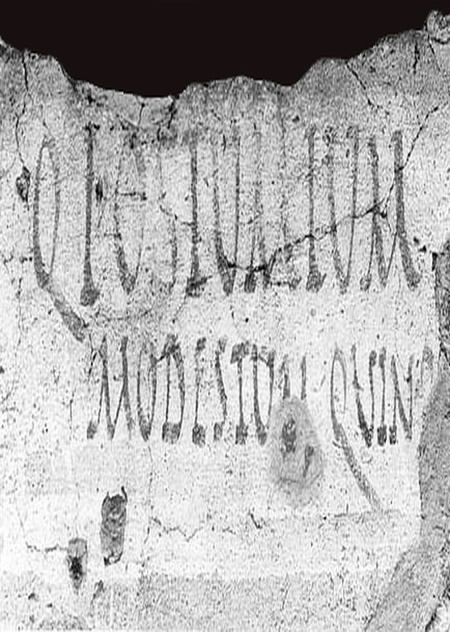
Graffiti, in a narrow epigraphic sense, was scratched into plaster or other surfaces with a sharp object. Dipinto was executed with paint, often in large letters, sometimes on a pre-primed white surface. This distinction affects the time required for creation, reading distance, durability, and the possibility of editing the text. Today, the term «graffiti» frequently encompasses both phenomena. In this study, we maintain the distinction: it prevents equating street political advertising with private inscription, even though both fall under wall communication.
Comparison: Scratching requires close proximity; paint allows you to work with large signs and visibility from a distance.
METHOD: 6 parameters. Each object is examined using the same set of questions.
- Location: address by regio, insula, entrance, or interior space. 2. Surface: exterior facade, passageway, or interior covering. 3. Technique: scratching or brushwork, color, and layer. 4. Visual Form: letter size, orientation, density, and the ratio of image to text. 5. Communicative Genre: request, praise, name, joke, propaganda, or invitation. 6. Level of Certainty: what is known from sources versus what remains interpretation. This matrix can be applied to inscriptions of various content without substituting analysis with free associations.
basis for comparison: one set of attributes for public advertising, letters, and drawings.
Inscription Archive: CIL IV
Corpus Inscriptionum Latinarum transforms individual walls into a comparable research corpus.
Volume IV of CIL compiles wall inscriptions from Pompeii, Herculaneum, and Stabiae. CIL IV allows for a connection between the transcription, the history of study, previous drawings, and readings clarifications. For specific examples, the presentation provides CIL numbers where identification has been confirmed. In addition to the corpus, the Ancient Graffiti Project is utilized, where an entry can include the discovery context, the text, orthographic normalization, and literature references. In this format, a single phrase becomes a source for material and social history. An important distinction: the entry number refers to the epigraphic object, not to the current photograph of the wall.
Inscription Rendering Cil 4 5296 SOURCES: CIL IV; Ancient Graffiti Project
CITY, ITS ROUTES, AND SOCIAL COMMUNICATIONS
Pompeii was a complete Roman city, complete with a forum, theaters, residential quarters, taverns, and street stalls. Inscriptions were found in various types of spaces—from bustling facades to the entryways of private homes. Location is critical because the walls functioned simultaneously as structure, decoration, and a medium for communication. The archaeological situation is unique, but it is not neutral: subsequent excavations, conservation efforts, and tourism have altered how we perceive these walls today.
Sources: Archaeological Park of Pompeii; Benefiel 2016
For searches, archaeological numbering is used based on districts (regiones), blocks (insulae), and entrances. The designation I.6.15, for example, indicates the house where gladiatorial drawings were excavated. This numbering does not replicate the ancient addressing system, but it allows for cross-referencing modern publications with points on the map. The city plan helps test hypotheses about the distribution of inscriptions. Comparing the street façade with the internal peristyle reveals fundamentally different observation scenarios. The street served communicative functions. Narrow streets, façades, entrances, and intersections established varying distances between the person and the sign. A passerby might see a large inscription at wall level, but reading finely scratched text required approaching very closely. Therefore, the scale of the message cannot be separated from the width of the street and the placement of doorways. Modern photographs offer insight into the architectural framework but do not reconstruct the precise ancient density of people, signs, and movement.
Via dell’Abbondanza connected important parts of the city and featured numerous commercial and residential entrances. When studying the inscriptions on its facades, researchers note the coexistence of political pronouncements, commercial functions, and decoration. Particularly telling are the sections where wall paint and traces of different inscriptions have survived. It is crucial not to attribute every modern photograph to a specific text; precise house or CIL number is necessary for interpretation. In the presentation, photographs of the street serve as evidence of the architectural context.
Pompeii, inscriptions on Via dell’Abbondanza SOURCES: Pompeii excavations; Viitanen & Nissin 2017
HOME AND PRIVACY TERMS
The atrium, hallways, and some other areas of the house could receive guests, clients, or visitors to utility spaces. This makes the term «private» conditional. Studies on domestic graffiti show that texts within the home might be addressed to a specific group, but not necessarily to a single person. The placement of graffiti sometimes aligns with the wall’s decorative system without destroying its central imagery. This coexistence allows the writing to be viewed as part of the practice of inhabiting residential space.
House of the Vettii — Pompeii Excavations SOURCES: Benefiel, The Culture of Writing Graffiti within Domestic Spaces at Pompeii, 2016
The stuccoed walls were suitable for painting and scratching. The smoothness of the layer aided in line work, while cracks, moisture, and subsequent repairs could alter readability. Decorative finishes were also significant: the inscription interacted with the existing color fields. After the excavation, the storage conditions changed drastically. Photographs from different years and early renderings sometimes capture texts that are now less discernible. Therefore, digital image enhancement should be viewed as a method of investigating the authentic object, rather than as a reconstruction of an «ideally preserved» wall.