Navigation
— Concept — The Chair as an Independent Object in Contemporary Art — The Chair as a Marker of Visual Code — The Chair Designed to Be a Contemporary Art Object — Conclusion — Sources
Concept
Chairs are among the most familiar household objects found in every apartment and public space. Chair classifications are incredibly diverse—for example, office chairs, kitchen chairs, patio chairs, specialized chairs for beauty professionals, and so on. Every person uses one of these types of chairs daily. Yet, behind such a seemingly prosaic piece of furniture lies the immense effort of the designer, who has spent countless hours engineering the chair while considering the minutiae of ergonomics and visual design. Indeed, beyond its utilitarian function, a single chair’s design can tell a complete story about the visual language of different eras. In the realm of contemporary art, the chair also carries significant meaning. Many artists draw upon the image of the chair in their works. Perhaps it is precisely its utilitarian nature that allows the chair to become a unique artifact for artists to represent.
In my visual research, I examine the chair from several artistic perspectives. The first is the chair as an independent object in contemporary art. In this context, what is crucial is not so much the external appearance or the design paradigm of this chair as the very fact of its existence. For example, artist Joseph Kosuth, in his «One and Three Chairs,» addresses the question—what constitutes a chair? In this installation, the chair is simultaneously the object itself, the term, and a photograph of the chair. Furthermore, the concept of the work would remain unchanged even if the chair were replaced with any other object.
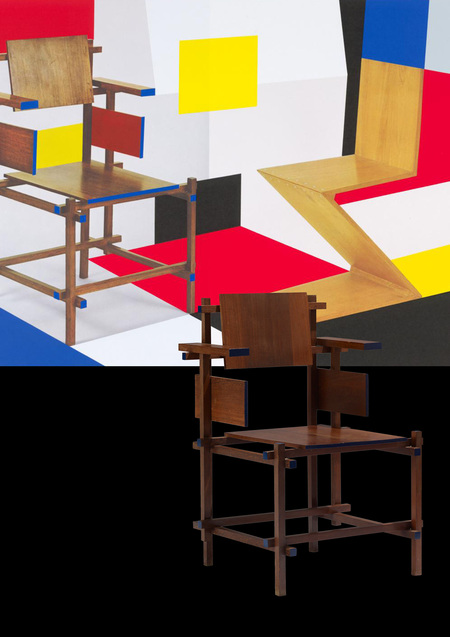
A second perspective views the chair as a marker of a visual code. Here, the chair’s external factors and its relationship to a specific historical era become significant, helping the artist draw attention to their statement. For example, Richard Hamilton, in his work «Putting on de Stijl, ” depicts Gerrit Thomas Rietveld’s chair. Replacing it with any other chair in this piece is impossible because the chair is the central figure of the composition, and the viewer’s attention is focused precisely on the rhythm, color, and its constructive geometric form. The third perspective focuses on the chair as an object of contemporary art. This section gathers examples of chairs that have, to some degree, lost their primary function as comfortable seating; they are viewed more as art objects rather than pieces of furniture.
The Chair as an Independent Object in Contemporary Art
Joseph Kosuth, «One and Three Chairs, ” 1965
Joseph Kosuth, «One and Three Chairs,» 1965
Jörg Immendorff, «Chairs, ” 1980
Yuri Khudonogov, Chairs, 1966
Joseph Beuys, «Chair with Fat,» 1964
Marcel Duchamp, «Bicycle Wheel,» 1913
Nacho Carbonell
Nacho Carbonell
Ivan Chuikov, «Window»
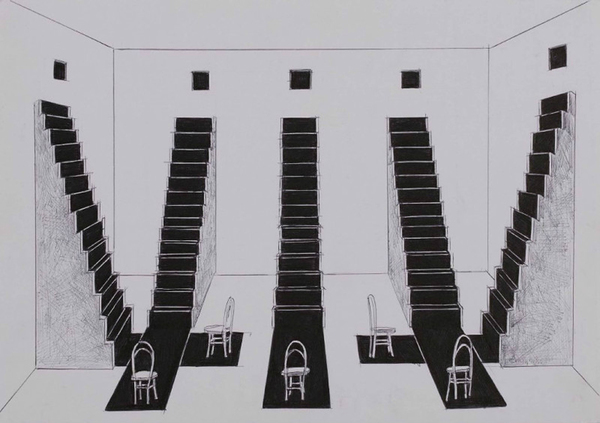
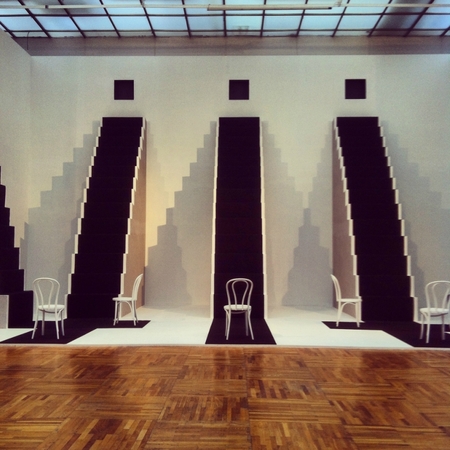
Dmitry Prigov
Anya Zelud, Chairs, 2023
Marc Andre, sculpture made from chairs
Tadashi Kawamata Installation, 2023
The Chair as a Marker of Visual Code
Gerrit Rietveld’s chairs in Richard Hamilton’s work, «Putting on de Stijl,» 1979
Richard Hamilton, «Putting on de Stijl,» 1979
Gerrit Thomas Rietveld Design Chair
The Zigzag Chair by Gerrit Thomas Rietveld
In Andy Warhol’s work, «The Electric Chair,» the chair’s design is as crucial as the object itself, which resides in an empty room, evoking terror and danger.
Andy Warhol, «The Electric Chair,» 1967
Andy Warhol, «The Electric Chair,» 1967
Jong de Gerrit, chair against the wall
In this installation by Pavel Pepperstein, the chair references a historical era and becomes an artifact of it.