Navigation
- Concept (Extended)
- Chapter I. Antiquity and the Middle Ages: Allegory of Fidelity and Hunting Valor
- Chapter II. Renaissance: The Humanization of the Image and the Emergence of Companion Breeds
- Chapter III. The 17th Century: Baroque Triumph and the Genesis of the «Fashion» for Miniature Dogs
- Chapter IV. The Poodle: From Water Retriever to French Artist
- Chapter V. The Dachshund: The «Badger Dog» and the Triumph of Functionality
- Chapter VI. Companion Dogs Before the «Fashion»: Papillons, Shih Tzus, and Maltese Bichons
- Conclusion
- Image Sources
- Bibliography
Concept
At the core of this visual study is the evolution of the canine image in Western European painting, spanning from Antiquity through the end of the seventeenth century. The analysis focuses on how the visual language used by artists to represent this animal transformed—how its utilitarian or allegorical significance gradually yielded to themes of emotional attachment and social status. Even through the seventeenth century, the dog had not yet become a mass «accessory» in the sense it would in the Enlightenment, yet it is during this period that the foundations of future «canine fashion» were laid.
This study examines two key registers of visual language: the symbolic-allegorical and the vernacular (status-related). In the first case, the dog functions as a complex sign inherited from ancient and Christian traditions. In medieval and early Renaissance painting, the dog is primarily a marker of fidelity (fides), loyalty, and piety. It often accompanies saints, married couples, or serves as an allegory for the pursuit of souls. Every element of its depiction—from its collar to its breed—carries specific semantic weight. However, concurrently, a second register develops. During the Renaissance, with the growing interest in human individuality and private life, the dog begins appearing in portraits of the nobility not only as a heraldic symbol but also as a companion. Artists increasingly depict real animals, paying close attention to their habits and anatomy. It was in the 15th–17th centuries in Europe that a «boom» occurred for domestic decorative dogs (ancestors of modern pugs, bichons, and spitzes), which were imported from Asia and became a desired trophy for the aristocracy.
Analyzing the paintings from this period reveals how artists—from Van Eyck to Velázquez and Rembrandt—utilized dogs to construct a multi-layered narrative. We observe how a small dog resting on the lap of a noblewoman or at the feet of a scholar’s husband transcends being a mere decorative detail, becoming a subtle instrument for conveying social status, familial bonds, and even the owner’s temperament.
The visual material demonstrates how by the end of the 17th century, the image of the dog ceases to be exclusively a religious illustration. It transforms into an independent character whose image is valued for its individuality, breed, and emotional connection to humans. The research is based on an interdisciplinary approach, combining a formal analysis of composition (the dog’s role in framing the scene, its scale, and its placement relative to the human figure) with the iconological method, which allows for the decoding of the hidden meanings embedded by patrons and artists in the portrayal of a specific animal.Particular attention is paid to the transformation of breeds—from large hunting dogs symbolizing strength and valor to miniature companion dogs signifying delicacy, luxury, and elite social standing. Thus, this study aims to prove that painting up to and including the 17th century is a crucial source for understanding the history of human-dog relationships, documenting the transition from rigid symbolism to the emergence of a fashion for living accessories.
Paulus Potter, «Cat Playing with Two Dogs» (1625–1654, Enkhuizen–Amsterdam, Philadelphia Museum of Art, USA)
Chapter I. Antiquity and the Middle Ages: Allegory of Fidelity and Hunting Valor
In medieval art, the dog was rarely depicted as merely a domestic pet. Its image was strictly canonized and subservient to religious and feudal symbolism. Most often, the dog served as an allegory for fidelity and devotion. In scenes of the Annunciation or on the gravestones of married couples, the dog at the woman’s feet symbolized marital faithfulness.
Jan van Eyck, «The Arnolfini Portrait» (1434, National Gallery, London)
A small dog (likely an ancestor of modern terriers) stands between the couple, serving as a symbol of fidelity, and its placement in the composition links the figures together.
Meanwhile, hunting played a massive role in feudal culture. Depictions of hunting dogs (hounds, greyhounds) were intended to emphasize the knight’s valor and nobility.
Paolo Uccello, «The Hunt in the Forest» (c. 1460s, Ashmolean Museum, Oxford)
Paolo Uccello, «The Hunt in the Wood» (c. 1460s, Ashmolean Museum, Oxford)
Although the painting was created during the Early Renaissance, it reflects a fading medieval tradition. The dogs here are part of a complex hunting mechanism; their movements and breeds are rendered with heraldic precision. During this period, the dog served a function—it was either a symbol of virtue or a tool of the hunt—but it had not yet been imbued with individuality.
Chapter II. The Renaissance: Humanizing the Image and the Emergence of Companion Breeds
The Renaissance brought changes to the perception of animals. Artists began to study nature more closely, and the aristocracy started to value exoticism and luxury. In the 15th and 16th centuries, dogs from Asia and the Ottoman Empire began to be imported into Europe in large numbers. These animals, which were not intended for work, became symbols of wealth and idleness.
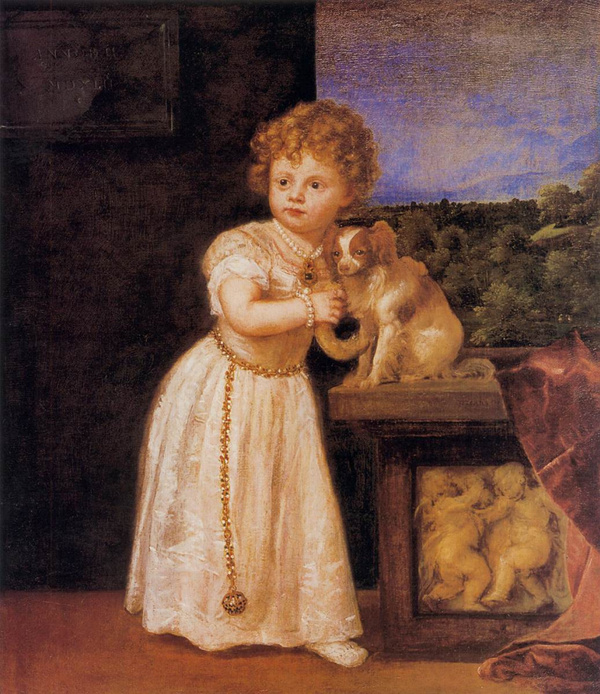
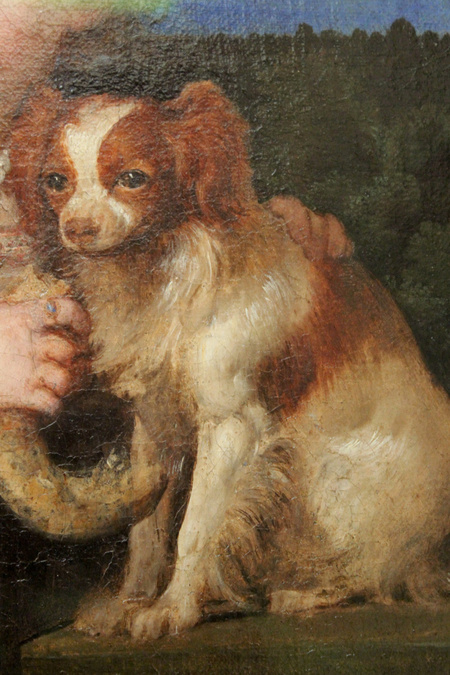
Titian, «Portrait of Clarissa Strozzi» (c. 1542, State Museums of Berlin)
A miniature dog rests in the arms of a girl from a noble family. This image confirms the rise of a «fashion» for dogs as a living accessory. Here, the animal is no longer simply an allegory for loyalty, but a marker of the family’s high status and affluence.
It was during the Renaissance that artists began paying attention to real breeds.
Anthony van Dyck, «Portrait of James Stuart, Duke of Richmond and Lennox» (1634, Metropolitan Museum of Art, New York)
Although it is already the 17th century, it continues the Renaissance tradition. A large greyhound (Dachshund) is depicted with anatomical precision, emphasizing the elegance and hunting grounds of the aristocrat. In contrast, portraits of noble ladies from the same era feature tiny spaniels and Bolognese dogs, which become symbols of delicacy.
Antoon van Dyck, «Portrait of Elizabeth and Philadelphia Wharton» (1640, State Hermitage Museum, Saint Petersburg)
Chapter III. The Seventeenth Century: Baroque Triumph and the Emergence of the «Fashion» for Miniature Dogs
The 17th century marked a turning point. Baroque art, with its love for theatricality and emotion, allowed dogs to take on a more prominent place in compositions. Dutch artists (the Dutch Masters) and great portraitists of that era began depicting dogs with astonishing psychological depth.
During this period, a definitive division occurs between two types of dogs in painting: fighting/hunting and decorative.
Paulus Potter, «Chain Dog» (1650s, Hermitage Museum, St. Petersburg)
Paul Potter — «Watchdog, ” (1653, Hermitage Museum, St. Petersburg)
Animal portraits where dogs function as independent protagonists. The artist captures their breed characteristics, personalities, and even social status (such as guard dogs).