The beach promises freedom from schedules and obligations. Yet, among strangers, private life becomes exposed: one must eat, change clothes, care for children, and arrange space for personal belongings. This openness makes the vacation an especially expressive photographic subject. In the book, random episodes begin to relate to one another: gestures, objects, colors, and ways of occupying space are repeated. A narrative emerges about collective leisure that cannot be contained within any single frame.
Research Question: How does the photobook transform private leisure scenes into public spectacle? To answer this, we compare Martin Parr’s The Last Resort and Massimo Vitali’s Entering a New World: Photographs 2009–2018. The overarching theme allows for a comparison not only of the activities depicted but also of the book’s structure: what happens to the photograph on the cover, how much space a frame occupies, how blank pages and neighboring images function, and what becomes noticeable through the repetition of motifs.The initial hypothesis is that the distinction between the two projects arises from the combined work of photographic capture and book design. Parr’s intimate subject matter gains added autonomy on a separate right-hand page. Vitali’s panoramas can become fields for extended contemplation due to their large format and spread layout. This hypothesis is tested against similar solutions: Vitali also features a solitary image opposite a blank page, and Parr photographs not just close-up vignettes but also crowds.
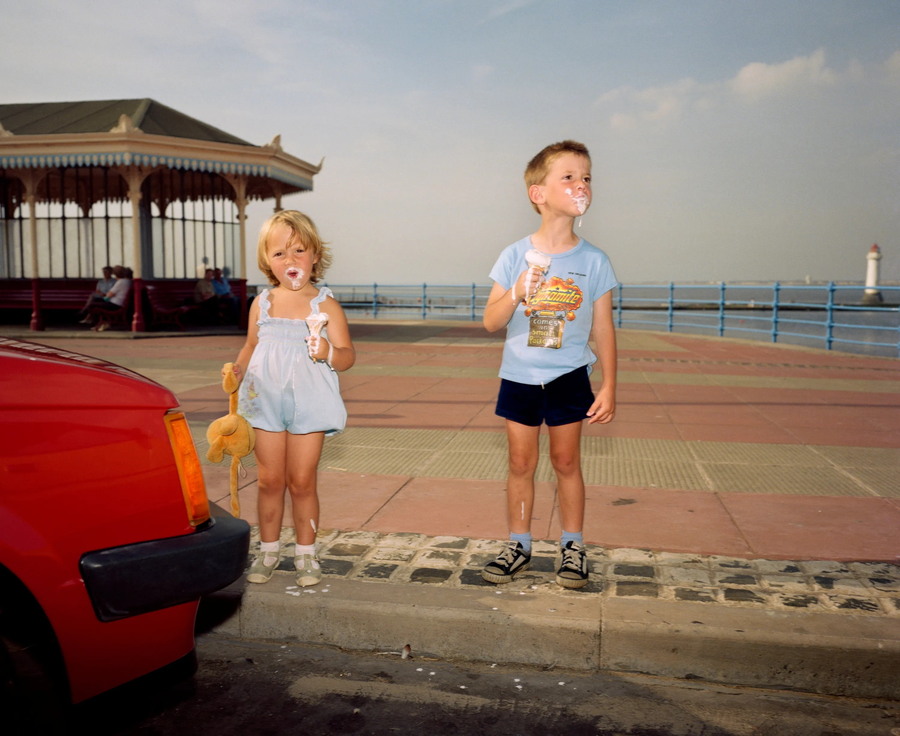
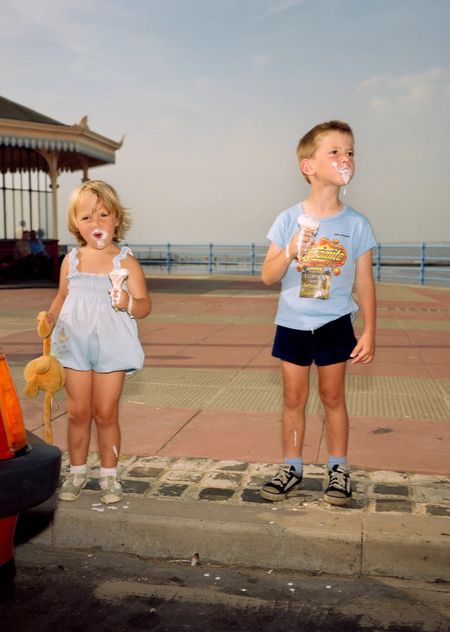
Martin Parr. Kids with Ice Cream. New Brighton, The Last Resort series, 1983–1985. © Martin Parr / Magnum Photos. Reproduction: The Photographers’ Gallery.
The main book volumes are The Last Resort, published by Dewi Lewis in 2008, and Entering a New World, published by Steidl in 2019. The history of The Last Resort begins with the 1986 edition from Promenade Press. Its design is examined through a 2026 facsimile by Dewi Lewis: the use of the same frame across the 1986 and 2008 versions allows the design effect to be separated from the photograph’s content. Consequently, two photographic projects and three book versions are compared, rather than two national modes of leisure.
The selection of these projects relates to the broader issue of public leisure and the difference in the scope of observation. Parr worked with a single resort, New Brighton, between 1983 and 1985; Vitali’s book compiles footage from various locations between 2009 and 2018. The difference in geography and time is accounted for as a condition of comparison. Based on these books, one cannot attribute the peculiarities of the frame to the character of English or Italian people. Rather, one can trace how a photographic episode gains meaning within a larger whole.
Categorization
1 — Two books on leisure: selecting editions, covers, and historical context.2 — From individual to crowd: camera distance, gestures, groups, and personal space.3 — From frame to spread: scale, margins, fold, single and double images.4 — How a narrative is built: repetition of objects, situations, and spaces.5 — Conclusion
1. Two Books on Relaxation
Martin Parr. The Last Resort. Book cover with text by Gerry Badger, Dewi Lewis, 2008. Reproduction: ROCKET Gallery. © Martin Parr / Magnum Photos.
Massimo Vitali. Entering a New World: Photographs 2009–2018. Steidl, 2019. Cover. Reproduction: Exibart Street / Steidl. © Massimo Vitali.
The Last Resort was first published in 1986; the 2008 edition by Dewi Lewis is used for the main comparison. According to the Parr Foundation, it is 84 pages long and contains 40 color photographs, with dimensions of 30,2 × 24.7 cm. Entering a New World was published by Steidl in 2019 and has dimensions of 36 × 29 cm. The publisher’s catalog indicates 216 pages and 120 images. These are books of different scales: a compact work focused on a single resort is compared to a larger collection of images from a decade. For comparison, scenes of leisure by the water were primarily selected. Vitali’s theme encompasses a broader range of public spaces, including shopping areas; these examples are discussed separately and are not referred to as leisure scenes.
Martin Parr. The Last Resort: Photographs of New Brighton. Designed by Peter Brawne, 1986; facsimile by Dewi Lewis, 2026. Cover. Reproduction: Martin Parr Foundation.
Massimo Vitali. Entering a New World: Photographs 2009–2018. Steidl, 2019. Book as Object. Reproduction: Steidl. © Massimo Vitali.
In the 1986 edition, The Last Resort greets the reader with large orange lettering and colorful geometric shapes. The title functions almost like a resort sign; the photograph on the cover does not feature a single protagonist. For Vitali, the image of the pool and swimmers immediately dominates the exterior of the book, with the title overlaid on top. Even before turning the page, the reader is enveloped by a vast space. These covers offer different ways to enter the material—either through the graphic sign of a place or through a field rich with events.
Martin Parr. The Last Resort: Photographs of New Brighton. Photography by Peter Brawne, 1986; facsimile by Dewi Lewis, 2026. Spread. Reproduction: Martin Parr Foundation.
Martin Parr. The Last Resort. Dewi Lewis, 2008. Book spread. Reproduction: Martin Parr Foundation. © Martin Parr / Magnum Photos.
Both spreads feature a man lying next to a child, as well as people on concrete steps. The content of the photograph remains unchanged. In the 1986 design version, the colored elements extend beyond the image boundaries—the blank page becomes part of the interactive graphic environment. In the 2008 edition, white margins remain around the same scene. This framing suggests focusing attention within the frame. This example illustrates why the impression of a photobook cannot be entirely attributed to the photographic technique.
Martin Parr. The Last Resort. Dewi Lewis, 2008. Book spread. Reproduction: Martin Parr Foundation. © Martin Parr / Magnum Photos.
Massimo Vitali. Entering a New World: Photographs 2009–2018. Steidl, 2019. Book spread. Reproduction: Steidl. © Massimo Vitali.
Both books connect everyday human life with spaces of leisure. In Parr’s work, an ice cream stand fills a small scene with faces, hands, colorful clothing, and objects. In Vitale’s, bathers are situated within an extended natural landscape. Moreover, both presented frames are placed on the right-hand page opposite a white space. This similar book design allows the viewer to perceive the difference in the images themselves. For the research, these kinds of comparable conditions are what matter—not a predetermined dichotomy between «ironic Parr» and «serene Vitale.»
2. From the Individual to the Crowd
Massimo Vitali. Animaletti 1, 2004. © Massimo Vitali. Reproduction: Edwynn Houk Gallery.
Massimo Vitali. Photograph from the collection for the exhibition Entering a New World: Photographs 2009–2018 (Steidl, 2019). Publication: Exibart Street. © Massimo Vitali.
In the image of the kids with ice cream (the first photo in this longread), you can see sticky hands, messy faces, and varied expressions. The red car is almost touching the girl’s figure—the viewer seems to be standing next to her on the sidewalk. In Animaletti 1, similar small details are scattered across the entire water surface. The inflatable animals, the turns of the heads, and the distances between the swimmers require searching. In Parra, a specific moment immediately captures attention, while in Vitali, it gradually emerges from the general field.
The repetitive poses of the swimmers in Vitali transform individual movements into a pattern across the surface. A close-up allows one to read facial expressions; a wide view reveals the repetition of action among different people.
Martin Parr. Crying Child. New Brighton, series The Last Resort, 1983–1985. © Martin Parr / Magnum Photos. Reproduction: ROCKET Gallery.
Massimo Vitali. Cefalù Mother and Child, 2008. © Massimo Vitali. Reproduction: Edwynn Houk Gallery.
In the frame featuring the stroller, several actions collide in one small area: the child is crying, the woman is lying with her eyes closed, and things are scattered nearby. The gaze doesn’t have time to transform this scene into a tranquil family picture. In Cefalù Mother and Child, the water separates the figures, leaving open space around them. Caring for the child turns out to be part of multiple simultaneous activities. The difference arises primarily from how much space is given to one episode.
Martin Parr. Open Pool. New Brighton, The Last Resort series, 1983–1985. © Martin Parr / Magnum Photos. Reproduction: ROCKET Gallery.
Massimo Vitali. Porto Miggiano Blue Raft, 2011. © Massimo Vitali. Reproduction: Edwynn Houk Gallery.
Massimo Vitali. Photograph from the collection for the exhibition Entering a New World: Photographs 2009–2018 (Steidl, 2019). Publication: Exibart Street. © Massimo Vitali.
The shot of the open swimming pool prevents the Parra method from resolving into a wide shot. Here, there is also a crowd, viewed from above. However, the bodies in the foreground and the diagonals of the loungers sharply reduce the distance to the viewer. In Porto Miggiano Blue Raft, the cluster of people extends along the cliff, and the water occupies a significant portion of the frame. The density of relaxation is palpable in both cases, but in Parra, it presses in closely, while in Vitali, it takes on an extended form.Another densely filled shore in Vitali demonstrates that a multitude of figures on its own does not define the character of the image. What matters is whether a close body remains in front of the viewer, how the foreground is structured, and where the boundary of the overall mass lies.