INTRODUCTION
It seems to me that ancient Egyptian art belongs to one of those few artistic phenomena we learn to recognize long before we begin to truly understand them. One can have no grasp of Egyptian history, be confused by the dynasties, or not know the pharaohs' names, yet still correctly identify an Egyptian depiction by a few key characteristics: figures with profile heads and broad shoulders, colossal statues, columns, hieroglyphs, and figures arranged in horizontal registers. These elements are so firmly ingrained in our conception of Ancient Egypt that they are perceived almost as a ready-made visual archetype of the country.
Perhaps that is why, upon my first viewing of the cartoon «Prince of Egypt» (1998), I had no particular questions about how it depicted the world of Egypt. The enormous palaces, endless colonnades, massive sculptures, and painted walls perfectly matched the Egypt I was accustomed to seeing in film and illustrations.
But when I began viewing the film specifically from the perspective of art history, an interesting thing became clear. Almost all of these images seem historically familiar, yet they do not always correspond to actual monuments. Sometimes the scale changes, sometimes one type of architecture appears in a completely different setting, and sometimes the artists take a very recognizable historical composition and place different characters within it.
Moses' dream particularly intrigued me. In this episode, the surrounding world literally transforms into ancient Egyptian mural painting. The characters begin to exist according to the laws of flat imagery, find themselves inside registers, and then these registers gradually transform into navigable space.
This led me to wonder: what exactly happens to ancient Egyptian art when it is translated into animation? Do artists merely replicate the recognizable style, or do they alter the fundamental principle by which the image exists?
I wanted to test this with specific examples, rather than being limited to general impressions of the film.
In this study, I examine three approaches to reinterpreting ancient Egyptian art: altering scale and spatial organization, transplanting historical imagery into a new context, and transforming static composition into animated narrative.
The primary focus is on the art of the 18th and 19th Dynasties of the New Kingdom. This selection is tied to the historical setting of the animation itself—its action unfolds during the reigns of Seti I and Ramesses II—though certain artistic motifs are borrowed from earlier periods.
For comparison, I am using architectural monuments, sculpture, murals, and reliefs, museum catalogs, Egyptological publications, and materials about the film’s creation. I also separately analyzed a video clip of Moses’s dream: the sequential frames help reveal movement nuances that cannot be captured in a single illustration.
I want to establish one boundary immediately. The resemblance between a screen image and a historical monument does not yet prove that the artists were copying it specifically. Sometimes we can speak of a quite accurate visual citation, and other times—only of the use of general principles of ancient Egyptian art. I believe it is important for the research not to mix these cases, even if there is a strong desire to find as many coincidences as possible.
The first thing I noticed upon a second viewing was how small the people look next to the Egyptian architecture. Sometimes it seems as if the palaces and temples exist in an entirely different system of scale. The columns rise beyond the frame, the walls stretch across vast distances, and a person is left only to navigate within these spaces.
Initially, I assumed the artists had simply exaggerated the size of the structures for dramatic effect. However, it turned out that real Egyptian monuments could also be incredibly monumental.
For example, the Great Hypostyle Hall of the Karnak Temple consists of 134 columns, twelve of which reach approximately twenty meters in height. Its construction dates back to the reigns of Seti I and Ramses II. [5]
Colonnade: Rhythm and Scale
«Prince of Egypt»: A space with a series of high columns
The Great Hypostyle Hall of Karnak, 19th Dynasty
It is quite difficult to visualize a twenty-meter column until you see a person next to it. This is precisely why human figures are so vital in the architectural shots of the cartoon. Without them, we would simply see large structures, but with them, we can perceive the difference in scale.
However, Karnak is interesting not just because of the size of individual columns. They are arranged in a specific order, forming numerous parallel rows. The space feels almost infinite because of the constantly repeating supports.
A similar principle can be seen in the depiction of the palace and temple interiors in «The Prince of Egypt.» The columns are lined up one after another, gradually diminishing in perspective, and guiding the viewer’s gaze into the distance.
But here, the film offers an additional opportunity—the movement of the camera.
When characters move through a vast space, we observe one column giving way to the next. Scale ceases to be merely a ratio of object sizes; instead, we begin to perceive it through the movement itself, through the distance that must be covered.
This creates a rather interesting scenario: the ancient Egyptian architectural principle endures, yet it is perceived differently. In a real temple, a person navigates between the columns themselves, while in a film, the camera organizes that movement for them.
With that said, I wouldn’t claim that the on-screen interiors directly replicate Karnak. Columns featuring vegetative capitals appear in various Egyptian monuments, so the presence of such elements is not enough to pinpoint a single prototype.
Karnak here helps us understand the principles underpinning such architecture: repetition, rhythm, axial organization, and the vast difference between human scale and the monumentality of the structures.
There is one other factor I found significant.
In ancient Egypt, palaces were largely constructed from mud brick. Stone monumental complexes were primarily associated with religious architecture. However, in the cartoon, these two environments noticeably merge—the palace adopts many features of a temple. [4]
From a historical reconstruction standpoint, this isn’t entirely accurate. However, if we view the film as an artistic work, this choice becomes more understandable. The monumentality of the temple helps convey the royal residence as a place where power is felt literally in the scale of the walls. Furthermore, artists did indeed place particular emphasis on scale. In a Los Angeles Times article, Brenda Chapman mentioned that after traveling to Egypt, the team reconsidered their initial perception of the dimensions of the ancient structures. It turned out they had depicted them as insufficiently grand. [2]
Therefore, I wouldn’t call the architectural scales in the film solely the fantasy of the animators. Rather, they derive from the real monumental quality of ancient Egypt and amplify it, so that the viewer feels the same effect even through the screen.
1.2. Architecture That Shows the Way
Regarding the colonnades, the impression is relatively clear: their core effect is linked to repetition and spatial depth. However, the film employs another architectural device—vast ceremonial entrances organized around a central passage. For comparison, I chose the Luxor Temple, specifically the monumental entrance created during the reign of Ramesses II. A pylon stands before the temple—two massive, tower-like sections separated by a passage. Under Ramesses II, colossal royal statues and obelisks were also added here. [6]
Pylon and Entrance Organization
«Prince of Egypt»: Architectural Horizon, Pylon-like Forms
Luxor Temple: Pylon and Statues of Ramesses II, 19th Dynasty
At first glance, the structure appears quite simple. Two enormous walls, with an entrance between them—nothing particularly complex. But it is precisely this simplicity that makes the composition so convincing.
The pylon immediately establishes the direction of movement. Even if a person is unfamiliar with Egyptian architecture, they understand where the main entrance is located. The large, symmetrical volumes literally guide the gaze toward the central passage.
In the «Prince of Egypt, ” certain temple and palace spaces are arranged in a similar manner. Massive architectural elements frame the small figures of the characters, and the passage between them becomes a natural continuation of movement.
It struck me as interesting that the architecture in these frames serves two purposes simultaneously. On one hand, it creates a sense of grandeur. On the other, it helps the directors manage the viewer’s attention.
We look where the composition itself directs us.
And again, it is important not to mistake similarity for direct copying. I did not find grounds to claim that all the monumental entrances in the cartoon replicate the Luxor Temple specifically. Pylons were a characteristic type of structure in ancient Egyptian temple architecture.
But this example clearly shows how a historical architectural technique is translated into cinema. An entrance that organizes human movement in real space begins to organize both the character’s movement and the viewer’s gaze in the film.
1.3. Massive Statues and Tiny People
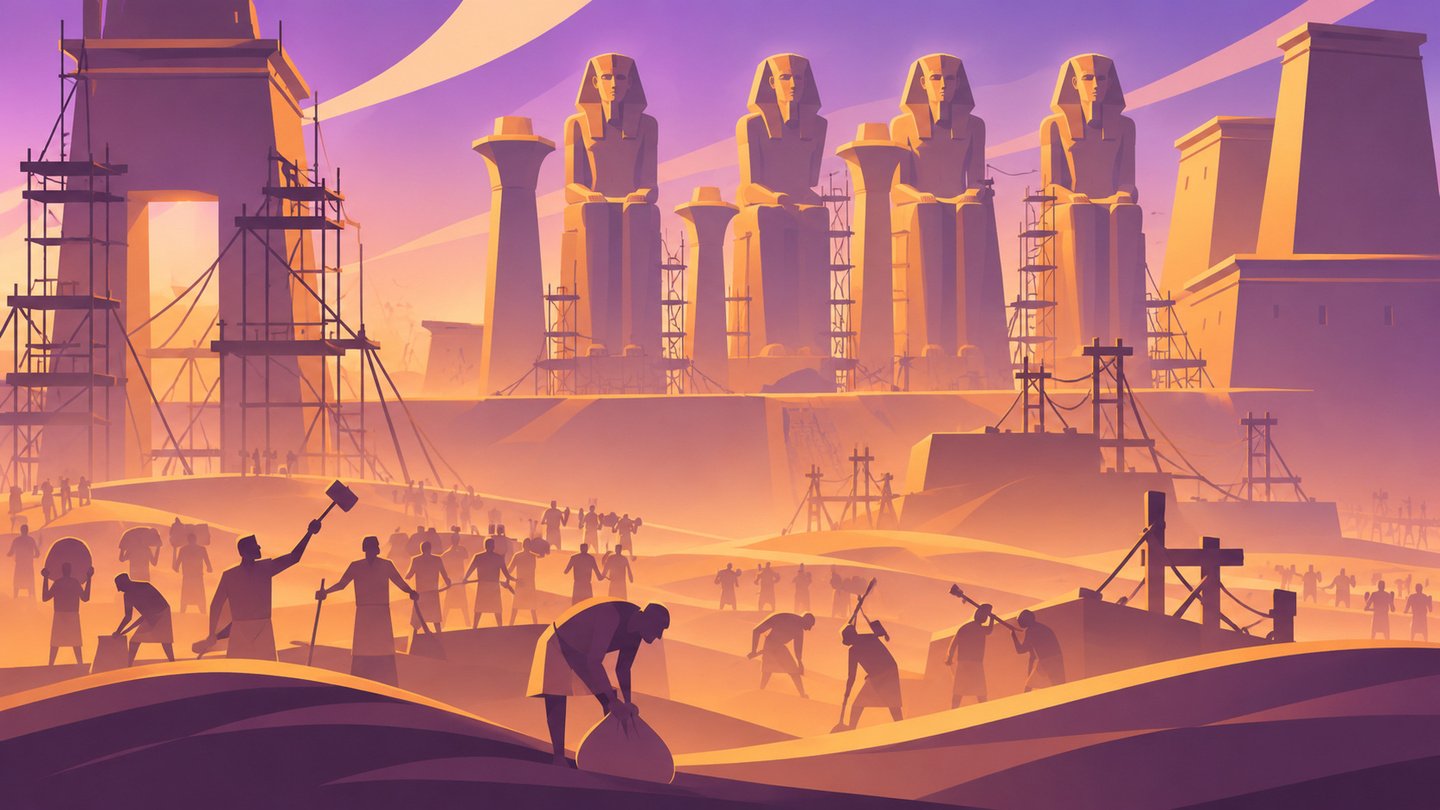
If the architecture in the film seems incredibly large, the royal sculpture at times appears even more imposing.
This made me wonder why colossal statues are such a convenient medium for representing power.
In Ancient Egypt, the size of royal sculpture was not necessarily proportional to the actual human body. The enormous statues of pharaohs were tied to the concept of the ruler and his elevated status.
One such monument is the granite colossus of Ramses II, originating from Memphis. It is currently housed in the Grand Egyptian Museum. The sculpture stands 11.35 meters high; originally, it was situated near the Temple of Ptah. [7]
Colossus of Ramesses II