concept
Blue has always held a unique perception among people because in their minds, it has been inextricably linked to the most mysterious and enigmatic natural phenomena: water and the sky. The rarity of natural pigments capable of rendering this color elevated this association to an absolute, making blue a symbol of something sublime and infinite. My goal is to explore how, throughout human history, this color has served as a medium to express the concept of a divine origin—something eternal and spiritual. This visual investigation is an attempt to analyze the nature of blue as a connection between the material world and humanity’s spiritual yearning to touch something godlike.
Before establishing a specific symbolic meaning for blue, one must look at the history of its presence in human life. In nature, the blue color is relatively rare in the form of stable mineral pigments. It is precisely this characteristic that has largely defined its exceptional status in the palette of other colors. One of the most ancient and valuable natural sources of blue color was lapis lazuli—a semi-precious stone of deep blue hue with characteristic golden pyrite flecks.
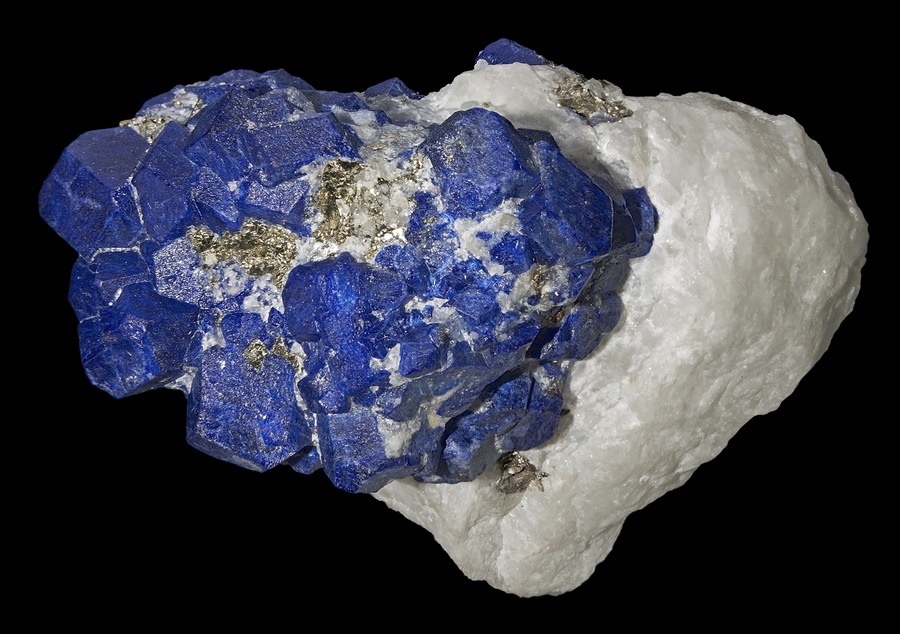
Badakhshan Lapis Lazuli (Afghanistan)
As early as the seventh millennium BCE, lapis lazuli was used to create jewelry and decorative objects. Jewelry made from this stone became a symbol of wealth, power, and high social standing.
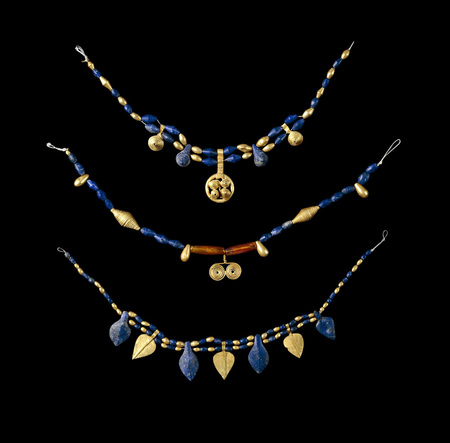
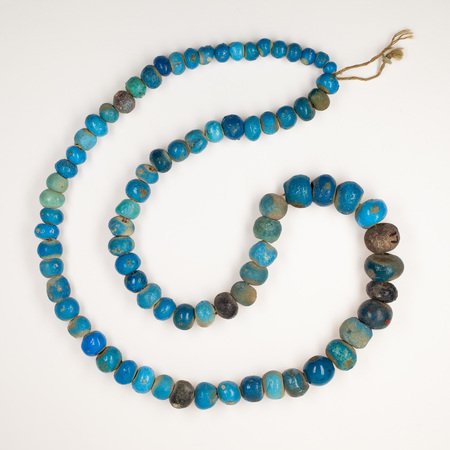
1. Lapis Lazuli and Gold Jewelry 2. Faience Beads
The invention of synthetic pigment played a special role in the history of blue. Around 3300–3200 BCE, the so-called Egyptian Blue emerged in Ancient Egypt—one of the first known artificially created inorganic pigments in human history. It was produced by heating a mixture of quartz sand, calcite (lime), a copper mineral (such as malachite or copper shavings), and alkali/fluxes at a temperature of about 800–900 °C. As a result of this complex chemical process, a material was formed that, after grinding, turned into a vibrant blue powder. It is worth noting that in the ancient Egyptian language, this powder was called iryt hsbd (or irit khesbed), which literally translates to «artificial lapis lazuli.»
The Pharaoh Seti’s Burial Chamber |
The invention of this pigment marked a true turning point in art history. Blue ceased to be exclusively the color of rare precious materials and gained the ability to be widely used in painting, ceramics, sculpture, and architecture. The creation of artificial blue allowed creators to depict the expanse of the sky on a two-dimensional plane. Thus, over time, a connection formed in many cultures between the color blue and the concept of divine presence.
Ancient Egypt: blue like the color of the heavens and primordial waters
In Ancient Egypt, the color blue first acquired a profoundly religious and even cosmic significance. Egyptians perceived the world around them through a complex system of mythological concepts. In this system, natural phenomena were closely tied to the actions of the gods. The color blue was primarily associated with the heavens and the primeval waters—from which, according to Egyptian creation myths, life emerged. Water here represented not merely a natural element but the foundational substance of all existence. Consequently, blue took on the meaning of rebirth, vital energy, and eternal renewal. It is also worth noting that in Egyptian culture, the color blue was frequently used to depict the gods themselves. For instance, the god Amun-Ra, the sun god and «lord of all gods, ” was shown with blue skin in several images from the New Kingdom period.
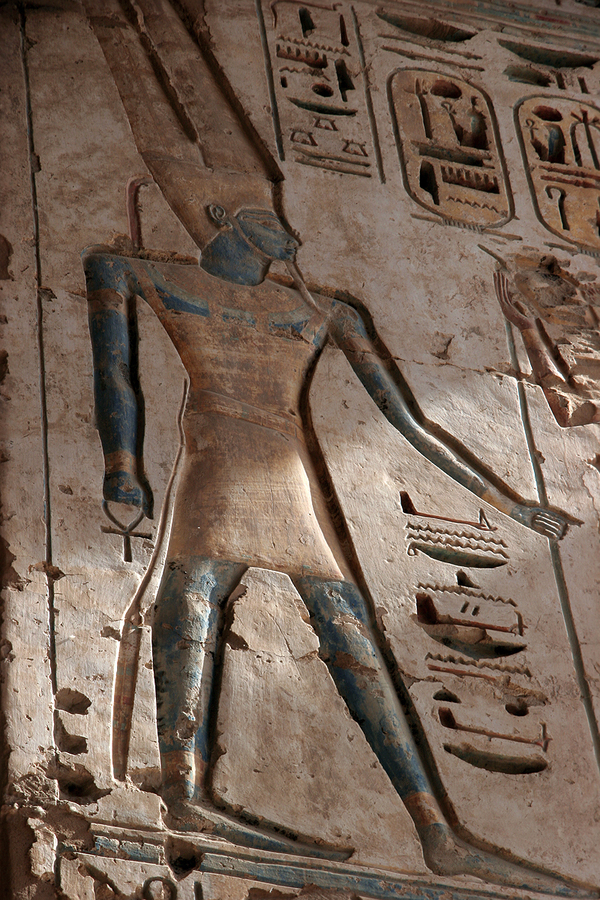
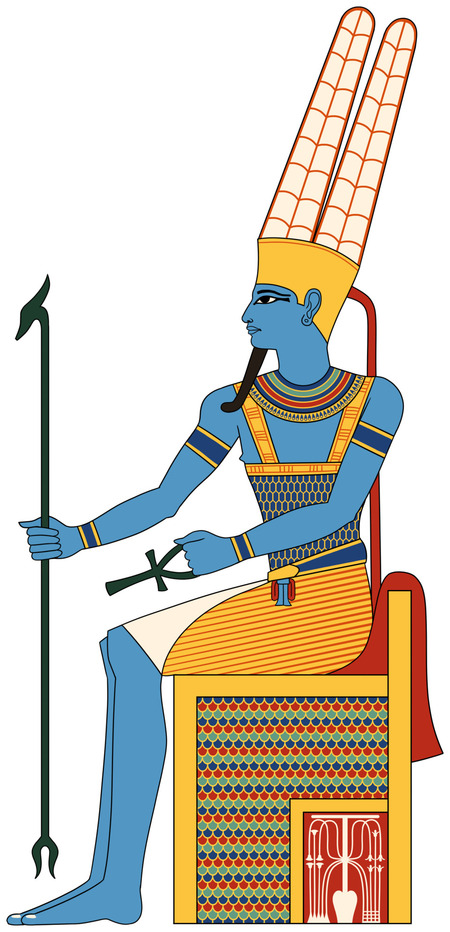
1. Relief from the mortuary temple of Ramses III 2. Depiction of the god Amun-Ra
The blue tone of his skin emphasized his belonging to a world unattainable by humans. In this context, color served as a peculiar visual signifier of divinity. The use of blue in funerary art deserves special attention. The ancient Egyptians believed in life continuing after death and, therefore, strove to ensure the deceased could exist in the afterlife. The colors applied by artists to sarcophagi, funerary masks, tomb walls, and ritual objects held not only decorative but also symbolic meaning. It is therefore unsurprising that blue was frequently employed for these items. According to the worldview of the ancient Egyptians, its presence connected the deceased with the divine order and the possibility of rebirth. One of the most famous examples of Egyptian art is the painting «Garden in the Tomb of Nebamun, ” created around the 14th century BCE. In this fresco, blue also functions as a symbol of prosperity, natural abundance, and eternal existence.
Nebamun Garden. Fresco from the tomb of Nebamun, circa 1350 BCE.
No less significant was the use of blue in Egyptian ceramics and faience. Egyptian faience was a distinct material with a characteristic glossy glazed surface, often colored in hues ranging from blues to turquoise. It was used to craft amulets, divine figurines, small vessels, ornaments, and funerary objects. Thus, in Ancient Egypt, blue became much more than a decorative color. It was in those times that the concept of blue as a color—a color possessing inherent religious significance—became particularly pronounced.
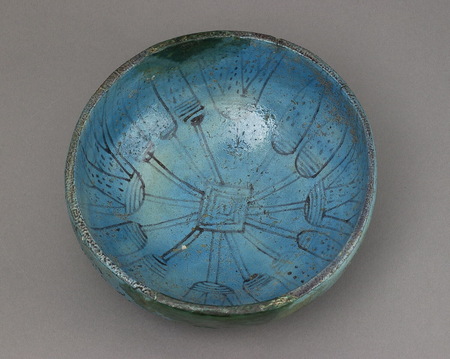
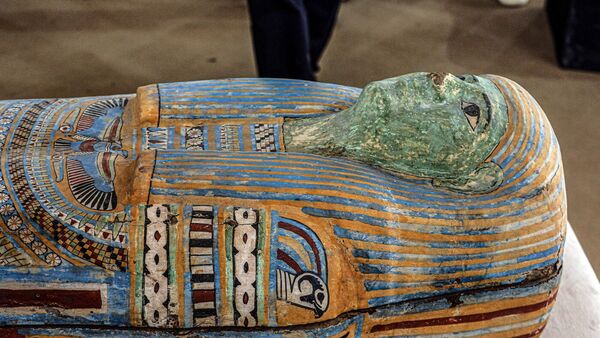
1. Bowl of Egyptian faience, Early XVIII Dynasty (c. 1539–1425 BCE) 2. Painted ancient Egyptian sarcophagus
Ancient Mesopotamia and Babylon: Blue as the Embodiment of Divine Power
The next crucial stage in the history of blue color is Ancient Mesopotamia, particularly Babylonian civilization. Here, blue also takes on a sacred significance. While in Egypt it was primarily associated with primeval waters, the sky, and eternal rebirth, in Babylon, blue also became a symbol of the majesty of the gods, royal power, and sacred space. Lapis lazuli held a special place in Mesopotamian culture. This stone was considered a precious material worthy of the gods and rulers. In Mesopotamia, gemstones, glass, glaze, and pottery were viewed as artistic means capable of embodying the special properties of the divine world. This idea manifested most vividly in the architecture of the Neo-Babylonian kingdom, which reached its zenith under King Nebuchadnezzar II in the 6th century BCE.
Ishtar Gate and the Processional Way in Babylon, 6th Century BCE.
The most prominent monument demonstrating the Babylonians' relationship with the color blue is the famous Ishtar Gate, constructed around 575 BCE. It was part of the defensive and ceremonial system of the city of Babylon and served as the entrance to the Processional Way, along which solemn religious processions marched. Ishtar was one of the principal goddesses of Ancient Mesopotamia, worshipped by the Babylonians, Assyrians, and other peoples of the region. She embodied love, fertility, beauty, and warfare simultaneously. Through the deep blue color of the tiles and the depictions of sacred and mythological animals lining the gate, the architectural space transformed into a kind of transition from the mundane world to the sacred.
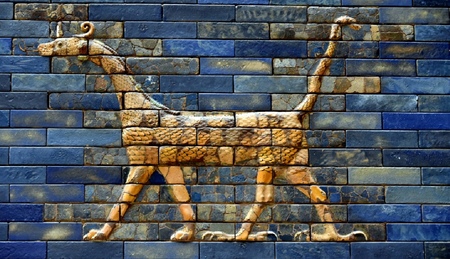
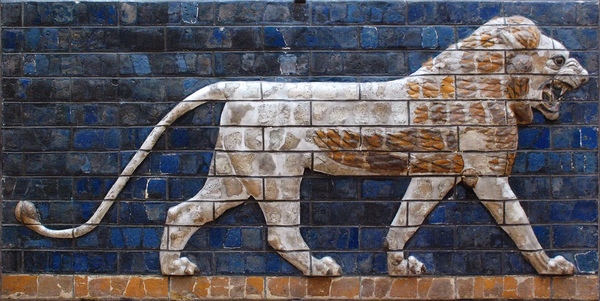
1. Dragon guarding the goddess Ishtar in Babylon 2. Lion from the Processional Way in Babylon
It is important to pay attention to the manufacturing technology of the gates themselves. The blue bricks were covered with a special glaze that acquired a rich color and characteristic sheen after firing. Because of this, the surface of the architecture was not merely painted; it seemed to become precious. Babylonian artisans effectively transformed clay—one of the simplest natural materials—into something resembling a gemstone. We must not forget that the blue color of the gates is inextricably linked to the demonstration of status and power. The Ishtar Gate was not only a religious object but also a means to demonstrate the might of the Babylonian ruler. Nebuchadnezzar II strove to display the greatness of his state through the scale, richness, and technical perfection of the architecture. Therefore, blue simultaneously became the color of divine and royal majesty.
Ishtar Gate at the Pergamon Museum in Berlin
In Babylon, blue acquired the meaning of a monumental, sacred color. The Ishtar Gate can be seen as one of the most striking examples of how color transcends being solely an element of a pictorial image and transforms into an independent association with sacred space.
Ancient Greece and Rome: Shifting Perceptions of the Color Blue
As ancient culture spread, the perception of the color blue began to shift. In Ancient Greece and Rome, it continued to be used in painting, architecture, ceramics, and decorative arts; however, it no longer held the central position in religious symbolism that it did in Egypt and Babylon. This does not mean that ancient societies did not ascribe significance to it or appreciate its beauty. Blue was used to paint details on temples and sacred sculptures. It was simply that in Ancient Greece, the attitude toward color was largely determined by the characteristics of the ancient worldview. Color served as an important means of artistic expression, but its meaning was not tied to specific religious symbolism. Furthermore, the ancient Greek system for denoting shades differed from the modern one. For instance, Homer did not use a dedicated word for the color blue in his epics. When the poet described the sea, he resorted to epithets such as «wine-dark» or «violet-colored.» This suggests that, in the understanding of the ancient Greeks, blue was a secondary color.
Artistic Reconstruction of the Temple of Minerva
A similar trend can also be traced in the art of Ancient Rome. The Romans inherited many artistic and technological achievements from Greek culture, and they also adopted traditions of using Egyptian pigments. Blue became widely used in mural painting, mosaics, glassmaking, and interior decorative design. The Romans actively utilized the Egyptian blue that is already known to us. The use of blue is particularly well-documented in the frescoes of Pompeii.
The Blue Room in Pompeii
Christianity and the Formation of New Blue Symbolism