Concept
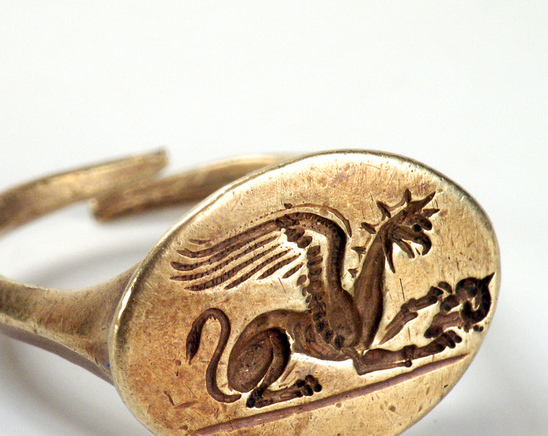
A griffin attacks an armed person on the vase, its image appears near the hand on a ring, near the face on a headpiece, and near the city name on a coin. One recognizable image appears on objects of different functions. This variety determines the choice of research topic. The griffin is examined through the composition and intended use of the object.
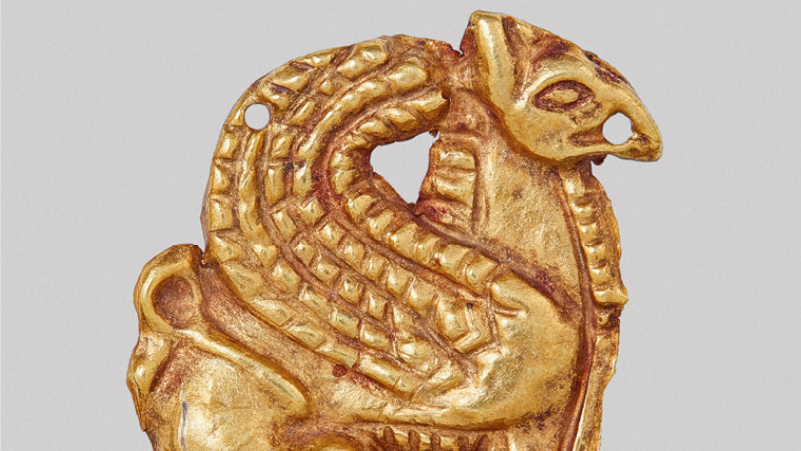
Unknown master. Gryphon plaque. 4th century BCE.
Research Question: How does the role of the griffin change depending on the function of the object it is depicted on and its placement within the composition?
The role of the griffin in this research is understood through its participation in the depicted action, its connection to adjacent figures, or the function of the object. The griffin might contrast with the central figure, participate in the movement of a harness, or serve as a connecting element within the symbolism on a coin.
Hypothesis: The function of the object and its composition are key factors determining the role of the griffin.
To test this hypothesis, images on objects of different functions are compared, as are distinct compositional solutions on items of the same category. Special attention is paid to instances where objects of the same function feature different depicted subjects. Such comparisons allow us to establish the extent to which the griffin’s role is tied to the object’s use, and what significance the arrangement of figures, rhythm, and symmetry holds.
The collection is primarily composed of artifacts from the 5th–4th centuries BCE associated with the Bosporus region, Prikubanye, and the Don. These items include headwear, weaponry, equestrian equipment, jewelry, and coins. Attic painted vases are used for comparison, two of which are sourced from foreign museum collections. The list has also been augmented with a bronze Griffin head from the 7th century BCE, an item that falls outside the research timeframe, to specifically highlight the creature’s characteristic features. In total, the catalog features eighteen objects, along with an image of a sphinx included to define the distinctive features that establish the uniqueness of the Griffin’s depiction.
The visual investigation is divided into four parts—based on the ways in which the griffin integrates into the object or drawing. Each of these is presented differently: it might be a collision, synchronized movement, a static depiction, or the transformation of an image into a recognizable sign. The images primarily examine details: where the mythological creature’s paws are directed, where the tabs for stitching are located, the underlying structure of the coin’s frame, and how the creatures are arranged around the central character, framing it. This allows for a comparison between the object’s overall appearance and its minute elements, which helps in understanding how the design conforms to the intended function of the item.
Material selection is based on three criteria: the availability of high-quality images, the reliability and verifiability of the object’s data, and the ability to compare it with other items. The dating and provenance of finds are determined using museum accession cards, archaeological reports, and collection catalogs. The works of N. A. Pavlova and A. E. Petrakova help clarify the origin and function of individual objects. The research by A. E. Tereshchenko and V. B. Zhizhin-Gefter allows for a comparison between the coins and the embroidered plaque. The studies by D. Braun and M. V. Skrzhinskaya help most accurately reveal the cultural and religious significance of the griffin motif.
When studying the findings, the degree of their preservation and the accuracy of information regarding their use in antiquity are taken into account. All assumptions about the religious significance of the drawings are primarily cross-referenced with historical sources.
Griffin as a Dangerous Collision
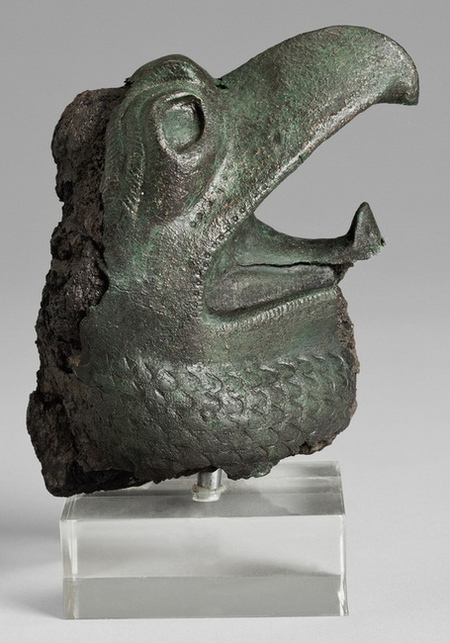
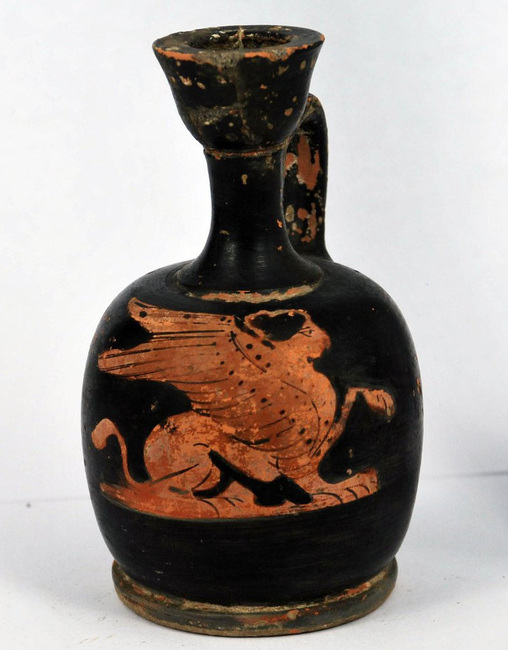
Left: Unknown master. Griffin head. 7th century BCE. Right: Unknown vase painter. Lekythos depicting a sphinx. Last third of the 5th century BCE — beginning of the 4th century BCE.
Wings are not making the creature a griffin
The bronze griffin head combines traits of a bird and a predatory beast. The expressive beak underscores the creature’s fantastic nature. The sphinx, in turn, has a human head on its body. The wings bring the creatures closer, but they do not erase the differences. This is important for further analysis: if we label any winged predator a griffin, the uniqueness of its image will be built upon false assumptions.
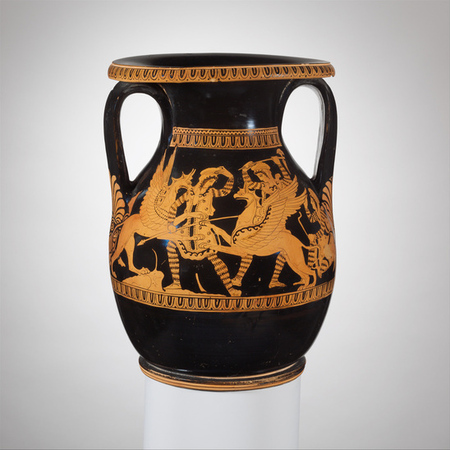
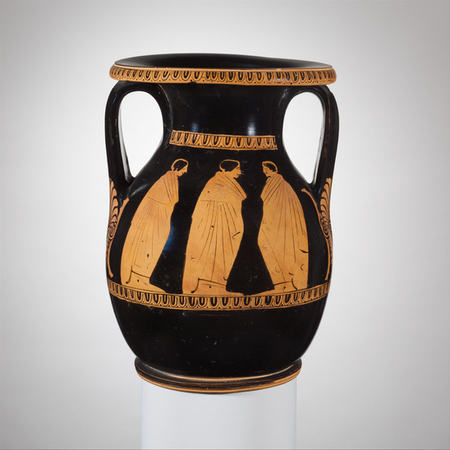
Master of Munich 2365 (attribution). Pelican with a scene of the battle between arimaps and griffins. Circa 375–350 BCE.
One Vessel Holds Two Orders
On the front of the vessel, the movements of people and animals are presented in contrast. Raised limbs and weapons indicate the dynamism of the scene. On the reverse, three figures stand much more calmly. The vertical cloaks enhance the static nature of the image. The comparison occurs within a single object: the rotation of the vessel transitions the viewer from a dangerous and chaotic space to an ordered and secure one. This is how visual contrast is expressed within a single item. It is created by the direction of movement, the posture of the figures, and the interaction between the forms.
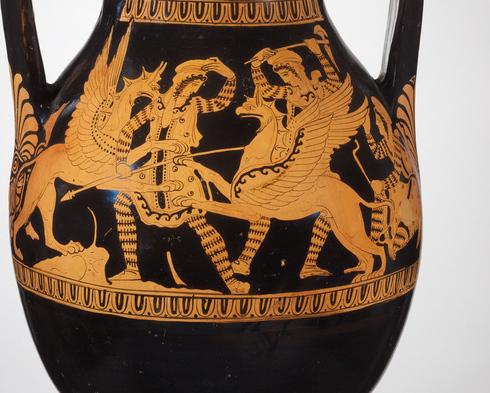
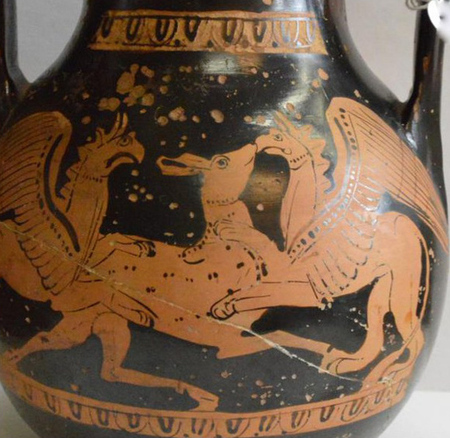
Left: Munich Master 2365 (attribution). Pelican with a scene of battle between arymasps and griffins. Circa 375–350 BCE. Right: Unknown vase painter. Pelican depicting griffins tearing apart a doe. Mid-4th century BCE.
One Situation—Different Roles
In the first short film, griffins attack a human. The battle scene maintains a dynamic of opposition: the warrior holds a weapon, turns toward the beast, and defends their personal space. In the second short film, two griffins surround a deer, and its body becomes a motionless center toward which the entire attack is directed. This similar pressure yields different results: in the first case, it is an open conflict with the possibility of resistance; in the second, it is a hopeless torment. The image of the griffin changes its function: on the left, it acts as an opponent to the human, an equal rival, while on the right, it transforms into an inevitable, overwhelming force.
Unknown artisan. Gold sword scabbard fitting. Second half of the 4th century BCE.
Griffin on Weaponry
On a golden ornament from the Pyat Bratsev kurgan, a griffin tears apart a doe. Its paws hold the animal, and its head is bowed toward the prey. Below is depicted a battle between humans. Both scenes illustrated on the scabbard are not arbitrary: they convey the combative nature of the event. The griffin serves as a wild parallel to military superiority. Its appearance enhances the object’s function: the scene of the victim’s mauling signifies military triumph.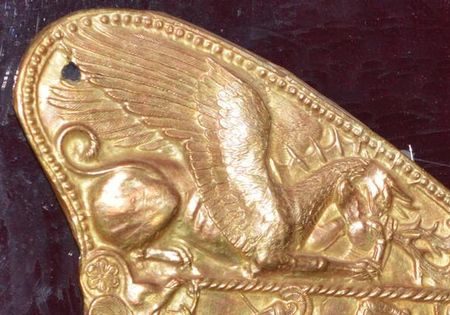
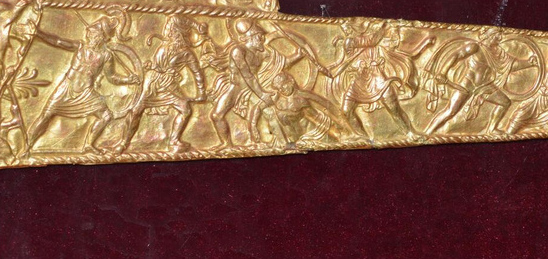
Unknown Master. Gold sword scabbard mount. Second half of the 4th century BCE.
Struggle and Supremacy
The human battle on a sword sheath consists of several confrontations. Participants include attackers, the wounded, and the defeated. The Griffin depicts a different scene of conflict: the predator has already mastered the prey. Therefore, the two scenes complement each other—violence is present in both. The Griffin here is a symbol of cruelty and savagery.
Gryphon and Movement
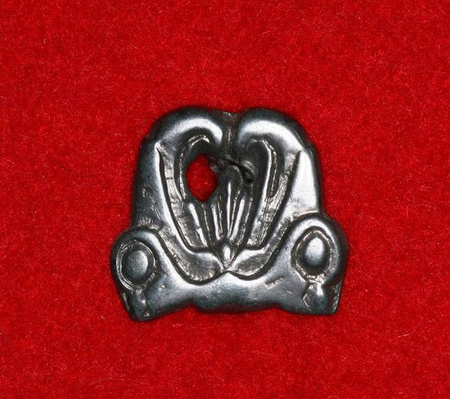
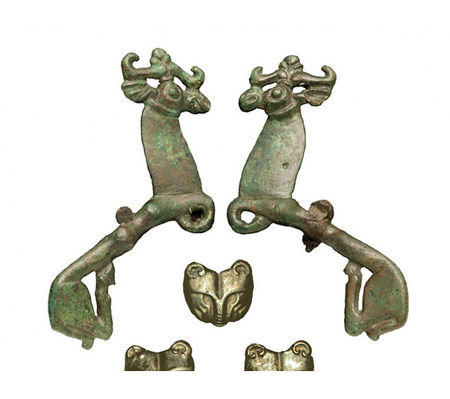
Left: Unknown artisan. Horse harness plaque featuring griffins. 5th–4th centuries BCE. Right: Unknown artisan. Paired psalms, browband, and plaques. First half of the 4th century BCE.
Griffin on Horse Harness
On the plaque from the Cemdolinskaya Morigilnik site, the heads of griffins are oriented in opposite directions. There is no figure for them to attack here: the predatory heads are arranged in a symmetrical pattern, creating a harmonious image. Fantastic creatures also feature in the ornamentation of the horse harness from the Ulyap psaliai. The museum identifies them as griffins and hippocampi. While the griffin retains the recognizable appearance of a dangerous beast, here it appears as a symbol of the strength that the harness can carry.
Master Pasiphae. Pelican with Dionysus’s Chariot. Circa 380–370 BCE.
Griffin in Dionysus’s Chariot
On a Louvre tapestry, a griffin moves in Dionysus’s chariot alongside a panther and an ox. The god holds the reins, and the animals are directed in one direction. Unlike battle scenes, the griffin does not confront the central figure but aids its movement. Its strength takes on a different role—it serves the deity. The mythical creature retains its wings and powerful talons, but this time, it emphasizes the power of the one beside it.
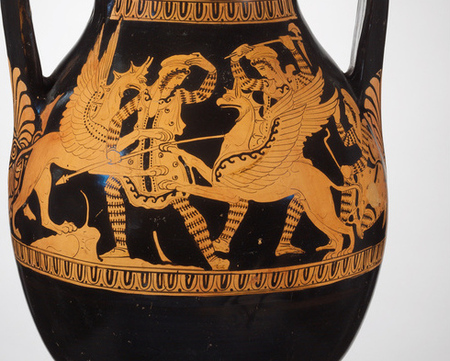
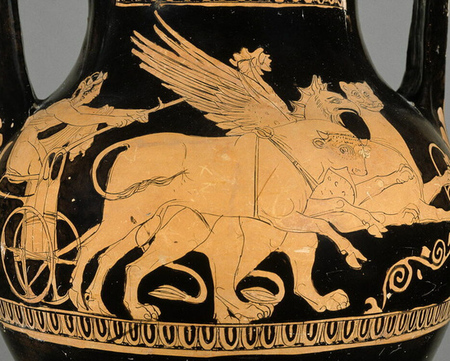
Left: Munich Master 2365 (attribution). A pelican with a battle scene of arymasps against griffins. Circa 375–350 BCE. Right: Pasiphae Master. A pelican with the chariot of Dionysus. Circa 380–370 BCE.
The Man’s Adversary, Yet the Deity’s Companion
The griffin’s raised paws, captured during a struggle on the pelike, are aimed at the human, whereas on the vessel with Dionysus, the beast’s movement continues alongside the entire chariot. In the first case, the griffin’s strength hinders the human; in the second, it supports the deity. Both objects belong to the same vessel type, but the mythical creature plays different roles. Therefore, the object’s designation does not fully determine the griffin’s function. One must also consider who the beast is associated with. The composition also carries special significance.
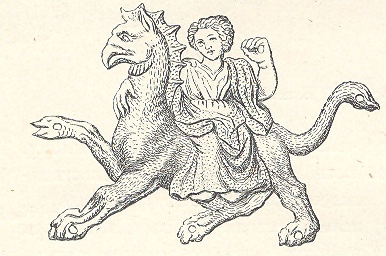
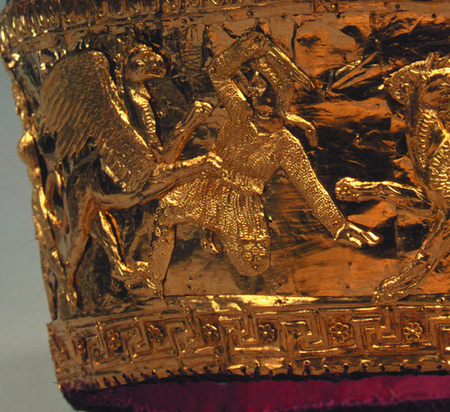
Left: Unknown master. Menade on a griffin. Headpiece ornament. 4th century BCE. Right: Unknown master. Kalath with scenes of combat against griffins. 4th century BCE.
Menad’s Companion, Man’s Adversary
In the published illustration, the menad is seated on the back of a griffin. She does not fend it off, nor does she point any weapon at it. The beast’s body serves as a support for the human figure. Compared to the Pelika, where the griffin attacks the human, the relationship has shifted: intimacy no longer implies danger. The griffin becomes the menad’s companion. The griffin’s movement is again tied to another character. The mythical creature plays a supportive role. In the Kalafa from the Great Blovnitsa, the human figure next to the griffin is, conversely, engaged in a confrontation. The predator once again assumes an attacking posture, facing off against the human. Both images pertain to headwear, but here the object’s function plays no role—the composition dictates the meaning of the mythical image.