Navigation
1 Concept2 Product Weakness3 Competitive Position Weakness4 Consumer Perception Weakness5 Conclusion6 Bibliography7 Image Sources
Concept
Traditionally, advertising aims to present a product in the most favorable light, emphasizing its strengths and shaping a positive brand image. In this process, features, limitations, or circumstances that might be perceived as weaknesses are usually hidden or compensated for by highlighting other advantages.
However, history shows a contrasting approach in advertising: some brands intentionally draw attention to their own limitations, controversial characteristics, or less advantageous market positions. Instead of avoiding negative associations, they make them the foundation of their advertising message.
Furthermore, from a visual communication standpoint, the effectiveness of advertising depends not only on the information it conveys but also on the manner in which that information is presented.
Research Objective: to determine how characteristics traditionally perceived as brand weaknesses become central elements of its advertising communication.
Key Research Question: What visual and semantic techniques allow brands to present their own weaknesses as arguments to their advantage?
Research Hypothesis: Utilizing weaknesses in advertising can contribute to the formation of a positive brand image if the visual and verbal communication alters the context of their perception.
To test the hypothesis, three types of weaknesses are considered that can be leveraged in advertising communication:
01. Product Features — the characteristics and limitations of the product itself that can traditionally be perceived as flaws.
02. Competitive Position — a less favorable standing of the brand relative to major market players.
03. Consumer Perception — the audience’s ambivalent attitude toward the product, including dislike, criticism, or polarized opinions.
Each type is examined using the example of a separate brand: Volkswagen, Pepsi, and Marmite.
Material Selection Principle For this research, we are selecting advertising campaigns where characteristics traditionally perceived as brand weaknesses become the foundation of the advertising message. The focus is on materials that allow us to trace how the advertising idea reinterprets these features and uses what visual and verbal means to form a new perception of the product.
Research Structure is organized by the type of weakness being examined: moving from the product’s intrinsic characteristics to the brand’s competitive positioning, and then to consumer perception. This sequence allows for a comparison of various ways in which negatively perceived attributes are utilized in advertising.
Thus, this research addresses the question of whether openly acknowledging one’s limitations can be a way to stand out from competitors, capture audience attention, and establish a recognizable brand identity.
Product Weakness
In traditional advertising communication, consumer attention is most often focused on product strengths. In these instances, characteristics that might be perceived as limitations usually remain outside the advertising message or are offset by showcasing the product’s stronger attributes.However, not every product feature has an unambiguously positive or negative connotation. In such cases, the task of advertising is not to hide a controversial trait or convince the audience that it doesn’t exist, but rather to shift the context of how it is perceived. Advertising does not deny a limitation; it invites the consumer to view it from a different perspective.
«The most powerful element of advertising is truth» [1] — Bill Bernbach, advertiser and co-founder of DDB
One of the most recognized historical examples of this strategy was the Volkswagen Beetle advertising campaign, created by the Doyle Dane Bernbach (DDB) agency starting in the late 1950s. Instead of concealing the car’s compact dimensions, simple design, or unconventional appearance, the advertising messages made these features the central element of their argumentation. [2]
Volkswagen Beetle, «Think Small, ” 1959. Doyle Dane Bernbach (DDB) Agency, New York.
At a time when the American auto market focused on large, powerful, and prestigious vehicles, Volkswagen offered consumers a contrasting approach. The «Think Small» campaign didn’t hide the Beetle’s compact size; it transformed it into the primary selling point. The advertising encouraged people to consider practicality and mindful consumption. Thus, a feature that could have been perceived as a limitation became a symbol of a rational choice. [2; 3]
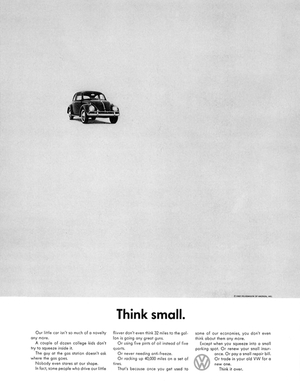
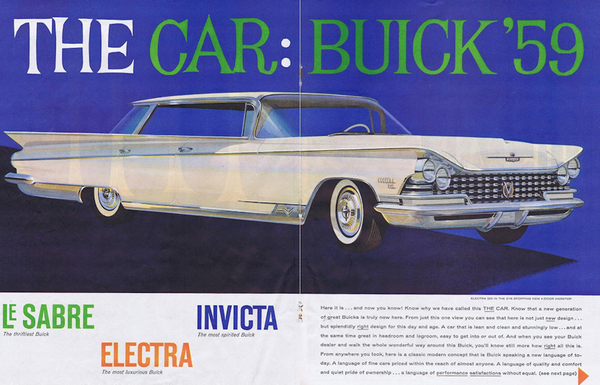
Left: Volkswagen Beetle, «Think Small, ” 1959. Doyle Dane Bernbach (DDB), New York Right: Buick Electra 225, „The Car: Buick ’59, ” 1958. McCann-Erickson, New York
The poster is built upon a deliberate violation of traditional principles of automotive advertising. A small photograph of the Beetle is placed in the upper left corner of the page and surrounded by vast empty space, which visually emphasizes the car’s compactness even more strongly. The car is not artificially enlarged or made to appear more imposing. Comparing it to other automobile advertisements of the same period, such as «The Car: Buick ’59, ” reveals how far Volkswagen deviated from the conventional principles of automotive advertising of its time. [3; 4]
Volkswagen Beetle, «Lemon, ” 1960. Doyle Dane Bernbach Agency (DDB), New York.
In American English, the word «Lemon» refers to a low-quality or defective vehicle. At first glance, it seems that Volkswagen is openly admitting to a flaw in its product. However, the main text reveals the opposite meaning: the vehicle depicted was rejected due to a minor component damage on the dashboard that the buyer likely wouldn’t have even noticed. Thus, Volkswagen transforms a negative expectation into evidence of high production standards. Instead of the usual promises of flawless quality, the brand offers a concrete example of meticulous vehicle inspection. [5; 6]
«We sort through the defective cars, and you get the best.» [6]
— Volkswagen «Lemon» advertisement copy, translated from English
The car appears intact on the surface, creating a contradiction between the image and the negative connotation of the word. It is this discrepancy that prompts the viewer to consult the explanatory text positioned below in three narrow columns. The absence of decorative elements and the restrained presentation lend the advertisement an almost documentary quality. Moreover, the photograph itself does not play the primary role; rather, its interaction with the headline is key—without reading the text, the viewer cannot definitively grasp the ad’s meaning. [5; 6]
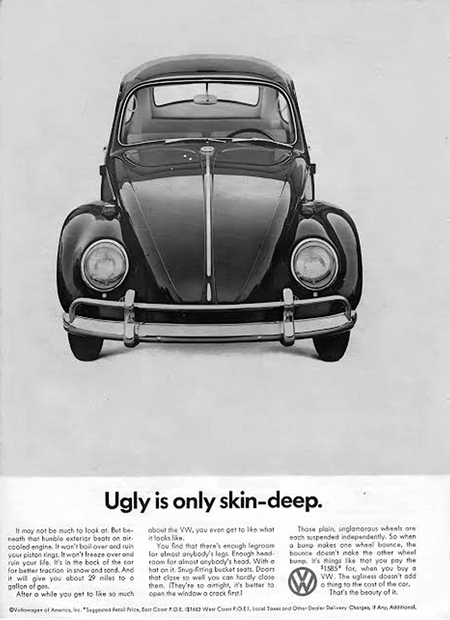
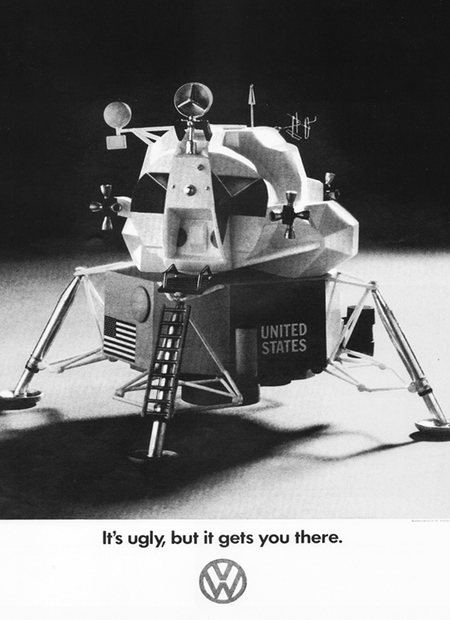
Left: Volkswagen Beetle, «Ugly Is Only Skin-Deep.» Doyle Dane Bernbach (DDB) Agency, New York Right: Volkswagen, «It’s Ugly, But It Gets You There, ” 1969. Doyle Dane Bernbach (DDB) Agency, New York
In the advertisements «Ugly Is Only Skin-Deep» and «It’s Ugly, But It Gets You There,» Volkswagen addresses the Beetle’s unappealing exterior, turning it into the foundation of its advertising message. In the first instance, the brand suggests not judging the car by its appearance, but rather focusing on its practical qualities: economy, reliability, and functionality. In the second, it develops this idea through a comparison with the lunar module of the «Apollo 11» mission. Despite its unusual and unattractive design, the spacecraft successfully fulfilled its mission—transporting the astronauts to the Moon.In both campaigns, the brand refuses to justify the car’s design; instead, it changes the very criterion by which it is evaluated: appeal is determined not by outward beauty, but by practical utility. [7; 8]
Volkswagen isn’t trying to prove that the Beetle is beautiful. It proposes a new understanding of appeal—through practicality, economy, and the absence of paying extra for superficial flair.
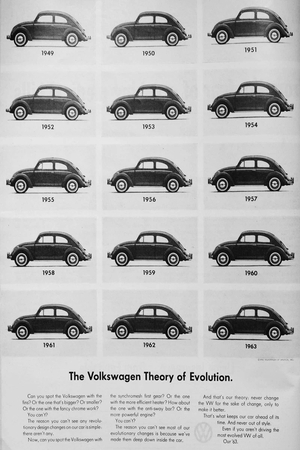
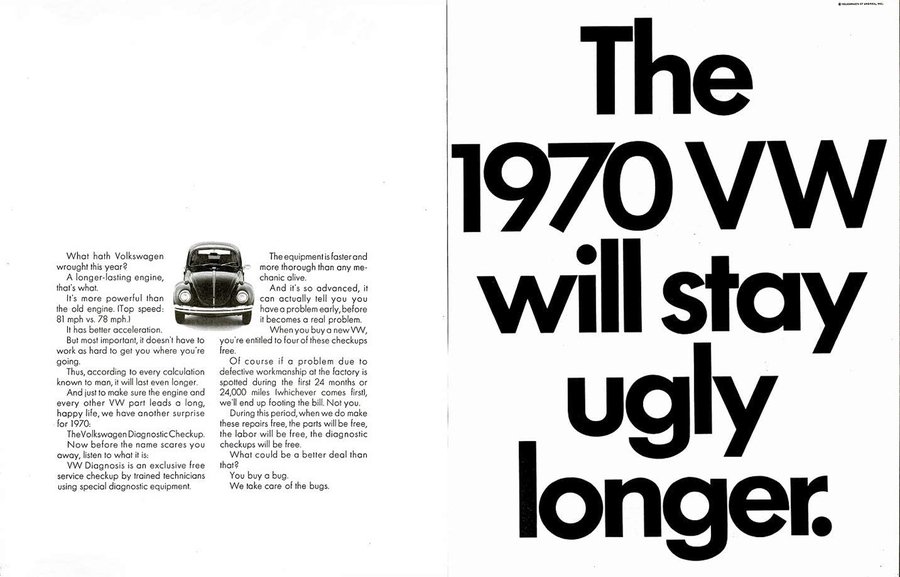
Left: Volkswagen Beetle, «The Volkswagen Theory of Evolution, ” 1962. Doyle Dane Bernbach (DDB), New York Right: Volkswagen Beetle, „The 1970 VW Will Stay Ugly Longer, ” 1969. Doyle Dane Bernbach (DDB), New York
In the advertising for «The Volkswagen Theory of Evolution» and «The 1970 VW Will Stay Ugly Longer, ” Volkswagen appealed to its nearly unchanged exterior appearance and lack of radical design alterations. While competitors regularly updated their models, Volkswagen emphasized that it was improving the engine, heating, and other structural elements without changing the time-tested look. This design consistency ceased to be perceived as a sign of obsolescence and instead became evidence of thoughtful engineering, technical refinement, and the vehicle’s longevity. [9; 10]
Conclusion
Volkswagen’s advertising strategy demonstrated that a product’s weaknesses can become the foundation of its appeal. Instead of concealing the Beetle’s compact size, unusual appearance, and simplicity, the brand recontextualized these traits through the lens of practicality, economy, and reliability. Volkswagen did not attempt to conform to conventional notions of the ideal car—it challenged those notions themselves. Minimalist composition, ironic headlines, and visual metaphors allowed it to stand out against the backdrop of traditional automotive advertising.