Navigator
1. Concept 2. The Feature of Anthropomorphic Motifs 3. Symbolic Interpretation of the Image 4. Conclusion 5. Bibliography 6. Image Source
Concept
Stećci are medieval tombstones primarily found in modern-day Bosnia and Herzegovina, as well as in some neighboring Balkan regions. Emerging between the 12th and 15th centuries, they represent a unique phenomenon of burial art, reflecting the artistic traditions and worldview of medieval Balkan society. One of the most significant collections of stećci is the Radimli necropolis, located near the town of Stolac in modern-day Bosnia and Herzegovina. It is known for the variety of tomb shapes and the richness of its relief decoration, which includes geometric and floral ornaments, crosses, anthropomorphic figures, and scenes featuring human figures. Within this study, Radimli is examined as an independent visual and historical-cultural complex, allowing for an in-depth study of the distinctive visual language of the stećci.The anthropomorphic figures in the visual program of the Radimli necropolis are of particular interest, as the posture of the body and individual gestures acquire independent expressive meaning. Among these, the motif of the raised hand stands out, appearing in various forms. In some instances, the hand is depicted separately from the body or raised to head level; in others, it becomes part of a more complex composition involving multiple human figures. The proportions of the depiction, the position of the palm, the direction of the hand, and its relationship with the other elements of the composition can significantly influence the visual perception of the gesture. Despite its apparent simplicity, this motif raises questions about its symbolic content and role in funerary art. It is precisely the repetition and diversity of its visual forms that make the raised hand an independent object of iconographic study.
The presence of similar images in the necropolis suggests that the gesture did not serve a decorative function, but may have been connected to specific conceptions of humanity, death, and the afterlife. Its meaning is not self-evident and may depend on the historical, religious, and compositional context. Discussions on this topic continue to this day. A raised hand can evoke associations with prayer, greeting, blessing, or address; however, none of these interpretations should be accepted without comparison to historical and visual evidence. This leads to the central research question:
What are the possible symbolic meanings of a raised hand in the burial iconography of medieval Bosnian churches, and how do they relate to the religious and cultural perceptions of medieval Bosnia?
Radimlja Necropolis, near the town of Stolac, Bosnia and Herzegovina. 15th-century medieval stećak tombstones. Photo: BiH Commission to Preserve National Monuments.
In my view, the image of the raised hand is not merely a recurring artistic motif, but a potentially significant element of the visual language of stećci—a language through which concepts of human interaction with the sacred world might have been expressed. I believe it is crucial to examine this gesture, considering its possible historical origins and cultural parallels. I hypothesize that the convergence of local artistic traditions with earlier, more widespread iconographic motifs from medieval art may have influenced the formation of a distinct visual form for the gesture on the stećci. Furthermore, this study does not aim to find a singular, universal meaning for the raised hand, but rather seeks to uncover a spectrum of possible interpretations.
The primary objective of this research is to examine the image of the raised hand as an element of the burial iconography in medieval stećci, trace the possible historical origins of this motif, and determine its place within the system of religious and cultural beliefs in medieval Bosnia. Special attention will be given to analyzing the visual characteristics of the depictions, their compositional context, and comparing them with analogous gestures in other artistic traditions. This approach will allow us to consider the raised hand simultaneously as an independent visual sign and as part of a broader system of medieval symbolism.
The research will be organized around several major thematic directions. The first will be dedicated to analyzing the pictorial program and the characteristics of the anthropomorphic motifs in the stećci. The second direction will focus on a visual study of the raised hand: we will conduct a comparative analysis of the gesture’s possible origins and meanings by referring to ancient, early Christian, Byzantine, and medieval artistic traditions. The concluding section will interpret the findings within the context of the local culture of medieval Bosnia, allowing us to correlate visual parallels with the specifics of the region’s funerary art.
Thus, my goal was to move beyond a mere description of a single iconographic motif and to consider the raised hand as a potential carrier of complex symbolic content. Through the analysis of its visual forms, historical parallels, and cultural context, I aim to approach an understanding of the role this gesture played within the artistic language of the stećci.
The characteristic of anthropomorphic motifs
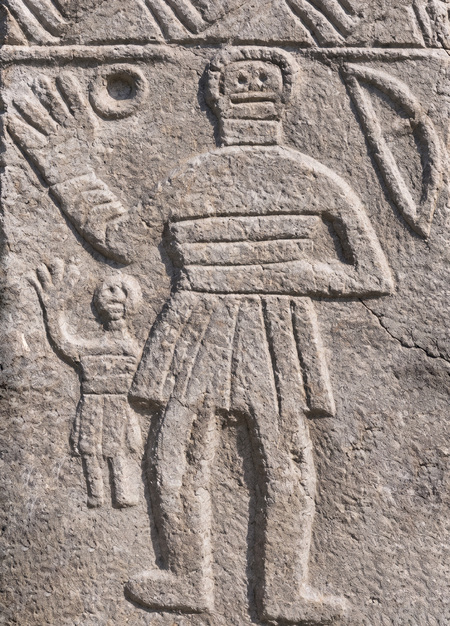
In the depictions from the Radimlya necropolis, one can observe a deliberate or simply recurring distortion of human anatomical proportions. The raised arm appears disproportionately large—in terms of length and scale, it can exceed the size of the head and visually corresponds more closely to the torso of the depicted person.
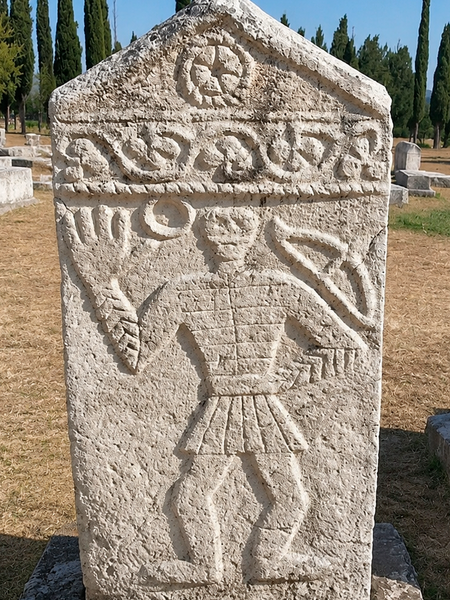
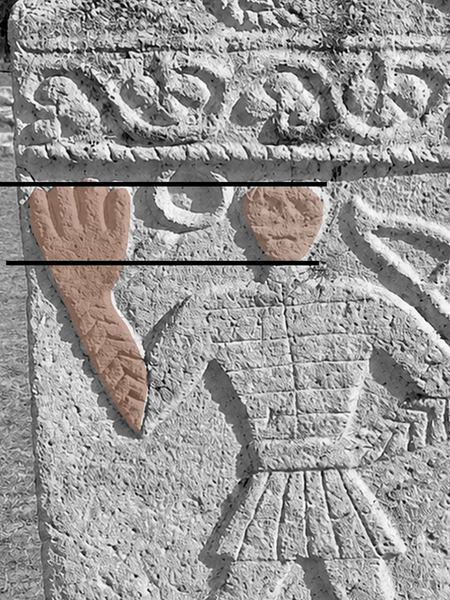
Radimlja Necropolis, near the city of Stolac, Bosnia and Herzegovina. A stećak featuring a figure with a raised arm.
Radimlja Necropolis, near the town of Stolac, Bosnia and Herzegovina. A stećak with a figure raising an arm.
It is interesting that the enlarged scale of the raised arm can serve as a visual accent, directing the viewer’s attention specifically to that element of the human figure. The arm gains an independent significance within the overall composition. One might surmise that such exaggeration was a deliberate artistic device, one through which the sculptors sought to highlight a particular gesture and underscore its symbolic meaning.
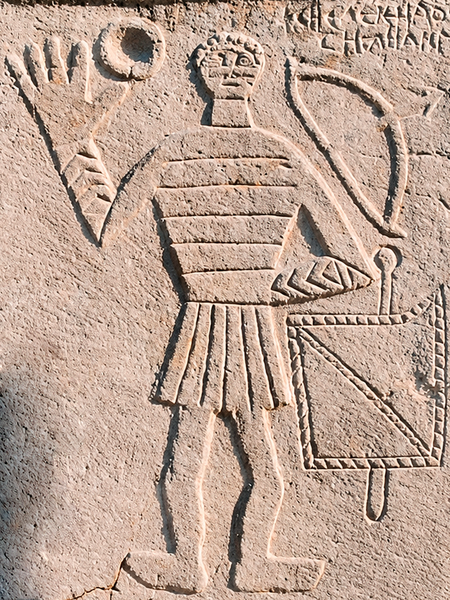
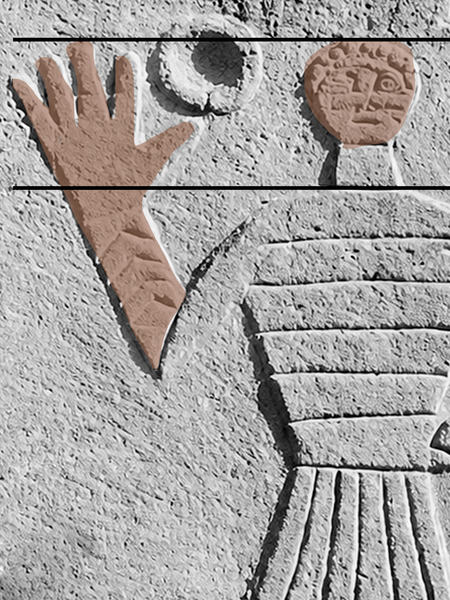
Radimlja Necropolis, near the town of Stolac, Bosnia and Herzegovina. A stećak featuring a figure with a raised arm.
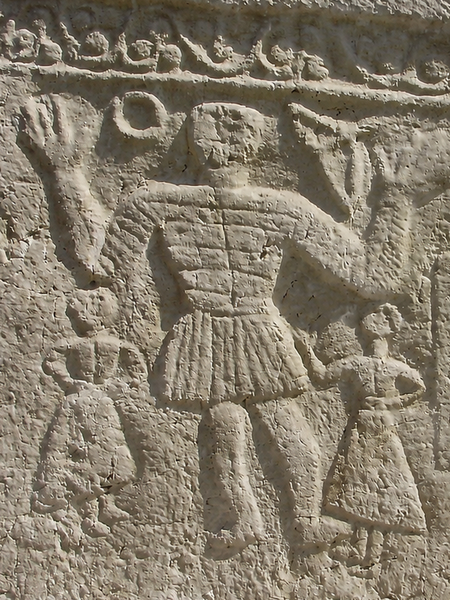
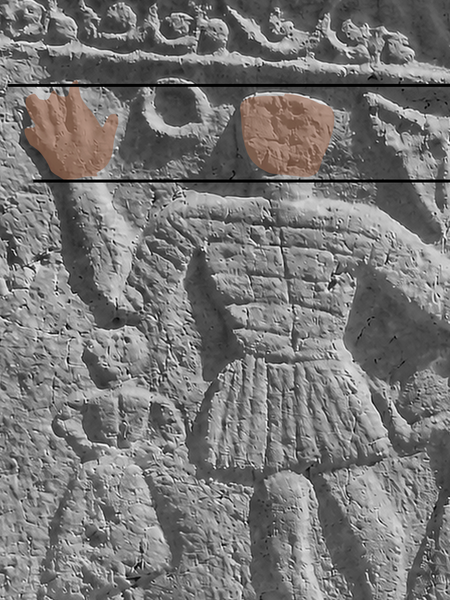
Radimlja Necropolis, near the town of Stojlac, Bosnia and Herzegovina. A stećak with a figure raising a hand.
The disproportion was not a random error, but an integral part of a specific visual language where the scale of individual body parts was determined by their semantic weight. This is why the enlarged arm becomes a crucial starting point for investigating the possible symbolic meanings of gesture in Radiml’s sketches.
Symbolic interpretation of the image
Prayer (Orans Gesture)
Orans (from Latin orans — «praying, ” „one who prays“) is an ancient prayer gesture in which a person stands with raised arms spread to the sides, usually bent at the elbows, with palms facing upward or forward.
The Radimli stelae feature human figures with two raised arms. This allows for a comparative analysis with the tradition of orans.
In early Christian burial art, such as the frescoes in the Catacombs of Priscilla, scenes of prayer are found. Whether on the walls or in motifs from other cultures, the position of the hands can be interpreted as a visible expression of turning toward the sacred realm. The difference is noticeable only in their proportions: in some frescoes, the hands significantly exceed the size of the head and become one of the main elements of the composition, whereas in other images, the focus is not placed on individual details.
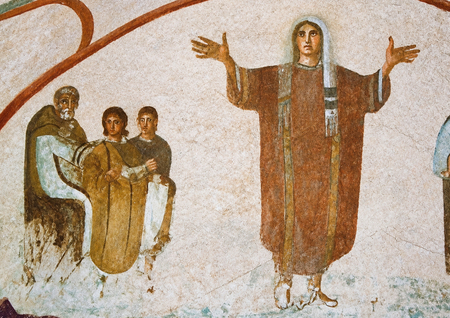
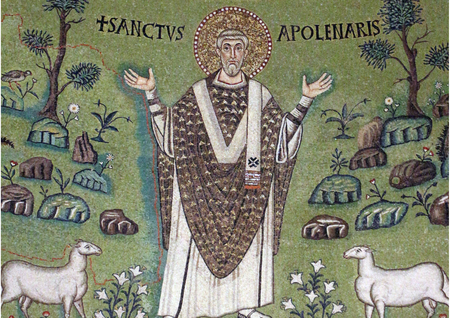
1. Catacombs of Priscilla, Rome, 3rd century. 2. Saint Apollinaris, Basilica di Sant’Apollinare in Classe, Ravenna, 6th century.
Siphon from the Radimlya necropolis.
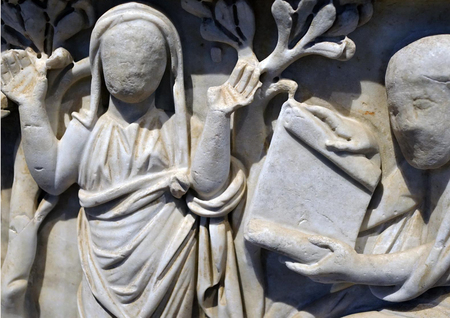
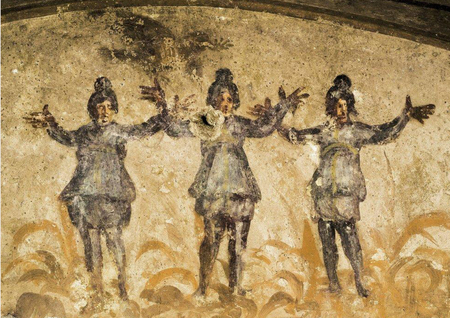
1. Sarcophagus from Santa Maria Antica, Rome, c. 270 CE. 2. Three youths in a fiery furnace, Priscilla’s Catacombs, 3rd century.
Adoration of the Sun or Christ
When considering this version, pay close attention to the circular elements found in medieval burial iconography of the Steppe peoples, as well as their potential interaction with the human figure. These circles are presumed to symbolize the sun.
Sticker from Radimli.
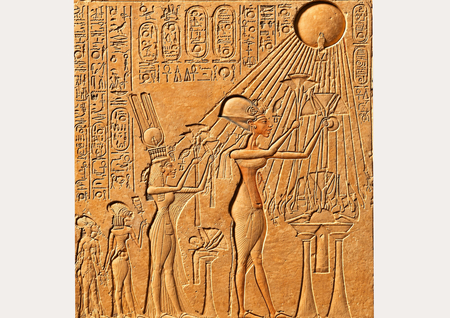
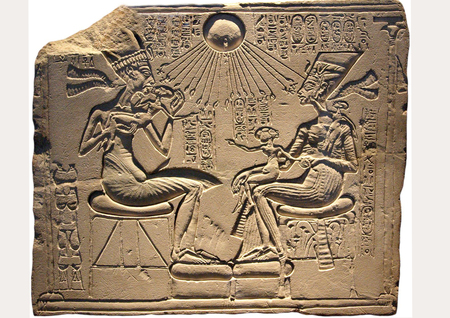
1. Egyptian figure in a gesture of adoration. 2. Relief featuring Akhenaten and Aten.
One possible interpretation of the raised hands on the Radimlya necropolis stelae is a gesture of reverence to the sun or an appeal to celestial powers. Comparing these to other cultures, one can look at reliefs from the Amarna period, where worship of the sun disk Aten is conveyed through figures with raised hands. Scandinavian rock carvings are also interesting, rivaling the stelae in their symbolic representations. In these images, the gesture becomes part of the visual connection between humanity and the divine.
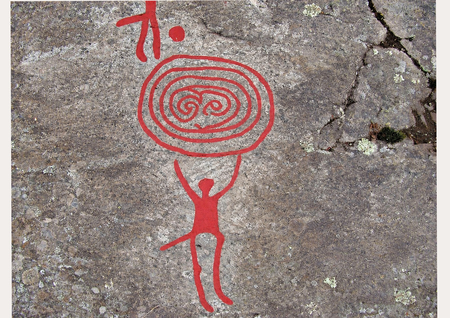
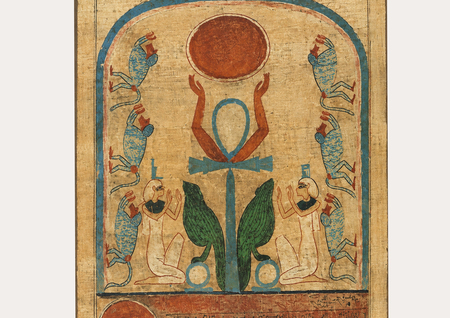
1. Scandinavian Rock Engravings. 2. Pavians Greeting the Rising Sun.