Concept
«The Romance of the Rose, ” initiated by Guillaume de Lorris in the 13th century and continued by Jean de Meun, presents the story of the Lover as a dream. The hero falls asleep, then gets out of bed, dresses, and heads to an enclosed garden where he meets allegorical characters. However, his movement and familiar actions do not yet signify a return to reality—the entire narrative remains part of the dream. For the artists who illustrated the poem, this presented a unique challenge: to render visible both the sleeping man and the sequence of events unfolding within his dream. This study focuses on 14th-century French illuminated manuscripts, specifically seven copies from the Morgan Library & Museum: M.372, M.503, M.48, M.185, M.324, M.120, and M.132 (circa 1320–1380). Comparing different depictions of the same literary plot allows us to identify the particularities of the artistic solutions without recourse to works from other eras or traditions. Later printed editions and manuscripts from the 15th–16th centuries are not included in the core collection.
Key question of the work:
How did 14th-century miniaturists transform a dream narrative into a visually coherent sequence of scenes, and what means did they use to denote the relationship between the sleeping protagonist and the depicted events? The hypothesis is that the boundary of the dream is determined primarily by the structure of the page: the frames, the repetition of the hero’s figure, the proximity of domestic and allegorical episodes, the shift in space, and the direction of movement. Furthermore, the illustrations do not necessarily draw a definitive line between dream and reality. Instead, they organize the narrative flow rather than reproducing a modern conception of dream psychology.
I. THE SLEEPING HERO: WHERE THE STORY BEGINS
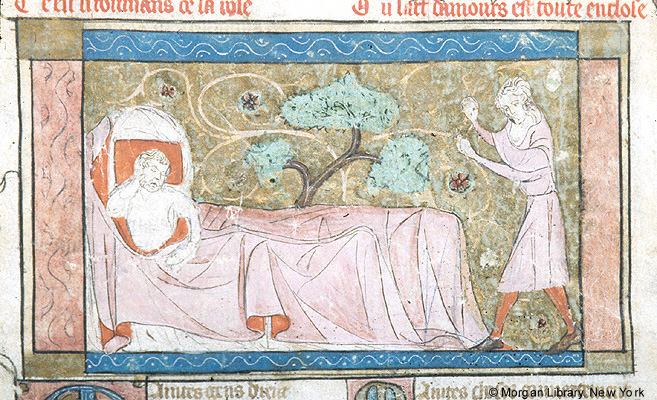
For the contemporary viewer, sleep in a painting is usually recognizable by closed eyes and the posture of a reclining figure. In a 14th-century miniature, this sign becomes the starting point of a long narrative: the image captures not so much a physiological state as the beginning of a special story. On the first leaf of manuscript M.372, the Lover lies in bed, and next to him is a blooming rosebush and the figure of Danger. The action, which is yet to be read in the text, is already indicated beside the sleeping body. The rose turns out to be not merely an interior decoration, but a symbol of the world toward which the dream is directed.
Unknown French miniaturist. «The Sleeping Lover and Danger.» Miniature from «The Rose Romance, ” c. 1320. Morgan Library & Museum, MS M.372, f. 1r.
However, the miniaturist does not conflate the external world with the dream’s content through a drastic shift in pictorial language. The background is conventional, and the scale of the plant and the allegorical character is subordinated to the clarity of the composition. The bed indicates where the protagonist is located, while the figure of Danger and the rose bush allude to future events. The proximity of these elements creates visual ambiguity—what belongs to the dream is situated in the same space as the sleeper. The image functions as a concise outline of the story to come.
The comparison with manuscript M.120, created approximately half a century later, is particularly striking. In this piece, the initial miniature is divided into two scenes. On the left lies the Sleeping Lover, standing nearby is Danger, armed with a club, and on the right, the god of Love releases an arrow that strikes the hero. The artist places the cause and the most crucial consequence of the romantic adventure on a single page. In contrast to the continuous space of M.372, the juxtaposition of different moments here is emphasized by the compositional division.
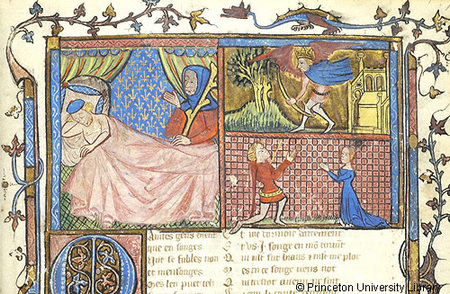
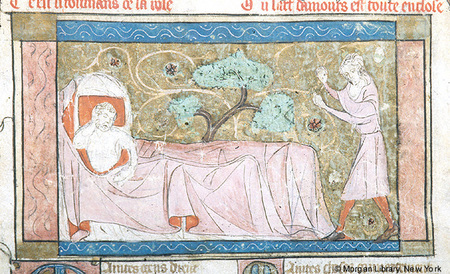
1. Unknown French miniaturist. «The Sleeping Lover and the Arrow of Cupid.» Miniature from «The Romance of the Rose, ” c. 1370. Morgan Library & Museum, MS M.120, f. 1r. 2. Unknown French miniaturist. „The Sleeping Lover and Danger.“ Miniature from „The Romance of the Rose, ” c. 1320. Morgan Library & Museum, MS M.372, f. 1r.
Comparing the two pages leads to an initial conclusion. The medieval miniaturist might signal the beginning of a dream not only with an image of a bed but also by including in a single vignette events that will unfold later in the narrative text. The sleeping body remains the point of departure, but the story visually extends beyond it. This is precisely why the next stage of research focuses not on the sleeping person himself, but on the structure of the multi-scene page.
II. FOUR SCENES IN ONE IMAGE
In the manuscript M.503, dated around 1340, the initial miniature is structured into four episodes unified by a single border. Top left, the Lover sleeps; top right, a figure dresses; bottom left, a person walks along a stream; and bottom right, someone approaches a garden fence. The reader sees the same character in four different poses, but the artist is not intending to depict four separate personalities. The division into small panels makes time visible: what sequentially unfolds in the narrative is simultaneously present on one surface of the page.
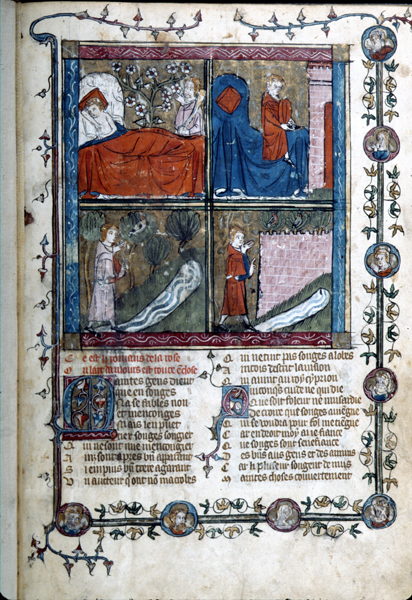
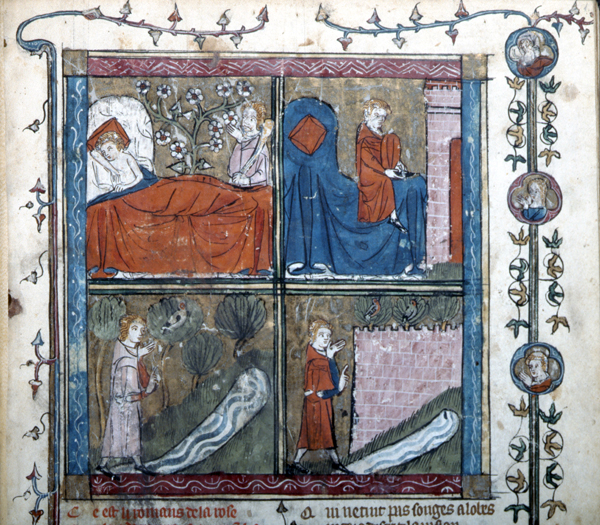
Unknown French miniaturist. «Sleep, Dressing, Walk, and Approach to the Garden.» Miniature from the «Romance of the Rose, ” c. 1340. Morgan Library & Museum, MS M.503, f. 1r.
The upper and lower scene pairs are connected not only by the character’s figure but also by recurring motifs. The bed establishes the starting point, the clothing marks the transition to action, the trees and stream lead to the garden, and the crenelated wall indicates a new boundary. The manner of connection itself is crucial: frames separate the episodes, but the similar colors and close scales unify them within a single visual whole. Each scene is distinct, yet none demands that the viewer believe they are looking at an independent, complete landscape.
A similar principle is applied in M.48, but the form of the division changes. Four episodes are inscribed within complex figurative frames; in the upper left panel, the protagonist lies next to a rosebush, then dresses, walks between trees, and stops before a garden fence. Here, the framing becomes a noticeable element of the image: the undulating contours of the dividers help view the scene as a miniature sequence of separate «windows.» Within each one, the space is extremely limited. Even the stream and the trees are necessary primarily for recognizing the action.
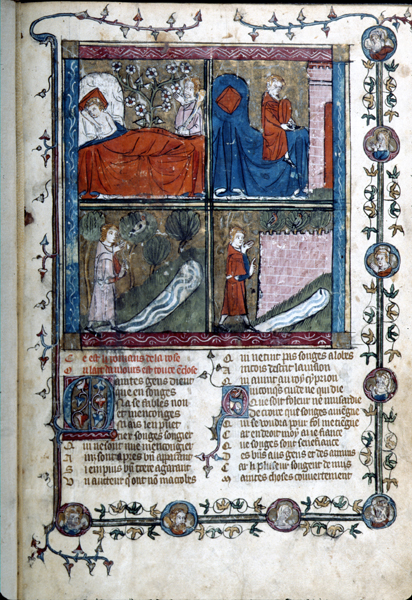
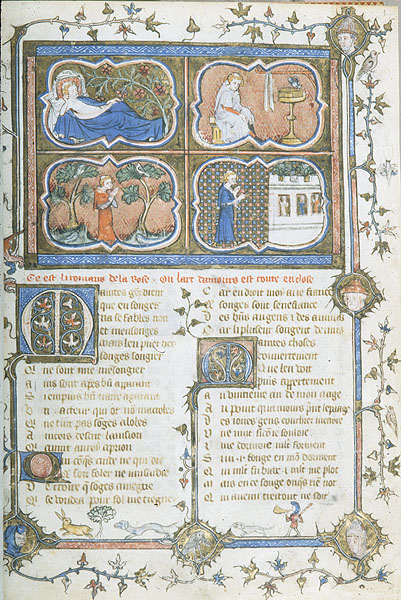
1. Unknown French miniaturist. «Sleep, Dressing, Walk, and Approach to the Garden.» Miniature for the «Romance of the Rose, ” c. 1340. Morgan Library & Museum, MS M.503, fol. 1r. 2. Unknown French miniaturist. „Four Scenes from the Story of the Lover.“ Miniature for the „Romance of the Rose, ” 1340–1350. Morgan Library & Museum, MS M.48, fol. 1r.
Comparing M.503 and M.48, we should not speak of the «emergence of cinematic montage"—that would be an anachronistic analogy—but rather of a medieval mode of sequential narrative within a single frame. The movement of the eye between scenes substitutes for the character’s movement through continuous space. The master organizes the viewing experience so that the recognition of the same character links the fragments into a temporal chain.
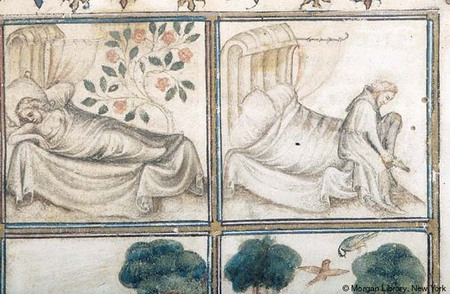
In M.185, four episodes are situated side-by-side again, but the miniaturist develops the everyday action in greater detail. In the second scene, the hero sits on a bench and puts on his shoes; nearby, a basin on a stand, hanging fabric, and a vessel are depicted. These details create a sense of a normal morning, even though the narrative still resides in the realm of dreams. The comparison with M.503 is particularly interesting: similar events are presented with varying degrees of material specificity. The more detailed interior does not prove that the hero has «actually woken up»; rather, it demonstrates how the conventional transition to action can be framed using the language of the mundane.
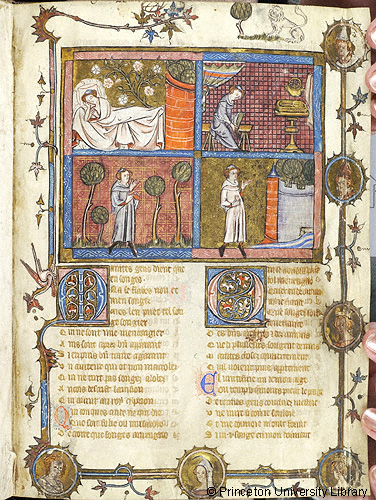
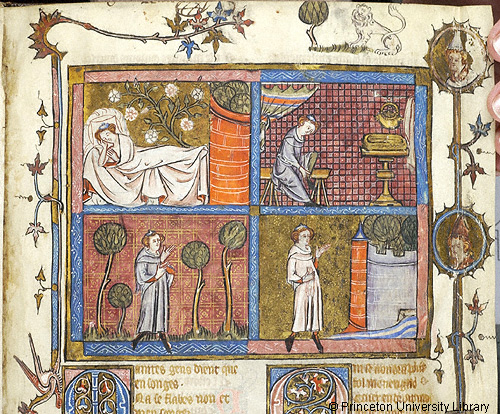
Unknown French miniaturist. «Four Scenes from the Story of the Lover.» Miniature for the «Romance of the Rose,» 1340–1350. Morgan Library & Museum, MS M.185, fol. 1r.
In M.324, the artist maintains a quaternary sequence but employs expressive figurative framing. These frames resemble decorative medallions; each episode is given its own small world. The scene of the walk is placed between stylized trees and waterways, while the scene approaching the garden is built around a portal. This method of division more strongly emphasizes the completeness of each moment than in M.503. At the same time, the recurring figure of the Lovers prevents the scenes from being perceived as independent images.
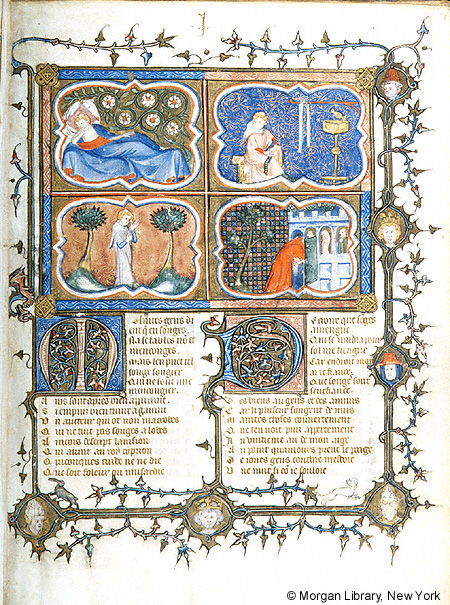
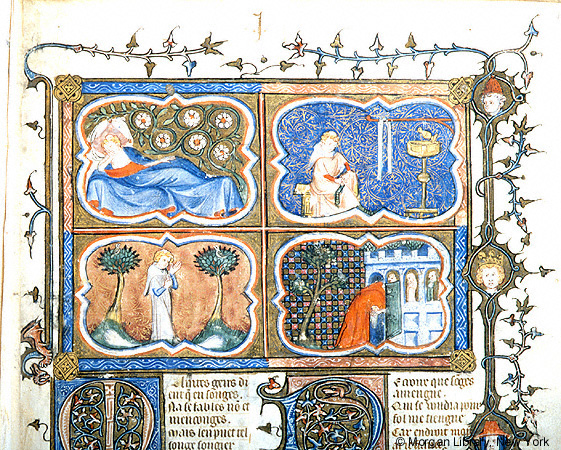
Unknown French miniaturist. «Four Scenes from the Story of the Lover.» Miniature from the «Romance of the Rose, ” circa 1350. Morgan Library & Museum, MS M.324, f. 1r.
The later manuscript M.132, dating to around 1380, presents four episodes once again. Interestingly, the final scene depicts the hero already in the garden rather than only at the gate. Thus, a slight alteration in the choice of the concluding moment affects the content of the entire prologue: in one case, the miniature concludes with an approach toward the boundary, while in the other, it depicts the state beyond it. This is particularly evident when comparing the final, lower right panels of M.503 and M.132.
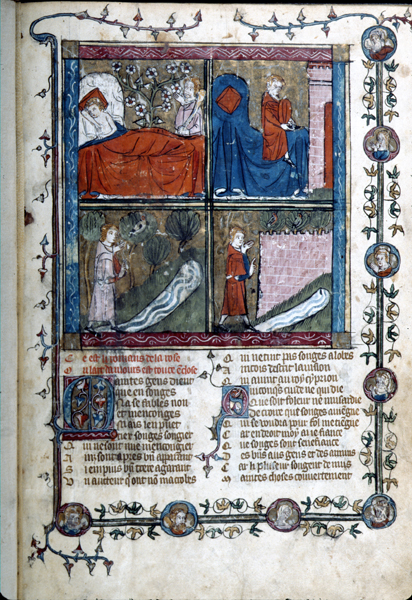
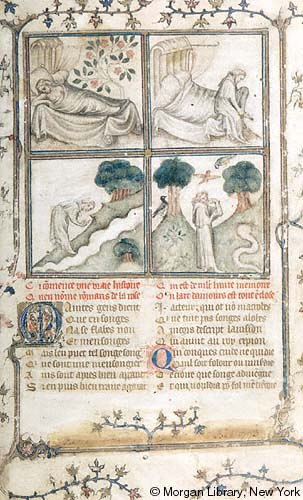
1. Unknown French miniaturist. «Sleep, Dressing, Promenade, and Approach to the Garden.» Miniatures from the «Romance of the Rose, ” circa 1340. Morgan Library & Museum, MS M.503, fol. 1r. 2. Unknown French miniaturist. „Four Scenes from the History of the Lover.“ Miniatures from the „Romance of the Rose, ” circa 1380. Morgan Library & Museum, MS M.132, fol. 1r.
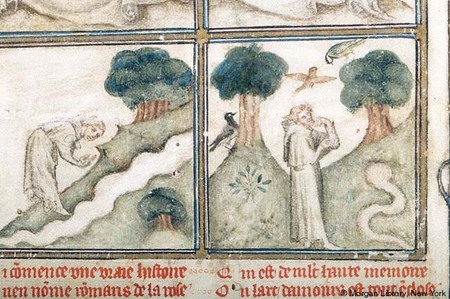
The aforementioned differences do not imply that individual masters held diametrically opposed views on dreams. The available images allow us to assert something more specific: one literary passage offered artists several equally plausible options for staging the scenes. Their choice determined the pace of the reader’s experience across the page and where the next part of the story unfolded. Therefore, the question of the dream’s boundary gradually transforms into a question of the miniature’s very boundaries.
III. THE GARDEN AS A TRANSITION TO ANOTHER SPACE
The garden fence in «The Romance of the Rose» is important not only to the literary plot. In the miniatures, it becomes a visible boundary the protagonist strives to cross. A wall, tower, or portal delineates the space «before» and «after, ” and this distinction can be more compelling than the characters’ appearances. In M.503 on leaf 5v, the Lover approaches Folly, depicted near closed gates. The artist places the dialogue before the architectural barrier: the characters’ raised hands are interpreted as an exchange of lines, and the wall reminds the viewer that the transition has not yet been completed.