Navigation
— Concept — The Superhero as a Symbol of National Ideals — The Formation of the Antagonist in Superhero Comics — The Visual Language of Propaganda — Conclusion
Concept
The topic selection stems from an interest in how popular culture responds to historical events and functions as a vehicle for disseminating social and political ideas. Superhero comics are traditionally perceived primarily as entertainment, yet during periods of military conflict, they acquire an additional function: reflecting public sentiment, shaping the image of the enemy, bolstering patriotism, and conveying concepts of heroism, duty, and national identity. This characteristic was particularly pronounced in American comics during World War II, when superheroes became directly integrated into the military agenda. Their characters were employed to express patriotic ideals, demonstrate opposition to fascism, and cultivate the concept of a just war. Thus, this theme allows for an examination of the comic not merely as an artistic work, but as a visual medium participating in the creation and dissemination of propaganda messages.
The research material primarily consists of American superhero comics from the World War II period (1941–1945), where the military theme is expressed through the narrative, characters' visual representations, cover design, and depiction of the enemy. The main selection criterion is the presence of direct or indirect propaganda elements within the works. These include the display of national symbols, the juxtaposition of heroes and adversaries, the formation of an image of external threat, appeals to patriotic sentiment, as well as motifs of military service, self-sacrifice, and collective responsibility. Special attention is given to works where the superhero acts not only as a protector of an individual but also as a symbolic representative of their country or a specific set of values. An important selection criterion is also the expressiveness of the visual execution: the use of color, composition, gestures, attributes, and characteristic costume details that amplify the image’s ideological content.
The research structure is built on a thematic principle and reflects the main ways the superhero comic is used as a propaganda tool. First, the historical and cultural context of military themes in American comics is examined, as well as the superhero’s position as a symbolic figure capable of representing national ideals. Next, the formation of the enemy’s image is analyzed: methods of visually and narratively contrasting superheroes against adversaries, the use of stereotypes, and techniques of demonization. A separate aspect of the research is dedicated to the superhero’s patriotic function—its role in maintaining morale, popularizing military values, and shaping the image of the ideal citizen. The concluding section explores the specifics of the comic’s propagandistic influence as a synthesis of image and text, where visual symbols, dialogue, and plot situations work together to create a unified ideological message.
The principle of selecting and analyzing textual sources is based on combining primary visual materials with research on the history of the comic book, propaganda, and American mass culture during the World War II era. Primary sources include the comics themselves: their covers, individual pages, story arcs, and character dialogue. These are examined as historical evidence that allows us to trace how political and social ideas were embodied in popular visual form. Secondary sources consist of scholarly publications, monographs, and historical studies that reveal the context of comic creation, the specifics of wartime American propaganda, and the development of the superhero genre. Source analysis accounts not only for direct ideological statements but also for hidden meanings expressed through visual metaphors, compositional decisions, symbolism, and character juxtaposition. Furthermore, propaganda is viewed not exclusively as direct state agitation, but as a broader system of ideas and images capable of shaping public perceptions of war and national values.
Key Research Question: How did American superhero comics from the World War II era utilize visual and narrative devices to disseminate propaganda and shape attitudes toward war, the enemy, and one’s own country?The study’s hypothesis is that the superhero comic during World War II was not merely a reflection of historical reality, but rather an active tool for shaping public consciousness. Through the combination of a recognizable hero archetype, expressive visual symbolism, and accessible storytelling, the comic transformed complex political and military processes into a comprehensible juxtaposition of good versus evil. The superhero became the embodiment of national ideals, while his adversary represented the threat that needed to be combatted. Thus, the popularity of the superhero genre and the characteristics of its visual language allowed for the use of entertainment as a medium to spread ideological tenets, strengthen patriotism, and legitimize the country’s participation in the military conflict.
Superhero as a Symbol of National Ideals
During World War II, American superhero comics became one of the tools for expressing national identity and patriotic sentiment. The superhero image gradually evolved beyond a mere entertainment character, acquiring symbolic significance: it embodied idealized qualities of American society, such as freedom, justice, strength, responsibility, and a willingness to defend the country. In the context of military conflict, these qualities became especially important, as society needed clear figures capable of sustaining faith in its own strength and uniting people around shared values. The superhero became a unique personification of the national character, and his fight against evil was perceived as an artistic reflection of American society’s confrontation with external threats.
It is important to note that the formation of this archetype began even before the U.S. officially entered World War II in December 1941. One of the first characters to embody the idea of a hero as a defender of social ideals was Superman. First appearing in Action Comics #1 in 1938, he originally represented not so much a national hero in the literal sense, but rather a protector of the weak and the oppressed. His superhuman abilities allowed him to confront crime, injustice, and the abuse of power. Superman served as a kind of ideal of justice—someone who could intervene in situations where ordinary people were powerless against violence or social injustice. This characterization proved particularly relevant amid the political instability of the late 1930s, the rise of fascist regimes in Europe, and the approach of a massive military conflict.
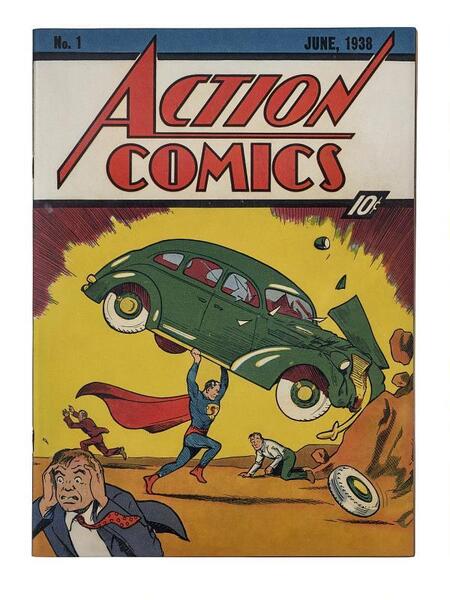
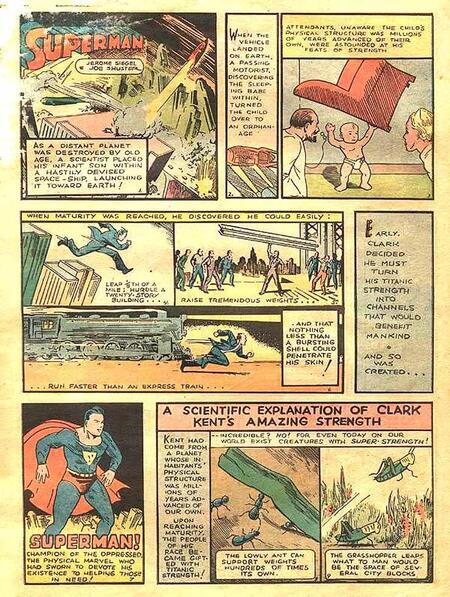
Joe Shuster cover. «Action Comics #1,» 1938 / Fragment from «Action Comics #1,» 1938
With the start of the war in Europe, Superman’s image gradually began to take on a more pronounced political tone. Even though the United States maintained neutrality, American creators were already addressing the international situation in their works. In issues of Action Comics and other publications, the character confronted adversaries who resembled representatives of the Nazi regime. One of the most telling examples was the appearance in 1940 of the special story, «How Superman Would End the War, ” published in Look magazine. In it, Superman directly intervened in the conflict, opposing Adolf Hitler and Joseph Stalin. Such a plot demonstrated that the superhero comic could become a platform for expressing a political stance even before the war became an immediate part of American public life. Furthermore, the character’s fantastic abilities allowed for the presentation of a complex international situation in an accessible form: a single hero, possessing exceptional strength and moral righteousness, could confront dictators and restore justice.
Excerpts from Jerry Siegel and Joe Shuster. «How Superman Would End the War, ” 1940
However, the most striking embodiment of national ideals in American superhero fiction is Captain America—a character created by Joe Simon and Jack Kirby. His first appearance was in Captain America Comics #1, published in December 1940 and dated March 1941. The character’s design was directly tied to American state symbolism: his suit mirrored the colors of the national flag, adorned with stars and stripes, and his primary attribute was a shield bearing a star. Unlike many other superheroes whose connection to a specific nation might be indirect, Captain America literally personified the United States. His outward appearance made the hero’s national identity obvious even before the reader encountered the plot. Thus, the character transformed into a visual symbol of the nation, and his actions took on significance not just as individual heroic deeds, but as the defense of national values.
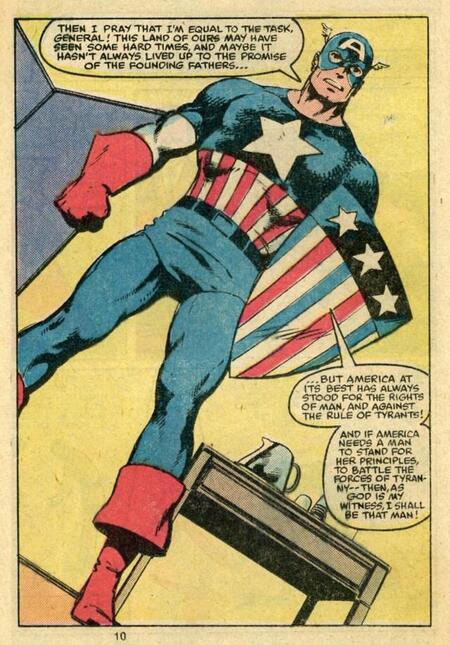
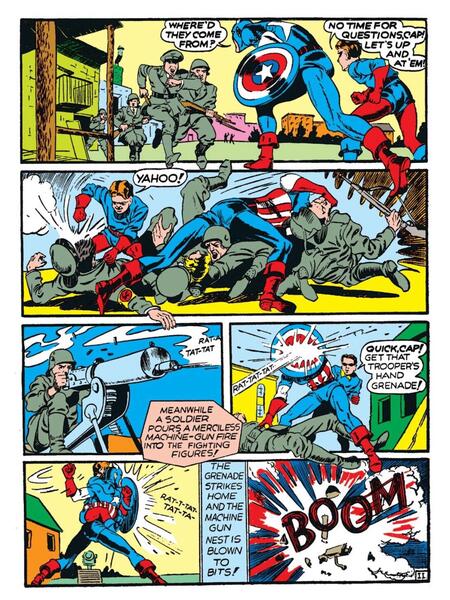
Excerpt from Joe Simon and Jack Kirby. «Captain America Comics #1, ” 1941
The character’s origin story holds particular significance. Before transforming into a super-soldier, Steve Rogers was a physically frail young man who, despite his body’s limitations, aspired to join the military. His desire to protect his country and oppose fascism proves more important than personal safety. After participating in a secret military experiment, Rogers gains superhuman physical abilities and becomes Captain America. This narrative structure reflects an important concept in military propaganda: heroism is defined primarily by a person’s inner qualities, their convictions, moral fortitude, and willingness to serve society. A physically weak man transforms into a powerful defender through his dedication to ideals he deems correct. Furthermore, Steve Rogers' story links the hero’s fantastical transformation to the activities of American military and scientific institutions, presenting the state as a structure capable of creating the conditions necessary to protect society. Captain America’s superpowers become an artistic expression of the nation’s strength and military potential.
Excerpt from Joe Simon and Jack Kirby. «Captain America Comics #1, ” 1941
It is noteworthy that the cover of the first issue of Captain America Comics depicts the hero striking Adolf Hitler. This image became one of the most recognizable examples of the direct incorporation of political reality into a superhero comic. It is important to note that the cover appeared nearly a year before Japan attacked Pearl Harbor and before the official entry of the United States into the war. Consequently, Captain America was initially conceived not merely as a character accompanying an existing military narrative, but as an expression of a specific public stance against the Nazi threat. His creators were opposed to the spread of fascism and isolationist sentiments, and the image of the blow to Hitler transformed the cover into a direct visual statement. In this case, the superhero served as a representative of American ideals even before the American state officially became a participant in the military conflict. According to the National Museum of American History at the Smithsonian Institution, the character was originally intended as the embodiment of American ideals and a means of fostering patriotic feeling.
Excerpt from Joe Simon and Jack Kirby. «Captain America Comics No. 1, ” 1941
The shield plays a crucial role in shaping the image of Captain America. Unlike traditional weaponry, which is used to inflict direct damage on an opponent, the shield is primarily associated with defense. It symbolizes the hero’s defensive function—his willingness to take threats upon himself and protect those around him. This visual characteristic allows us to perceive military power not merely as a means of destroying an enemy, but also as a tool for safeguarding freedom and security. The shield also reinforces the character’s connection to national symbolism, as the star on its surface echoes motifs from the American flag. Consequently, the individual elements of the costume combine to form a cohesive image of the hero, wherein physical strength, patriotism, and the function of defense are inseparable. Captain America is perceived not just as an individual possessing superpowers, but as a symbol of a state that serves as the guardian of a particular social and political order.
Cover by Joe Simon, Jack Kirby. «Captain America Comics #1, ” 1941
Importantly, the national ideal in the superhero comic was not embodied solely through the direct use of state symbols. It was also revealed through the characters' behavior, their moral principles, and their attitude toward collective responsibility. The superhero was often depicted as an individual who prioritizes the public good over personal interests, is willing to risk their life to save others, and does not use their abilities for personal enrichment or gaining power. This behavioral model shaped the concept of the ideal citizen—one for whom serving society is a natural moral obligation. In times of war, these qualities gained even greater significance, as they aligned with the need for public mobilization, support for the military, and the involvement of the civilian population in war efforts.
In this regard, not only Captain America but also other popular characters from American comics are illustrative. Superman, Batman, Robin, and Wonder Woman were also enlisted in military service, showcasing various forms of patriotic participation. Their activities were not always limited to direct combat: the characters could support service members, urge citizens to purchase war bonds and stamps, participate in resource collection campaigns, and demonstrate the importance of aiding the front lines. For example, the cover of World’s Finest Comics #8, published in 1942, depicts Superman, Batman, and Robin at a special kiosk selling war bonds and stamps. The heroes appeal to young readers, linking familiar entertainment imagery with specific forms of supporting the military economy. In this instance, the superhero becomes not only a symbol of national values but also an intermediary between state interests and the daily lives of citizens. His authority is leveraged to popularize specific models of social behavior.
DC Comics cover. «World’s Finest Comics #8, ” 1942
A particularly interesting aspect is that the superhero during this period represented an idealized model of American society, one that virtually lacked internal contradictions. They possessed physical superiority, yet they used it exclusively for the sake of justice; they had the autonomy to act, but they subordinated their actions to socially significant goals; they had extraordinary abilities, yet they remained bound by moral norms and concepts of duty. This type of depiction created an appealing image of national unity, where individual strength and personal initiative were channeled toward achieving a collective objective. Complex political and social processes were simplified into an understandable model where the hero represented the correct side, and their actions were perceived as a natural and necessary confrontation with a threat.
Fawcett Comics excerpt. «Four Favorites #8, ” 1942
Researcher Jason Dittmer, in his article «America is Safe While its Boys and Girls Believe in its Creeds! : Captain America and American Identity Prior to World War 2,» examines Captain America as a symbol that links individual identity to the collective perception of the nation. According to the researcher, the comic book contributed to shaping American national identity even before the U.S. entered World War II. This allows us to view the superhero not merely as a reflection of pre-existing patriotic ideals, but as a tool for their active construction. The reader encountered not an abstract depiction of the state, but a concrete character whose actions, appearance, and moral principles made national ideals comprehensible and emotionally resonant. Because of this, political values took the form of a personal narrative with which the audience could relate.
Constructing the Enemy Archetype in Superhero Comics
One of the most significant propaganda techniques in American superhero comics during the World War II era was the construction of the antagonist through juxtaposition against the heroic protagonist. If the superhero embodied freedom, justice, and national values, their adversary represented a threat to these ideals. This kind of contrast allowed complex political and military events to be explained through a simple, easily digestible narrative of good versus evil. The enemy was portrayed not merely as a military adversary but as a carrier of an ideology incompatible with American concepts of freedom and democracy. Consequently, the comic transformed a real international conflict into a clear confrontation between two opposing forces.