Navigation
Concept
- Historical Precursors
- Genre Formation
- MMO as a Distinct Gaming System Conclusion
Concept
Typically, a deck of cards belongs to all players simultaneously. It is singular, and the winner is the one who manages the cards they are dealt best—the suits, ranking, and chances of a lucky draw are equal for everyone. In the early 1990s, a genre emerged where everything is reversed. Each player comes to the table with their own deck, assembled from a personal collection, and the game itself cannot be purchased whole: it is sold in parts and is constantly expanded. These are collectible card games, or CCGs. The first and most influential of these was Magic: The Gathering, created by mathematician Richard Garfield and released in 1993 by Wizards of the Coast.
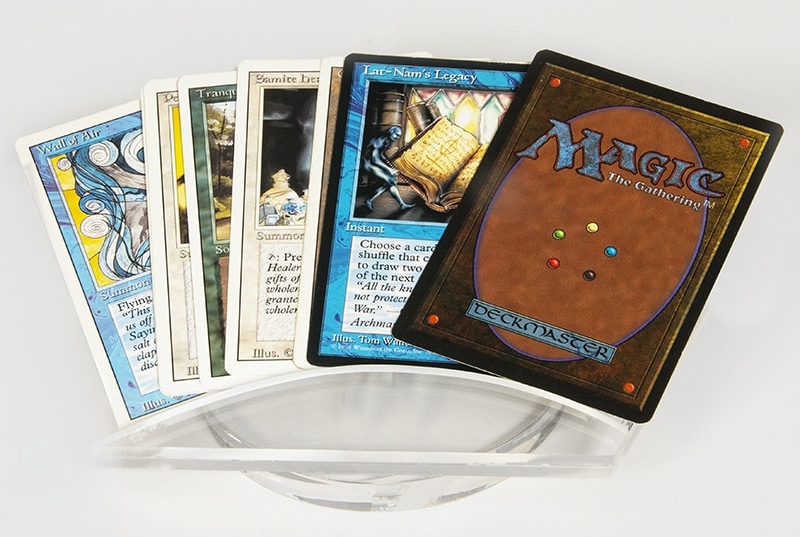
Magic: The Gathering cards from the collection of The Strong National Museum of Games (Rochester, USA). In 2019, the museum included the game in its National Hall of Toys of Fame [12].
CCGs are interesting because they combine two long-standing practices that previously rarely intersected: card games and collectible card games. The history of Magic is usually told from the perspective of the publisher and the game’s creator [14]. Here, the genre is examined more broadly—as the culmination of a long cultural line, spanning from 19th-century playing cards and tobacco inserts to 1990s tournaments.
«As devoted players bought cards, saved cards, traded cards, and bought more cards, the collectible card game genre was born» (Players bought, saved, traded, and bought more cards—thus the CCG genre was born) [12].
Topic — card games as a part of play culture. Subject — the origins of CCGs and their development as an independent genre. Goal — to understand the practices from which CCGs grew and how they differ from traditional card games.Objectives:
- To trace the history of playing cards and card games.
- To examine collectible cards as a cultural and commercial phenomenon.
- To analyze early attempts at playing with collectible cards.
- To describe the creation of Magic: The Gathering and the features of its model.
- To define the differences between CCGs and traditional card games and to outline their influence.
What made CCGs a new genre, rather than just another variation of a card game?
Hypothesis: Trading card games (TCGs) emerged at the intersection of card collecting and competitive card play. Attempts to combine these elements existed previously, for instance, in baseball games from 1904 and 1951 [2; 15], but in those games, the collection did not influence the match. Magic made the collection an intrinsic part of the game—what you possess determines the deck you build and what you can accomplish at the table.Chronological Framework — from the 1870s, when mass-produced collectible cards first appeared, to the late 1990s, when the genre fully solidified. Earlier card history is only relevant as background context.Each example was selected based on a single criterion: it must demonstrate the relationship between a card as part of a game and a card as an object of collection.The research proceeds from the precursors to the genre’s emergence, followed by an analysis of the genre itself.
Typically, KKI is written about as a commercial phenomenon or the history of a single game. Here, the genre is presented as a point of intersection between two cultural practices, where the collection has become part of the rules.
1. Historical Context
To understand what the CCGs brought to the table, we first need to look at how a standard card game and its card collection were structured before they existed as separate entities.
Mamluk playing cards (Kandzhifa). Egypt, c. 1500. Topkapi Palace Museum, Istanbul. The deck was already structured as a system: four suits with ranks within each. European decks would adopt this structure almost without change.
National variants of the deck quickly emerged across Europe. Italian and Spanish suits retained cups and swords; German decks introduced hearts, leaves, acorns, and clubs; and French decks featured hearts, clubs, trumps, and spades, which eventually spread globally [13]. In the 15th century, Tarot, a deck featuring an additional series of trump cards, appeared in northern Italy. Today, Tarot is often associated with fortune-telling, but it was originally used for games, and its opulent illustrations did not prevent it from remaining a playing card deck [13].
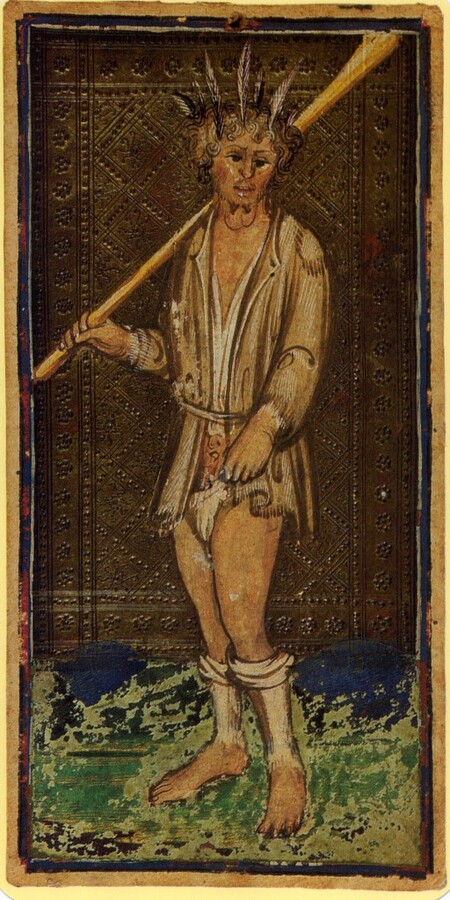
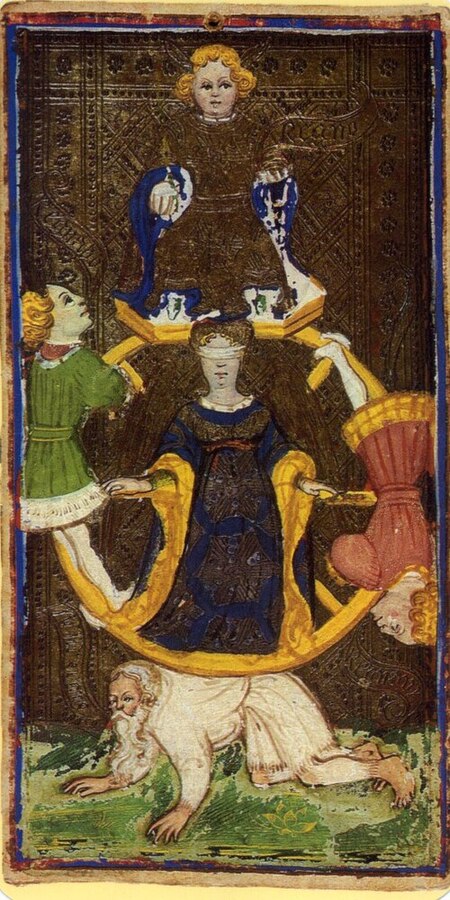
«The Fool» and «The Wheel of Fortune» from the Visconti–Sforza tarot deck. Northern Italy, mid-15th century, attributed to Bonifacio Bembo.
Many games have evolved from these decks. Card game historian David Parlett divides them into groups based on the main principle [13]. In trick-taking games (whist, bridge, preference), the goal is to win rounds with higher cards. In set-collection games (Rummy and similar ones), the objective is to gather specific combinations. Gambling games (Pharaoh, later Poker) revolve around betting on a random outcome. And patience games transform the deck into a puzzle for one person.
Piquet Deck: 32 cards of French suits. Piquet is one of the oldest trick-taking and combination games.
Despite all the variety, these games share something in common: everyone uses the same deck. No one can bring their own cards to the table that are stronger than their neighbor’s. In Kaioua parlance, a traditional card game combines agon (the skill to play the hand) and alea (the randomness of the shuffle), but it does not account for the inequality an individual brings from the outside [3].
Happy Families game cards: «Mr. Bones the Butcher» and «Mrs. Potts, Malara’s Wife.» England, second half of the 19th century, illustrations by John Tenniel.
Happy Families is a prominent example among these games—a mid-19th-century English children’s card game produced by John Jaques & Son, featuring illustrations by John Tenniel, the future illustrator of Alice’s Adventures in Wonderland. The deck consists of «families» of four characters: for example, Mr. Bounds the Butcher, his wife, son, and daughter. The player must assemble entire families by requesting missing cards from their neighbors. The date of the first release is varied; it is usually cited as 1851, though the Victoria and Albert Museum dates the game to the 1860s.
In the traditional game, the deck is shared. Players compete to see who can play the same cards in the best way.
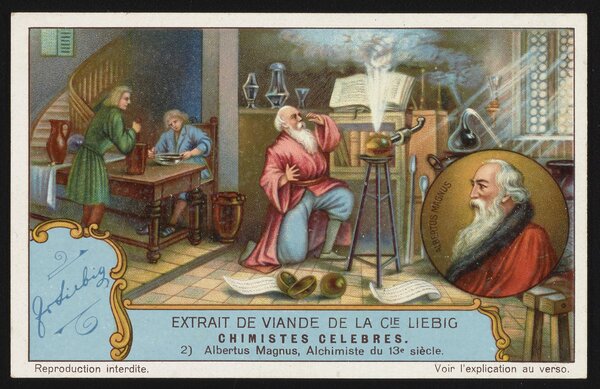
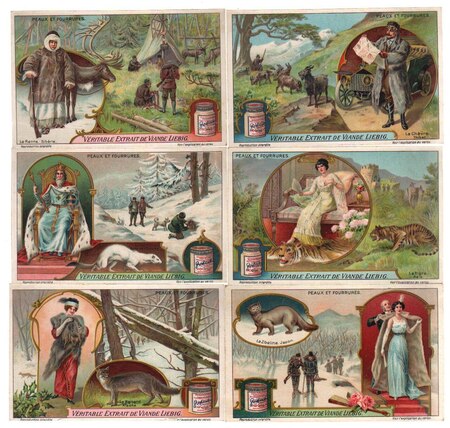
Liebig card «Albertus Magnus, 13th-century alchemist» from the «Famous Chemists» series. 1929, Liebig’s Extract of Meat Company. The complete Liebig card series «Leather and Fur.» Such series, consisting of six cards, were released from the 1870s until the mid-20th century.
The second line of development, without which collectible cards (CCGs) would never have emerged, is the collectible card. During the second half of the 19th century, color lithography became significantly cheaper, and images printed on cardboard proved to be a convenient form of advertising. Among the earliest and most famous were the cards produced by the Liebig company, which manufactured meat extracts. Starting in the 1870s, these cards were included in product packaging and released in thematic sets, usually containing six cards each—covering topics such as history, geography, science, and professions.
Tobacco companies followed the same path. In the late 1880s, cigarette manufacturers began putting cardboard cards inside packs—they made the package sturdier and encouraged repeat purchases. Soon, candy and chewing gum producers adopted this strategy as well [11]. The themes could be anything: actresses, flags, birds, or athletes.
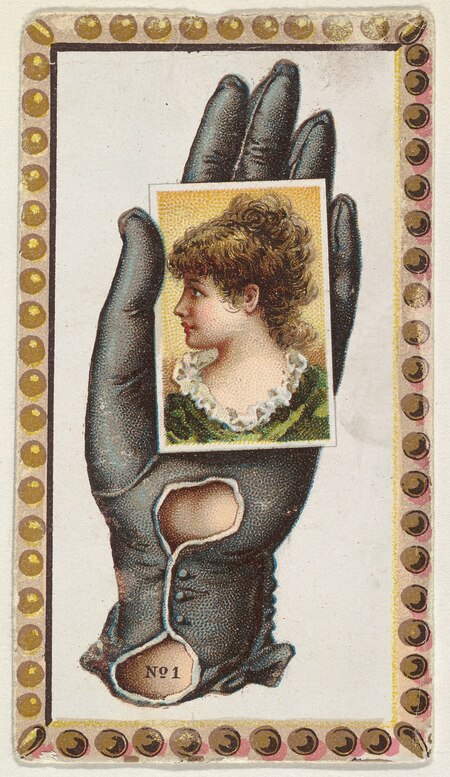
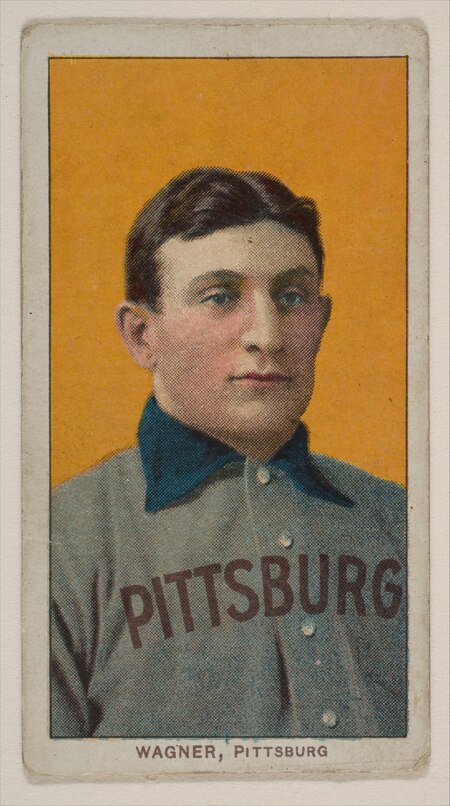
Card No. 1 from the Opera Gloves series for Allen & Ginter cigarettes. USA, late 1880s. Illustration 10. T206 card featuring «Honus Wagner.» 1909–1911, American Tobacco Company; specimen from the Jefferson Burdick collection, The Metropolitan Museum of Art.
According to Baudrillard, a collection is sustained by a missing object: the collector waits for the final card, and it is this absence that maintains interest in the entire series [1]. Producers exploit this directly: the card is hidden in the packaging, and the buyer does not know what they will get. The case of alea, which Kaioua describes as the foundation of gambling [3], moves from the game into the purchase itself. Our culture remembers this logic well in the 1990s generation: kids collected, traded, and won gum inserts from Turbo and Love is… («Love is…») in courtyards, and the rarer the insert, the more it was valued.
The collector is buying not a card, but a chance.
By the early 20th century, the card had already become both an object of collection and a carrier of information. The next step—playing with cards—was attempted several times, but a new genre did not successfully develop from it for a long time. The earliest known example is the The Base Ball Card Game, produced by Allegheny Card Company, which was registered on April 5, 1904. Each card featured the portrait of a major league player on the front and baseball iconography on the back. The set included 104 player cards and 8 team scorecards. Sources offer varying accounts of the game’s fate: one version suggests it simply failed to gain popularity and was forgotten until Garfield’s era, while another states it never made it to market and survives as a single, unique copy discovered in the 1980s [2]. In any case, the idea existed, but it never became a mass practice.
The Base Ball Card Game, Allegheny Card Company, 1904: a player card (Pitcher Brown from the St. Louis team) and the reverse side marked «Registered April 5, 1904.» The card already resembles a trading card, but the set is fixed, and there is nothing to collect.