Concept.
Grief is not always expressed through words. Sometimes, a person’s experiences are spoken far more eloquently through their movements: an outstretched hand, a bowed head, an attempt to embrace or touch someone who can no longer be reclaimed. In the moment of loss, the body seems to begin speaking in place of the person. It is this nonverbal language of grieving that becomes the starting point of my research.
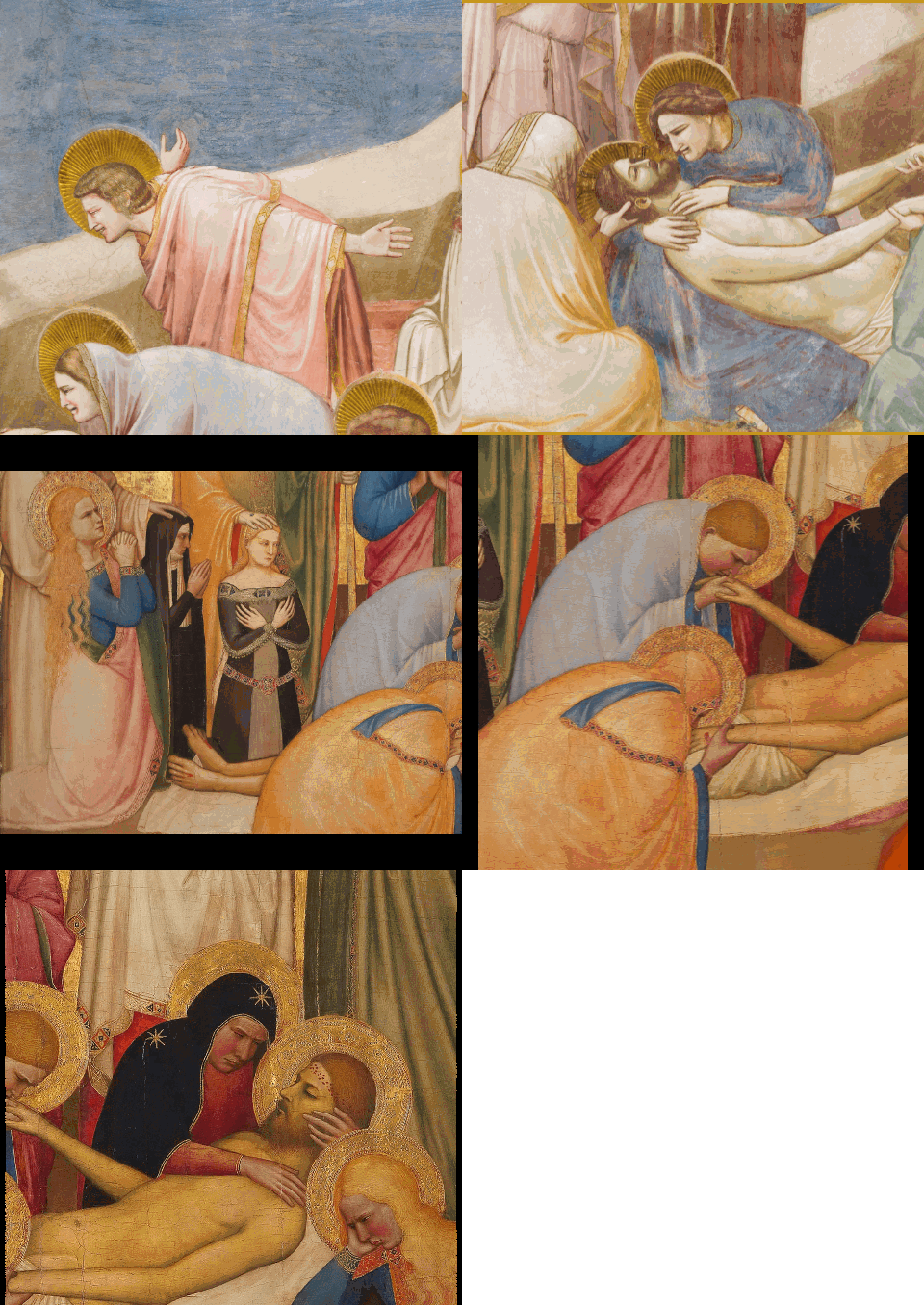
I want to examine how grief and the farewell to the deceased Christ were depicted in 14th-century Italian art. To do this, I am focusing on three scenes: The Deposition from the Cross, The Lamentation, and The Entombment. These scenes represent different moments of one single event—from the removal of Christ’s body from the cross to his burial. Each scene illustrates a distinct quality of the characters' interaction with the deceased: they support him, embrace him, surround him, or prepare him for burial.
The central question of my research is: how do the posture and movement of the human body assist artists in conveying grief in scenes of farewell to the deceased Christ? I aim to understand which gestures are employed to express emotional states and how their role changes depending on the depicted moment. I hypothesize that grief is revealed not only through facial expressions but also through the physical interaction between characters.
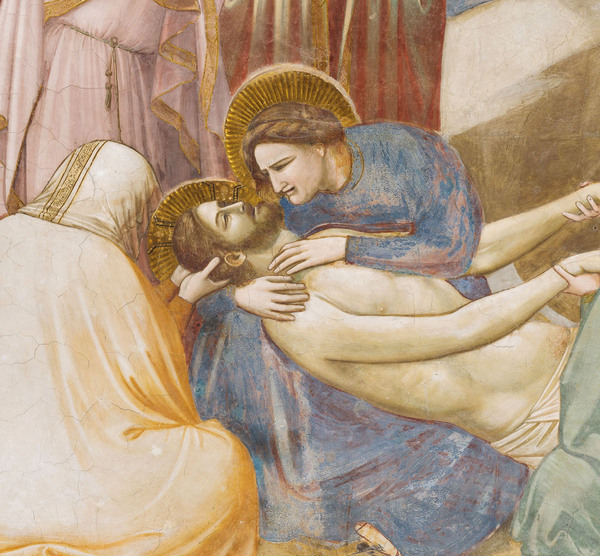
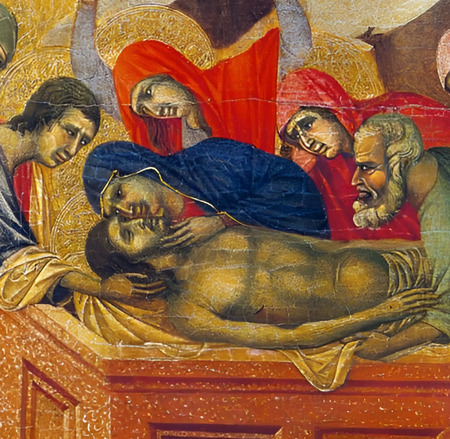
My focus will be on the positioning of hands, head and torso tilts, touches, embraces, and kisses. I want to examine how characters support Christ’s body, press against him, or reach out to him while maintaining distance. Figures that do not make direct contact with the deceased are also important—their poses and gestures contribute to creating the overall scene of mourning. The same gesture can hold different meanings: a touch expresses closeness and love, but simultaneously underscores the impossibility of bringing the person back to life.
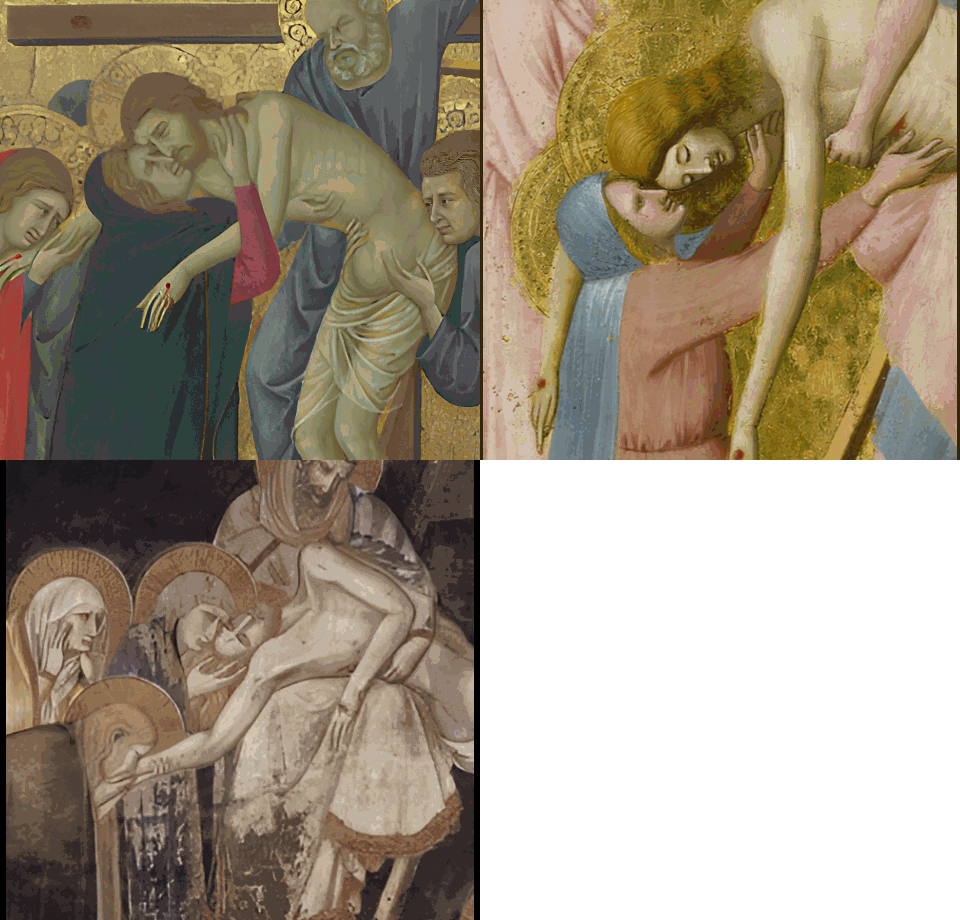
I will pay special attention to the placement of the figures in relation to Christ and to each other. Who is closest to his face, who is supporting the body, and who remains on the periphery? Can the distance between figures convey their relationship to the event as powerfully as physical contact? I am interested in tracing how artists distribute gestures among the participants in the scene and use that distribution to build the composition. To do this, I will compare works by various Italian masters of the 14th century, look for recurring gestures, and note the differences in their depiction. Comparing three different narratives will allow me to trace how the nature of the interaction with Christ’s body changes—from the immediate removal from the cross to the final farewell before the burial.
Throughout this work, I plan to examine the pieces holistically and also to study their fragments individually. This approach will allow me to perceive the overall composition while also focusing on the details—such as the gestures of the hands, the positioning of the heads, and the nuances of the touches—which might be overlooked when viewing the image as a whole. My research focuses on how the human body becomes a medium for expressing grief. Through gestures, postures, touches, and the distance between figures, I intend to understand how 14th-century Italian artists conveyed the experience of loss and farewell to the deceased Christ.
Section I. Taking Down the Cross
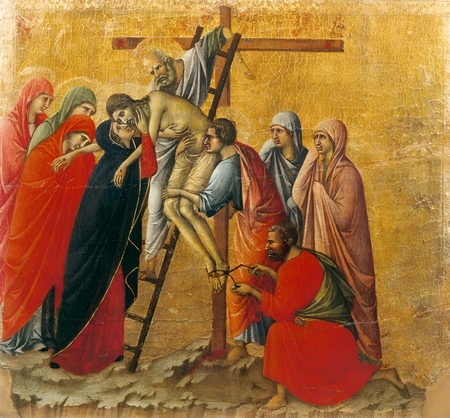
First, I would like to compare two works.
Дуччо ди Буонинсенья
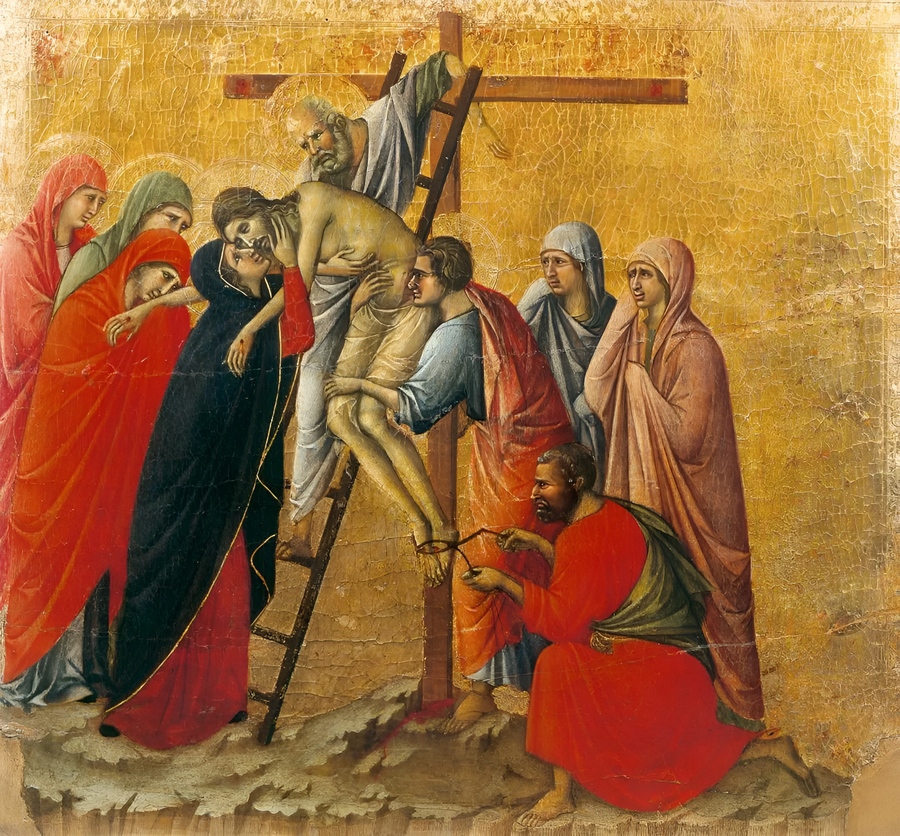
«Снятие с креста» (сцена 21 из «Маэсты») (1308-1311)
Уголино ди Нерио
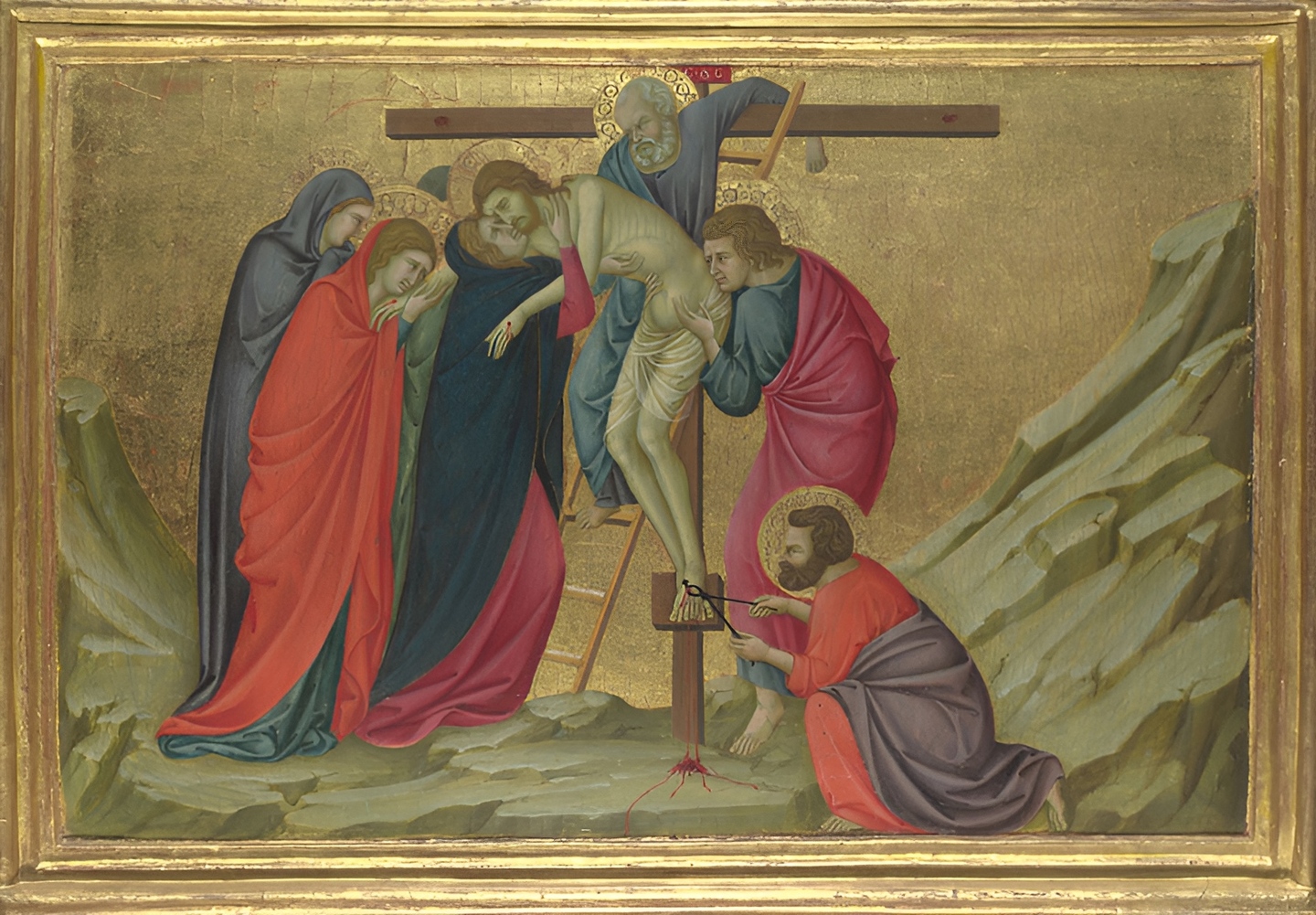
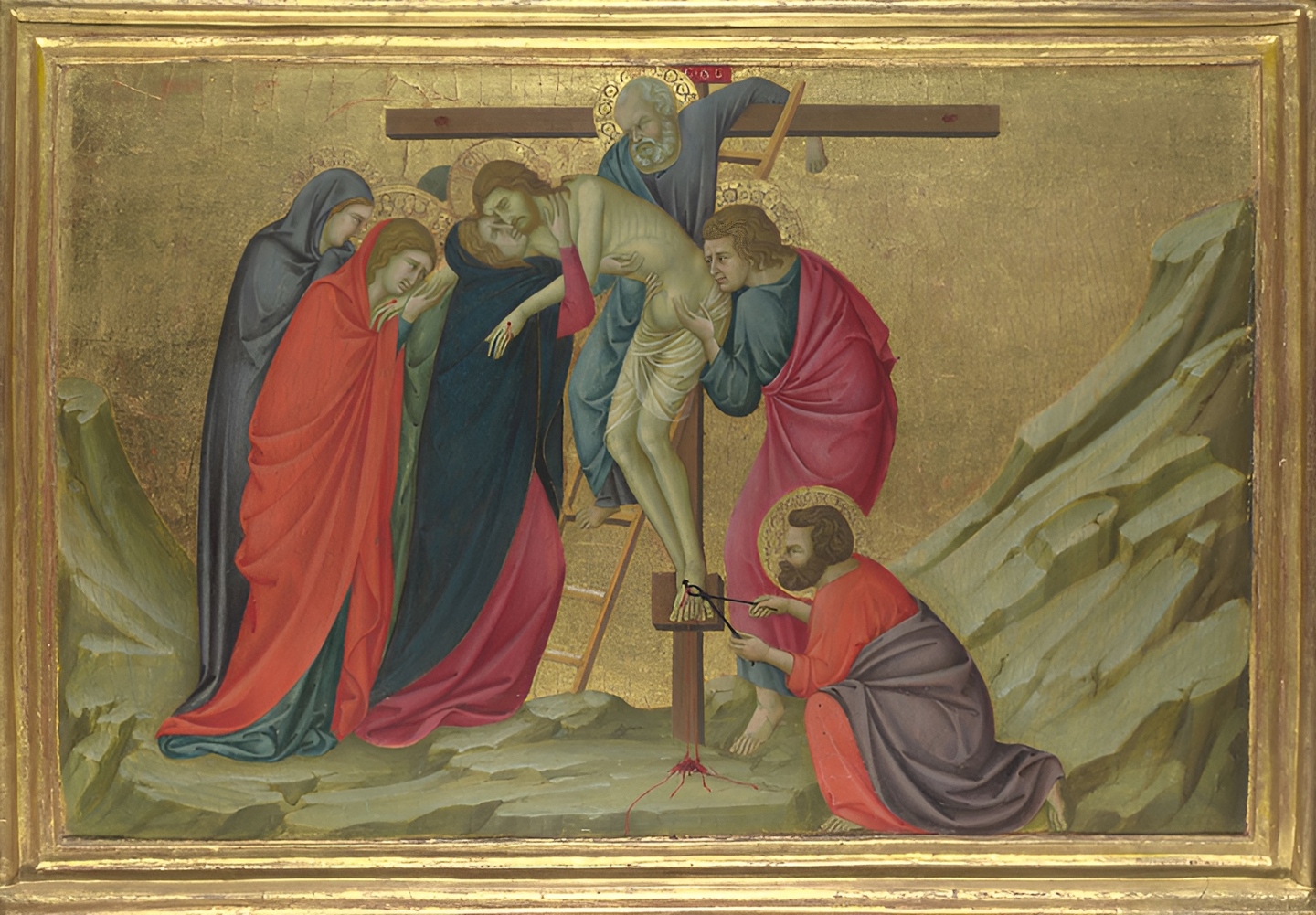
«Снятие с креста» (1325–1328)
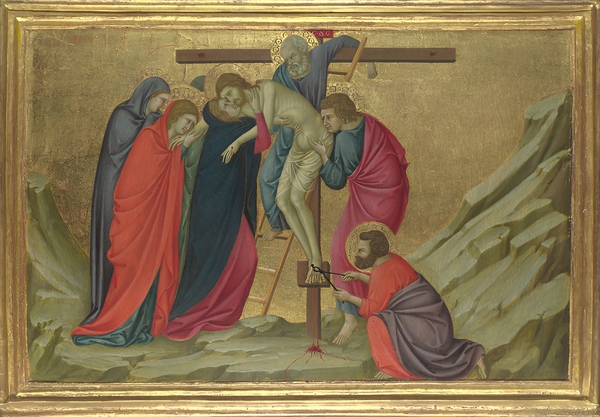
There is a direct artistic connection between these two works. Ugolino di Nerio references Duccio’s «Maestà» as a model when creating his own altarpiece for the Santa Croce church in Florence.
However, differences between the works are still present. Ugolino reduces the number of figures and arranges their interaction with Christ’s body differently, making individual gestures more pronounced.
Duccio di Buoninsegna
«The Deposition» (Scene 21 from the Maestà) (1308–1311) Museum of Cathedral Works, Siena, Italy. Part of the «Maestà» altarpiece, created for the Siena Cathedral.
Duccio di Buoninsegna depicts the descent from the cross as a scene of intimate interaction between the characters and the body of Christ. Here, the corporeal language speaks volumes.
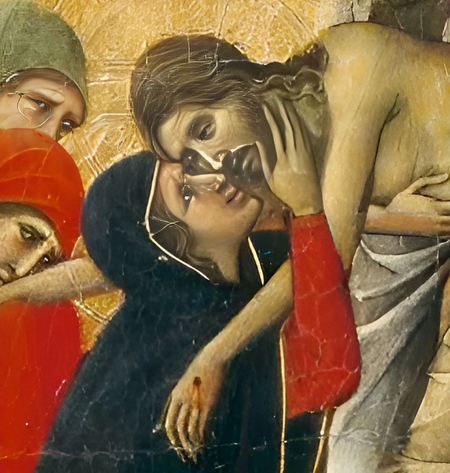
Mary of Nazareth conveys her grief primarily through moving toward her son. She reaches out toward his face, as if trying to maintain one last moment of closeness. Her gesture differs from the actions of the other characters: she is not merely involved in taking the body down from the cross; she strives to touch Christ, to embrace him.
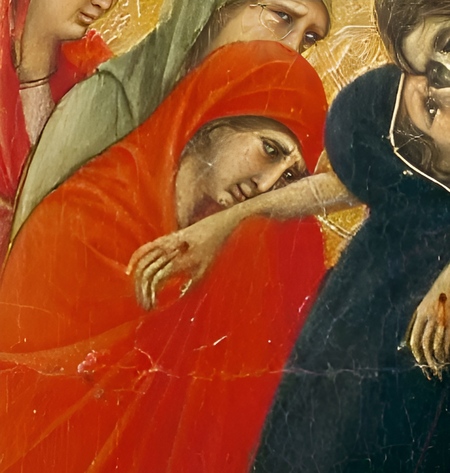
Maria Magdalena presses his hand against her cheek. She holds his hand near her own face. This gesture makes the grief particularly corporeal: the woman seems to be trying to extend contact with Christ, even after he has died. Furthermore, her posture is not about supporting or moving his body. The touch here becomes precisely an expression of sorrow.
The other women stand near Christ, bowing toward his body. They maintain a small distance. Their grief is conveyed through the angle of their heads and torsos, as well as through their hand gestures. The scene depicts varying degrees of intimacy—from direct contact to sorrow expressed solely through posture.
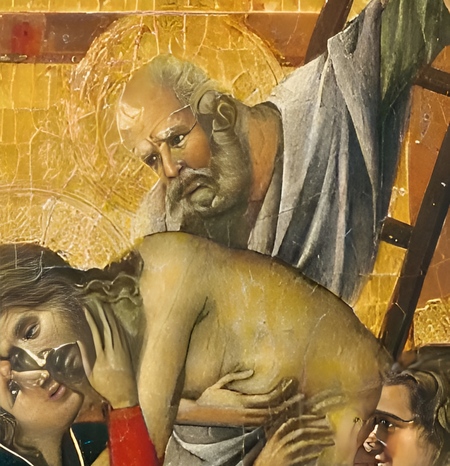
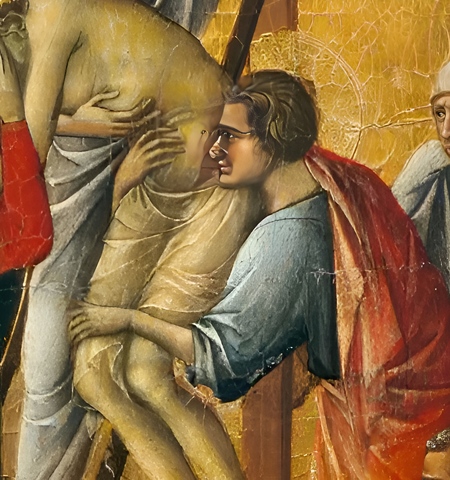
If the female figures in this scene more frequently express grief through the longing for touch and closeness with Christ, the men interact with his body in a slightly different manner. Their gestures are more concerned with physical support and the process of taking him down from the cross.
Ugolino di Neri «The Deposition» (1325–1328)
Ugolino di Nerio’s work, «The Deposition,» allows us to see how a similar scene is approached by a different artist. Ugolino di Nerio references Duccio’s composition, using it as a model, yet he subtly alters the placement of the figures and their interaction with Christ’s body. Specifically, he reduces the number of women present in the scene.
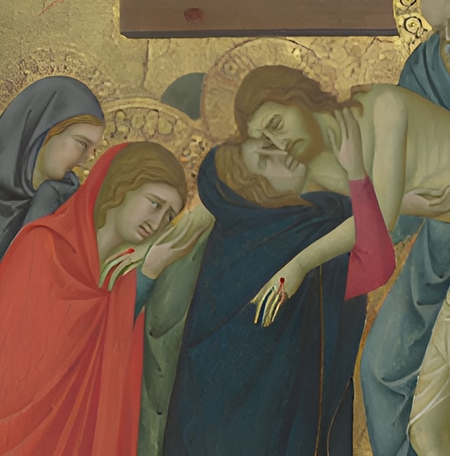
In Ugolino di Nerio, the physical closeness between the female figures and Christ becomes particularly noticeable. The Virgin Mary embraces her son, pressing her face against his. Unlike in Duccio, where she merely reaches toward Christ, Mary envelops him, as if trying to keep him near. Mary Magdalene stands beside her, pressing Christ’s hand against her cheek. This gesture echoes the scene in Duccio, but here it is integrated into a more intimate composition. Both women seek to maintain physical contact with Christ, yet they express their sorrow in different ways.
In Duccio’s work, the men are mainly engaged in supporting and taking the body from the cross. In Ugolino’s, John’s figure becomes particularly emotional: the physical support transforms into an embrace.
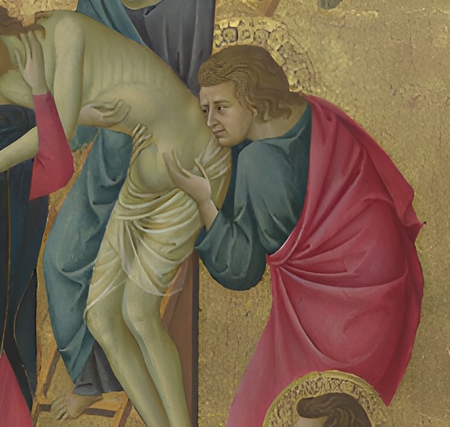
John clings to Christ’s body, not merely supporting it, but pressing it tightly to himself. This gesture retains the practical necessity of holding the body, yet simultaneously introduces a more overt emotional involvement. John seems unwilling to let go, so his movement is perceived not only as assistance in lowering Christ from the cross but also as an expression of personal grief.
In both works, a similar division of roles is maintained: women express grief through touch and the desire for closeness with Christ, while men participate in taking his body down from the cross. However, Ugolino noticeably alters the nature of this interaction. Where Duccio’s men support Christ’s body, Ugolino shows them tightly embracing him. The physical action here takes on a more emotional quality. The gesture of the Virgin Mary also changes: instead of trying to reach Christ’s face, we see an embrace where she presses herself against him, face to face. Meanwhile, the gesture of Mary Magdalene is repeated in both works.
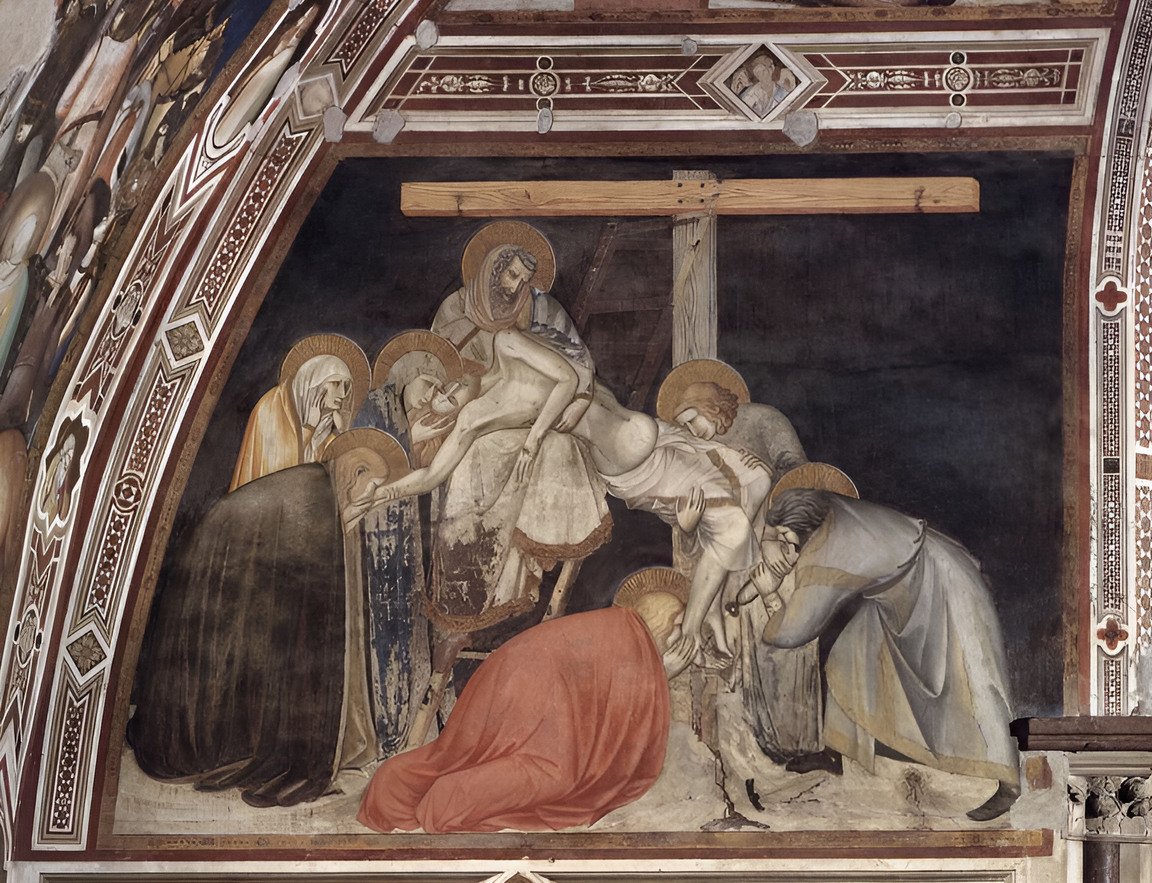
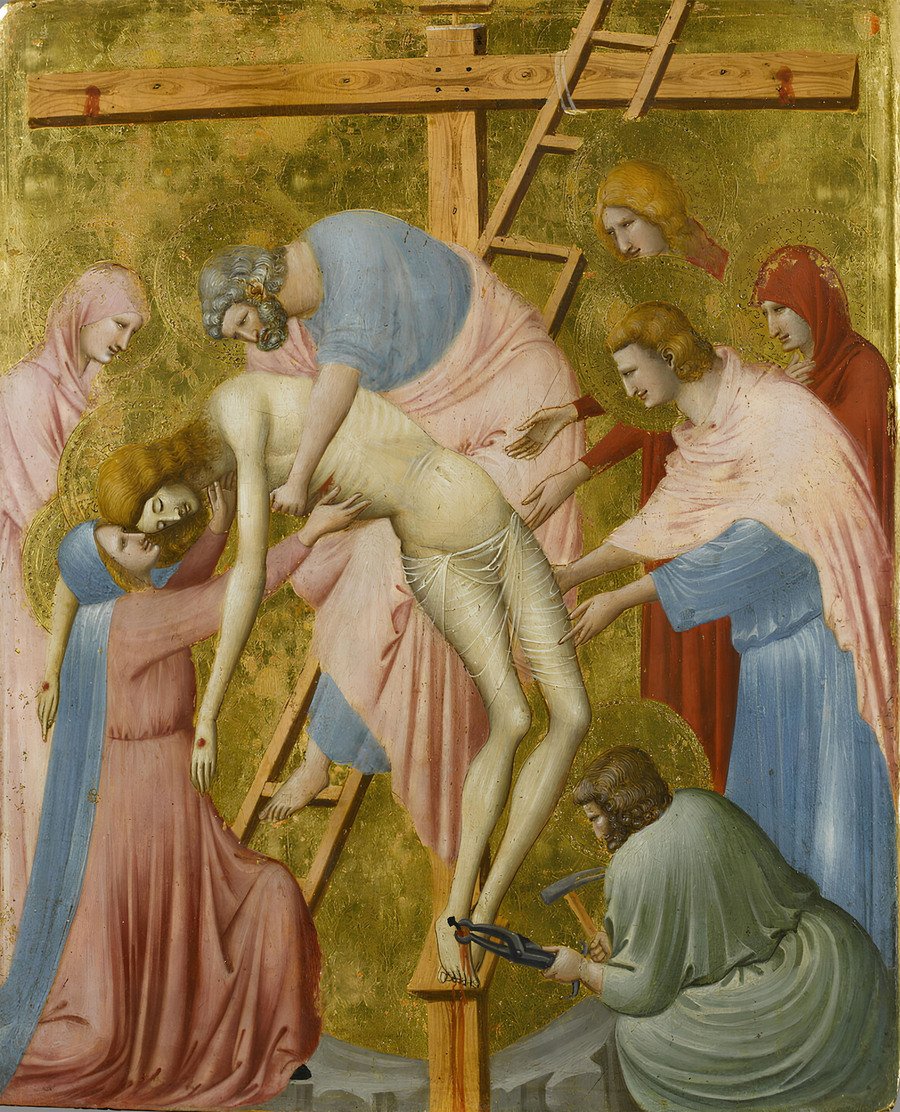
Pietro da Rimini «Descent from the Cross» (1325–1330) Louvre, Paris, France. Painting
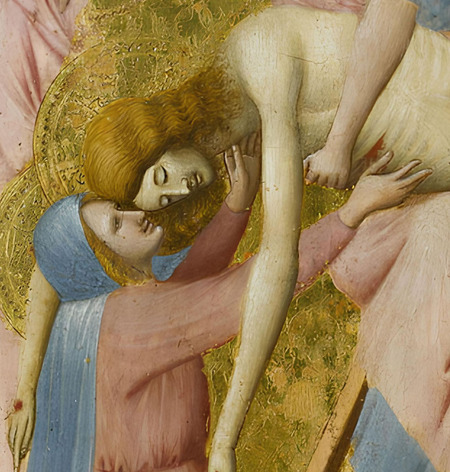
Unlike the previously discussed works, here Maria has not yet touched the body of Christ; she is only reaching out toward him, striving to embrace him. Thus, grief and emotional attachment in this piece are conveyed through the very motion toward Christ’s body and the desire to hold him.
The grief in this work manifests not only through the actions of the Virgin Mary but also through the gestures of the other figures. Their movements are directed toward Christ’s body. Some reach out to him, while others bring their hands to their faces. Thus, the sorrow assumes a collective expression, enveloping the entire group present.