Concept
In American cinema of the 1900s–1930s, transportation rarely remains in the background. It portrays the landscape, brings people together, serves as a setting, participates in the plot, and even dictates the entire film’s composition. This study examines modes of transport moving along a predetermined path (tracks or road) that carries people within a confined, shared space—such as a train, tram, stagecoach, or bus.
The working hypothesis is that transportation is a distinct space capable of fulfilling multiple roles simultaneously.
The landscape viewed from a train window is perceived differently than from a roadside: speed erases the foreground, and the world transforms into a sequence of shifting images [7]. Cinema inherited this framework: the train car window was equated with a rectangular screen [6], and the gaze of a passenger carried by the apparatus is considered one of the origins of cinematic perception [5]. The ultimate manifestation of this connection was in the halls of Hale’s Tours, where viewers sat in train cars, looking out the windows at the passing scenery [4; 5].
Yet, the train car has an interior side. Inside, people sit next to one another, and the arrangement of passengers reveals how they are connected to each other. Compartments in railway cars were separated into classes, while conversation never ceased in the open carriages [7]. Therefore, the window can look in two directions: outward, at the landscape, or inward, at the people. Motion and intimacy are linked here in one place: transportation presents a view of the world while simultaneously confining people together.
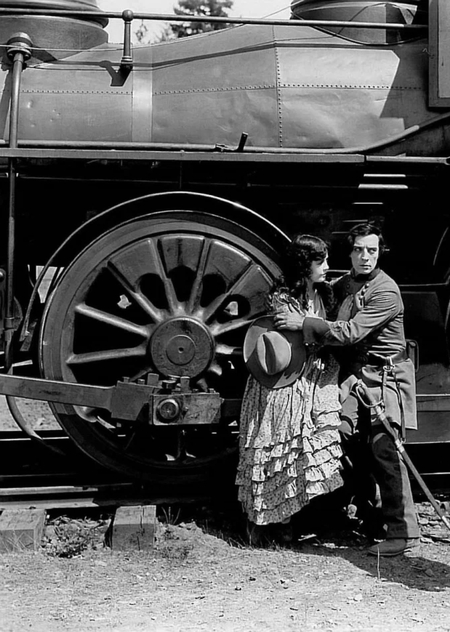
Next, transportation is examined through five roles. The «Window» section has two parts: «Landscape» shows how the picture visible through the glass conveys the movement and emotions of the characters, while «People» demonstrates the ridership as seen through the window frame. In the «Fellow Travelers» section, the confined space brings together and forces different people into proximity [1; 3]. «Arena» describes the train and tracks as a setting for fights and chases [6]. In the «Partner» section, the vehicle participates in the plot on par with the protagonist [5]. «To and Fro» illustrates how the route forms a loop, establishing the film’s composition [3; 5]. The structure is deliberately non-chronological. Films are compared based on the role of the transportation, not the year of release, and the same film may appear in multiple sections—for example, «Stagecoach» appears in «Window, ” „Fellow Travelers, ” and „To and Fro.“ The body of research consists of seven American films from 1903–1939: The Great Train Robbery (E. S. Porter, 1903), What Happened in the Tunnel (E. S. Porter, 1903), General’s Steam Engine (B. Keaton, K. Bruckman, 1926), Sunrise (F. W. Murnau, 1927), Shanghai Express (J. von Sternberg, 1932), It Happened One Night (F. Capra, 1934), and Stagecoach (J. Ford, 1939). The films span different decades and were directed by various filmmakers, so the roles of the transportation are not dependent on the style of a single author. The main method involves comparing shots in which the transportation fulfills the same function.
Window
Glass has two sides. Through it, you can look out, revealing the landscape at the center. Alternatively, you can look in at the people traveling, and the people then occupy the center. In this feature, the window moves in both directions—from the landscape to the people.
Landscape
«What Happened in the Tunnel» (1903, E. S. Porter)
In «What Happened in the Tunnel,» the window is used to indicate that the compartment is moving. In each frame, a different image is visible outside the glass, but the company inside remains seated in the same spots. The window functions as a motion indicator.
«Sunrise» (1927, F. V. Murnau)
In «Sunrise,» the window serves another function: expressing emotion. A man drives after his wife, whom he recently attempted to kill, and they stand side-by-side on a tram platform, looking down without meeting each other’s eyes.
Initially, outside the window is a quiet forest and a lake; later, the natural landscape transitions into an industrial scene. This change outside the window mirrors the shift between the characters: silence gives way to a crowded city, where they will soon reconcile [2].
«The Stagecoach» (1939, John Ford)
In «The Stagecoach,» if you look closely at the landscape, you can detect looming danger. Through the window, you first see a barren desert, and then approaching Indians.
People
Often, attention shifts from the landscape to the people.
«Shanghai Express» (1932, J. von Sternberg)
In «The Shanghai Express,» it is noticeable that the train windows are used to emphasize the character; the protagonist peers out, and the framing structure directs virtually all attention toward him.
Furthermore, this same technique illustrates the distinction between social classes. First-class passengers each occupy their own window seat in spacious, comfortable accommodations. Third class, conversely, is characterized by crowding—a huge number of people packed into a single window frame [7].
«The Transvoyager» (1939, J. Ford)
In «The Stagecoach,» the window is very small. This makes the focus on the characters and their emotions even more pronounced.
The windows are occupied by passengers, and in the pursuit, these same openings become the point from which shots are fired. The frame, which at the beginning of the segment showed nature, here shows people and their attitude toward the events unfolding around them: fear on the girl’s face, and the men are in a state of excitement, shooting during the attack.
The window functions as a shift in focus. In «What Happened in the Tunnel, ” „Sunrise, ” and „The Stagecoach, ” it directs the viewer’s gaze outward: initially, the landscape merely indicates movement, then it expresses the characters' emotions, and finally, it demonstrates danger. In „Shanghai Express“ and „The Stagecoach, ” the window allows a different perspective, revealing people. It is precisely through these frames that emphasis is placed on the characters, their characteristics, and their emotions.