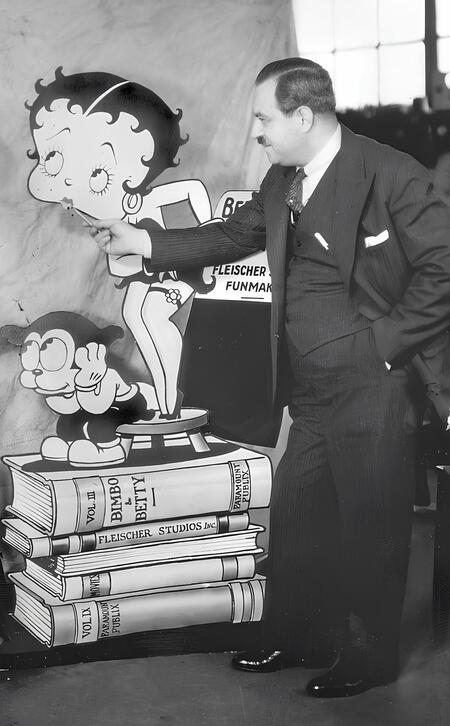
Max Fleischer: «No work is ever too tedious» [1]
Concept
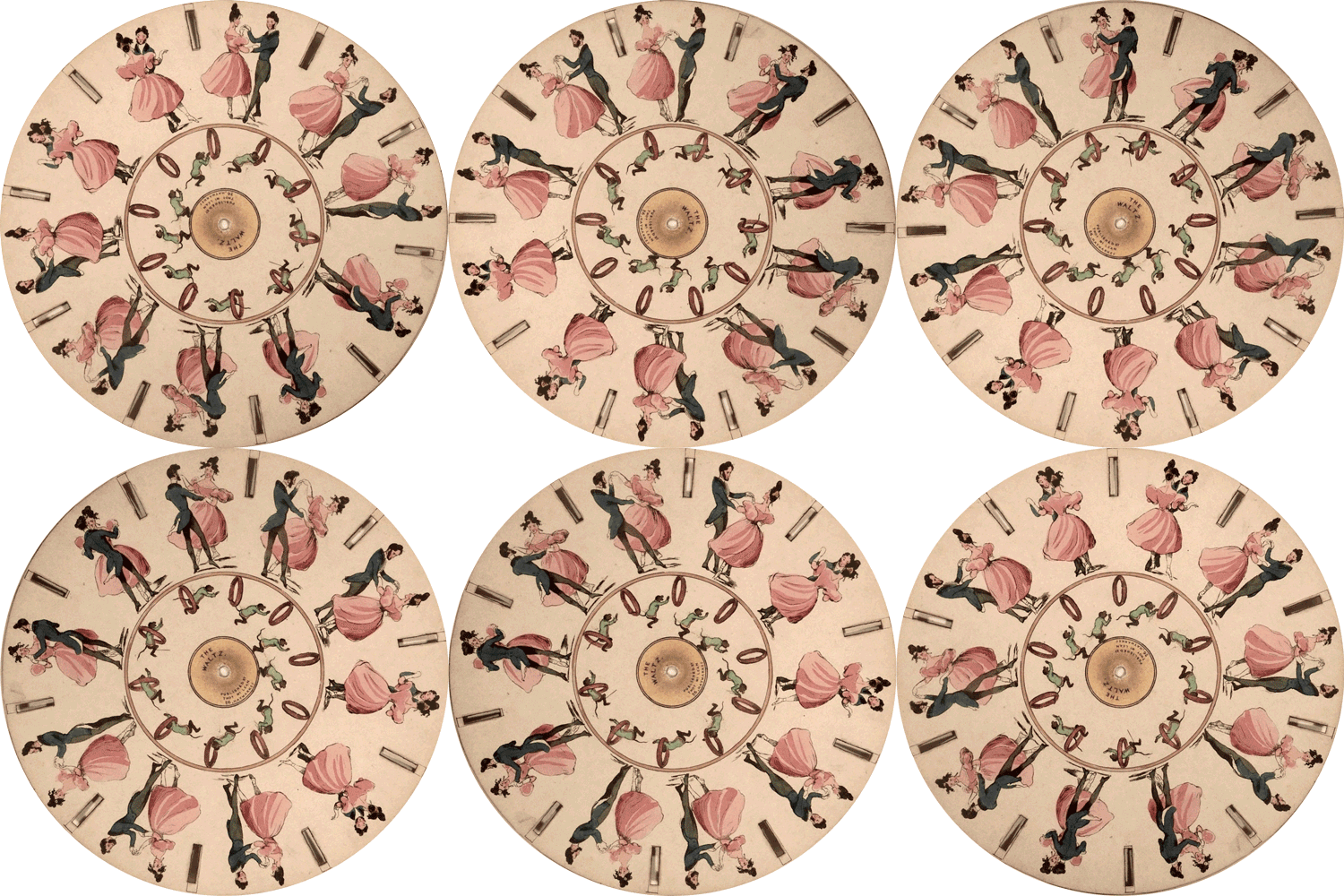
Animation is often perceived in the collective consciousness as mere entertainment—a fairy tale or some comical spectacle. However, by its aesthetic and technical nature, it is a far more complex, profound, and universal visual language.Unlike narrative cinema, which is rigidly tied to material reality and forced to document only what physically exists before the camera lens, animation possesses absolute freedom. It is capable of constructing worlds entirely from scratch, defying the laws of gravity, or conversely, visualizing abstract physical phenomena with extreme precision—things invisible to the human eye.Thomas McLean—"The Waltz» stereoscope disk, from the series «McLean’s Optical Illusions,» 1833.
The topic selection is based on studying an under-explored vector of early animation. In the early 1920s, the industry developed primarily as a comedic mainstream, but concurrently, a utilitarian direction was forming where drawing was stripped of decoration and transformed into a moving schematic.
Max Fleischer’s films—such as «Einstein’s Theory of Relativity» (1923), «Evolution» (1923), and «How to Shoot the Lewis Gun» (1918)—and a number of others stand as a unique artifact of that era. They prove that animation became the progenitor (or perhaps grandparent) of modern infographics, motion design, and scientific film a century ago.
The core question of this study is how Fleischer managed to translate complex abstract physics formulas into a comprehensible language of on-screen imagery before the advent of computer graphics. This required not only technical proficiency but also abstract conceptualization, ensuring that the content could be understood both by the animator and by the viewer afterward.
It is possible that the author’s background as an engineer, coupled with his experience in scientific journalism and his inventions (notably, the rotoscope), helped in this process. This allowed him to develop a system of vivid visual metaphors that fused strict schematics with live cinematography. However, we will elaborate on this in more detail later.
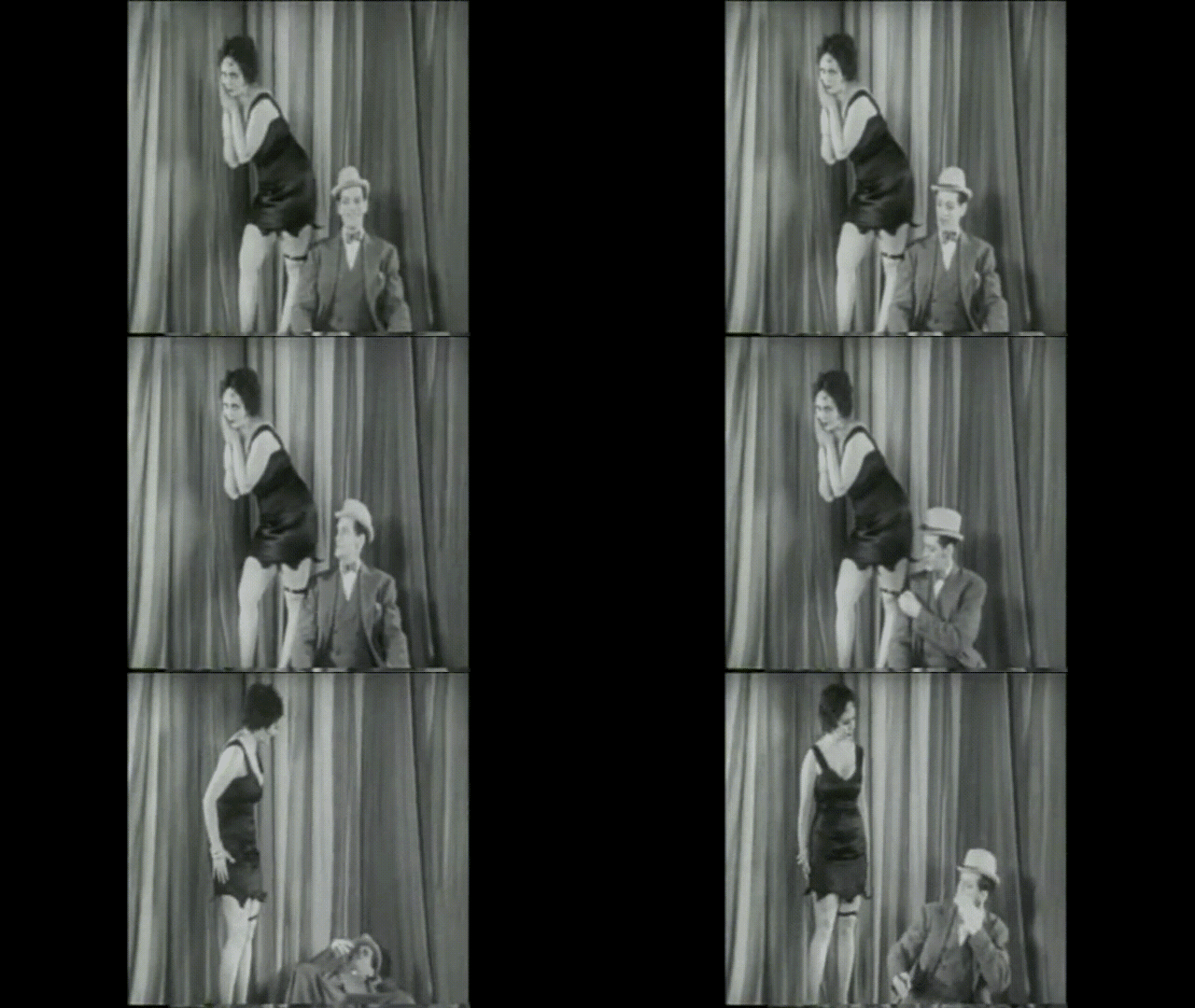
Fleischer Studios — a fragment from a working on-set film shoot of the actress-model in the guise of Betty Boop, intended for subsequent rotoscoping, 1930s
The principle for selecting material and research textual sources is based on chronological and comparative approaches.The primary subject of the visual research, in the majority of cases, is the restored version of the 1923 film «Einstein’s Theory of Relativity,» from which key schematic scenes and textual explanations were extracted, while also considering other similar works. To build historical context and contrast, footage from early 1920s entertainment cartoons (such as the «Felix the Cat» series, «Clown Coco, ” and others), newspaper clippings from that time or later, and journal excerpts were also utilized, alongside later works from Fleischer Studios (for example, „Betty Boop“ from 1930) to demonstrate the evolution of the directorial style. Additionally, fragments, clippings, and footage from other years were incorporated into non-primary sections of the research (such as the concept) to provide variety to the film.For the textual component, the research relied on primary sources and foundational works on the history of animation. The study analyzes the original intertitles of the 1923 film itself, as well as Fleischer’s own statements on the art of animation.
Excerpt from Leon Schlesinger Productions (Warner Bros.) — «Sittin' on a Backyard Fence» 1933
The principle of the research structure follows the logic of moving from a broad historical context to the detailed visual anatomy of the work. The paper is divided into five thematic blocks: an introduction; Fleischer’s professional journey from technical illustrator to animator; the technological challenge of 1923; a step-by-step analysis of the film’s main graphic techniques; and a comparative analysis of the author’s artistic and entertainment styles. This structure allows for a systematic answer to the central question, the defense of the hypothesis, and the revelation of the evolution of the animation language.
Categories
- Concept
- Context and Contrast (Introduction)
- Engineering Path
- The 1923 Challenge
- Visual Anatomy of the Film
- Fleischer vs. Fleischer
- Conclusion
Excerpt from Walt Disney Productions — «The Fire Fighters, ” 1930
Context and Contrast
By 1923, world animation had moved beyond the initial phase of technical novelties and had transformed into a full-fledged entertainment industry. The movie screens were dominated by comedic sketches and eccentric characters. Audiences came to laugh at the adventures of Felix the Cat or the early characters created by the young Walt Disney. Animation was perceived solely as a lighthearted genre, built on visual gags and the cheerful violation of the laws of nature.
Excerpt from Walt Disney’s «Alice’s Wonderland» (Alice Comedies series), 1923
At the same time, the world was gripped by a true scientific fever. Albert Einstein’s name dominated the front pages after his theory of relativity was confirmed and he received the Nobel Prize. Ordinary people debated the warping of space and the slowing of time, but almost no one could visualize how this functioned in practice. A standard movie camera was powerless—the invisible laws of physics could not simply be captured on film in a studio, and complex physics terminology was unfamiliar to many.
Excerpt from The New York Times — «LIGHTS ALL ASKEW IN THE HEAVENS, ” November 10, 1919. The note reports on the findings of solar eclipse observations by British astronomers, who confirmed the bending of light rays near the Sun and proved the correctness of Einstein’s theory of general relativity, „EINSTEIN THEORY TRIUMPHS.“
It was at the intersection of «loud» animation and high science that the unique experiment of the Fleischer brothers' studio emerged. In 1923, the twenty-minute film «Einstein’s Theory of Relativity» was released to the screen. For the first time in history, the tool of animated motion was used not for comedy, but to translate complex formulas into an accessible visual language on screen.
Engineering Track
Let’s start by exploring how the world-renowned author Betty Boop connects with mechanics and blueprints.Max Fleischer’s journey into animation didn’t begin in the traditional sense of an art studio, but with rigorous technical training. While studying drawing in New York, he also graduated from a Mechanical School, which forever shaped his engineering approach to every image.
Mike Fleisher: «Gilbert Evans was the greatest newspaper man I’ve ever known, and he could recognize genius when he saw it. Evans used to tell me that I had the makings of a great cartoonist, I took him at his word, and so, you see, I’ve been striving for greatness ever since.» [1]
(«Gilbert Evans was the greatest newspaper man I ever knew, and he could spot genius. Evans always told me I had the potential to be a great cartoonist; I believed him, and since then, I have striven for greatness.»)
Max took his first steps into his profession at The Brooklyn Daily Eagle. Beginning as a courier, he progressively mastered the roles of photographer and staff cartoonist, learning to work with printing plates, optics, and sequential newspaper strips. A key milestone was his position as art editor at the popular science magazine Popular Science Monthly. His work visualizing mechanisms and scientific discoveries for a mass audience shaped his unique approach: the ability to translate complex, abstract concepts into clear diagrams and blueprints.
Max Fleischer — fragment from the series «E. K. Sposher, the Camera Fiend, ” The Brooklyn Daily Eagle, December 3, 1903.
Max Fleischer: «It was after I had made a fairly sizeable start as an artist on The Eagle that I went to Popular Science Magazine as a special writer and illustrator. There I first began to study the possibilities of the animated cartoon on the screen.» [1]
(«After I had made a fairly significant start as an artist on The Eagle, I moved to Popular Science Magazine as a special writer and illustrator. It was there that I first began to explore the possibilities of animation on the screen.»)
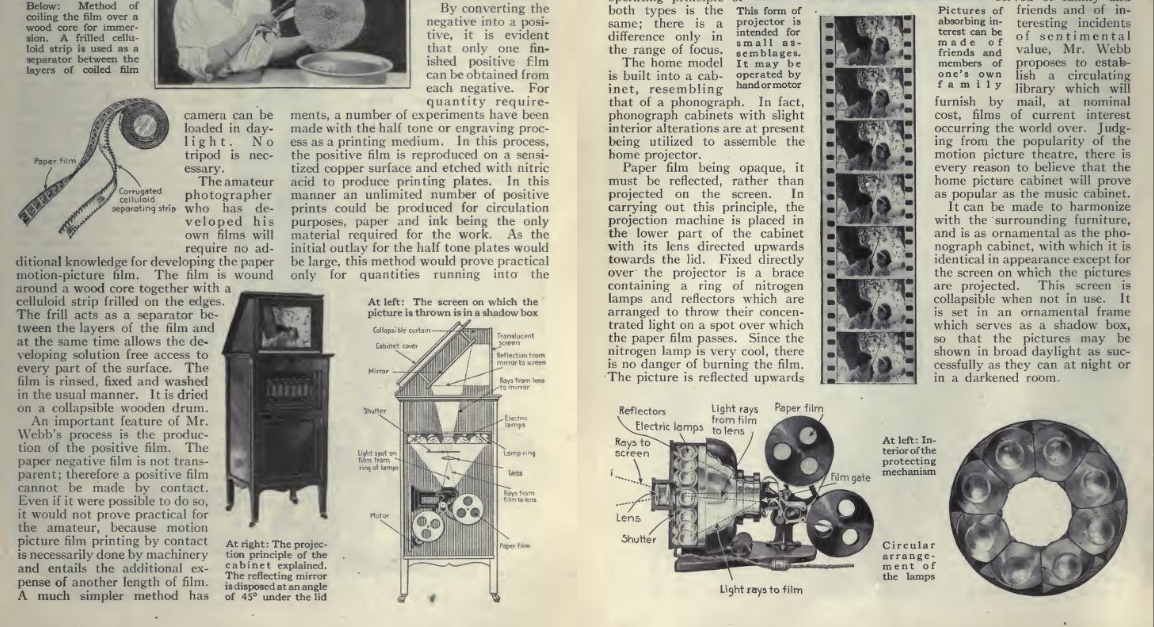
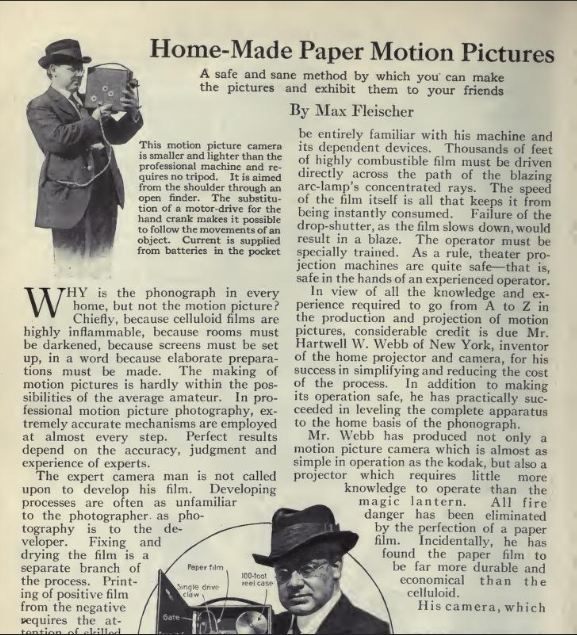
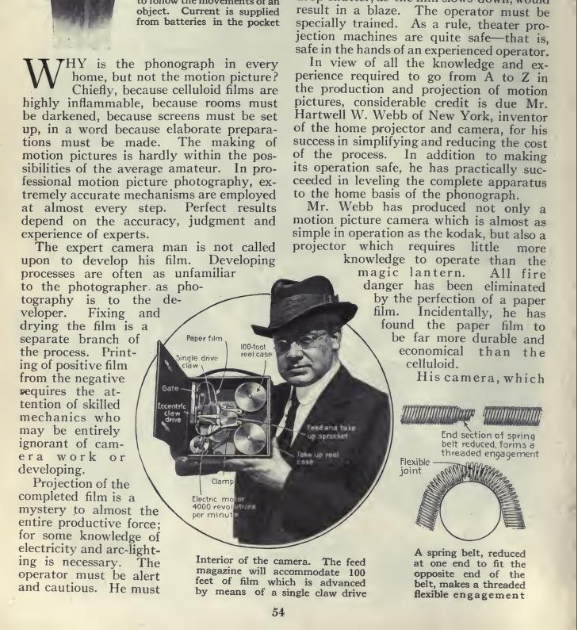
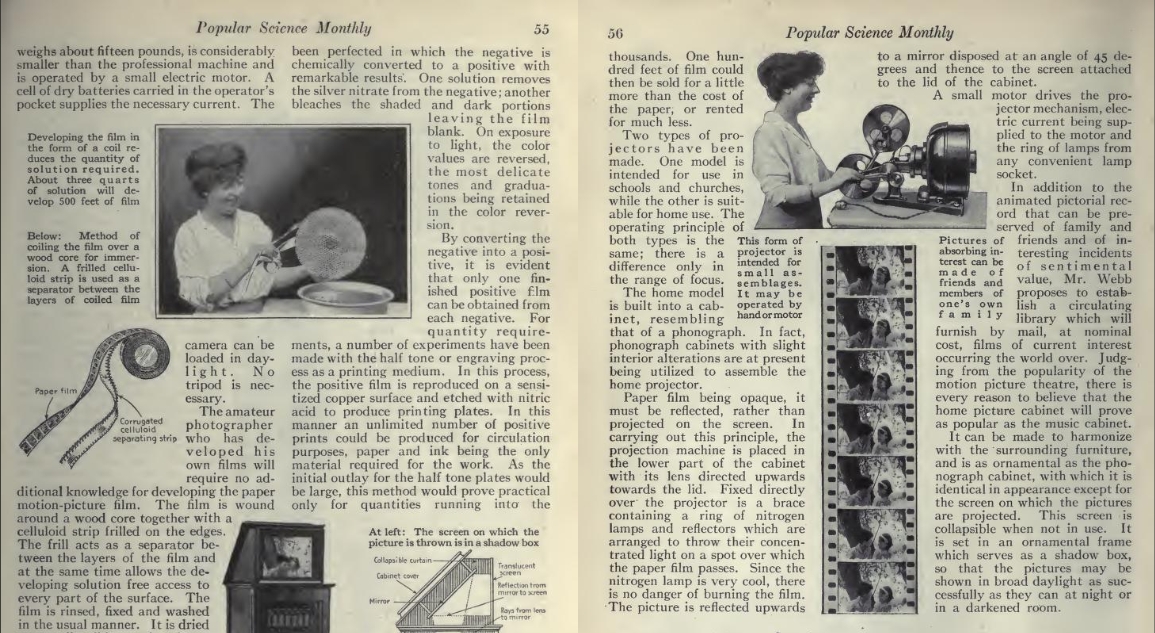
Max Fleischer — article and technical drawings «Home-Made Paper Motion Pictures» in Popular Science Monthly, 1917.
In the mid-1910s, commercial animation was just emerging, and the movements of drawn characters on screen appeared crude, angular, and unnatural. Fleischer set before himself not an artistic, but a purely engineering problem: how to mechanize the drawing process and achieve the fluidity of living motion.In 1915, Max filed a patent for the rotoscope (officially granted in 1917). As noted in the Fleischer Studios archive [3], the device was a hybrid of a projector and an easel: footage recorded live, frame by frame, was projected onto a glass panel, allowing the artist to precisely trace the contours of a moving figure. This transformed photographic plasticity into smooth graphic outlines.
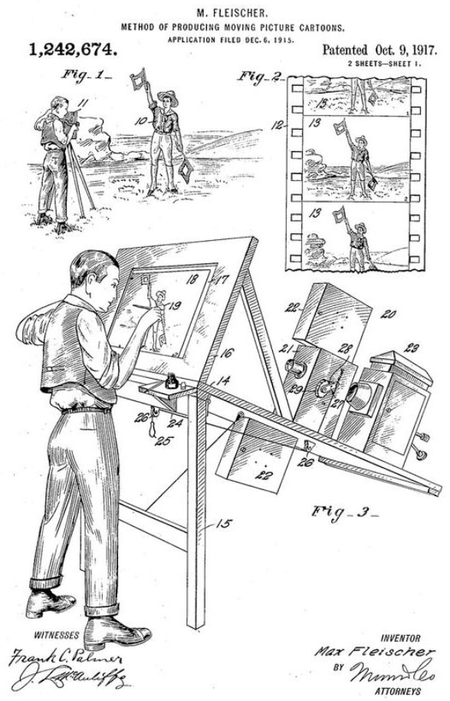
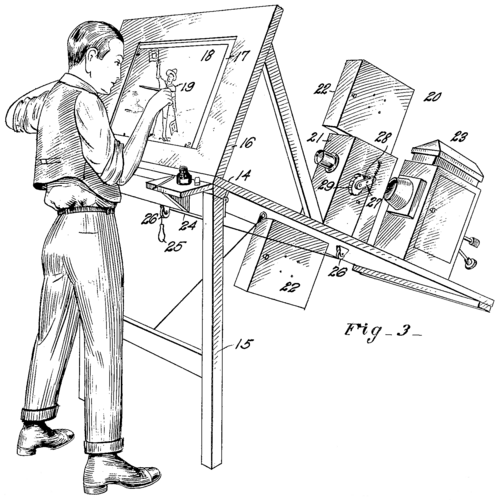
Max Fleischer — patent drawing of the rotoscope and an enlarged fragment, «Method of Producing Moving Picture Cartoons, ” patent issued October 9, 1917.
Excerpts from: Fleischer Studios — «Snow White, ” 1933 Documentary footage of the Cabe Calloway Orchestra, 1932 „Minnie the Moocher, ” 1932
To test the device in action, Max shot his brother Dave on film and then redrew the footage frame by frame. This resulted in the creation of the character Clown Coco (from the «Out of the Inkwell» series), whose movements astonished viewers with their incredible, almost unnerving realism.
Max Fleischer—a fragment of the original storyboard for Koko the Clown («Koko the Clown, ” Out of the Inkwell series) 1920s