Navigation
Concept When an Image Begins to Speak Music Without Sound Motion, Music, and Color Drawing on Film Stock and Creating Motion Conclusion
Concept
In the history of 20th-century abstract art, one of the most significant and vibrant shifts was the reinterpretation of the concept of imagery. Unlike traditional painting, which exists as a single, static frame, animation unfolds and develops over time. Depicted objects can change shape, position, and interact with one another. Thus, movement becomes an independent expressive medium capable of shaping composition and creating visual rhythm within the frame. It is precisely the capacity to control movement and time that makes animation particularly compelling for artistic experimentation.
A specific focus of these experiments involved synesthesia—the interaction of perceptions in which the qualities of one phenomenon can be conveyed through another.
In the art of the 1920s and 1930s, this principle manifested as a desire to find something that could translate music visually. If painting could convey a musical impression through color, composition, or line quality, cinema allowed for the reproduction of the very process of form transformation. The absence of a traditional narrative allowed the focus to shift to the organization of the image in time. Sound, lacking a visible form, gained the ability to exist on screen through movement, color, geometry, and spatial relationships. This was less about literally depicting the sources of sound and more about a complex process wherein the image acquired properties associated with auditory experience. Repeating shapes could create a sense of rhythm, abrupt cuts could mimic a musical accent, smooth motion could evoke a sustained sound, and changes in image scale and intensity could represent visual crescendos or diminuendos. Consequently, abstract animation became a space for experimentation—a realm where invisible musical motion found a material expression in shifting form. Therefore, the visualization of sound in abstract animation was fundamentally tied to the investigation of movement as an independent artistic language.
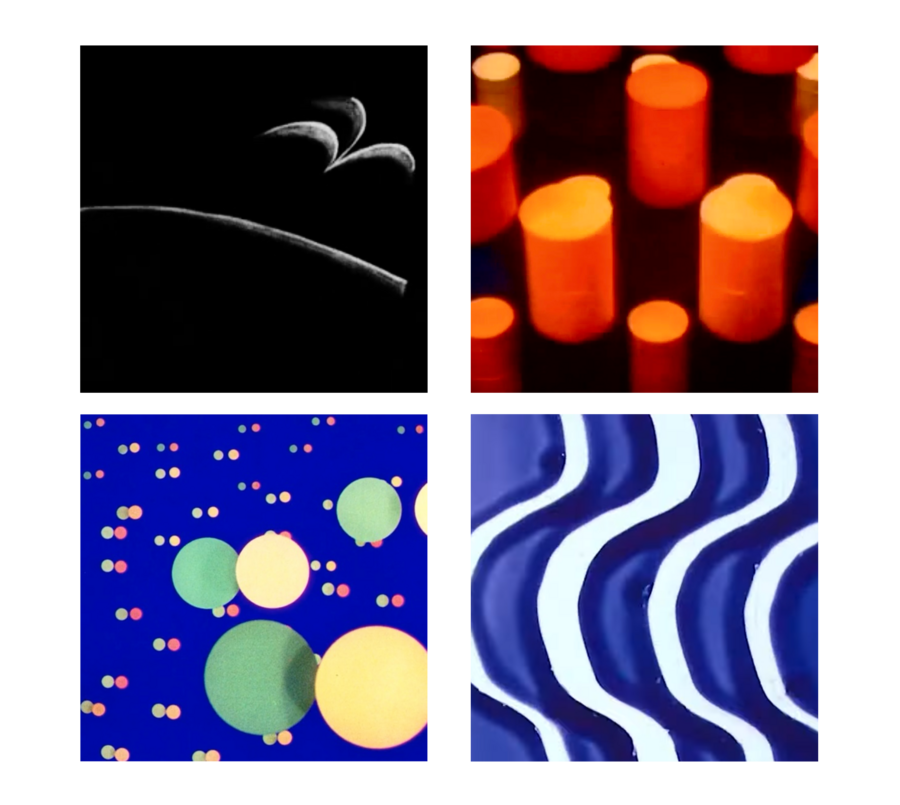
Top left: «Study No. 7» Oscar Fischinger, 1931. Frame fragment. Top right: «Composition in Blue» Oscar Fischinger, 1935. Frame fragment. Bottom left: «Optical Poem» Oscar Fischinger, 1938. Frame fragment. Bottom right: «Color Box» Len Lay, 1935. Frame fragment.
In these works, artists employed various methods of interacting sound and image. In some instances, the musical structure served as the blueprint for constructing the visual composition, even when the film lacked its own soundtrack. In others, the movement of forms was deliberately synchronized with the musical piece. Finally, some creators experimented with the very foundation of animation, creating images directly on film.
For example, the experiments of Viking Eggeling, which were initially silent and connected to music only through vivid associations conveyed by the rhythm of the animation, paved the way for Oscar Fischinger’s work. These pieces demonstrate a closer interaction between abstract animation and musical compositions. His Studies series, begun in 1929, illustrates how sequences of geometric and organic forms can be structured to align with musical material, resulting in complex visual compositions where movement becomes an immediate mode of interpreting sound.
From early experiments with composition, framing in rhythm, to more complex ways of merging image and music, artists explored the possibilities of cinema. The focus was on how animation can evoke a sense of sound through movement. Examining the works of Ruttman, Richter, Eggeling, and Fischinger will reveal diverse approaches to this problem and trace how the synesthetic principle influenced the development of expressive capabilities in abstract film.
When an image starts to speak
The connection between abstract animation and music within the characteristics of moving imagery. The viewer perceives not only the object’s form and color but also the speed of movement, direction, and duration of appearance. The significance lies not in a single composition, but in a multitude of compositions that succeed one another in adherence to a defined overall rhythm.
In music, rhythm is formed through the alternation of sounds and pauses, and the repetition of motifs. In animation, it is formed through the repetition of shapes and the alternation of light and dark areas.
If a specific shape appears multiple times at regular intervals, the viewer recognizes it as a motif. If the intervals between appearances gradually shorten, an impression of acceleration is created. If the movement becomes less regular, the visual sequence assumes a more complex and tense character. Repetition plays a crucial role in this process. In a static image, repeated elements primarily establish compositional order—they create symmetry and a sense of balance. In animation, repetition takes on an additional dimension because the viewer observes the form returning over time. The same element might appear in different parts of the frame, change size or position, or gradually transform into a different shape. Thus, repetition becomes a means of developing visual action.
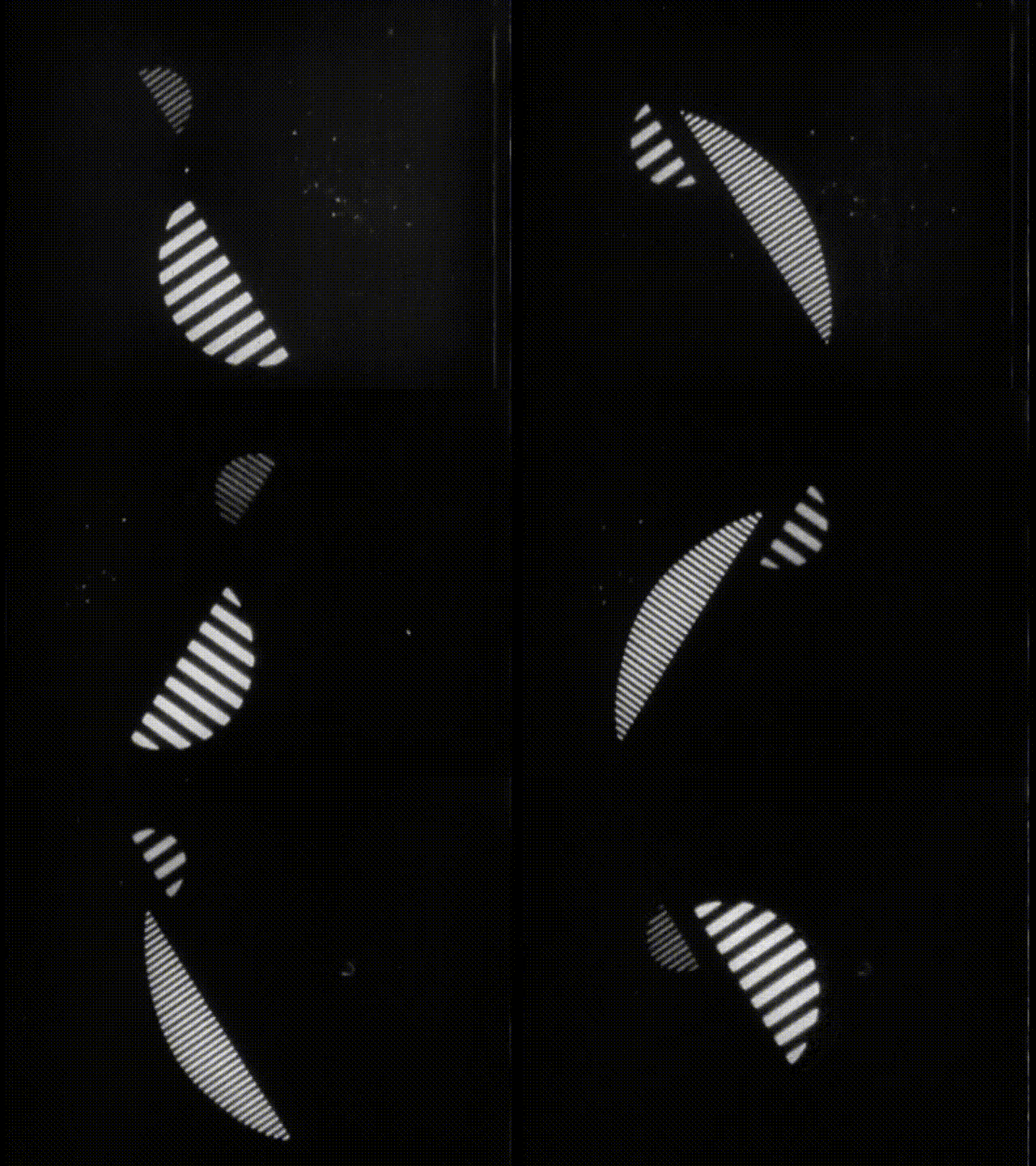
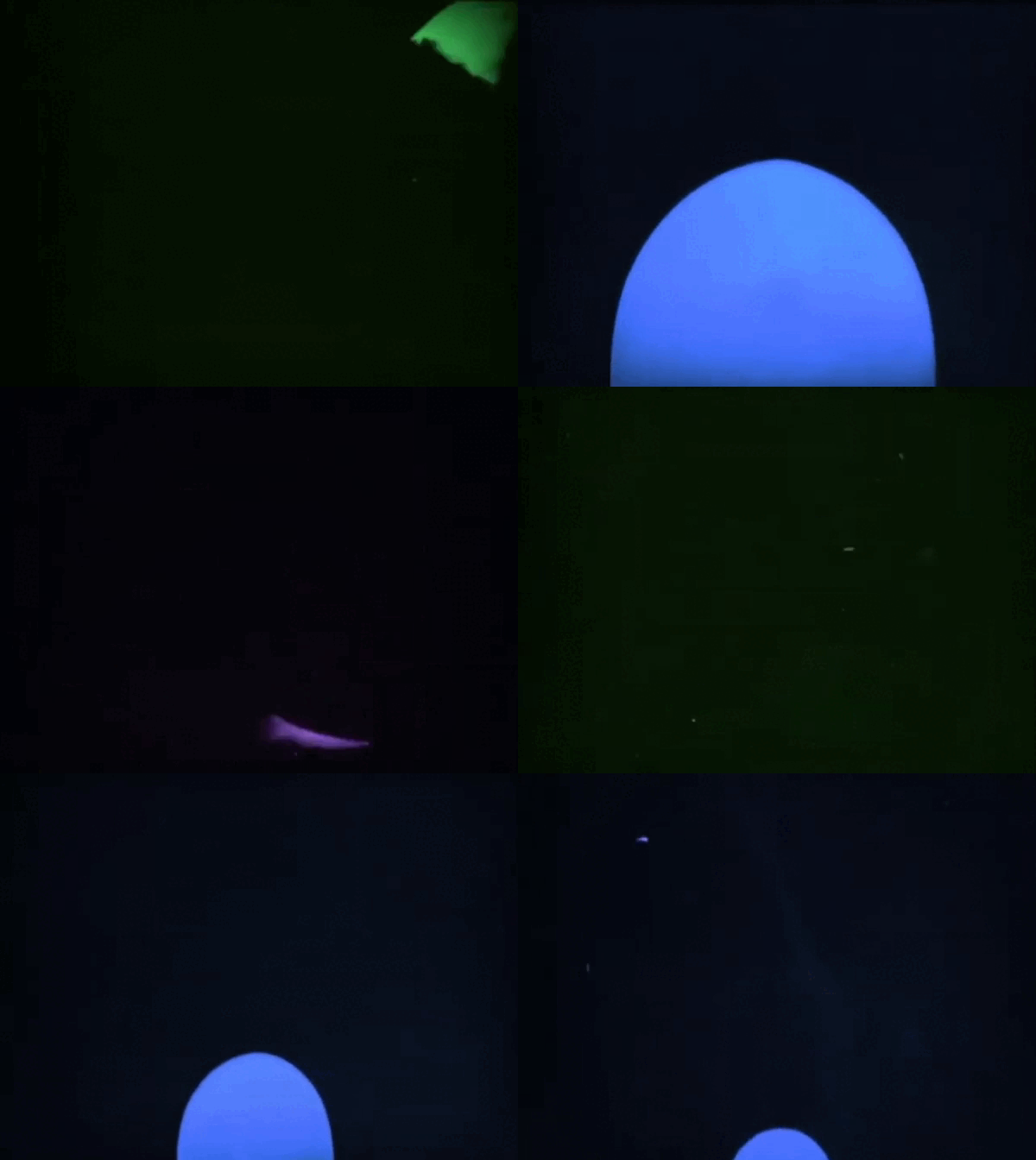
Left: «Diagonal Symphony» by Viking Eggeling, 1924. Excerpt. Right: «Spiel mit Licht: Opus I» by Walter Ruttmann, 1921. Excerpt.
The character of motion is also important, because the smooth transition of a shape can suggest continuity and expanse, akin to the sustained, calm sound of a melody. However, abrupt changes and the sudden appearance of new figures are perceived as visual accents, sounding like a break in the melody—a sharp moment within it. Yet, such associations are not universal rules: the same visual device can be perceived differently by various viewers. Its expressive power is not determined by a pre-established correspondence between form and sound, but by the context in which the form appears and develops. Color can also contribute to creating a visual rhythm. Its significance is not limited to decorative embellishment. The alternation of contrasting color fields can create a sense of sharp accents, whereas a gradual shift in hues establishes visual continuity. The emergence of a bright color amidst dark or muted areas draws attention, much like an unexpected sonic event. If, however, color elements repeat in a specific sequence, they become part of the film’s overall temporal organization. In such instances, the viewer perceives not merely a collection of colored objects, but a transformation of the color environment throughout the work.
«Composition in Blue» by Oscar Fischinger, 1935. Excerpt.
It is also important to note that abstract animation does not necessarily need accompanying music to be perceived as musical. In some films, rhythm arises solely from the movement of shapes. This distinction allows us to separate two closely related phenomena. The first relates to visual musicality—the capacity of an image to evoke a sense of rhythm, tempo, and development without the requirement of sound. The second involves the direct interplay between image and music, where visual changes correspond to an actual musical composition. This is why early abstract animation cannot be seen merely as an attempt to illustrate music. For many artists, the priority was to discover an independent language of moving forms that possessed expressive capabilities comparable to those of music. The image was not intended to literally mimic the sound. It could exist alongside music, engage in a dialogue with it, create its own sequence of events, or even dispense with sound entirely.
This is one of the main features of those years' experiments—artists were exploring not only the possibility of merging two arts but also animation’s capacity to organize time autonomously.
Animation allows us to perceive rhythm, feel tempo through movement, and experience abstract form as something mutable and sonorous, even when presented to the viewer purely as an image.
Music devoid of sound
Viking Eggeling
One of the earliest and most consistent examples of the search for visual musicality is the work of Swedish artist Viking Eggeling. His interest in abstract form stemmed from a desire to find a universal artistic language based on the interaction of simple visual elements. Eggeling viewed line and geometric form as independent expressive means capable of changing and entering into relationships with each other, reminiscent of a musical composition. This approach was particularly vivid in the film Diagonal Symphony (Symphonie Diagonale), created in Germany between 1922 and 1924.
«Diagonal Symphony»
Eggeling created images using paper and metal foil against a black background. He arranged the visual elements along the diagonal of a rectangular screen. This allowed him to transcend the static nature of the frame, establish a dynamic vector of movement, and avoid symmetry. Eggeling viewed the film as a «visual counterpoint, ” where white lines, arcs, rectangles, and serrated shapes slowly transform, resembling a melody. For Eggeling, this was an attempt to create a language accessible to anyone—a language without words that unified art and music.
«Diagonal Symphony» by Viking Eggeling, 1924. Frames.
It virtually lacks the action typically found in cinema—the viewer does not watch characters, follow the plot’s development, or gain a sense of any real space. Instead, the screen becomes a space for the existence of abstract forms and their sequential appearance and disappearance, as if creating a pause. The image might begin with a single line fragment that gradually lengthens, is supplemented with new elements, and transforms into a more complex shape. Then, it changes—some of its parts disappear while others continue to evolve. Thus, the viewer observes not so much the movement of an already existing object as the process of its emergence and disintegration, the pauses, and the new plays. The film scenes featuring the appearance or disappearance of a specific element in direct or mirror projections were created by closing the forms with foil. They themselves resemble musical notes or some kind of drawing.
«Diagonal Symphony» by Viking Eggeling, 1924. Excerpt.
The image is perceived as a continuous narrative that has no beginning or end due to the gradual transformations of its forms. Eggeling’s method of organizing movement is particularly intriguing. He does not aim to create the illusion of objects actually moving through space. Instead, the viewer witnesses a sequential evolution of the graphic structure itself. Movement is perceived not as the displacement of objects, but as the development of an abstract composition. The diagonal in the film’s composition is also noteworthy. Diagonal directions generate a sense of internal tension. The gaze does not simply move from left to right; rather, it constantly alters its trajectory, following the elements that arise and dissipate.
The film’s title alludes to a musical form; however, it is important to note that «Diagonal Symphony» is a silent piece. Its musicality is not derived from synchronizing the image with a specific melody. It emerges solely from the repetition of forms. The alternation of their appearance and disappearance, coupled with the gradual increasing complexity of the composition, creates the impression of visual rhythm. In this sense, Eggeling’s film can be seen as an attempt to build a work that possesses musical logic but utilizes lines and geometric shapes instead of sound.