Concept:
Italy is generally considered the cradle of the Renaissance because it is the direct heir to ancient culture in the Western world. It is telling that Rome—the eternal city, which spent millennia under the yoke of barbarians—never lost the memory of its former glory, yet the leadership in the revival of ancient thought belonged not to Rome, but to Florence. In Florence, the founders of the Renaissance worked—Brunelleschi, Alberti, Donatello, Leonardo da Vinci, Michelangelo, and Raphael. It was in this city that Plato and other Greek philosophers were first translated into Latin.The Renaissance was a period beginning around the 14th century and ending at the close of the 16th century, which is traditionally associated primarily with Italy. The ideas and imagery of the Renaissance largely shaped the aesthetic ideals of modern humanity—its sense of harmony, measure, and beauty. Historically, the Renaissance is often categorized under the late Middle Ages, viewing it as a «bridge» to the New Era; however, in terms of worldview, it still leans toward the Modern Age: the Quattrocento established the aesthetic canons of modern humanity, deeply rooted in consciousness.
Renaissance—a crucial stage in the spiritual and cultural development of Western European nations. This movement originated in Italy in the 14th century, later spreading to France and Spain. During the Renaissance, a new understanding of beauty emerged—one that celebrated humanity and the harmonious union of the soul and body; it marked the beginning of humanism’s dissemination and the formation of science. Beauty became considered a good as important as health and strength. The key characteristics and value of beauty were examined in the works of Italian humanists, philosophers, and artists such as Lorenzo Valla, Luca Pacioli, and Agnolo Fiorentoli. The study and celebration of the beautiful proportions of the human body—its plasticity, color, and form—are explored in the art of Leonardo da Vinci, Titian, Dürer, and many other distinguished masters of this era. A new aesthetic ideal manifested in the creation of new costume forms and new fashion, whose key objective became shaping a supple and harmonious figure. In European states, Renaissance culture developed in different periods. It first appeared in Italy: the Italian Renaissance spanned from the 14th to the mid-16th century. In France, it began in the late 15th–early 16th century; in England, it lasted from the 16th to the early 17th century; and in Spain, it spanned the 15th–17th centuries. Italy, serving as a trade intermediary between East and West, became the wealthiest nation in Europe by the 15th century. The Medici family, the largest Florentine bankers, commanded vast resources. Power was concentrated in their hands, and to solidify it, the Medici established their own court—a court whose splendor could not be matched even by the royal courts of Europe. The Medici increased their renown by inviting distinguished artists, musicians, and celebrated philosophers to their court. The feudal nobility of European countries showed interest in everything happening in Florence at the Medici court, largely imitating it, including the Italian costume. In the 15th century, Florence was the leading authority in Italian fashion. In the 16th century, Venice superseded it.
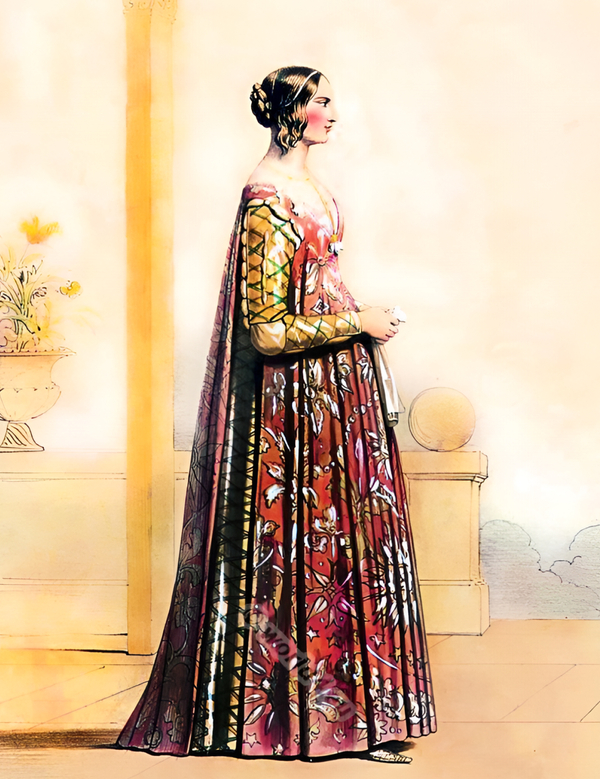
Although French Gothic fashion influenced the Italian costume, it lacked fussiness and extravagance. The main features of the garment’s silhouette were not vertical lines but horizontal ones; overly long trains, pointed, long shoe toes, dangling sleeves, deep necklines, and tall headwear disappeared. The details of the costume did not lengthen the figure. Italian clothing of this period shows traces of antiquity: simplicity and soft fluidity, freely cascading folds, and natural, «human» proportions.
Humanism—a new conception of humanity. The aesthetic ideal of beauty.
The Flourishing of Culture and Art
The Renaissance was a pivotal stage in the spiritual and cultural development of Western European nations. This movement originated in Italy in the 14th century, later spreading to France and Spain. During this era of revival, a new concept of beauty emerged—one that celebrated humanity and the harmonious union of the soul and the body. This period saw the spread of humanism and the foundation and development of science.
Beauty becomes as great a good as health and strength. Its primary characteristics and value are examined in the works of Italian humanists, philosophers, and artists such as Lorenzo Valla, Luca Pacioli, and Agnolo Fiorentino. The study of the beautiful proportions of the human body—its plasticity, color, and form—is explored and glorified in the art of Leonardo da Vinci, Titian, Dürer, and many other distinguished masters of this era.
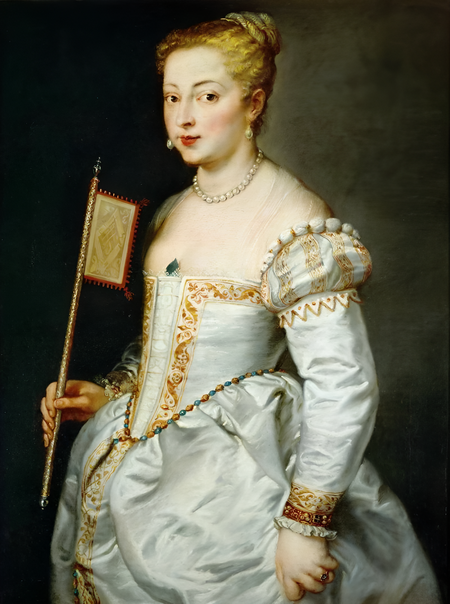
«Портрет дамы в белом» Тициан
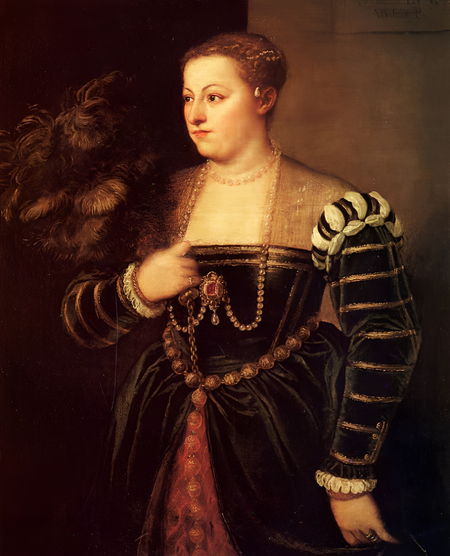
«Портрет Лавинии» Тициан
Textiles, Color, and Ornament
Textile production, much like other fields of European craft and applied art, is experiencing significant growth. Italy is the epicenter of craft development. In thriving Italian cities (Genoa, Milan, Florence, Venice), silk weaving and printed fabric manufacturing are flourishing.
In terms of weave, density, and appearance, Italian silk fabrics displayed exceptional diversity. Italian damasks and velvets were particularly impressive. On a damask, the pattern was woven with gold thread on a gold ground or silver thread on a silver ground. Its contours were accentuated with colored satin or velvet lining. On a gold or silver background, the intricate looped pattern of the velvet, featuring loops of various heights, created a play of light and shadow.
The ornaments primarily featured stylized motifs of pineapples, tulips, grapevines, and acanthus leaves set against a background of vegetal scrolls and patterns. Pomegranate designs and «peacock feathers» were also particularly popular. In addition to floral motifs, the fabrics reproduced figures of animals and birds. The color palette of Italian Renaissance textiles was distinguished by its vibrancy, polychromy, saturation, and color contrasts. The most favored colors were cool red, blue-cyan, emerald green, and gold. For mourning attire, brown, purple, and dark crimson—rather than black—were utilized.
Fabrics were also produced in other European countries: the Netherlands, Germany, Spain, and France. Major centers of weaving craftsmanship included the Dutch cities of Bruges and Utrecht, which were renowned for linen fabrics and embossed velvets. In addition to the pattern and stuffing, embroidery of motifs shaped like gold leaves, rings, and medallions featuring raised images of lions, dragons, and birds was actively employed, alongside embellishments with pearls and precious stones. The weight of a garment created in this manner could reach 25–40 kg.
Beginning in the 15th–16th centuries in Italy, France, and later in other European nations, linen fabrics ceased to be used for outerwear, being replaced by brocade, velvet, and heavy silk. Linen became an indispensable material for undergarments; nevertheless, its matte or shiny surface and whiteness continued to play a significant decorative role in the costume (initially, linen undergarments were visible at the armscye opening, neckline, and lacing closures, and later in decorative slits of outerwear).
Starting in the 15th century, lace began to be used in Europe to trim the edges of shirts and sleeve cuffs. The first Venetian laces were embroidered, similar to guipure, without a tulle foundation, made from white and cream cotton. Later, knitted laces appeared in black, gold, and silver, fashioned into a border composed of small loops whose combination created intricate geometric patterns. Patterns for creating both embroidered and woven laces began to be published in special collections in Italy and other European countries.
Men’s Suit
Florence was the dominant fashion dictator in the 15th century, and Venice in the 16th century. Florentine attire of the 15th century still retained the fitted silhouette of French Gothic style. Furthermore, the costume did not feature exaggerated shapes; it was comfortable, and the shoes had a rounded toe. The main items in a man’s wardrobe included: a shirt, a doublet, hose-trousers, a simar, a tabard, and a cloak.
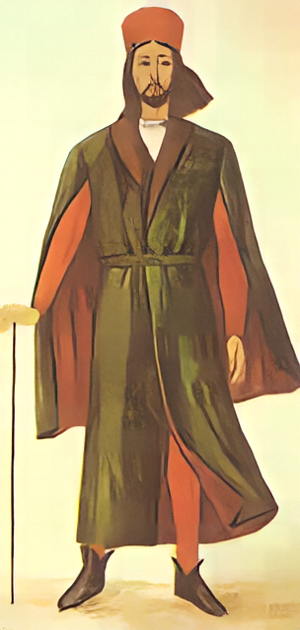
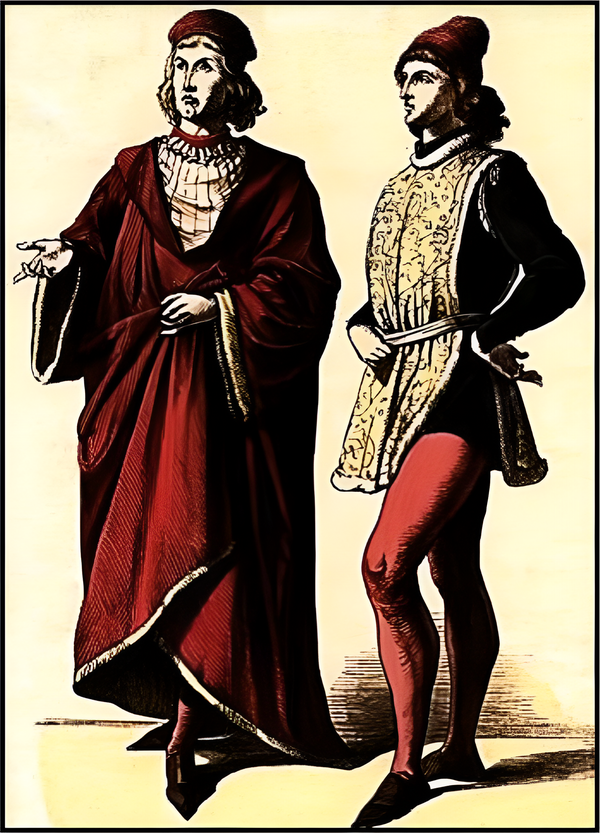
Shirts were most often made from thin white fabric; they reached mid-thigh length. They were worn tucked into pants. The softly dropped shoulder line, significant volume in the bodice, and long sleeves allowed the shirt fabric to spill out of the upper garment’s sleeve slits, creating voluminous puffs. Additionally, the shirt was worn outside the pants and under short outer garments. The neckline was wide, either oval or square, and its edge was finished with trim, lace, or a ribbed strip of fabric.
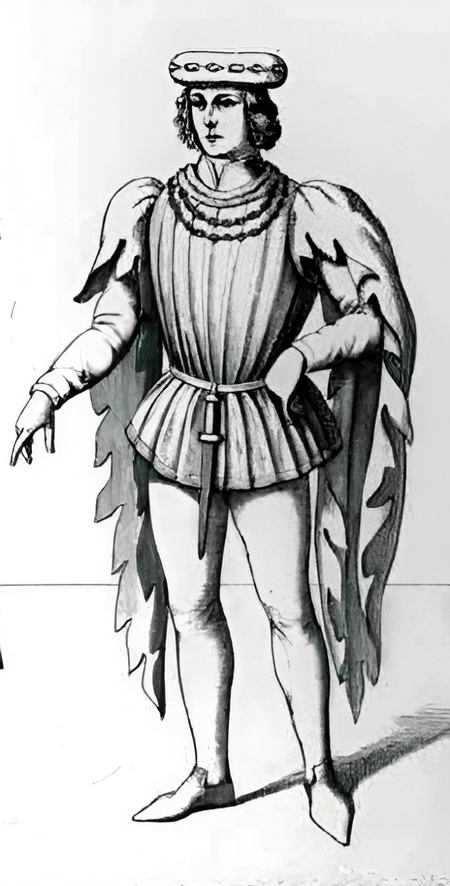
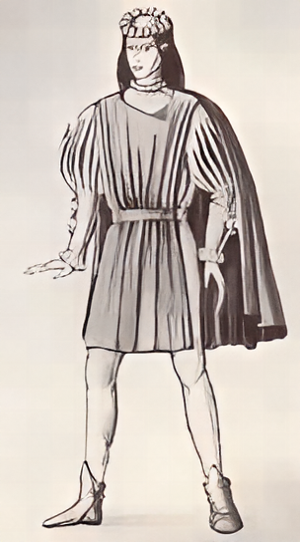
A cote was a short, open upper garment reaching to the waist or hips, fastened with buttons or lacing. It hugged the chest, waist, and hips, featured a dropped hem, and had a neckline finished in various ways: a high standing collar, a deep triangular cutout, or an oval cutout with an insert. The sleeves were not set into the armscye but attached at separate points (bottom of the armscye, shoulder, side). This provided the necessary freedom of movement. The sleeves were cut at the shoulder and the elbow. Through all openings and slits, the fabric of the undershirt was allowed to show, followed by decorative trimming, forming voluminous puffs.
Trousers-leggings made of stretchable material clung tightly to the shape of the legs. In the 15th century, both parts were joined with a gullet that was fastened at the top and on the sides with buttons or laced up. The trousers-leggings were attached to the hose with thongs through special slits. Beneath the hose and trousers, a chemise was visible. For a long time, the fashion for mipart persisted: one leg would remain solid-colored, while the other would be striped.
Toward the end of the 15th century, short breeches—reaching mid-thigh or higher—began to be worn over hose. In 15th-century Florentine fashion, such breeches remained fitted to the hips. By the middle of the 16th century, they began to be made wider toward the bottom.