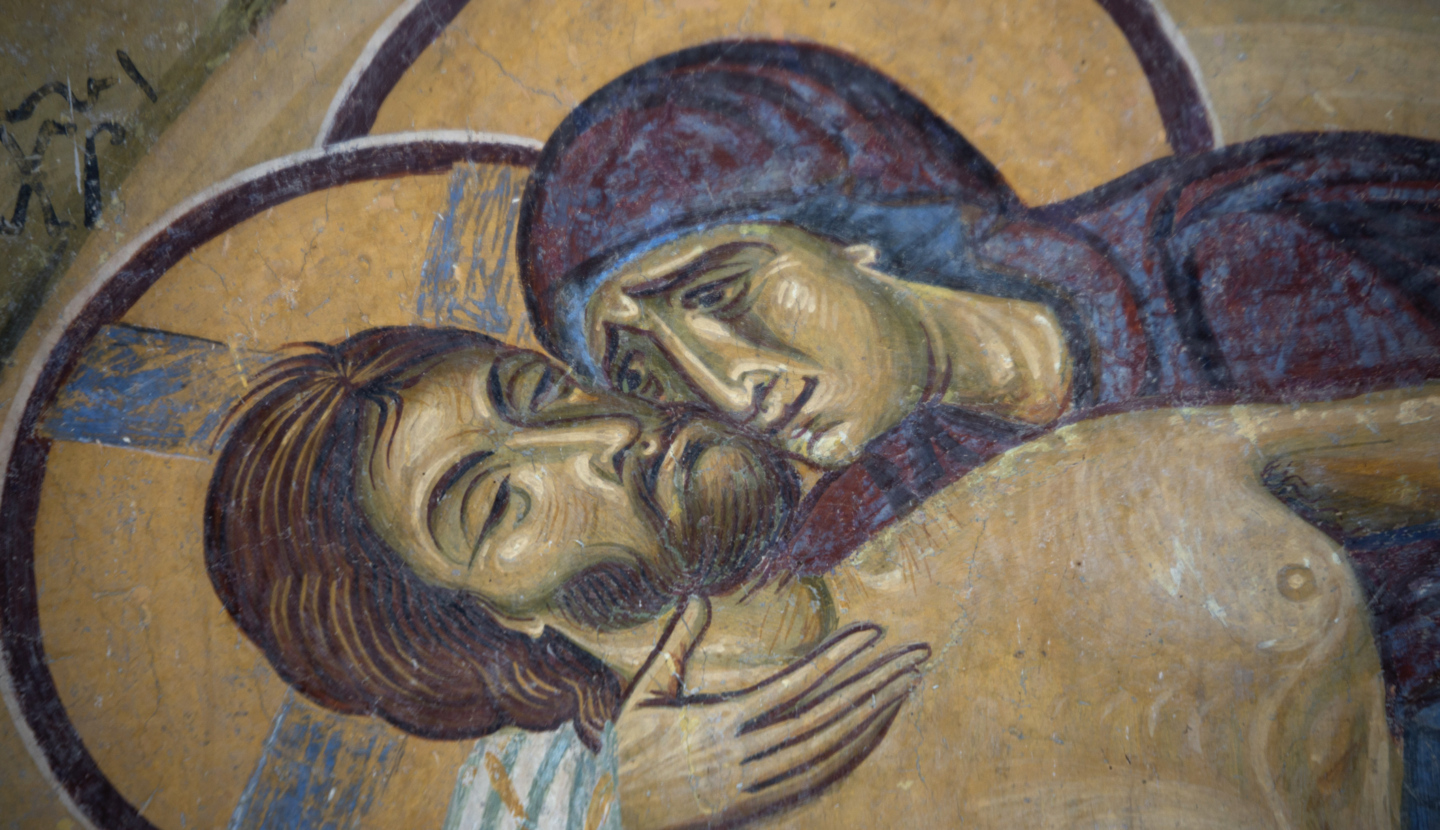
Язык скорби. Жесты плача в византийской живописи XII века
Concept
How to depict sorrow when the expression must remain calm?
Byzantine painting is centered around a visage that gazes calmly and directly at the supplicant. The saint’s impassivity was understood as a sign of a transformed nature, so strong emotion remained on the periphery of the church frescoes for a long time. In the 12th century, during the Komnenian era, this position shifts. Figures bow over a dead body, cover their faces, press cheek to cheek, while angels weep above the scene. This theme was chosen because it demonstrates how artists conveyed grief within a strict canon without undermining it. The starting point is Henry Maguire’s article, «The Representation of Grief in Middle Byzantine Art» (1977). The editors of the volume Managing Emotion in Byzantium call it the work that initiated the study of emotions within Byzantinistics [10]. Maguire showed that grief was communicated through recurring gestures—from tumultuous ancient lamentation to a hand near the face and a covered head [9]. Later, he connected these scenes to the church rhetoric of mourning, particularly to the homily of George Nicomedia during Great Friday [8, p. 91–108; 9, p. 161].
The material was selected based on three criteria
The first indicator relates to the date. Neres is dated to 1164 [2, pp. 95–96; 11], Kurbinovo is dated to 1191 [3], Mirozh is assigned to the middle of the century, no later than 1156 [1, pp. 107–112; 5], and Castoria Lazarev is dated to the end of the 12th century [2, p. 101]. The second indicator concerns the subject matter. The study includes only scenes where grief forms the core content of the image—specifically, the «Crucifixion, ” „Descent from the Cross, ” „Lamentation, ” and „Dormition.“ The third indicator relates to tradition. Comparisons are made within the Byzantine circle, which includes Greek masters who worked in Rus', and the Daphni mosaic from the late 11th century serves as a starting point. The organization is structured according to gesture typology and the intensity of emotional expression. The first section is dedicated to quiet sorrow—that is, the inclination of the head and hand toward the face. The second examines whether the frescoes depict violent weeping. The third analyzes the central gesture—the embrace cheek-to-cheek—and the fourth demonstrates how the gesture dissolves into style toward the end of the century. Within each section, examples progress from an early monument to a later one. The dating and stylistic assessments are drawn from the works of V. N. Lazarev, V. D. Sarabyanov, O. V. Ovcharova, and I. Sinkevich. Maguire’s works explain how the Byzantines understood gestures of grief. Literary texts are cited only when they illuminate the artist’s choice; the image itself remains the object of analysis.
How did Byzantine painting, with the impassive face as its ideal, develop a visual language to depict grief?
In the 12th century, sorrow in Byzantine painting was conveyed not through spontaneous facial expressions, but through a system of recognizable gestures linked to the ecclesiastical rhetoric of lamentation. Each gesture carried a specific nuance of grief, and in the frescos by Mirozh, Neresi, and Kurbinovo, a kind of vocabulary of sorrow is assembled.
Prologue. Before the Tears
Let’s begin with an image where the suffering is already present but has not yet disrupted the balance. This is the «Crucifixion» in the Daphni Monastery iconostasis near Athens, which the BYZART catalog dates to the late 11th century[6].
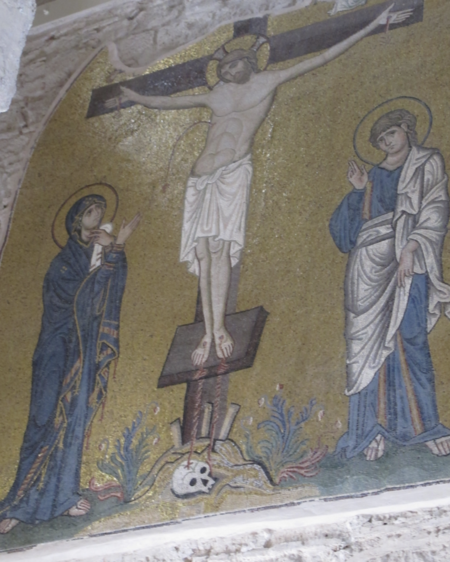
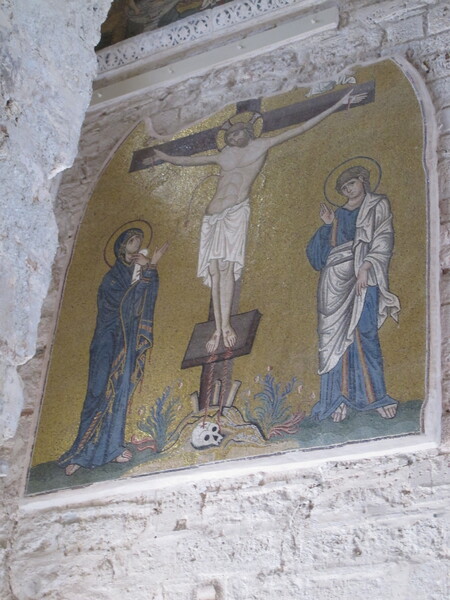
Daphne Mosaic Masters. Crucifixion. Late 11th century. Mosaic. Icon of Daphne Monastery, Attica, Greece
On a golden background stand the Cross, the Theotokos, and St. John the Evangelist. Christ’s body is subtly curved, his eyes closed, and death is portrayed as repose. The empty gold surrounding the figures transforms grief into silence.
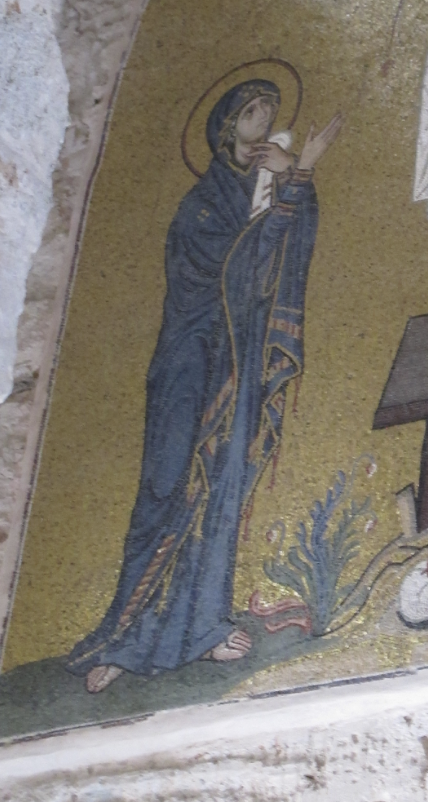
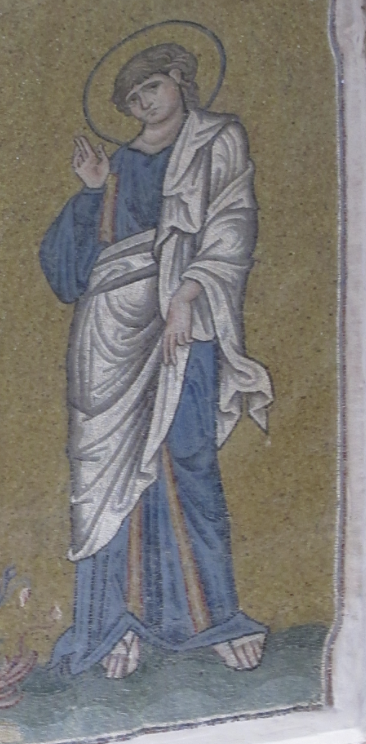
Daphne Mosaic Masters. Crucifixion (fragments). Late 11th century. Mosaic. Icon of the Daphne Monastery, Attica, Greece
Every figure already conveys its own gesture. The Virgin points toward the Son as a witness, and John raises his hand to his face, echoing the contemplative pose of ancient mourners[9]. The master knows the gestures of grief, but he doses them deliberately. This suggests that a vocabulary of sorrow existed even before the 12th century.
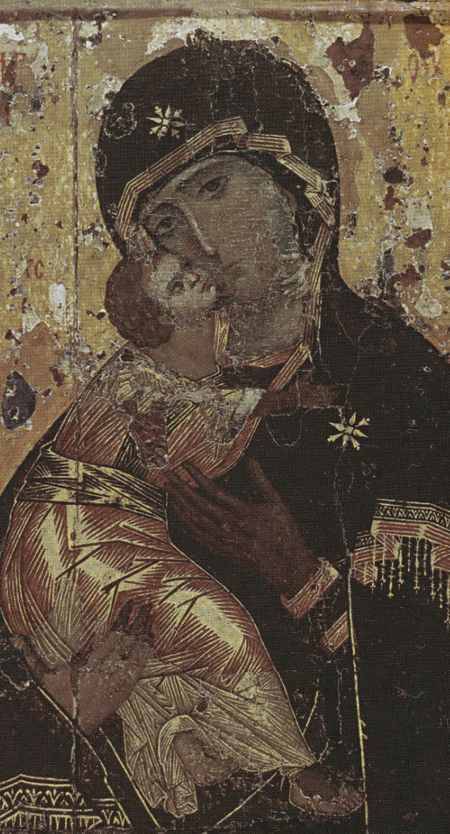
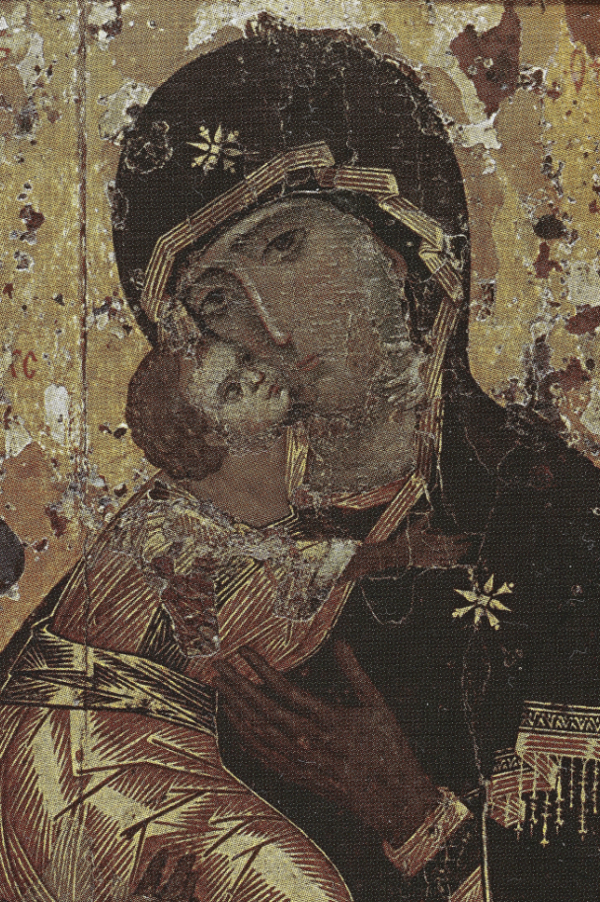
Constantinopolitan icon painter. Vladimir Mother of God. First third of the 12th century. Wood, tempera. St. Nicholas Temple-Museum in Tolmachi, under the State Tretyakov Gallery, Moscow.
The Vladimir Icon of the Mother of God, brought from Constantinople in the first third of the 12th century, belongs to the «Theotokos in Humility» type. The infant presses his cheek against the mother’s, and her gaze is directed toward the viewer. This gesture of tenderness will return in the «Lamentation, ” where the mother presses against her deceased Son.
Head tilt. Quiet sorrow
The most ancient gesture of mourning is the bowed head with a hand raised to the cheek. Maguire links this to ancient funerary art [9]. In the 12th century, this gesture was typically reserved for John and men interring Christ.
Masters of the Mirozhsky Monastery. Lamentation. Circa 1140. Fresco. Transfiguration Cathedral of the Mirozhsky Monastery, Pskov, Russia.
«Lamentation» occupies the lunette of the north wall of the cathedral [1, pp. 107–112]. The body of Christ lies horizontally along the lunette, with the Virgin Mary and John bowed over Him. At the sides stand the mourners, with covered heads, and Nicodemus; at the top, angels soar. Each participant has a specific role in the overall mourning scene.
Masters of the Mirozh Monastery. Lamentation (fragment, the Theotokos and Apostle John by the body of Christ). Circa 1140. Fresco. Saviour Transfiguration Cathedral of the Mirozh Monastery, Pskov, Russia
John’s grief is constructed through inclination. The figure is leaned toward the body, the head is bowed, and the line of the shoulders mirrors the curve of Christ’s body. The emotion is conveyed not through facial expression, but through the positioning of the head. Nicodemus connects sorrow with the concern for the burial. According to Lazarev’s observations, Pskov masters aimed to convey grief, yet they «never lapse into exaggerated emotionalism» [1, pp. 107–112]. Restraint is found in those engaged with the body.
Master Neresi. Lamentation and Venerables. 1164. Fresco. Church of St. Panteleimon, Neresi, North Macedonia
In the Nerezi «Lamentation, ” the scene is positioned above a row of silent saints. For the monks of this church, weeping over Christ was an integral part of the Passion Week experience [4]. The viewer perceives both prayerful serenity and sorrow side-by-side.
Master Neresi. Lamentation. 1164. Fresco. Church of St. Pantelimon, Neresi, North Macedonia.
In the depiction of St. John, he holds Christ’s hand, and his bent figure draws the viewer’s eye toward the Theotokos and the Child [7]. A quiet sorrow here already yearns for the touch of the body.
The scream that isn’t there. Restraint, as is usually the case.
Maguire’s raised arms and ripped hair relate to the intense grief of ancient mourners[9]. It is important to check whether such gestures appear in 12th-century frescos.
Master Neresi. Lamentation. 1164. Fresco. Church of St. Panteleimon, Neresi, North Macedonia.
In Neresi, the power of grief is conveyed through faces. Smarthistory notes that «the folds of grief cut across their faces, ” which is rare in Byzantine art (author’s translation)[7]. The second means is the landscape, where the hills slope toward the center, directing the viewer’s gaze toward the figures[7]. According to Lazarev, the line served the master of Neresi as „a perfect tool for achieving the necessary emotional accents”[2, p. 96]. However, the turbulent gestures of ancient lamentation are almost absent in the frescoes examined. The cry is conveyed through the line, the tilt, and the landscape. There are no definitive examples of pulled hair or torn clothing in the frescoes considered. The vocabulary of sorrow in the 12th century is selective, and this is the first refinement of the hypothesis.