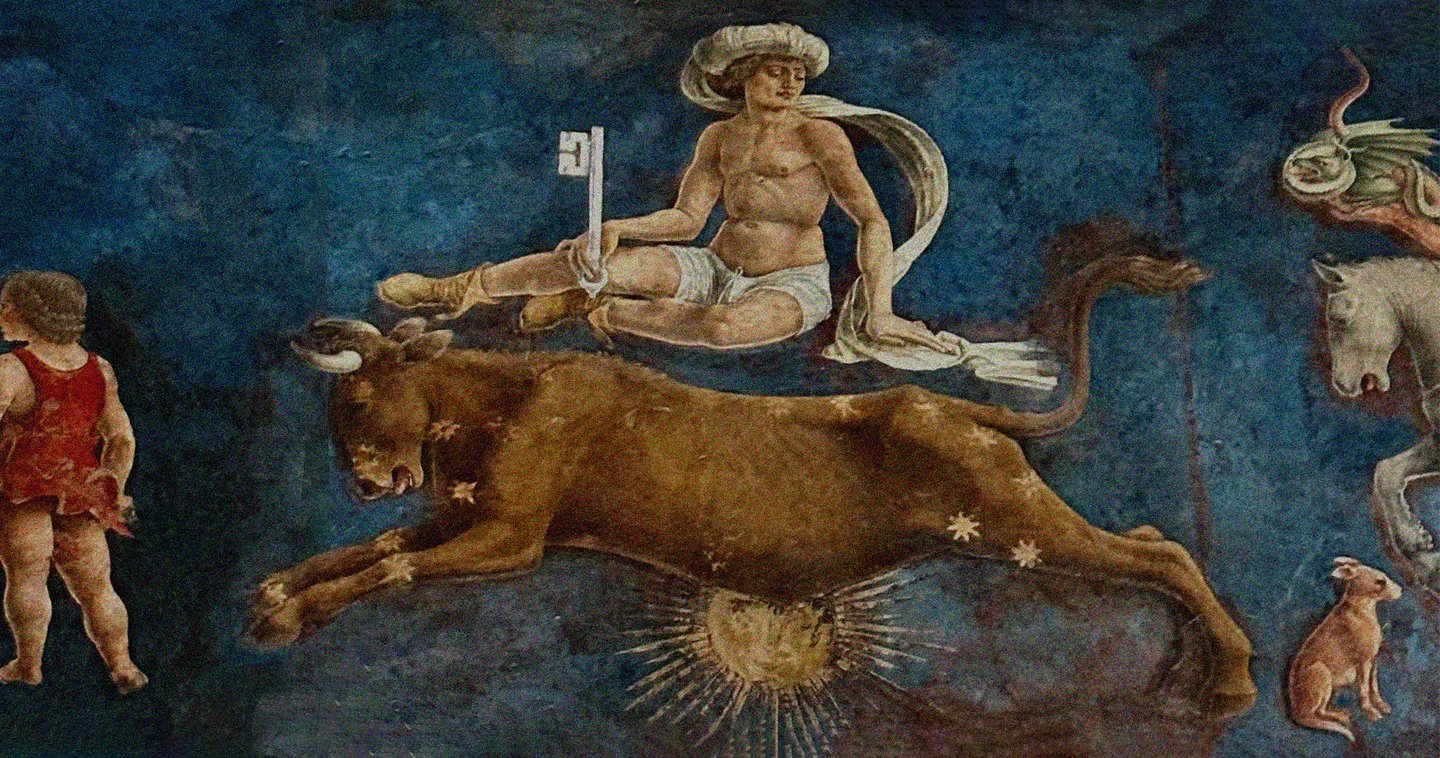
Зал Месяцев в Палаццо Скифанойя
История и иконология знаменитого цикла фресок
Concept
The murals in the Hall of Months at Palazzo Schifanoia were created between 1469 and 1470 for the commission of the ruler of Ferrara, Borso d’Este. Artists from the Ferrarese school worked on the cycle, including Francesco del Cossa and Ercole de' Roberti; the authorship of individual parts of the mural continues to be debated by researchers. The basis of the murals is the concept of an annual cycle: images of the months are combined with mythological and astrological motifs, as well as the theme of life at the Ferrarese court. Together, they form a complex visual program that links conceptions of time and the order of the world with the glorification of Borso d’Este’s reign. This cycle of frescoes belongs to the painting tradition of the Italian Renaissance and holds an important place in the heritage of the Ferrarese school. Its distinctiveness lies not only in its artistic execution but also in its synthesis of several cultural traditions. Ancient mythology, astrology, and courtly culture become parts of a unified conception. These connections are not always obvious to the viewer without referring to the history of the murals' creation and to the sources that help interpret their images. The objective of this study is to examine the history of the Hall of Months cycle and decipher its iconological program: to determine what meanings the images acquire within the historical and cultural context of their time. It is important to view the murals not merely as individual paintings, but as a system organized within the hall’s space and designed for a specific interpretation.
The main part of the research will consist of image analysis: describing the preserved fragments, comparing their details, and studying the meanings of individual motifs. This approach will allow a gradual transition from the overall structure of the cycle to its individual elements. A key reference point will be the work of cultural historian Aby Warburg, who presented his study of the frescoes at the Palazzo Schifanoia in 1912. His reference to astrological sources demonstrated that understanding the cycle requires considering not only the history of Italian painting but also the broader history of how images have existed and been transmitted. During the period of the palace’s decline, the frescoes were covered with a layer of white gypsum plaster, meaning the cycle is not perceived in its original form today—some images are lost or preserved only in fragments. This must be taken into account during the analysis, differentiating between the original intention of the painters and what is available to the contemporary viewer. The visual component of the research will be built upon comparing the general views of the hall and photographs of individual fragments with museum and scientific materials. The choice of this topic is also connected to my personal experience. A couple of years ago, I visited the Palazzo Schifanoia and saw the paintings of the Hall of Months with my own eyes. They made a strong impression on me, but at the time, I did not fully understand what was depicted on the walls or how the individual parts of the cycle were connected. Now, I have decided to return to that impression and delve into what lies behind the observed images. This research will be an opportunity for me to connect the direct experience of visiting the palace with a deeper study of the history and meaning of its frescoes.
Palazzo History
Construction on the Palazzo Scifanoia likely began around 1385, when Marquis Alberto V d’Este undertook extensive building projects in the city. These included the erection of the now-lost residences of Belfiore and Palazzo Paradiso, where the Arioste library is located today. The palace was built near the extreme northeastern section of the city walls and served as a so-called «delizia”—a space dedicated to leisure, recreation, and entertainment for the d’Este family. Following the first renovation of the palace in 1391, Bortolo d’Este initiated a major expansion starting in 1466. The future Duke of Ferrara, with the assistance of court architect Pietro Benvenuto da Ordini, decided to add another story atop the existing structure. The centerpiece of this new section became the distinguished Hall of Months (Salone dei Mesi), the decoration of which was crafted by prominent artists under the guidance of humanist Pellegrino Ghirlandaio. The final expansion of the palace, which also included a general refresh of the decorative elements, was finally accomplished under Ercole I d’Este, who commissioned the project from architect Biagio Rossetti. After Ercole’s death, the building changed hands multiple times: first it passed to his brother Sigismondo, then to Francesco—brother of Alfonso I—and finally to his daughter, Marfisa.
Palazzo Scifanoia in 1838
The final years of the 16th century marked the beginning of the residence’s decline: first with its leasing in 1582, and subsequently with Ferrara passing under the authority of the Papal States (Devolution) in 1598. This dilapidation reached its peak in the 18th century when all painted surfaces were whitewashed. It wasn’t until 1820 that the artist and restorer Giuseppe Saroli rediscovered the first fresco fragment, completing restoration work in 1840. In just a few decades, the former country estate («delicia») once again became the focus of historical and art-historical research on European art, until the Museums of Ancient Art of Ferrara were established there in 1898. Finally, the destructive earthquake of 2012 necessitated a large-scale architectural restoration and the renovation of exhibition spaces.
Palazzo Scifanoya
Abi Warburg
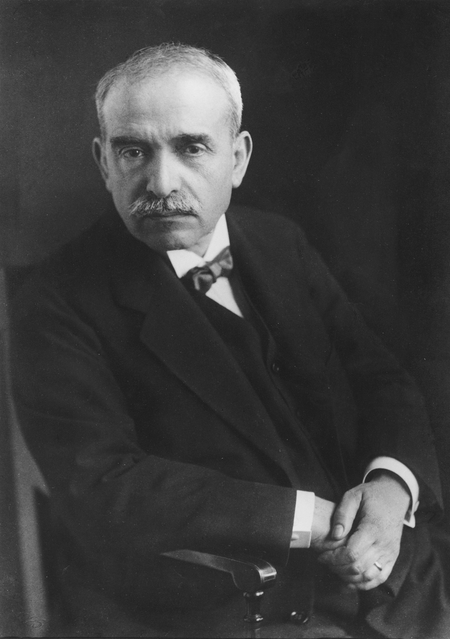
Aby Moritz Warburg (1866–1929) was a German art historian and cultural theorist from a banking family in Hamburg; having renounced banking, he studied in Bonn, Munich, and Strasbourg, and worked in Florence. He extensively researched the «afterlife of antiquity» (Nachleben der Antike)—that is, how ancient images, gestures, and «formulas of pathos» (Pathosformel) are transmitted, forgotten, and then «reawaken» in new eras, as well as the «wandering of images» (Bilderwanderung) across cultural and linguistic borders.
In the Hall of Months, Warburg focused on the middle, enigmatic tier that had perplexed researchers for centuries. Around 1908, while reading Franz Bol’s «Sphaera» (1903) with a German translation of a chapter from the Arab treatise of Abu Masar (Albumasar), executed by Adolf Duroff, he suddenly recognized the «Indian sphere» of al-Mashar in the Ferrar figures and correlated them with a sequence of 36 decans. The culmination was the first surviving figure—the «black man» (vir niger), the first decan of Aries, depicted with dark skin, red eyes, and white clothing with a rope around his waist (although by this point, he had lost the axe he possessed in the Indian tradition). Warburg identified him, albeit controversially, with the Greek constellation Perseus. Warburg mapped the transmission route of these images: Hellenistic-Egyptian decans → Indian astronomy (Varahamihira) → Arab science (Baghdad, 9th century, Abu Masar’s «Introductorium maius”—a treatise titled „The Book of the Great Introduction to the Science of Star Judgment, ” which provides Persian, Indian, and Greco-Ptolemaic versions of the decans) → Latin Middle Ages (translations by John of Spain and Hermann of Carinthia, 12th century; compilations by Leopold of Austria, Pietro d’Abano with his „Astrolabium magnum, ” and Guido Bonatti’s magical „Picatrix“) → the Ferraran Renaissance. He demonstrated that the cycle’s program was „international astrology“: layers of Egyptian, Greek, Indian, Persian, and Arab conceptions, which coalesced into a courtly cosmological project that glorified the duke under a cosmic order.
Additionally, Warburg was also able to identify the ideological inspiration for the frescoes. Adolfo Venturi published Francesco del Cossa’s letter to Borso d’Este from March 25, 1470, in 1885. In this letter, the artist, while discussing the work on the frescoes dating from March, April, and May, complained about poor treatment by the project managers—namely, Pellegrino Pisani and others. A thorough analysis of this letter enabled Warburg to isolate the figure of Pellegrino Pisani, an astrologer, librarian, and chronicler of the Este family.
Hall of Months
Placement of murals in the Months Hall
Initiated by Borso d’Este in 1466, the expansion of the original «delica» allowed for the creation of a spacious hall intended for hosting guests and the court, as well as for glorifying the duke’s lineage and his political and civic virtues. This great hall, which features one of the largest secular decorative cycles of the Renaissance, is divided into eighteen vertical panels (compartments) depicting the twelve months of the year, interspersed with cityscapes and multi-figure scenes; the cycle is meant to be «read» counterclockwise, starting from the south wall. Each month is divided into three tiers, or registers: the uppermost tier invariably features the triumph of the Olympian deity patron of that period, surrounded by human activities traditionally associated with it. The middle register displays the zodiac signs accompanied by depictions of the three decans—pagan deities called upon to patronize the three decades that constitute the month. Finally, the lower register presents the viewer with scenes of daily life, in each of which Duke Borso is depicted three times: inspecting his estates, hunting, or governing his duchy.
Conceived and developed by Borsso in collaboration with the court astrologer Pellegrino Prishani, this cycle was executed by a diverse group of artists between 1469 and 1470. Besides Francesco del Cossa, whose participation in the frescoes of Skifanai is documented by his own letter asserting his authorship of three months—“from the side of the front hall» (March, April, and May)—stylistic analysis identified the hand of the so-called «Master of Wide Eyes» and his workshop for the frescoes of June and July, the court painter Gerardo da Vicenza for the August section, and his apprentice Ercole de’ Roberti for the September section. These masters and their workshops employed true fresco technique not across the entire surface of the hall, but alternated or replaced it with tempera applied «a secco”—directly onto the already plastered surfaces—as evidenced by the poor preservation of the frescoes from October, December, January, and February, as well as the adjacent cityscape scenes.
Eastern Wall
East Wall
March
March
Upper Frieze
Francesco De’Cossa and the workshop, the two upper registers by Marta
Patronage of Minerva. The goddess celebrates her triumph in a chariot drawn by unicorns, adorned with flowing veils catching the wind. Here, she is depicted as the goddess of justice—a wise and prudent ruler of the city—and (as Athena Ergana) the patroness of the arts and feminine pursuits (weaving).
To the left is an image of the goddess’s children: doctors, artists, poets, and lawyers who were affiliated with the University of Ferrara. Among these figures, one can recognize Leon Battista Alberti (whose «portrait» was identified by Ranieri Varese). To the right, three weavers at a loom, surrounded by a group of elegant ladies, illustrate the fate awaiting those born under the Aries sign.
Athena is connected to weaving through the myth of Arachne. The three female figures in the foreground represent the three Moirai, who measure the eternal flow of destiny.
The lower frieze depicts Borso d’Este, wisely administering justice. On the internal architrave of the palace where Borso resides, there is a clear inscription: «IUSTICIA» («Justice»). Thus, the benevolent influence of Athena is reflected in the highest virtue of the magnificent Prince of Ferrara: the complex intertwining of pictorial scenes is intended to glorify his just rule, as well as his anticipated and foreseen appointment as Duke by the Pope.
Middle frieze
Three deans with the Zodiac sign Aries
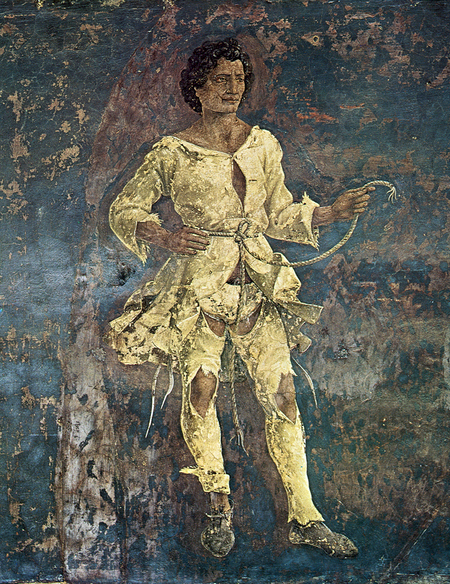
The first Aries dean is a dark-skinned man with red eyes and a sturdy build, dressed in a white, tattered jacket and pants. He stands in a menacing pose, girdled with a rope around his waist, one end of which he holds in his left hand. The image is derived from the Indian sphere found in the Alphamasara treatise. Warburg persistently saw in it the metamorphosis of the ancient Greek constellation Perseus—here disarmed, whose attributes are no longer recognizable, save for the dean’s aggressive stance. It is more likely that the figure originates from a «phantom» constellation located in the boundary zone between Pisces and Aries. Manilius, writing his astrological poem in the 1st century CE, attributes a curious destiny to those born under such an astral configuration—to climb a rope stretched to the sky while performing acrobatic feats. This rope of the phantom acrobat refers to the long band connecting the two Pisces of the same constellation.
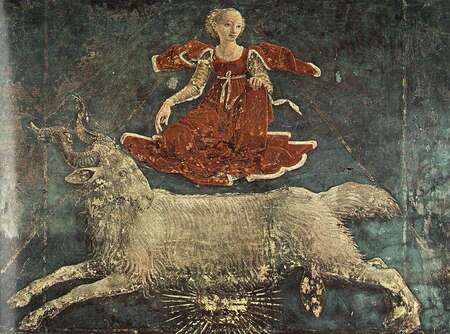
The second dean of Aries is a woman with light hair, crouched down; she is wearing an elegant red dress with flowing fabric on her shoulders. The figure partially reflects the description from the Indian sphere of Albumasar: «a woman dressed in red garments, having only one leg and resembling a horse in appearance.» Her regal bearing and luxurious attire hint at the dominion of Cassiopeia, who (according to astral myth) is associated with the constellations Cepheus, Perseus, Andromeda, and Cetus (the sea monster).