Путь мифических существ в искусстве: от античной пластики до барокко
Contents
1 — Introduction
2 — Hypothesis
3 — Main Body
3.1 — Mythological Imagery in Ancient Art
3.2 — Classic Bestiaries in Book Miniatures
3.3 — Fantastic Creatures in Art of the 15th–18th Centuries
4 — Conclusion
5 — Bibliography and Sources
1. Introduction
In the art of Western European Middle Ages, fantastic creatures—dragons, manticore, basilisks, sirens, and unicorns—hold a special place.
To the modern viewer, these images may seem like the product of free fantasy or fairy tale invention; however, the medieval person perceived them as real inhabitants of distant lands and as essential elements of the Christian worldview. Artists of that time could not see these creatures in person, relying exclusively on ancient texts and written descriptions found in bestiaries.
2. Hypothesis
Throughout art history, mythological creatures have been constructed based on a single principle of hybridization (combining recognizable parts of real animals), yet their artistic language has evolved with each era. While masters in Antiquity subjected hybrids to the laws of real plasticity and anatomy, medieval bestiaries transformed them into a conventional visual code through vivid color and gold backgrounds. During the 15th to 17th centuries, this trajectory culminated in these figures escaping the confines of books—emerging into real landscapes, chiaroscuro, and complex volumetric forms.
3.1 — Mythological Imagery in Ancient Art
I will start with the Griffin, as the griffin is one of the most enduring hybrids in art history, originating from the Ancient East and arriving in Greece. It merges the body of a lion with the head, wings, and talons of an eagle. In Antiquity, this union of two sovereigns of nature symbolized invincible power and vigilance; consequently, griffins were depicted on temple vessels and armor as formidable guardians and amulets. Later, this image, virtually unchanged, transitioned into medieval bestiaries, where it became a Christian symbol of Christ’s dual nature—earthly and celestial.
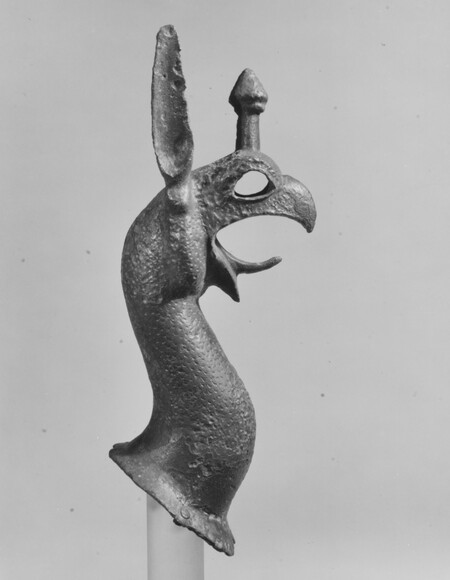
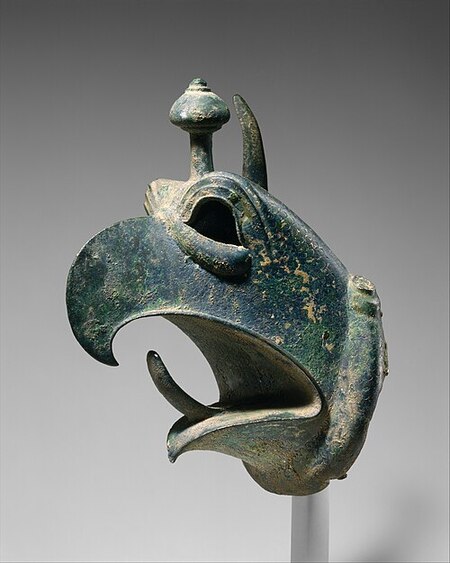
These cast and chased heads on curved necks (protomes) (c. 7th century BCE) decorated the edges of massive ritual cauldrons in ancient Greek sanctuaries. Both monuments demonstrate a unified archaic canon: a predatory, open eagle beak with a protruding tongue, pointed ears, a characteristic cranial protuberance on the forehead, and deep sockets for inlays.
In the era of Antiquity, images of fantastic creatures were often built by combining parts of different animals. A clear example is the Etruscan bronze sculpture of the Chimera from Arezzo, created around 400 BCE.
What is interesting is that this sculpture combines realism and fiction. On the one hand, the proportions and anatomy are rendered with maximum believability; on the other, we are presented with a creature that simply cannot exist outside human fantasy. In the future, this technique will become a primary tool for medieval artists, who will construct invisible beings from familiar natural elements.
Attic red-figure stamnos, «Odysseus and the Sirens» (c. 480–470 BCE, British Museum). The vase depicts a scene from Homer’s Odyssey, where the hero is tied to the ship’s mast to hear the Sirens’ song without perishing.
The sirens are depicted as hybrids with female heads and the bodies of predatory birds. Serene, antique faces with meticulously styled hair contrast with powerful, clawed limbs and expansive wingspans. Yet, the artist subjects these mythical creatures to the laws of living plasticity: two sirens are tense and poised on the cliffs, while a third dives swiftly toward the ship. The careful rendering of every feather and the distinct silhouette against the black lacquer make the fantastic image incredibly convincing and establish a visual canon that later medieval artists would inherit.
Fragment of a Samnite bronze belt depicting a hippocampus and a dolphin (300–200 BCE, Italy. British Museum, London).
This 13,3×7.25 cm plaque is part of a broad Sasanian belt, created using repoussé technique. Small perforations along the bottom edge were intended for stitching a soft leather lining, which was attached to the metal from the inside.
At the center is a horned hippocampus accompanied by a diving dolphin. Here, the Italian master combines features of a terrestrial horse, fish fins, a long serpentine tail, and small horns. For ancient warriors, such an image served as a genuine amulet, rather than merely a beautiful adornment—a testament to how vital mythical creatures were to the culture and worldview of Antiquity.
3.2 — Classical Bestiaries in Book Miniatures
Following the decline of Antiquity, the depictions of mythological creatures migrated from sculptures and mosaics to the pages of illuminated manuscripts. In these works, animals are either woven into flat book ornamentation or transform into illustrative diagrams accompanying the text.
Moving into the Early Middle Ages, one must mention one of the most famous representatives of non-existent beasts.
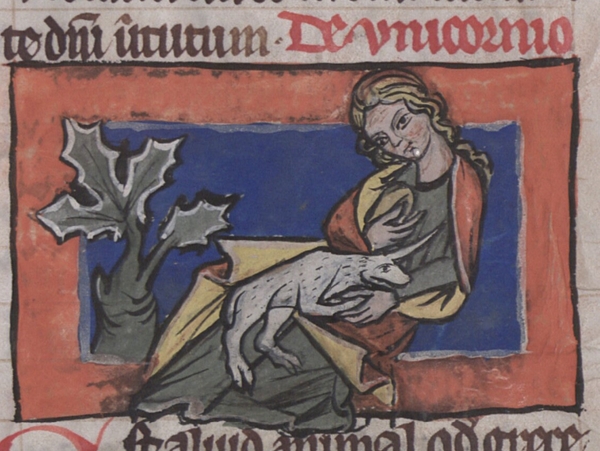
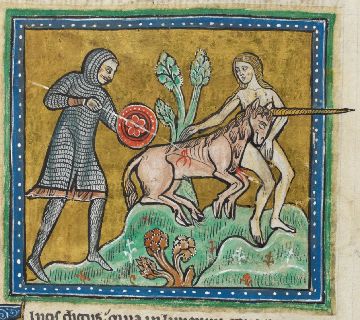
In medieval bestiaries, the unicorn was described as a fierce and elusive beast, the size of a small goat, donkey, or horse, but possessing a single long spiral horn on its forehead. Belief in its reality was bolstered by the tusks of the Arctic narwhal, which northern traders brought to Europe and sold as «unicorn horns”—items believed capable of purifying water and wine of poison.
For medieval art, this image acquired immense symbolic significance. In the Christian tradition, the ferocious beast that could only be tamed by an immaculate maiden became a direct allegory for Christ and the Virgin Mary, while its small size symbolized humility. In miniatures, the scene of capturing the unicorn evolved into a complex visual drama about purity, sacrifice, and the defense of virtue, making it one of the most recognizable icons in European art.
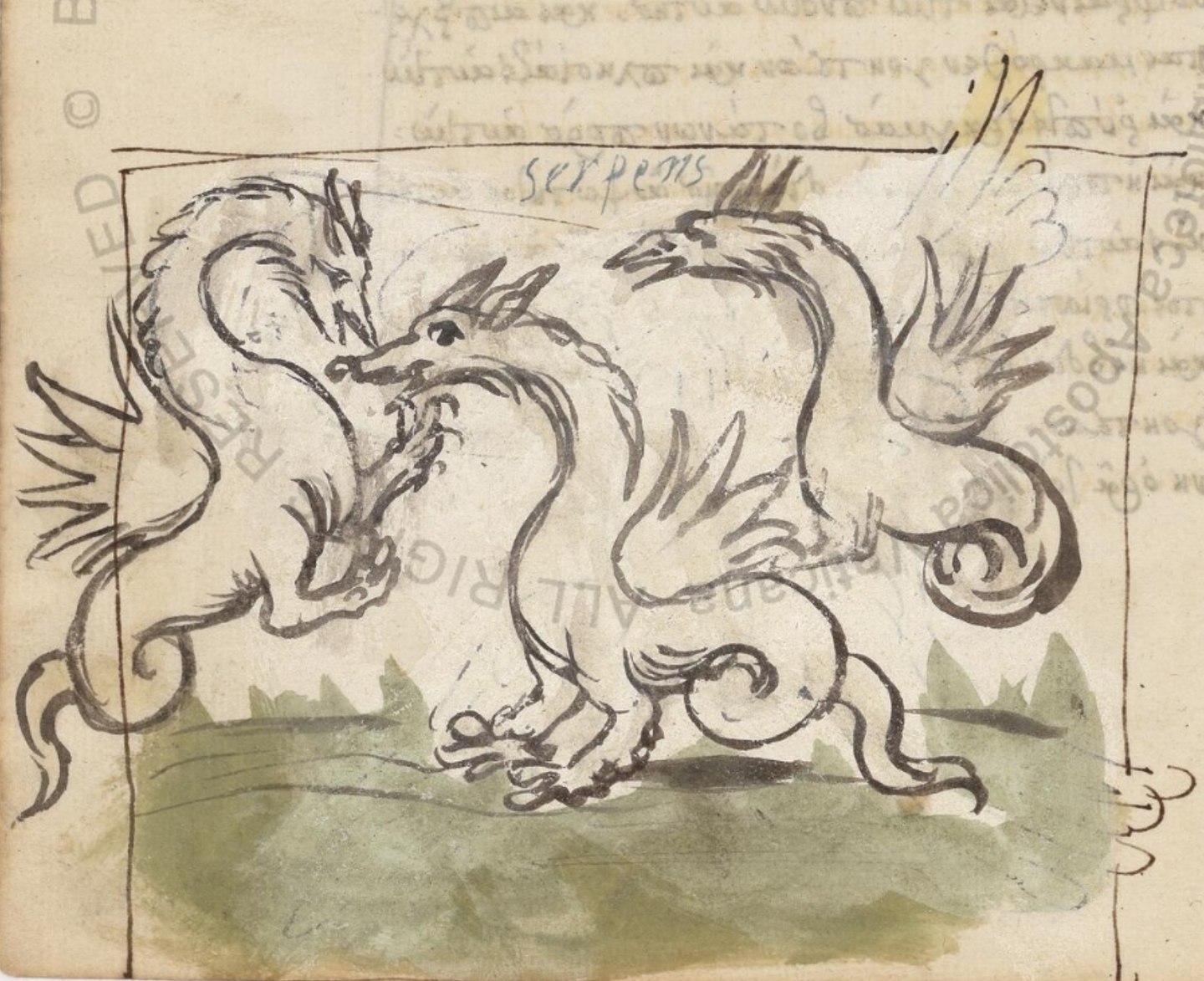
The next creature to mention is the basilisk. In medieval bestiaries, the basilisk was described as the «little king» (regulus) of all serpents, capable of killing with its gaze, hiss, and poisonous breath. Its visual depiction in manuscripts became a literal illustration of the legend regarding its origin. It was believed that the basilisk hatched from a rooster’s egg incubated by a toad, after which it would grow a serpentine tail.