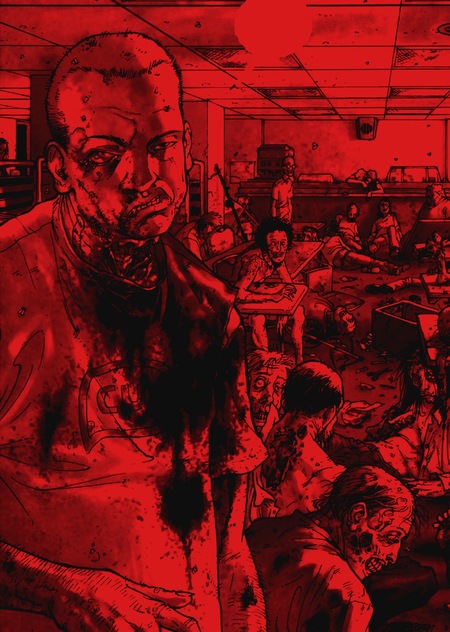
Concept
Zombies are one of the most enduring yet mutable archetypes in popular culture. They first appeared in American comic books in the early 1950s, were banned by the Comics Code Authority in 1954, and resurfaced in the 2000s when they became a central genre trope. The starting point for this study was R. Kirkman’s The Walking Dead. In this comic, the zombies gradually fade into the background, and the threat emerges from the living people themselves. This observation suggests that the zombie archetype, in each iteration, speaks not about the dead, but about the fears of the living.
Research Question and Hypothesis
This research addresses the question of how the visual representation of the zombie in comics has evolved and what societal anxieties it reflects across different periods. The hypothesis is that the zombie functions as an «empty vessel» which each era fills with its own specific fears and anxieties. In the 1950s, these fears were related to the loss of loved ones and the technological arms race; in the 2000s, they centered on social decay and the nature of humanity itself; and in late 2010s manga, the preoccupation was with a life dominated by work.
The body of the monster is the body of culture: the monster is born as the embodiment of a specific time, feeling, and place, and it changes along with culture and its fears. Synopsis by: J. J. Cohen. Monsters and Culture (Seven Theses), 1996 [15]
Material Selection Principle
The material was selected based on the principle of contrasting time slices. Comics from 1952 depict an early, «pre-censorship» portrayal of the zombie. Documents from 1954 explain its disappearance. The Walking Dead (2003) and Marvel Zombies (2005) present the return and reinterpretation of this image within the American tradition. Zom 100 (2018) allows for a comparison with Japanese manga. The early comics are in the public domain.
Structuring and Categorization Principle
The study is constructed chronologically: 1950s → the 1954 ban → 2003 → 2005 → 2018. It concludes with an analysis of how the depiction of zombies and the fears expressed through them have evolved. Each chapter follows a unified structure: historical context, analysis of specific pages and scenes, an examination of the zombie archetype, and a conclusion regarding the fear articulated by that image. This approach allows for meaningful comparisons across the comics.
Principles for Selecting and Analyzing Textual Sources
The primary material for the research is visual—comic book pages and covers—analyzed through comparative visual analysis. Textual sources are used to reconstruct the historical context. This includes the text of the Comics Code Authority (CCA) (1954), which explicitly prohibited the depiction of «walking dead,» ghouls, vampires, and werewolves, and materials regarding the 1954 Senate hearings that preceded its adoption.
Where did the zombies come from?
Zombies—a product of the New World: the image originates in Haitian folklore and serves as a reminder of colonialism and slavery. Early zombie films, beginning with White Zombie, played on the fears of the white audience of the post-imperial era.
Retold by: K. U. Bishop. American Zombie Gothic, 2010 [16]
«White Zombie, ” dir. V. Galperin, 1932 [12]
Zombies have been slaves to sorcerers, victims of scientific experiments, a backdrop for human warfare, and even a symbol of freedom from labor.How has this image changed, and what fears did people hold about it at different times?
Hypothesis and Method
Zombies are simply a form that is filled by various fears.I analyze comic book pages from different eras based on the same criteria, and at the end of each chapter, I answer: what is this generation afraid of?
1950s: Zombies Before the Code
«Zombie Bride»
Joe Farnsworth and his wife, Lily, are on their honeymoon in Haiti. They drive into the jungle, where they are attacked: Lily is kidnapped by the servants of a «master zombie» who commands other undead creatures.
That night, the master performs a ritual, and Lily turns into a zombie, now subservient only to him. Joe searches for his wife in the jungle for two days and finds her, but she no longer recognizes him and is ordered by the master to kill him.
In the end, the master releases Joe, but he chooses to become a zombie himself—drinking a deadly poison to remain with his wife forever.
Voodoo #2 (Ajax/Farrell, 1952), «Zombie Bride» [3]
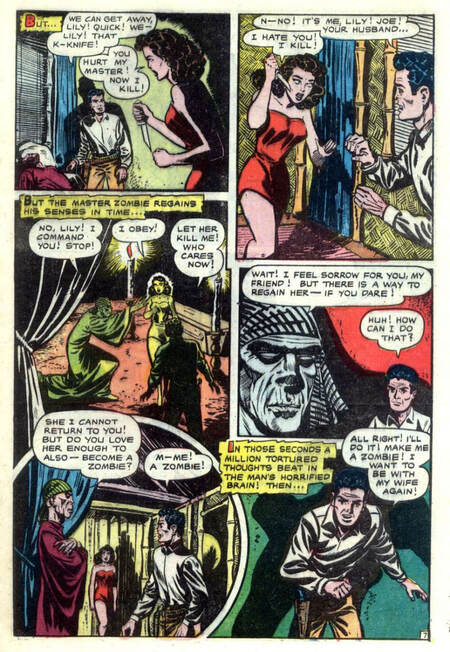
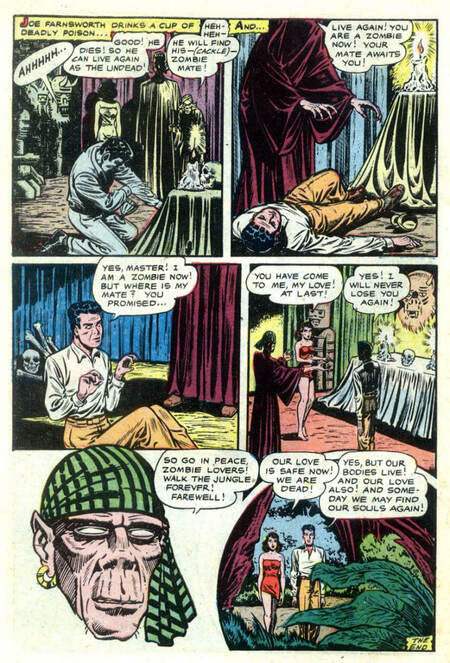
Voodoo #2 (Ajax/Farrell, 1952), «Zombie Bride» [3]
In «Zombie Bride,» it wasn’t entirely clear what fear we were talking about. But we are human, and our fundamental emotions are the same as before: a person will do anything for love—even become a zombie to be with the one they love.
«Ghouls Castle»
Joanna ends up in a quiet house in the woods and finds herself captive there. The house belongs to the mad scientist Barker.
Barker, with his assistants, brings the bodies of deceased professors and scholars into the castle and uses an electrode apparatus to bring them back to life. This creates ghouls: they remember everything they knew in life and are required to work for Barker with their intellect.
Having escaped her cell, Joanna sees these ghouls behind the bars. They do not attack; instead, they ask her for help.
Haunted Thrills #4 (Ajax/Farrell, 1952), «Ghouls Castle» [4]
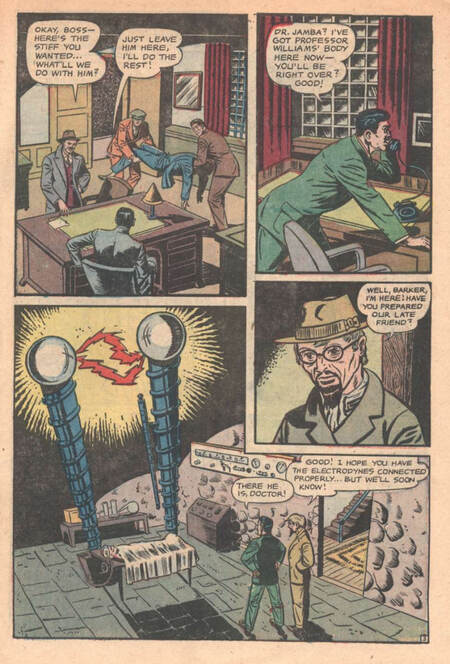
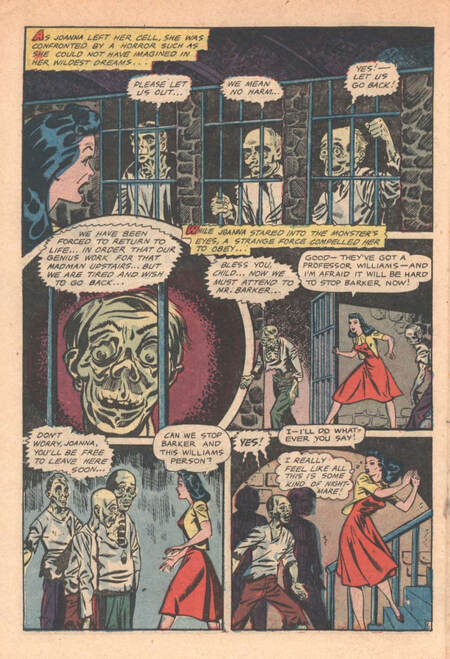
Haunted Thrills #4 (Ajax/Farrell, 1952), «Ghouls Castle» [4]
The core of this comic is obvious. The age of industrialization begins—a race: who is faster, who is smarter. And some people are willing to do anything. The professor turns other professors into ghouls to preserve their knowledge and then exploit it.
1954: Ban
In 1954, psychiatrist Frederick Wertham published the book «The Seduction of the Innocent»: according to him, such comics harm children and lead to criminal behavior.In the spring of 1954, the Senate Subcommittee on Juvenile Delinquency took up the issue of comics. Publishers feared government censorship and decided to implement self-censorship.