May 23 | Tuesday
Russkoe Slovo, No. 114 New Supreme Commander Completely unexpectedly, there was a change in the post of supreme commander: General Alekseev retired, and General Brusilov was appointed to his place. Undoubtedly, the war has not brought forth a more popular name than that of the new supreme commander. He was surrounded by the aura of a hero from the very first months of the war, following the brilliant successes of the Brusilov army in Galicia. General Brusilov managed to convey both his popularity among the public and his deep love for the army up until the days of the revolution, and the revolution only strengthened these feelings… «General Brusilov is taking command of the entire Russian army at a decisive moment in the war with the conviction”—he told our correspondent—“that the ‘army revives and grows stronger every day’ and will fulfill its duty to the Motherland, forcing the enemy to conclude peace on the terms that free Russia demands.»
May 24 | Wednesday
A Sick Russia (A Conversation with Alexeev)
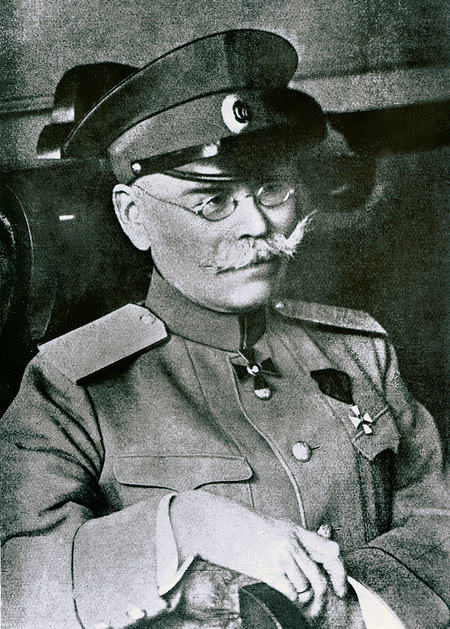
New Time, No. 14784
A poignant, unforgettable day at the Headquarters of the Supreme Commander. The presidium of the Army and Fleet officer congress came before General Alekseev to give him a final «farewell.» General Alekseev’s departure surprised everyone; the congress met this news with a deathly silence… Words cannot describe the final parting scene of the combat officers with their commander. The moment the General said, «Perhaps soon I will be a private citizen; I have already submitted my resignation request,» he wept. Tears streamed down the faces of the wounded officers… General Alekseev received me the night before his departure. It was ten o’clock in the evening… He spoke simply, from the heart—good. His voice held an incorruptible sincerity, as well as pain and longing for Russia: «Russia is struggling in heavy spasms; Russia is being reborn, and it takes time to overcome a serious illness.» …The less developed the populace, the more it seems to them that some invisible enemy is encroaching upon their rights, «taking and snatching them away.» Everyone has forgotten their duties, and this is the most crucial point. But there are no rights without responsibilities. It is easy to inspire masses with a speech, especially with a popular orator like the Minister of War. But thousands of orators are needed to instill in the soldiery the connection between their rights and their duties. This can only be achieved through education… The greatest crime against the fatherland is that which lowers the morale of the army, fostering in the soldiers a sense of animal fear by proposing to end the war without pressure, without attack, without victory. This is my deepest confession…
If you knew the intensity of the propaganda pushed onto the army—from Germany, and from our own rear lines. And the weary army, which was not always fed everything it was entitled to, eagerly swallowed flattering, cunning speeches. On the ground of known material shortages, a grave trend developed: «World at any cost.» Phenomena like the Kronstadt Republic—these are shameful episodes. The bitter truth is that many hands are stained with officer’s blood. It reveals a complete dereliction of duty to the motherland. These are spasms of treachery against Russia. Every Russian feels shame at such spasms, and the blood of Russian officers cries out to the heavens. It is a dark, somber stain on the canvas of the Russian Revolution. May God grant that these are the last spasms. Germany’s situation is not easy, but the cultivation of its people in iron discipline, in unifying and reconciling love, saves the German nation… Look what remains in Germany now: the disabled, the children, the very old—all sent to the front. And look in Petrograd at how many young, strong people remain there, who have not yet seen battle!… My mandate to Russian society is to demand that the army know that defense is possible only through offense—through attacking… Especially since our land is occupied! Russia cannot exit the war crippled and ravaged. And they want to seize much from us. So, no—forward, attack—the agitated general raises his voice—we must beat and drive the German army from our native land. And the army must fulfill its duty to the free homeland until the very end. Russia has spent much on it—love, strength, and resources… Our army has everything. What is needed is only inspiration, and a battered, ailing Russia has the right to demand this final sacrifice of ours.A. P. Tupin
Early Morning, No. 115 The Decrees of the «Republicans» The Kronstadt residents prohibited the import of bourgeois newspapers into the Kronstadt «Republic.» To increase their funds, the Kronstadt residents imposed a levy on cinemas and several enterprises. (Own correspondent)
New Times, No. 14784 The Manilovism in Power …Over a hundred Bolsheviks, about 90 Socialist Revolutionaries, and 45 Mensheviks of the Zimmerwald faction sit in the Kronstadt Soviet, collectively exercising the «dictatorship of the proletariat”—a concept from which the shadow of K. Marx certainly recoils. The local intelligentsia, terrorized by the anarchists, remains silent. Some officers languish in prisons, under conditions no less dreadful than those of German captivity…Y. Naumov
May 25 | Thursday
Exchange Gazette, No. 16249 (Evening Edition) Letter to the Editor Intemperance is reaching colossal proportions. Apothecary shops are the breeding grounds for alcoholism, as they dispense vast quantities daily of cologne, henna water, dental elixir, and other cosmetic alcoholic waters. Primarily bought by laborers and soldiers, these substances are consumed instead of wine; individuals spend their last pennies on them, poison their health, and, most significantly, lose their reason—a tragedy made all the more terrifying during these trying times. We believe that the best course of action would be to remove all cosmetic and alcoholic waters from sale. To achieve this, we must first close the cosmetic laboratories that have spread so widely recently, the majority of which are exclusively engaged in the production of cologne, henna water, and the like. Furthermore, it is necessary to prohibit the dispensing of various fruit essences from pharmacies and apothecaries. These essences, which have no medicinal value, when added to denatured alcohol, make it more palatable for drinking. These essences are also sold in enormous quantities, indicating heavy consumption of the denatured product. The denatured alcohol should instead be diluted with a substance that would make it impossible to drink (for instance, some emetic agent). We reiterate the necessity of taking the strictest measures against individuals and institutions that prioritize their personal material interests over and above their country.Employees of the Sokolnicheskaya Pharmacy (Suvorovsky Ave., Bldg. No. 60)
Speech, No. 119 In the «Tomsk Republic» The Tomsk province decided to outpace all of Russia. A provincial popular assembly has already convened there, supposedly elected through universal, direct, equal, secret suffrage. This assembly is already developing a special constitution for the Tomsk province. …There is not a word said about subordination to the Provisional Government, which is currently the highest authority in the country… …The Taryshkinsky rural popular assembly, comprising 207 citizens, issued the following verdict regarding the Tomsk provincial popular assembly’s decision to grant its members a daily allowance of seven rubles, including travel reimbursement to and from Tomsk… The Taryshkinsky assembly sent this telegram to its deputy, Solovyov: «Declare to the assembly that those who sent you demand that you and the other deputies renounce the materialistic decision regarding the seven-ruble daily allowance: as a worker, you shall receive three rubles…»
May 26 | Friday
Assembly of Peasant Deputies
Delegates of the 1st All-Russian Congress of Peasants' Deputies. V. Chernov on the right (seated).
Today, the Minister of Agriculture V. M. Chernov spoke at the peasant congress for the last time. Disputes over agricultural issues have ended. On behalf of the congress presidium, the resolution developed by him is proposed…
Russkoe Slovo, No. 117
«The All-Russian Council of Peasant Deputies declares to all Russian peasantry that from this moment on, not only the final resolution of the land question, but the entire process of preparing this resolution—at the central level and locally—is transferring into the hands of the working population itself. Therefore, the next and most critical task for the leading elements of the peasantry is to organize elections for local and district land committees, ensuring that the following principles form the foundation of their work in preparing the reform: the transfer of all lands—state, monastic, church, and privately held—into common national property for equitable labor use without any compensation.
The All-Russian Council of Peasant Deputies is deeply convinced that private ownership of land, including its forests, waters, and subsoil resources, will be abolished by the all-people constituent assembly, which will establish the fundamental law on land, on the conditions and procedure for its transfer into the hands of the workers, and on the procedures for its use and allocation…
In order to preserve the integrity of the land reserve that can be utilized for future agricultural reform, the strict and unswerving enforcement of a ban on the purchase, sale, collateralization, and transfer by will of land until the constituent assembly is necessary.
…The All-Russian Council of Peasant Deputies invites all the peasantry to peacefully, yet firmly and steadily implement in legal norms the sacred thoughts and aspirations of the working farmer, which have long been expressed in the cherished slogan of every peasant: „Land and Freedom.“
The Assembly adopts this resolution unanimously against two votes, and with one abstention…»
A.F. Kerensky in the Trenches
The Expulsion of the Coward Riga. During his tour of the Riga Front, A.F. Kerensky happened to visit one division particularly affected by the corrosive propaganda of Bolshevism. The Minister of War gathered the soldiers of one regiment around him and gave a passionate speech, in which he explained the meaning of the revolution, clarified the true principle of defensive warfare—one that required not only staying in the trenches but also actively engaging in offensive action. After this speech, a representative of the group enthusiastic about Bolshevism stepped forward from the crowd of soldiers… «Why should I care about land and freedom,» he continued, «if they kill me? We need peace, not freedom.» A.F. Kerensky, whose oratory ignited the soldier’s reaction, began to illustrate, using figurative language, the falsity, perversion, and civic bankruptcy of Bolshevik trends. Throughout this time, the soldier, who had been staring gloomily at the minister, interrupted him with disjointed outbursts and finally exclaimed: «We must end this war peacefully!» …A. F. Kerensky, who watched the soldier’s eyes—eyes burning with malice—continued his speech, speaking of fighters for freedom, of how some in this difficult moment concealed petty interests and the shameful cowardice of slaves behind grand ideals of peace… The minister’s inspired address had a profound impact on the soldier, among whom notes of protest against the Bolshevik’s speech had already begun to resonate… «Regimental Commander,» the soldier interrupted A. F. Kerensky, «I order you to release this soldier from military service. Send him to the village and state in the official order that the revolutionary army does not require cowards…» A deathly silence descended. The soldier turned white and silently collapsed face-down in a deep swoon… A.F. Kerensky, accompanied by Radko Dimitriev, Dragomirov, and other generals, proceeded toward the front line via the message paths, where he continued his discussion with the soldiers—notwithstanding the obvious danger, he sat with Radko Dimitriev on the parapet, facing the enemy. On his return, A.F. Kerensky passed by a fresh military cemetery. He stopped there again and, removing his hat, stood motionless for several minutes. His lips were murmuring something inaudibly.
At the Khesinskaya Palace Today, a group of Kronstadt sailors appeared at the Khesinskaya Palace and appealed to the Bolshevik leaders, asking them not to comply with the world judge’s eviction order. The sailors stated that they consider the Khesinskaya Palace to be national property and, as representatives of the people, presented the palace as a gift to the revolutionary parties. Concurrently, the delegation handed over two machine guns to its ideological leaders to defend the palace in the event that the judicial power carried out its eviction decree. Representatives of the revolutionary parties thanked the sailors for the gift and explained to them that any resistance would be futile and detrimental to the cause of the revolution. The Khesinskaya Palace, they said, cannot be considered national property because we still live under the conditions of the capitalist system, where the right of ownership has not been abolished.
May 27 | Saturday
New Times, No. 14787 Athletics Following last year’s precedent, the Petrograd sports lovers’ circle has begun its closed track and field competitions. The results from the first day of these events are as follows: The opening prize in the 100-meter dash was won by Familiant — 11.2 seconds. The jubilee prize in the 5,000-meter race was won by Gallin, with Uymal finishing second and Neisil third. In the 400-meter relay, the team consisting of Spiegel, Litovchenko, Familiant, and Reshetnikov won. The time was 47.7 seconds. In the long jump, Zhuralev took first place (form 1 meter 24 cm) with 6.84 meters. In the discus throw, Familiant excelled (form 5 meters 58 cm) with 50.91 meters, while Egorov placed second (form 9 meters 1 cm) with 47.81 meters. …Results of the two-handed throws.
May 28 | Sunday
Death Battalion
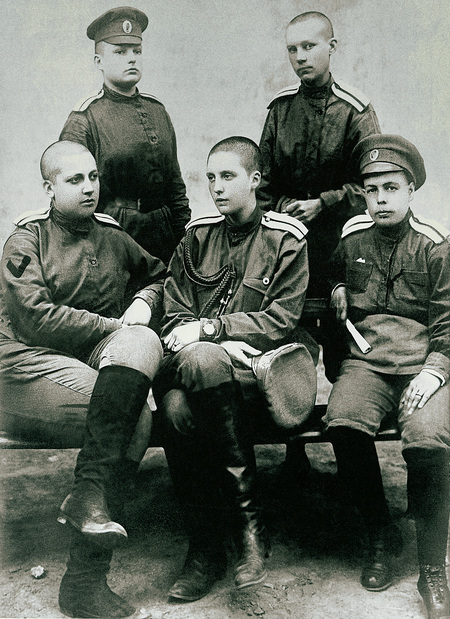
Russian Word, No. 119 In Petrograd, a women’s union for aiding the motherland was established, aiming for the active defense of the homeland on the front lines. Its primary mission was the creation of «women’s death battalions,» dedicated to swearing an oath to charge against the enemy in the leading ranks. The organization is headed by the wife of the peasant soldier, Bochkareva. During the current war, Bochkareva participated in several battles, was wounded six times, and was awarded the soldier’s George Cross for outstanding military achievements. A. F. Kerensky has already approved the statutes of the women’s union for aiding the motherland and permitted the formation of the battalion. So far, about 300 women have signed up. By order of the Minister of War, 10 instructors have been assigned to train the women in military drill and weapon handling. The female soldiers will be provided with a special facility. After their combat preparation, the first platoon will be sent to the front line. On the front, the women’s death platoon will be completely isolated from the rest of the army. All duties—both logistical and administrative—will be performed by the women themselves. Command responsibilities have also been entrusted to them. Bochkareva has been appointed commander of the first platoon and, by order of A. F. Kerensky, has been promoted to the first officer rank. Accompanying the first group of women is the wife of the Minister of War, O. A. Kerenskaya, who pledged to remain in the trenches at all times if necessary…
Photo: A group of shock troops from the first women’s death battalion