9/11 | Monday
«System»
They say that Russian domestic life is currently in a state of chaos. They say. But I personally see a coherent and robust system in every aspect of our domestic life. I will not speak merely in assertions. Here are the facts… A manufactory warehouse was discovered in Plyushchi. Shots were fired. A commissar’s assistant was wounded, a woman was injured. Fish were found—obviously lightly salted, judging by their stench, which testified to insufficient readiness for speculative competition. Shots were fired. First aid was administered to the injured… A passerby carrying four French rolls under his coat was detained. Shots were fired. Though not here, but a little further away, where four poods of stearin candles were discovered. The owner of the French rolls was introduced to the norms of justice by a dozen hefty fists. If you ask me about the state of the textile industry in Russia, I can answer with confidence: «Shots were fired…» Where there is confidence, there is no chaos—there is a system. And this is the system: «Shots were fired.» DE-NIS
Moskovsky Listok, No. 205 Building Committees According to the mandatory decree of the Moscow City Duma from September 5th, the distribution of bread from bakeries and shops will begin on October 1st exclusively to residents' organizations. It is therefore necessary to immediately form building committees. The City Administration has developed a draft charter for the Moscow building committees… Where building committees already exist, there is no need to create new ones…
Central Worker Cooperative Currently, the Food Council of Moscow’s factories and plants is engaged in the prompt transfer of all food affairs to the hands of the Moscow Central Worker Cooperative. The Food Council’s efforts to supply the capital factory and plant population with essential goods have yielded positive results. Firewood is being stockpiled at affordable prices, a significant batch of cigarettes and tobacco has been purchased, and contracts have been signed with two major mechanical footwear production factories… The footwear will be distributed at the Food Council’s warehouses. To compensate for the shortage of bread, the Food Council has decided to substitute it, where possible, with chocolate, cocoa, and other confectionery products. To this end, a petition has been submitted requesting that the Worker Cooperative be granted 5,000 poods of sugar monthly for transfer to one of the confectionery factories to produce the aforementioned goods…
Transfer of Confectionery Factories to Cooperatives …The Moscow Consumers' Union has acquired factories such as «Triumph» and the G. and E. Lenev enterprises. The «Kooperatsiya» Union has leased the Ivanov and Markov enterprises. Contracts have been concluded between the Moscow cooperatives and other confectionery factories for the supply of a known portion of all their production.
Morning Russia, No. 219 National Congress Opens Kyiv (Staff Correspondent). A congress of peoples, convened by the Ukrainian Rada, opened in a solemn atmosphere. Delegates arrived from Lithuanian, Tatar, Belarusian, and Georgian peoples, totaling 23 delegates; the other attendees were local Ukrainians. Jews sent two representatives. There are also representatives from the Cossacks on the front. Some delegates are still en route… The congress opened with a welcoming speech by the Chairman of the Central Rada, Hrushevsky…
September 12 | Tuesday
Morning of Russia, No. 220 The Riga Front On the Riga sector, south of the Pskov highway, our units advanced and captured a portion of the enemy position… (PTA)
Morale in the Troops The Command (Self. Corp.)… Based on recent events, the antagonism between officers and soldiers, stoked by irresponsible elements, has intensified even further… Furthermore, a rumor is circulating throughout the forces that on October 1st, there will be a general order for demobilization and return home. Soldiers openly state at private meetings and gatherings that on October 1st, they will plant their bayonets in the ground and head to the rear…
September 13 | Wednesday
Early Morning, No. 209 Position of Revolutionary Democracy A resolution by the Petrograd Council of Workers' and Soldiers' Deputies, adopted by a majority of 463 to 248 votes, states that to save the revolution and the country from the horrors of counter-revolution and complete economic collapse, an immediate break with the landowning and bourgeois classes and the establishment of power by authorized representatives of workers' and peasants' organizations are necessary. The foundation of this power must be: the immediate proposal of a universal democratic peace to all peoples of the warring states, the immediate abolition of private ownership of landed estates without compensation and their transfer to the administration of peasant committees, the organization of worker control over production, the imposition of severe taxation on large capital holders, and the confiscation of military profits. At yesterday’s night session of the Central Executive Committee of the Soviets of Workers', Soldiers', and Peasants', after speeches by I. G. Tsereteli, V. M. Chernov, Steklov, Kamenev, Libera, and others, a question was put to a vote regarding the recognition of the coalition principle in the organization of power. The coalition principle was adopted by a majority of 119 to 101. Following this, P. O. Bogdanov submitted an amendment stating that a coalition with the People’s Freedom Party was unacceptable. This amendment was adopted by a majority. (Own correspondent)
Bolshevik Delegates The Petrograd Council of Workers' and Soldiers' Deputies elected Lenin, Zinoviev, and Sadovsky to the democratic conference from the Bolshevik faction.
Shop Closures Starting October 1, many large industrial enterprises in Moscow will close down. The Myur and Meriliz shop will cease trade due to a lack of goods. The Siu confectionery factory is closing all its stores.
09/14 | Thursday
Cossack — ethnicity
Early Morning, No. 210
At the Peoples' Congress, the Cossacks' statement was read, asserting that they should be recognized as a nationality, not a social estate. It also addressed the Cossacks' overall aspiration for a union with other nationalities to achieve mutual support for the federation and expressed their readiness to join this bloc.
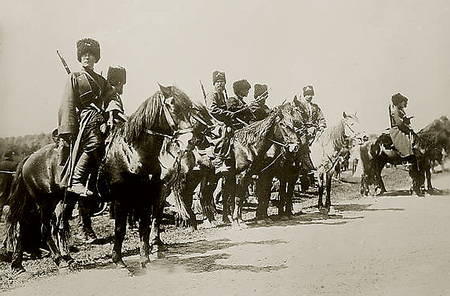
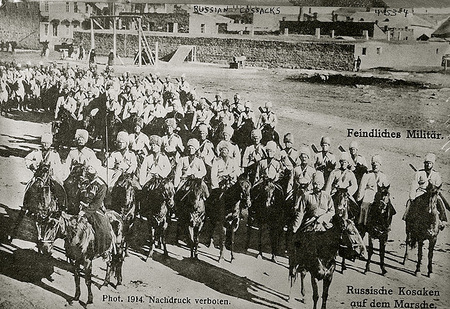
Rossiyskye Vedomosti, No. 210 Military Circle in Novocherkassk Rostov-on-Don (From our correspondent). …A significant shift toward federalism has emerged in the circle. Proponents of federalism plan to unite the Don, Kuban, and Astrakhan Cossack troops and establish a federal union for southeastern Russia in the near future. Comrade Bogayevsky, the Cossack leader, spoke out against federalism…
Russian Will, No. 218 At Smolny Buffet …We are seated in the buffet designated for members of the Central Executive Committee’s bureau, which is also attended by all Committee members. Beside me sits the famous Liber, with his black beard, conversing with the equally famous military doctor Dan. At the next table, Trotsky is whispering something to Martynov. The chairman of the soldiers' section, Zavadye—a bourgeois-looking free-minded man—is reading aloud his satirical biographies of the leaders of democracy… They are talking about the latest «mischiefs» of the bourgeois press and criticizing the cadets. A fearsome Kameniev arrived—a stocky man of the district official type—and brought his wife, with whom he sat down for breakfast. People are just people. Even in their private lives, they are very kind people. With the exception of Trotsky, whom even the Bolsheviks dislike… But why do these people show so much malice toward Russia? Why do they torment it so mercilessly? Simply because they don’t think about it at all. They are busy with their own affairs—their exclusively their own business… These people, who are shaping the fate of Russia, neither want nor can think about the consequences of what they are doing. «The Bolsheviks are winning. What happens next?» I ask a member of the Central Executive Committee. «Nothing special. The Bolsheviks are just like everyone else…» «And will they seize power themselves?» «Yes. But only if they have an absolute majority.» «And will that happen soon?» «Probably soon. We are all leaning further left by the hour. Each of us strives to be half a step further left than our neighbor…»
V. Samoilov
Moskovsky Listok, No. 208 Lenin in Petrograd (By telephone) The situation has changed—and Lenin has arrived in Petrograd, reportedly from Finland. On the same day, the Bolshevik leader had a meeting with his political associates. It is possible that Lenin himself will speak at the combined meeting of democratic organizations with a major address regarding the events of July 3–5. Once the authorities received word of Lenin’s location, the question arose: should the prosecutor’s supervisory order to arrest the Bolshevik leader, in connection with the events of July 3–5, be carried out? …Considering the changed conditions of the moment, political circles believe that the order to arrest Lenin and other Bolsheviks is unlikely to be enforced.
September 14–16
Izvestiya of the C.I.K. and the Petrograd Council of Workers' and Soldiers' Deputies, No. 170 | Russkaya Volya, No. 220 (evening edition) | Russkiye Vedomosti, No. 211 | Rannee Utro, No. 211 | Utro Rossii, No. 223 | Russkaya Volya, No. 220 Impressions …Heavily reinforced military patrols near the theater, endless—at every door—suspicious and nitpicky controllers, the excessive nervousness of the commandant’s office—all set a tense, expectant mood… The start of the meeting was cold and formal—a real calm before the storm. Chekhidze’s speech was delivered abruptly and dryly, followed by hurried applause… The storm began with the appearance of Kerensky. This cannot be forgotten—neither the rampant Bolshevik waves nor the inspired, tormented face of their suppressor… The convergence of the two poles of the Russian Revolution—the ecstatic, popular, national versus the theoretical, international, alien to the homeland and the Russian Revolution—created an intense jolt. The morning newspapers revealed to Russia that Kerensky had emerged as the victor.Mikhail Yefimovich
To Lenin’s Cause
For the last two days, agents from counterintelligence and the city police have been searching for Lenin and Zinoviev throughout the city. The police learned that Lenin and Zinoviev were at the vestibule of the Alexandrinsky Theater yesterday at 4 p.m., awaiting a decision from the presidium of the unified council of democratic organizations regarding their participation in the democratic council. The Bolsheviks were demanding guarantees of the inviolability of Lenin and Zinoviev from the presidium…
The presidium of the meeting responded that the immunity of Lenin and Zinoviev could only be guaranteed within the theater during the meeting. Due to this, Lenin and Zinoviev did not participate in the session. Yesterday, the Bolshevik faction informed the organizational committee of the democratic meeting that it would delegate two other of its representatives in place of Lenin and Zinoviev. According to the Bolsheviks' explanation, the initial election of Lenin and Zinoviev held only demonstrative significance…
The Bolsheviks justified their decision by stating that the presence of Lenin and Zinoviev would provide the pretext for derailing the entire meeting, since the Provisional Government would implement its decision by arresting Lenin and Zinoviev, and the Bolshevik faction would take vigorous measures against this…
Meeting Attendees According to the summary prepared by the organizing committee, the meeting included: Councils of Workers' and Soldiers' Deputies — 230 delegates, Councils of Peasant Deputies — 230, City representatives — 300, Zemstvos and Gubernia Executive Committees — 200, Army organizations — 83, Commissars — 22, Army and Peasant Sections — 18, Officers — 4, Veteran Soldiers — 6, Bloc representatives — 16, Professional unions — 100, Postal and Telegraph Servants — 12, Teachers — 15, Trade and Industrial Servants — 30, Central Cooperatives — 120, Worker Cooperatives — 38, Economic Group — 33, Press — 1, Food Organizations — 17, Land Committees — 20, Union of Orthodox Clergy and Laity — 1, Peasant Union — 10, Field Nurses — 5, Ukrainian Rada — 15, Muslim Council — 10, Council of National Socialist Parties — 10, Jews — 1, Poles — 2, Georgian Inter-Party Union — 5.
UNDER THREAT
The Александринsky Theater building, where the meetings of the Democratic Council were held
The Bolsheviks certainly failed to meet expectations. Instead of Lenin and Zinoviev, they brought only Kamenev to the democratic council. Not even Trotsky—the «beauty and pride of the Russian Revolution"—but only Kamenev. Clearly, the time has not yet come for that Bolshevik hour when Lenin’s spirit, which has been hovering over the Petrograd Soviet for ten days, should materialize in a stout, ruddy man with angry eyes looking in different directions and a barking voice…
L. Kamenev
Kamenev’s Speech …Power may rest in the hands of one class or another. Until now, power has been in the hands of the bourgeoisie. If democracy is unwilling to seize power now, it must openly state: «We do not believe in our own strength, so, Mr. Buryishkin and Mr. Kishkin, come and rule us.» (Laughter, applause.) It is pure utopian thinking to believe that the bourgeoisie will genuinely and honestly run our program… Kamenev calls for abandoning the attempt to compromise with bourgeois elements—urging democracy to believe in its own power and establish itself as the sole authority.
Bolshevik Intentions The Bolsheviks issued a proclamation asserting that the democratic meeting did not represent the will of organized democracy; therefore, it was necessary to counter it by convening a Congress of Soviets of workers, peasants, and soldiers' deputies… The Bolsheviks proposed that the delegates of the Soviets of Workers' Deputies should not leave Petrograd, but rather wait for delegations from the provinces to arrive at the Congress of Soviets, which would definitively and decisively address the question of transferring all power to the Soviets. (Own correspondent)