Index
[1] Concept [1.1] Hypothesis [1.2] Structure [1.3] Material Selection [2] Visual Language [3] Human [4] Narratives [5] Conclusion [6] References
Concept
They are everywhere. These flat, soulless people who try so diligently to earn our trust. Cute poses and colors are supposed to elicit a smile and sympathy, but instead they only receive a weary sigh and indifference. The vector «Frankensteins» of large corporations—what went wrong?
In recent years, we have become accustomed to seeing the same style everywhere, in various iterations and under different brands. And everyone is saying it: we are tired. People are voicing their frustration everywhere—from kitchen conversations to heated discussions on Reddit. To understand what went wrong, it is sometimes important to return to the origins. Why do cave paintings evoke a stronger emotional response despite the millennia separating us from their creators? Why does a primitive anthropomorphic image on a cave wall carry more life than a meticulously designed modern human figure crafted by professionals?
Hypothesis: Capitalism is to blame for everything. This is a phrase often thrown around today, but there is a kernel of truth to it.
The primal human resembles a child in his untainted consciousness and genuine attempts to understand the surrounding world. The cave dweller, like a young child, creates freely—undisturbed by the fear of making a mistake or drawing something «wrong» or «ugly.» It is precisely this primal boldness that generates images so vibrant and simple.
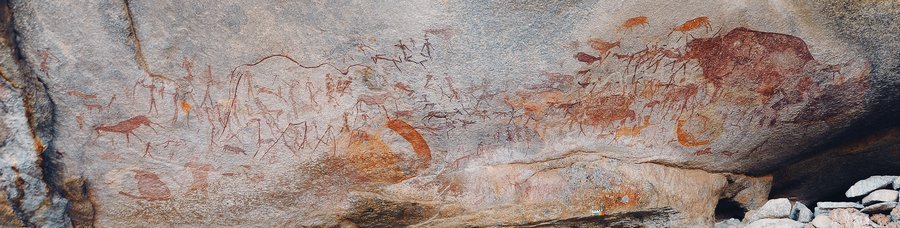
Zimbabwe. Markwe Cave.
Contemporary illustrations, particularly those favored by major corporations, are the product of professional work by entire teams of designers and artists. They must be precise and allow for no errors, as they form part of branding, directly influencing the company’s image in the eyes of the consumer, competitiveness, and so on. It is characteristic that along with the style, a «style guide"—a kind of instruction manual for applying the style—is formed. When an image loses its uniqueness, and a single visual motif is repeated too often, it leads to oversaturation.
Facebook Alegria («Facebook» is recognized as an extremist organization and banned in the territory of the Russian Federation)
Structure
The first research module defines the types of images under consideration, their characteristic features, and their historical context. Familiarity with the visual language allows the reader to focus attention on the key elements of the research, facilitating a more conscious engagement with the topic. The «Human» section presents a comparative analysis of the anthropomorphic image in prehistoric art and contemporary illustration. The next module, «Narratives,» expands the scope of study: the human is examined as a character within an extensive composition, and the motifs of human representation across different eras are defined.
Materials Selection
The research began by selecting several academic articles to form the theoretical foundation. The main query was: «The human image in prehistoric art.» It was important not only to study scenes featuring anthropomorphic figures but also to find a well-composed «portrait» of the prehistoric person as a creator, which could subsequently be used as a comparative criterion for worldview. To gather additional information, it was sufficient to utilize internet resources in both Russian and English.
For image sourcing, I utilized thematic resources: internet articles directly or partially related to the research topic, archives of cave paintings, museum websites, and official sites of style-developing designers. If the retrieved images did not meet the required quality parameters, the second search phase began using Google Lens. This process allowed me to find higher-quality images and expand the range of information sources.
Visual Language
«Corporate Memphis”—an unofficial name for a stylistic trend in commercial illustration that has dominated the industry since the late 2010s. The Memphis Group (1980–1987) is a design collective whose visual language (vibrant color combinations, geometric shapes) most heavily influenced the development of this aesthetic. The adjective „corporate“ arises from the widespread adoption of this style among large corporations.
Yukai Du. Illustrations for Apple.
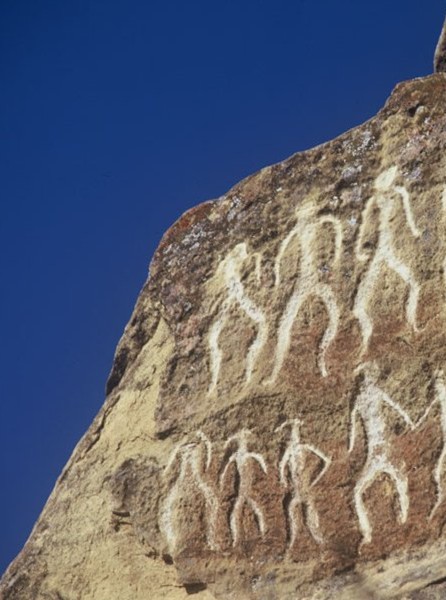
As part of this study, I will address the most ancient forms of art—pictographs and petroglyphs. Rock art, as the name suggests, is the painting of stone surfaces using pigments available to prehistoric humans. A petroglyph is an image carved into stone.
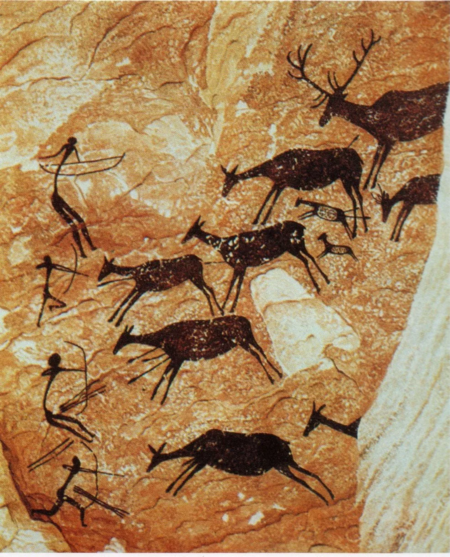
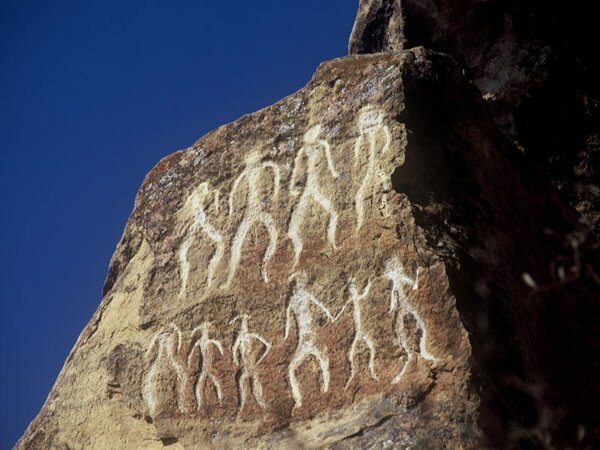
Valtorta Gorge. Spain. Neolithic. / Gobustan. Azerbaijan.
«The pictorial line, by which images are conveyed, has a 'unfettered, ' free character» [1, p. 259].
Tassilen-Adjer. Algeria. From 6000 BCE.
Facebook Alegria («Facebook» is recognized as an extremist organization and is banned in the territory of the Russian Federation)
The style incorporates the most vibrant defining characteristics of recent corporate aesthetics. The figure is constructed from geometric shapes, and mass dominates line. The strictness of the form is characteristic of vector graphics. Bright, varied color combinations. Deliberately distorted poses.
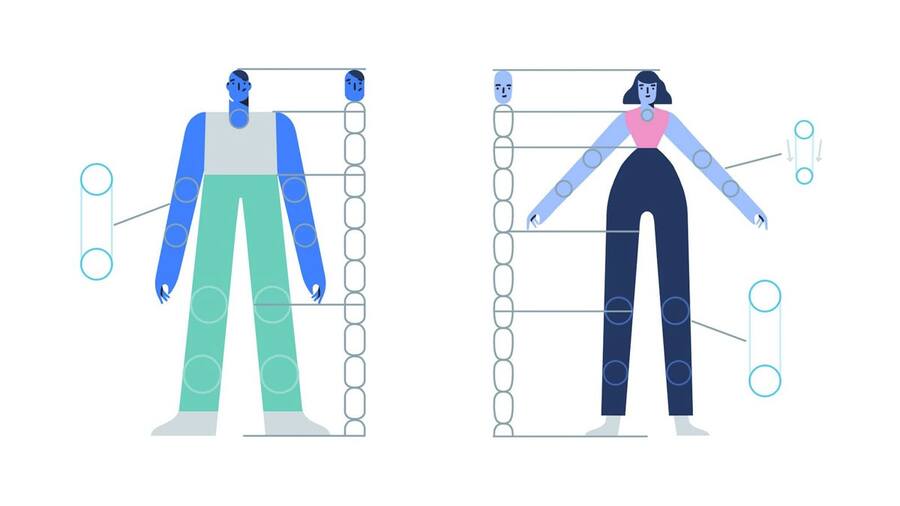
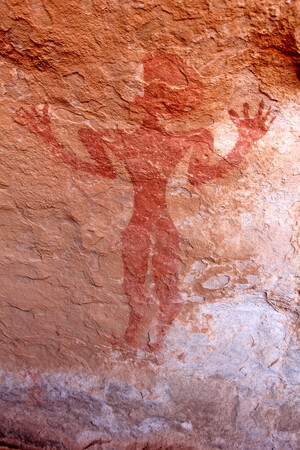
Facebook Alegria («Facebook» is recognized as an extremist organization and banned in the Russian Federation) / Tadart-Akacus. Libya.
Tassili n' Ajjer. Algeria
Kogul Dance: El Kogul, Catalonia, Spain.
Painterly line transitioning into a mass, limited color palette. Unintentional distortion lends a touching artistry to the figures. Lively schematic quality.
Human
Facebook Alegria («Facebook» is recognized as an extremist organization and is banned in the territory of the Russian Federation)