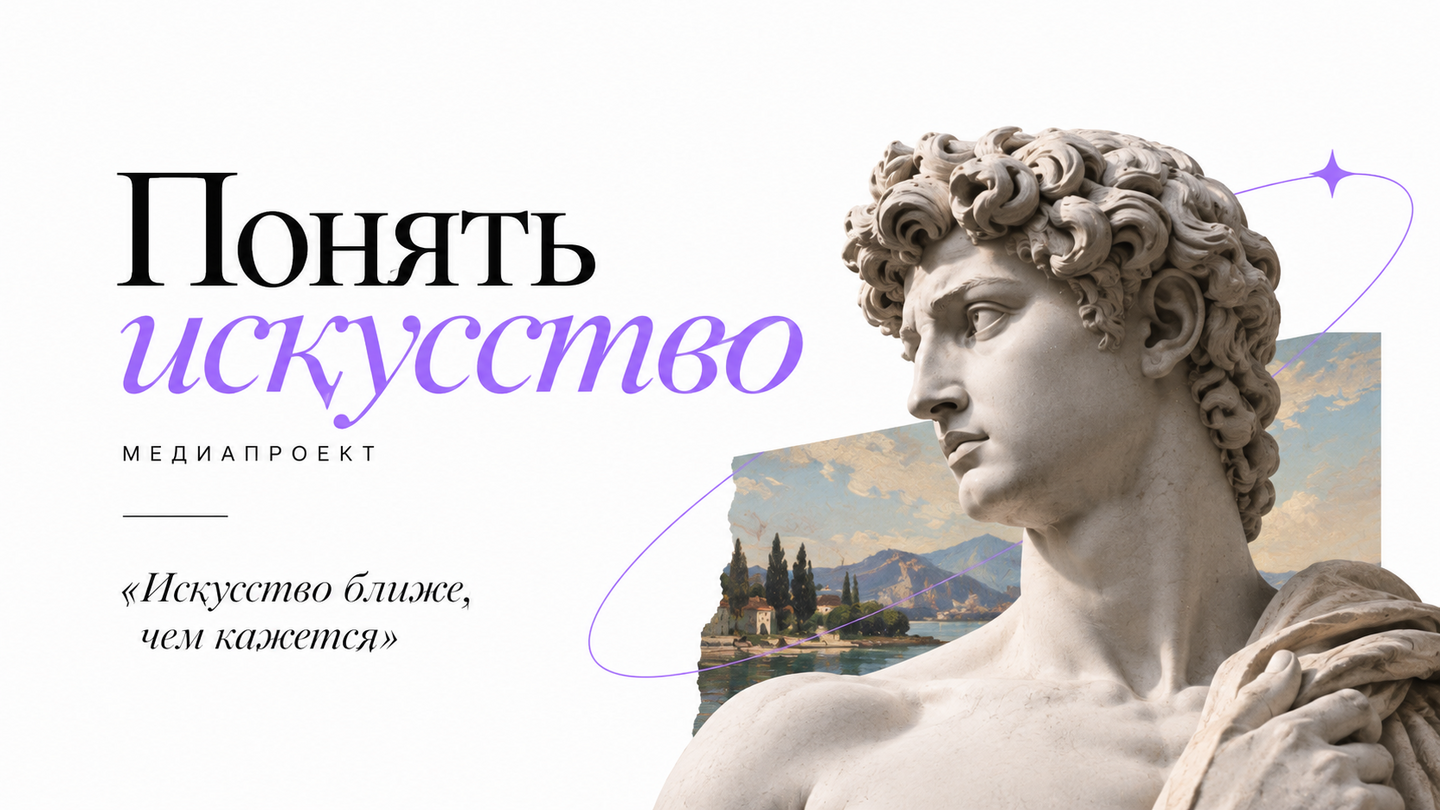
Concept
«Understanding Art» — an AI-media platform that helps everyday people understand painting, styles, and eras without pretension. We eliminate the fear of «looking foolish» in front of artwork and transform complex art history into clear, concise, and engaging content.Key Feature: An AI guide that tailors the artwork explanation to the user’s level (from «what even is this?» to «what is the innovation here»).Format: Website (main hub) + Telegram channel, VK Clips, Zen, podcast.
«One artwork—three minutes—complete understanding.»
Six-Month Thematic Plan
Focus: moving from simple questions to developing visual literacy. Each month features a new theme—a «capsule.»
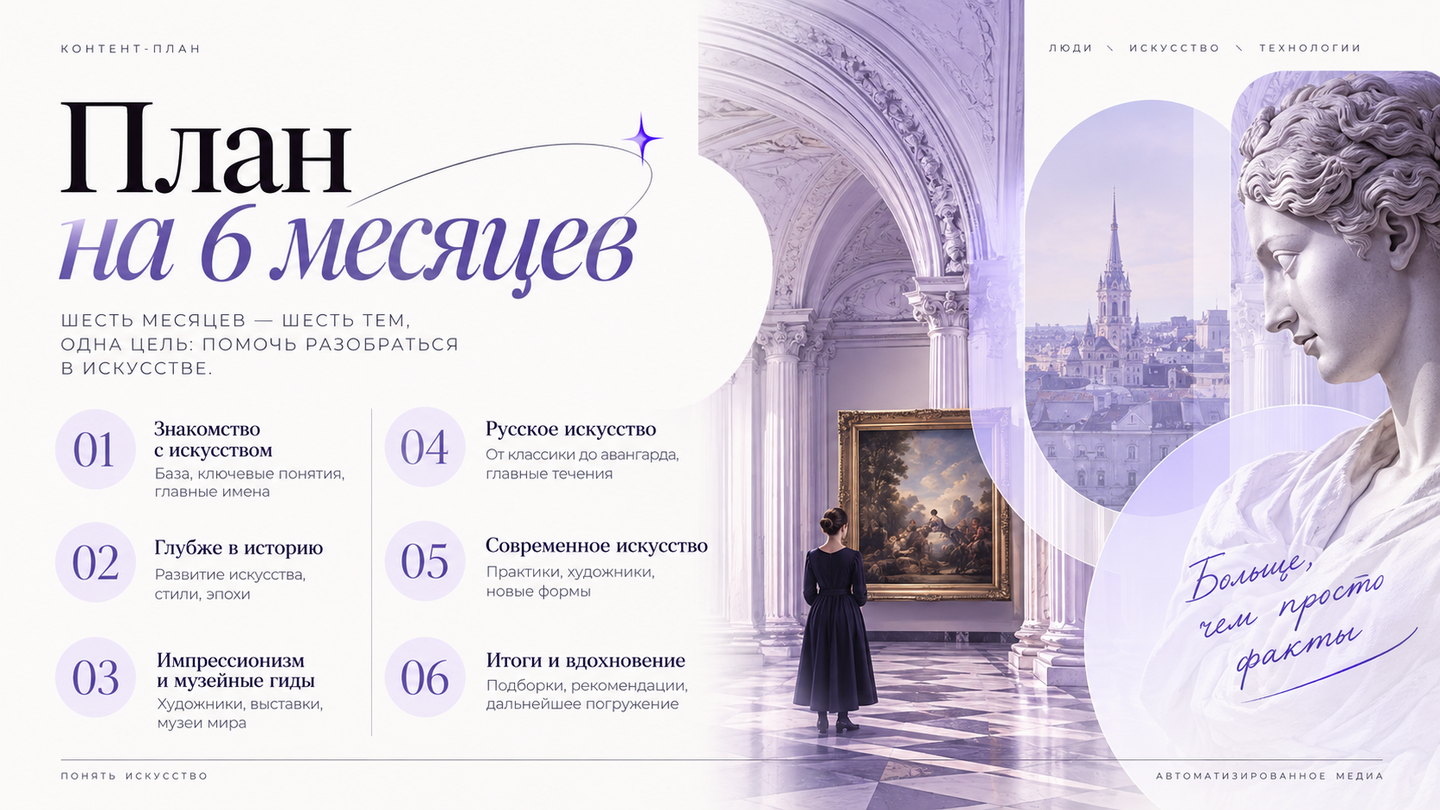
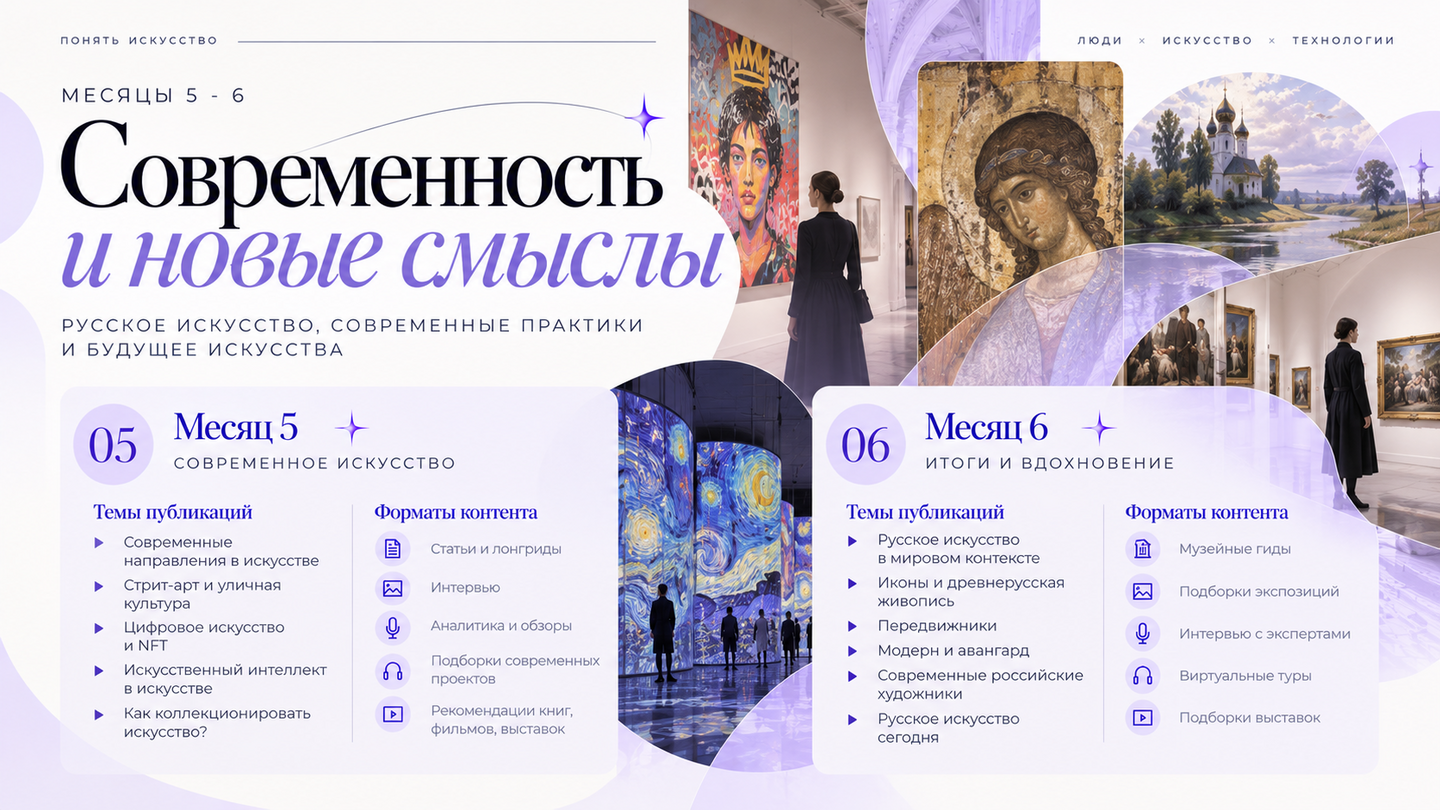
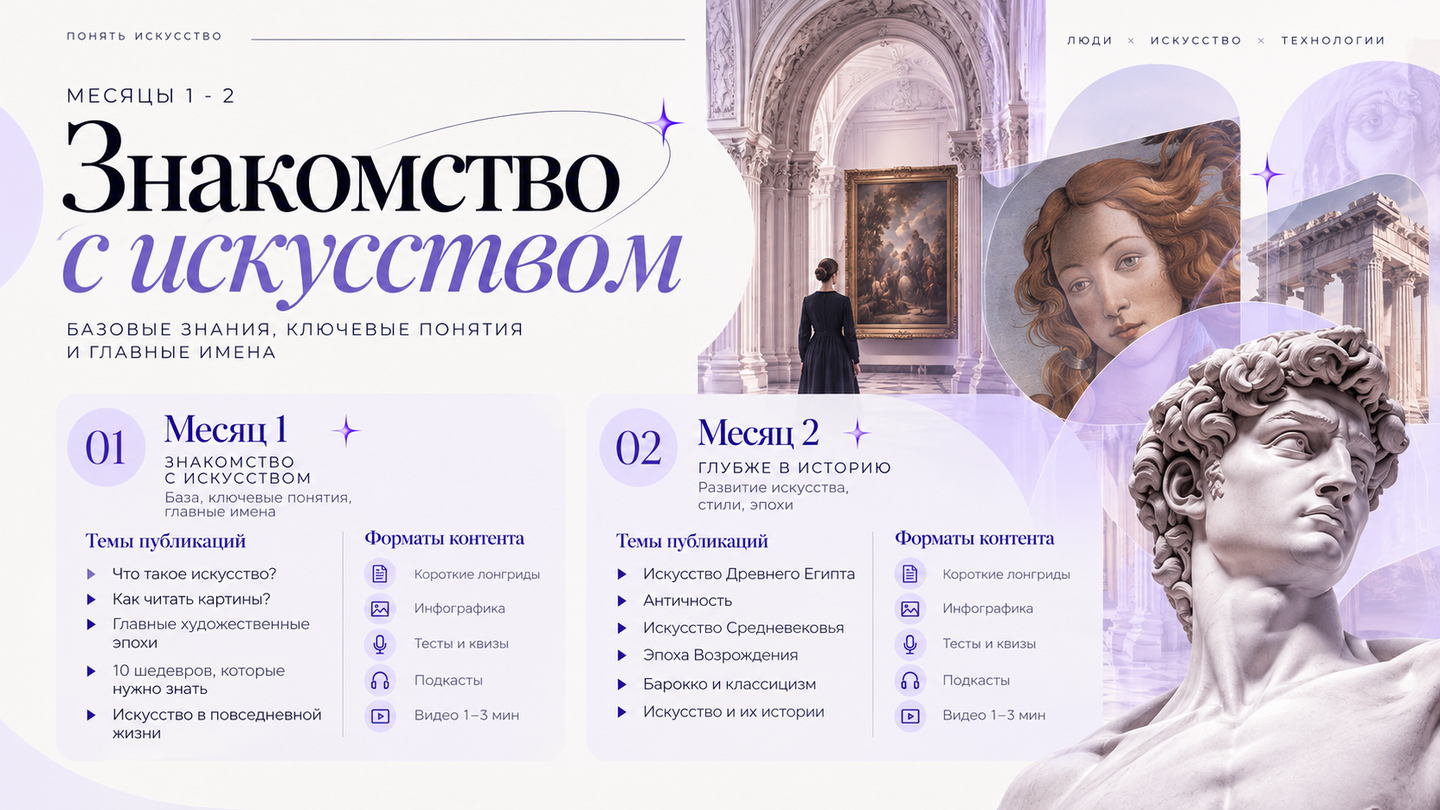
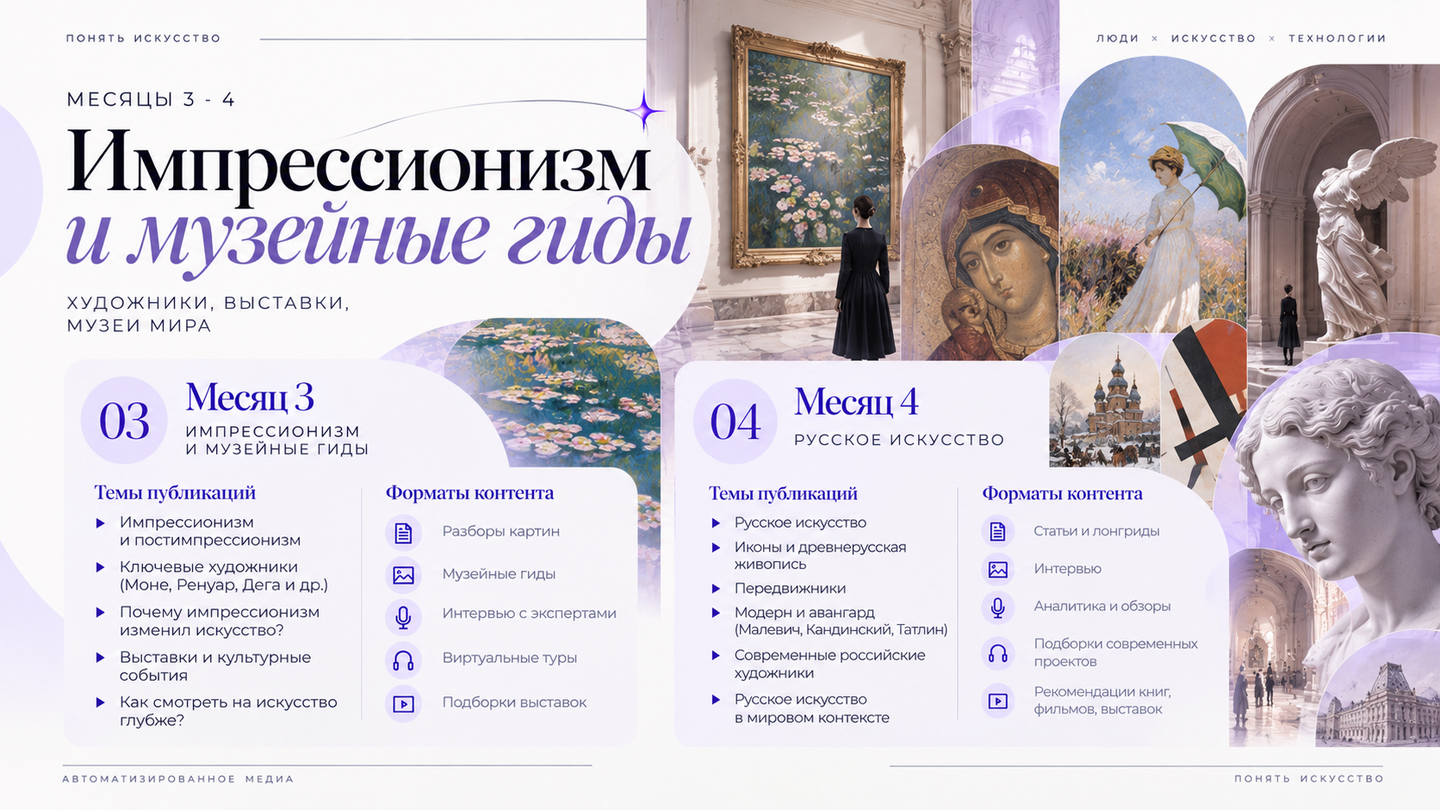
Monthly Calendar Plan
10 content samples
Format 1: Text (Telegram / Website)
Example 1. Column: «Silly Question»Question: «Why are paintings in museums hung so far away that you can’t see anything?» Answer: It’s not meant to torture you! In the 18th–19th centuries, artists painted for palaces and vast halls, where viewers observed them from a distance of 5–10 meters. This was designed for an overall effect. Also—paintings are sensitive to flashes, touch, and temperature fluctuations. What «silly» question about art is troubling you? Write in the comments, and our AI guide will answer the most popular one!
Example 2.
Column: «What Do I See?» (Text + Images)
Format 2: Video (Reels / VK Clips / Shorts)
Sample 3. «Style in 60 Seconds» Segment (Video Script)Visuals: A dynamic montage of Renaissance-era paintings set to rhythmic music.Voiceover Script: «How to tell the difference between the Renaissance and the Baroque in 10 seconds? Look at the light! In the Renaissance, the light is even, like in a photo studio—everything is clear, faces are idealized, and there is harmony. Now, the Baroque! The light bursts from the darkness—passion, drama, someone killing someone. The Renaissance is Zen; the Baroque is a thriller. Save this to impress at the museum!»
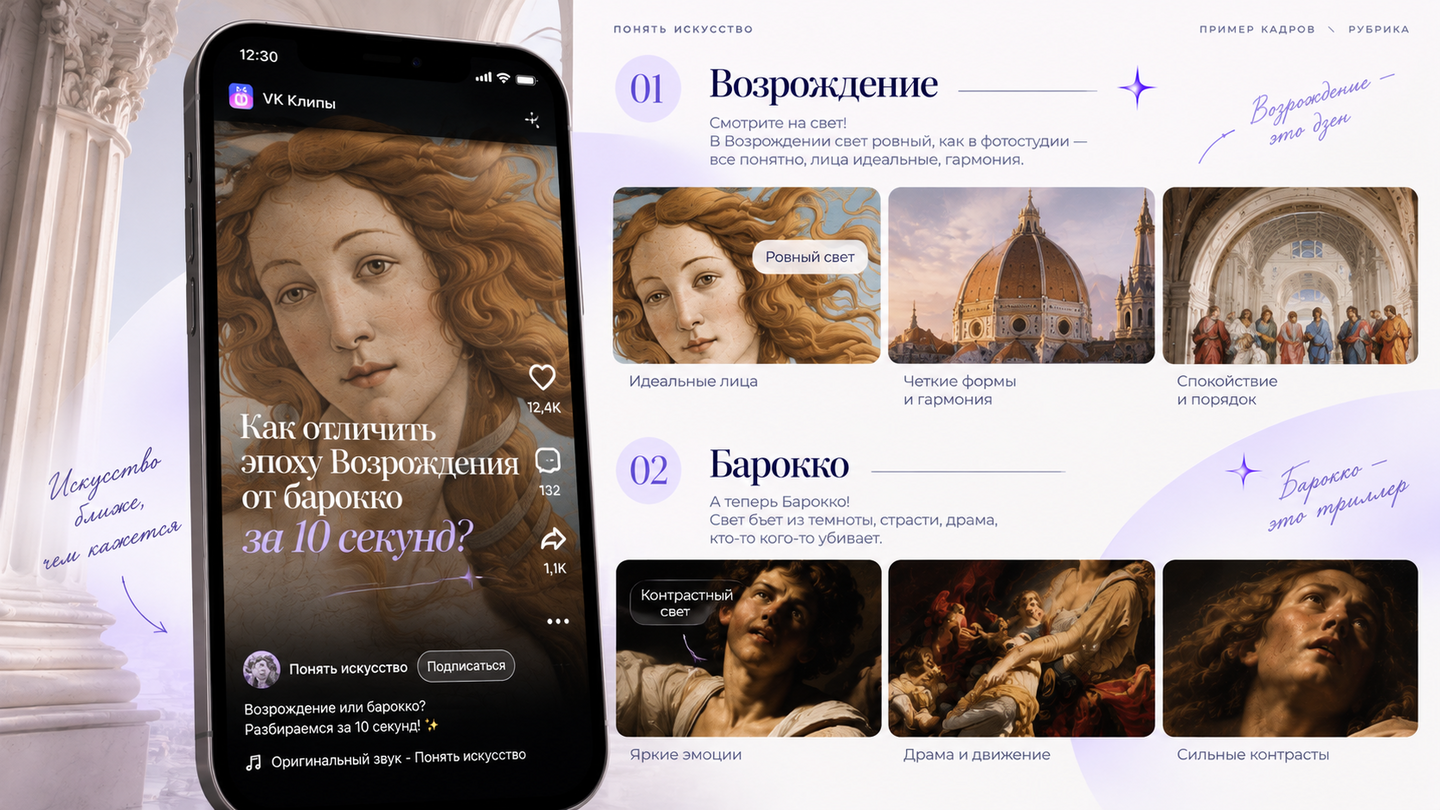
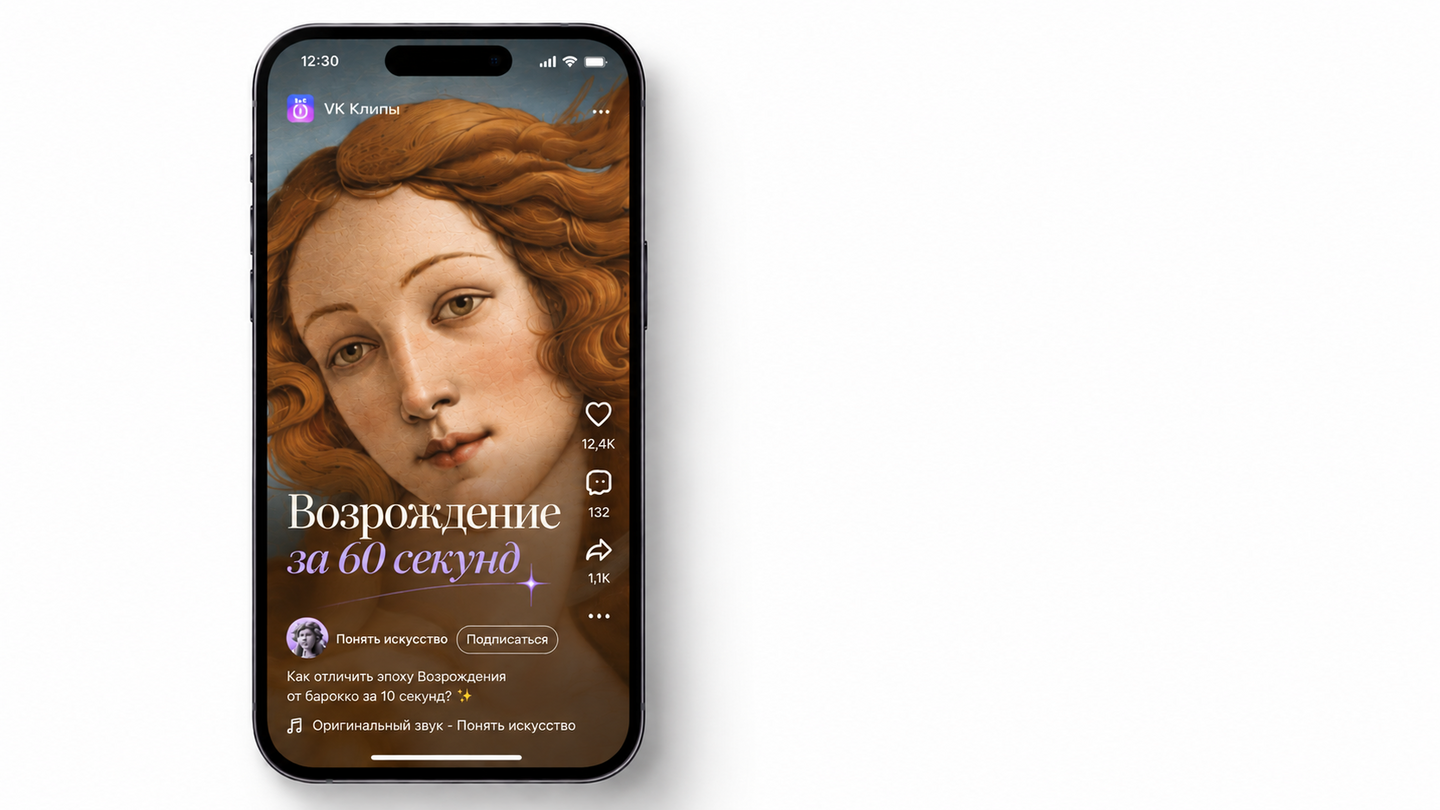
Image Examples
Example 4. Video (Script for AI Analysis Video)Visual: Split-screen. On the left—the user’s photo; on the right—the AI guide.User: «I don’t understand anything about art, but I like this painting. Why?» [Shows a reproduction] AI Guide (text on screen): «Excellent taste! You are drawn to the contrast between warm and cool tones. The artist uses the rule of thirds…» Text: «Ask your question to the AI guide on our website and understand art in 3 minutes.»
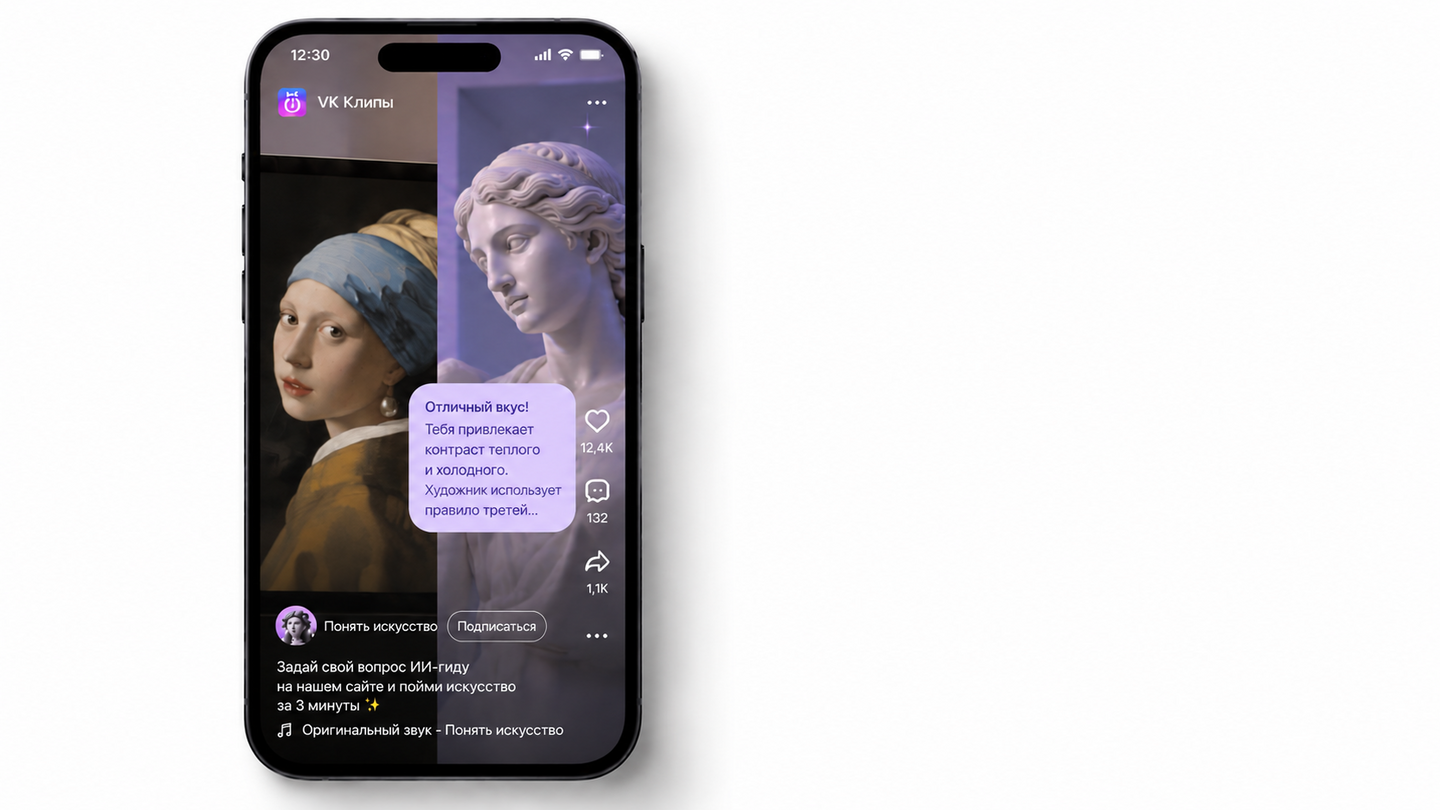
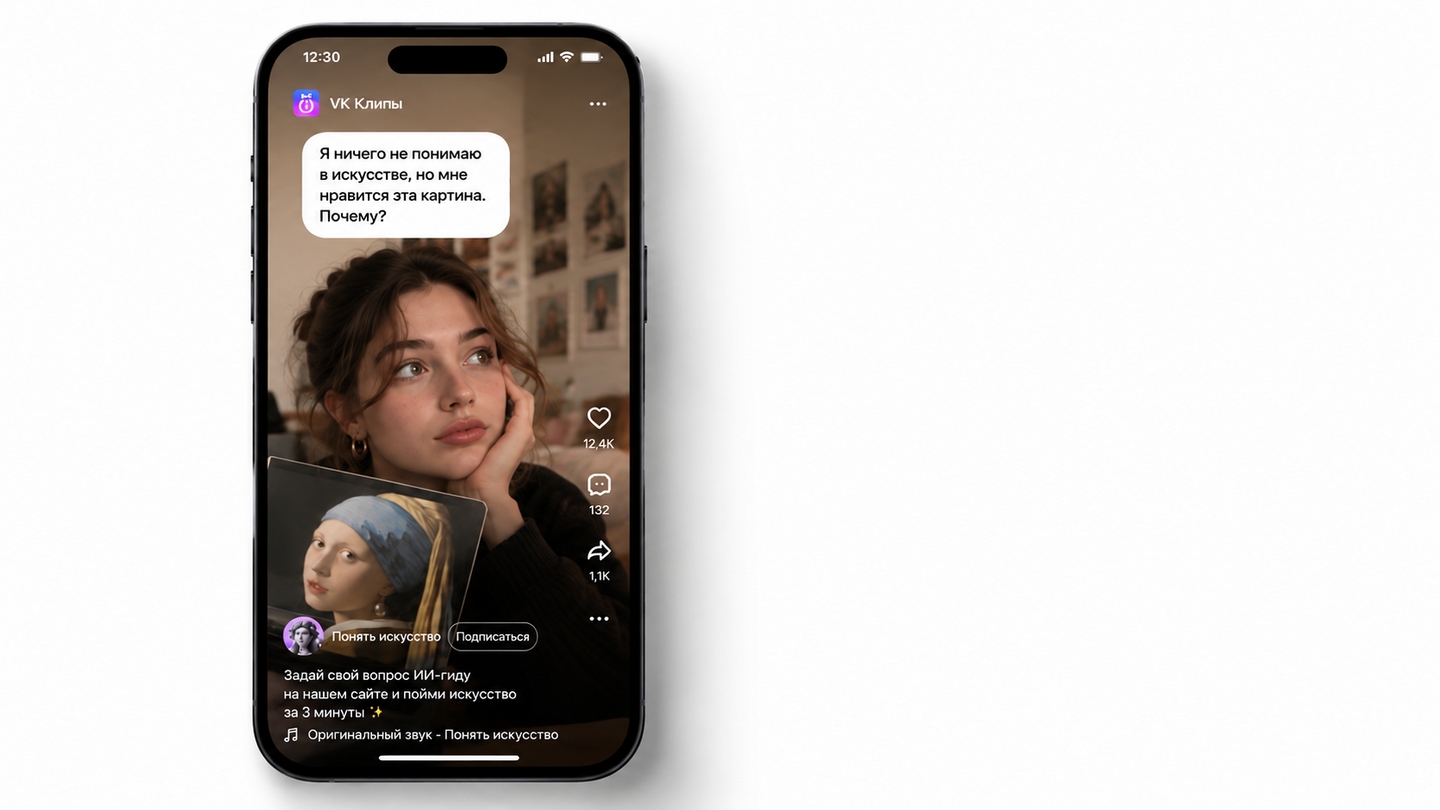
Sample Footage
Format 3: Audio (Podcast)
Example 5. Podcast «Art and Emotion» (Script/Transcript) (Sound: light rain noise, followed by soft piano music)Host: «Hello, this is „Understanding Art.“ Today we’ll talk about anxiety. You know that feeling when everything falls apart? In 1893, Edvard Munch felt the exact same way while walking across a bridge with friends. His friends walked ahead, and he was left alone… and the sky turned blood-red. Thus, „The Scream“ was born. Let’s listen to what anxiety sounds like and try to understand why this painting still grips us today…»Example 6. Audio Analysis for the Website (Transcript)«You have opened the painting „Girl with a Pearl Earring.“ Pay attention to her gaze. She is looking directly at you, yet her lips are slightly parted, as if she wants to say something. The earring is not just jewelry; it is a glint of light that draws the eye. Listen further to learn why this painting is called the 'Mona Lisa of the North.'»
Format 4: Text + Images (Website / Zen)
Example 7.Longread: «How to View Abstraction»Title: Why the «Black Square» is not just a square (and how you can do it too). [Image: Malevich’s Black Square]Many people think: «I can do that too.» But Malevich was the first to do it, in 1915, when art was obsessed with realism. He declared that color and form were more important than subject matter. It’s like the first rap track—at first, it seems like just recitation, but then you realize it changed music.
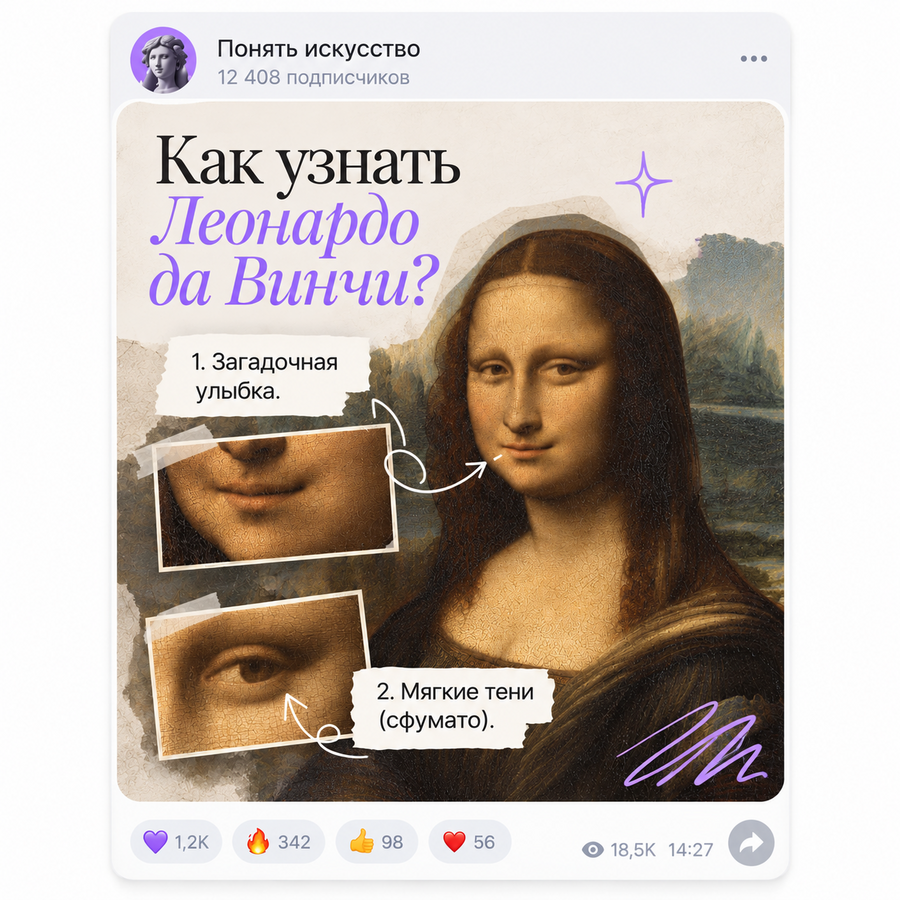
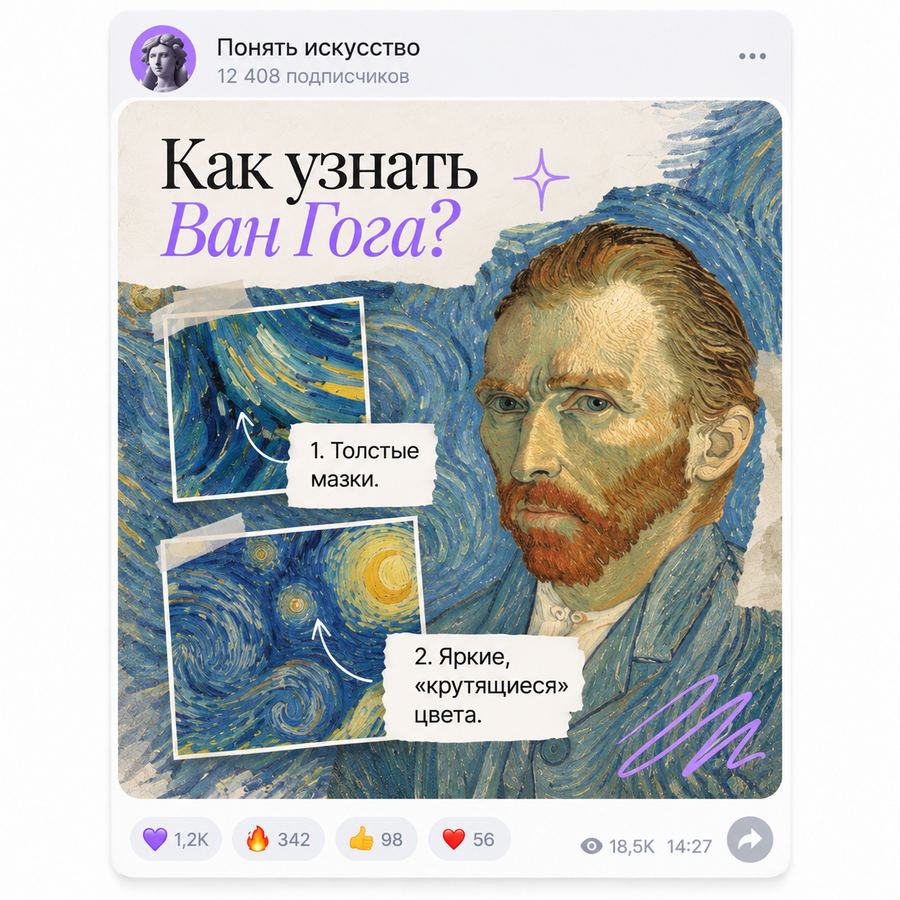
Example 8. Quick Reference Cards (Telegram)[Image 1] How to recognize Leonardo da Vinci?
- The enigmatic smile.
- Soft shading (sfumato).[Image 2] How to recognize Van Gogh?
- Thick brushstrokes.
- Bright, «swirling» colors.Post Text: Save these two cards. Now you definitely won’t confuse them in a museum!
Format 5: Interactive (Telegram / Website)
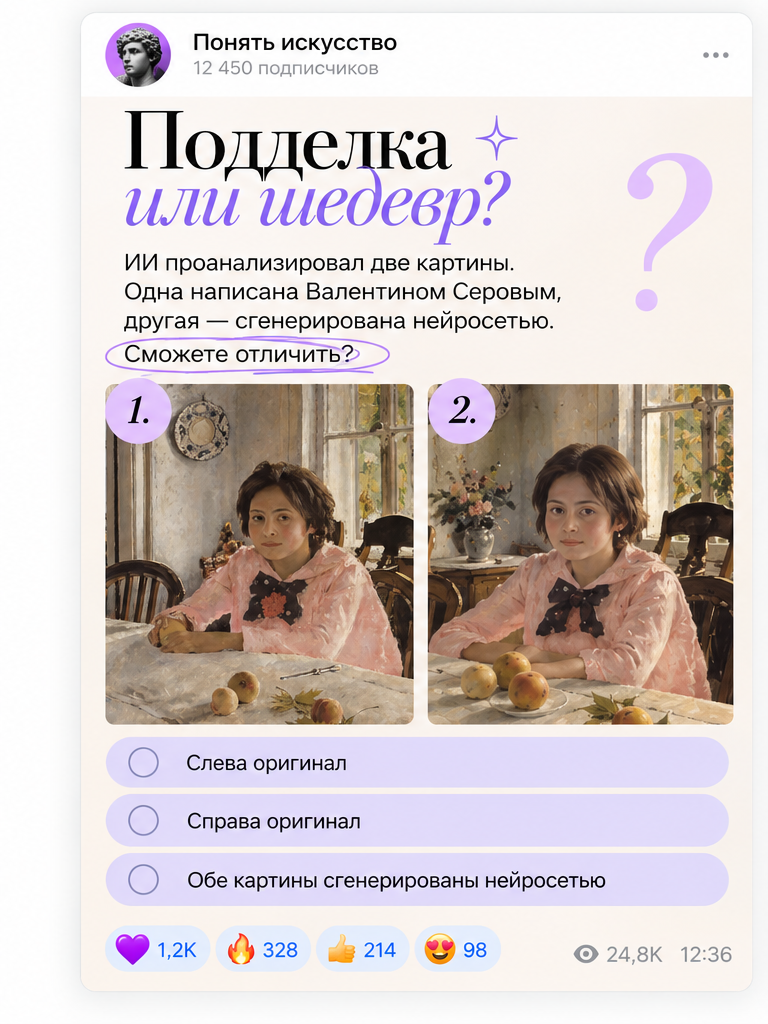
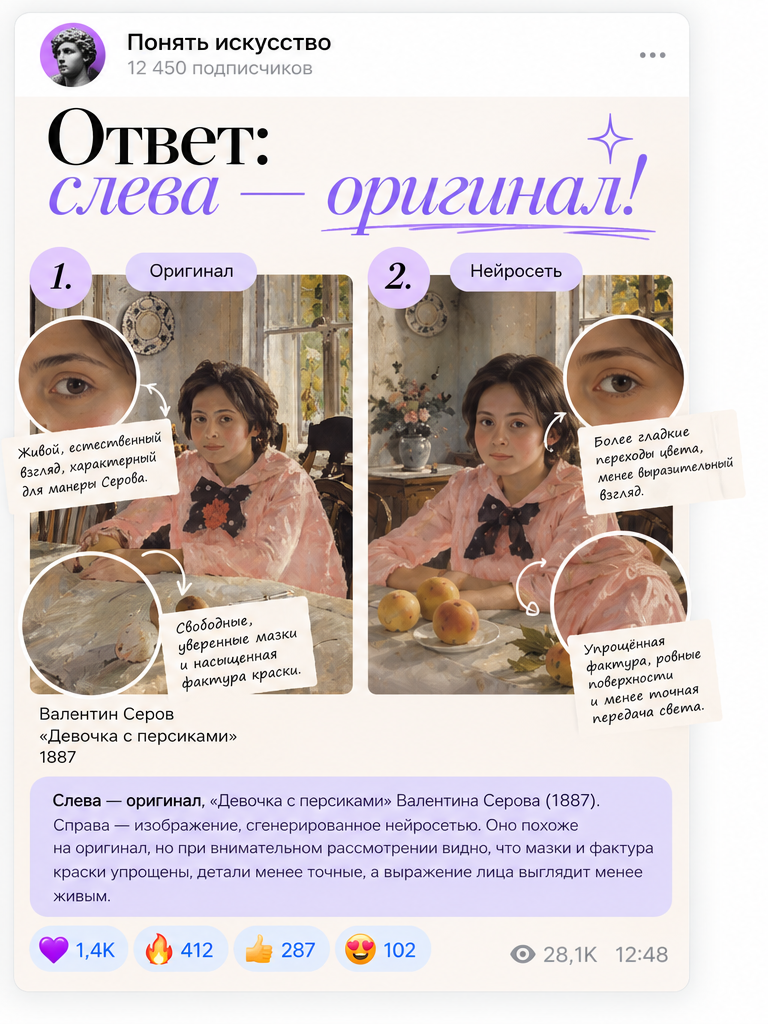
Example 9. Category: «Fake or Masterpiece?»Prompt: «AI analyzed two paintings. One was created by a master artist, the other was generated by a neural network. Can you tell the difference?» [Two images attached: generated portrait on the left, original on the right]Poll Options: 1) The original is on the left; 2) The original is on the right; 3) Both are AI-generated.After Voting: «The image on the left is from Midjourney! Notice how it messes up the fingers and the shadows…»
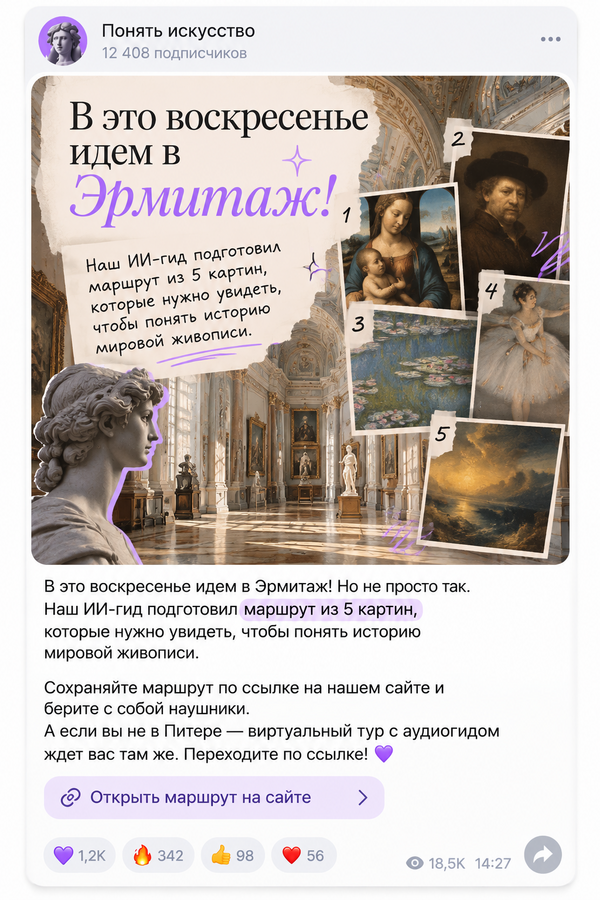
Sample 10. Post-Announcement (Telegram)Text: «This Sunday, we’re going to the Hermitage! But not just for a casual visit. Our AI guide has prepared a route featuring five essential paintings you must see to understand the history of world painting. Save the route via the link on our website and bring your headphones. If you aren’t in St. Petersburg—a virtual tour with an audio guide is waiting for you there. Click the link!»