Media Concept
Project Title and Concept
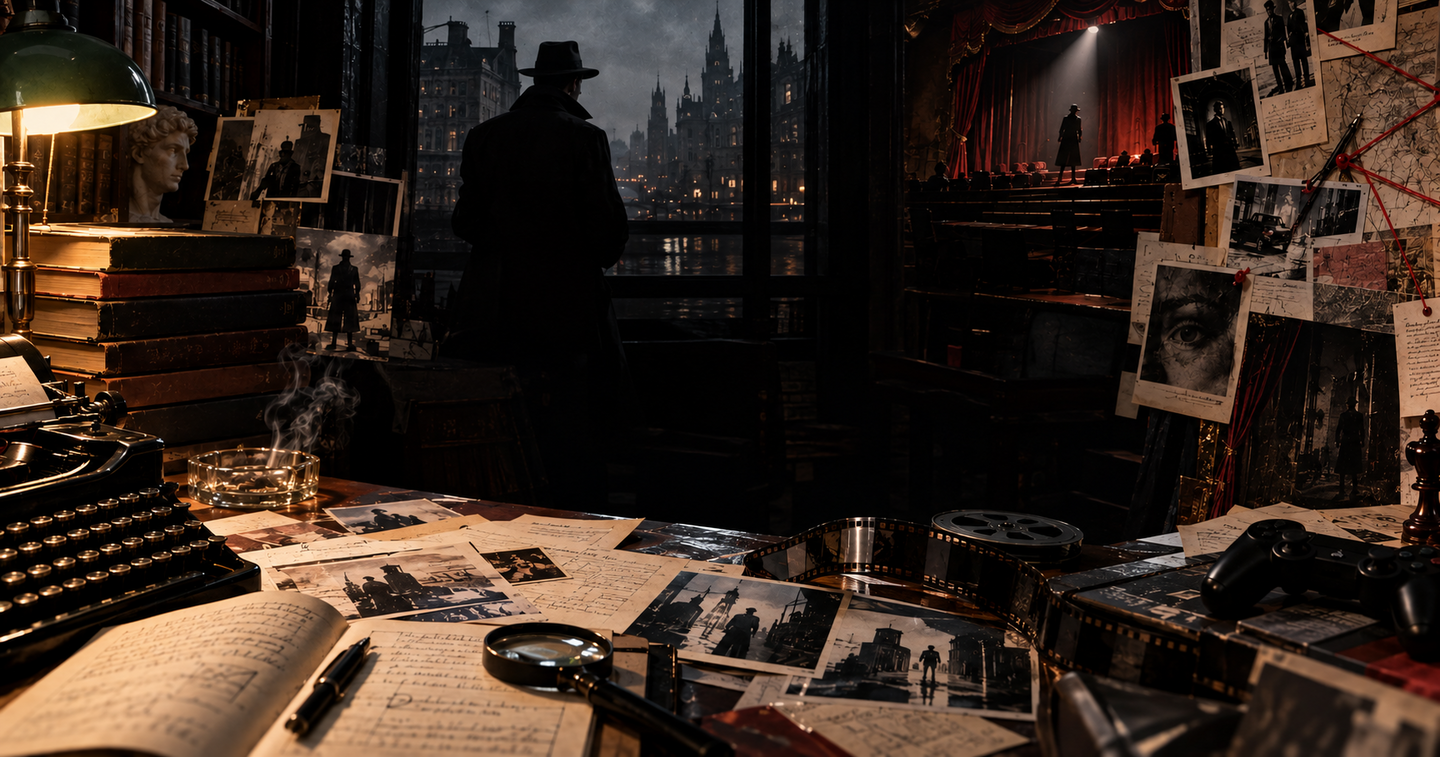
The Noir Archive is a niche cultural-analytical media outlet dedicated to detective fiction and film noir across literature, cinema, theater, and video games. The project examines the detective genre not merely as an entertainment format built around crime and the search for the culprit, but also as a vehicle for exploring human psychology, societal contradictions, and moral choices.
The core idea behind The Noir Archive is to demonstrate that beneath familiar detective plots lie deeper questions: Why does the human spirit need to know the truth? Does justice always align with the law? Can the narrator be trusted? And why is it sometimes easier for an audience member to empathize with the criminal than with the investigator?
Project Goal
To become a recognized Russian-language platform uniting enthusiasts of detective culture—readers, viewers, researchers, and authors.
To achieve this goal, the media undertakes several tasks: — Introducing the audience to classic and contemporary works of the detective genre. — Explaining the structure of the detective plot, its artistic techniques, and its cultural significance. — Analyzing new trends in crime literature, film, theater, and video games. — Building a community of people who are interested not just in knowing the story’s resolution, but in understanding why it works.
Target Audience
The primary audience for the «Noir Archive» includes people interested in detective fiction, psychological thrillers, noir, crime stories, and contemporary culture. Within this audience, four distinct groups can be identified: aficionados of intellectual thrillers, cultural researchers, viewers and readers seeking atmospheric works, and aspiring authors interested in dramaturgy.
Format and Venues
The main platform for the project is a Telegram channel. It allows for a combination of short notes, in-depth analytical texts, curated selections, polls, visual posts, and discussions. Further development plans include expanding to VK to broaden the audience, YouTube for video essays, and a dedicated website for publishing extensive analytical materials.
Unique Selling Proposition
«Noir Archive» differs from standard channels that recommend films and books because it doesn’t just tell you what to watch or read—it explains how the works are constructed and why they evoke specific emotions.
The main principle of the project: not to retell the detective story, but to investigate the detective story itself.
Six-Month Thematic Plan
The content strategy is designed for six months. Each month is dedicated to a distinct major theme, which is explored through several recurring features. The planned frequency is four publications per week, totaling approximately 16–18 pieces per month. Over the entire six-month period, we anticipate releasing about 100 publications.
The content strategy spans six months. Each month is dedicated to a major theme, explored through several recurring sections. The planned frequency is four publications per week—approximately 16–18 pieces of content per month. In total, about 100 publications are projected over six months.
Month 1. Meeting the Detective: Why Do We Love to Investigate?
Goal: To present a project, explain its approach, and engage the initial audience.
Key Topics:
- Why people love detective stories: the psychology of mystery.
- What noir is and how it differs from the classic detective story.
- How Agatha Christie changed the perception of investigation.
- Why Sherlock Holmes became a cultural icon.
- Five detective novels that are worth reading at least once.
- Is it possible to write a detective story without a crime?
- How a red herring works.
- Poll: what is more important—the killer’s character or the investigation process?
Additional monthly features: short recommendations, quotes, visual cards with genre concepts, and subscriber discussions.
Month 2. The Aesthetics of Noir: City, Shadow, and Moral Ambiguity
Objective: To establish a recognizable «Noir Archive» atmosphere and deepen genre expertise.
Key Topics:
- The origins of film noir.
- Why rain is almost always present in noir.
- The city as an autonomous character.
- The image of the femme fatale: history and reinterpretation.
- «Double Indemnity» as a classic noir exemplar.
- Neo-noir: from «Blade Runner» to «Drive.»
- Why the noir protagonist is rarely entirely virtuous.
- A film selection to introduce the aesthetics of noir.
Additionally—visual collections, discussions of favorite noir characters, and brief analyses of cinematic techniques.
Month 3. Crime and Psychology
Goal: To explore the psychological dimensions of detective narratives.
Key Themes:
- Why are we drawn to fictional criminals?
- How does a psychological thriller differ from a detective story?
- The unreliable narrator and reader manipulation.
- Crime and Punishment as a narrative of crime and guilt.
- Why do audiences empathize with antiheroes?
- «Mindhunter»: investigation through psychology.
- The ethics of true crime: where is the line between analysis and exploitation of tragedy?
- Can the criminal be the protagonist of the story?
Month 4: A Detective Outside of Literature
Goal: To demonstrate the interdisciplinary nature of the project and attract an audience interested in games and theater.
Main Topics:
- How the detective plot functions in video games.
- Disco Elysium: investigation as a study of personality.
- Return of the Obra Dinn: the player as a true detective.
- Why an interactive detective narrative differs from a book.
- Detective drama on the theatrical stage: how to build tension without editing.
- Agatha Christie’s «Mouse Trap» and the phenomenon of theatrical intrigue.
- What happens when the audience knows more than the character.
- Can a detective story exist without a definitive resolution?
Month 5. Contemporary Detective: New Characters and New Fears
Objective: To connect historical context with contemporary mass culture.
Key Themes:
- How the detective archetype has evolved in the 21st century.
- «Knives Out»: The resurgence of the classic whodunit.
- Scandinavian Noir and its socio-political commentary.
- Female characters in the modern crime genre.
- Why contemporary detectives increasingly critique societal institutions.
- Technology, digital footprints, and investigation.
- How streaming series have transformed crime dramaturgy.
- The genre clichés modern detective fiction attempts to deconstruct.
Month 6. The Future of the Detective and the Noir Archive Community
Goal: To solidify our audience and transition from one-way publications to collaborative discussion of the genre.
Main Topics:
- Can artificial intelligence become a detective within a work of art?
- The future of crime narratives in video games.
- Why the detective genre continues to evolve.
- The most interesting works analyzed over the past six months.
- How to write your own detective story.
- An interview with a genre author or researcher (planned material).
- Subscribers choose a work for an in-depth analysis.
- Final material: what the detective genre teaches us about truth.
Ten Samples of Content for the Noir Archive
Below are ten examples of posts prepared in the style of a future Telegram channel. They vary in genre and purpose—from analysis and reviews to curated collections, short notes, and interactive formats.