«The earth was without form and void, and darkness was upon the face of the deep. And the Spirit of God was hovering over the face of the waters.»
Genesis 1:2
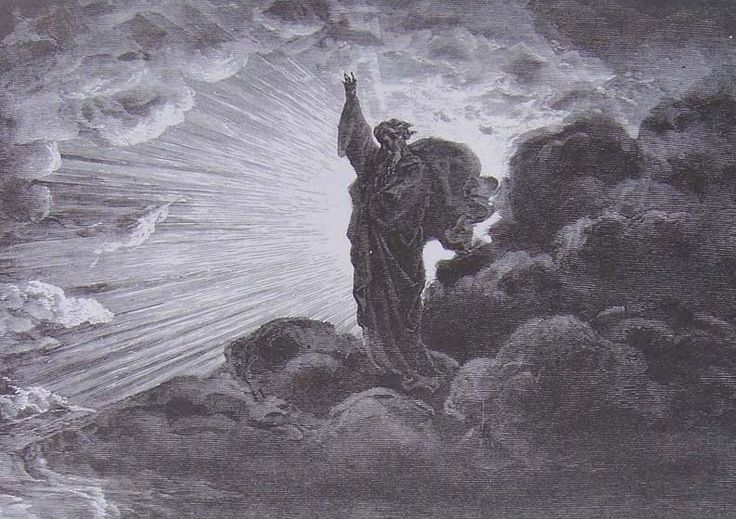
Gustave Doré, «Creation of the World» (1864–1866)
I. Concept
Since the age of primitive tribes, humanity has been fascinated by the question of the universe and the organization of everything around it. Observing harmony and order in one aspect, humanity also perceived entropy and void in its opposite. This duality of existence both attracted and frightened people. The trajectory from chaos to cosmos remains a central enigma for thinkers of all eras—its earliest descriptions can be found in ancient cosmogonic myths, ranging from the Mesopotamian epic «Enuma Elish, ” where world order emerges from a vanquished chthonic chaos, to the Old Testament Book of Genesis, where creation is the result of the divine Word transforming chaos.
In the context of this study, chaos is not mere disarray but a primal, potentially hostile reality devoid of any discernible form, structure, or meaning. The cosmos embodies the complete antithesis of disorder—it is harmony resulting from a divine or human effort to transcend chaos.
Art finds a visual reflection of this eternal contradiction. The advent of a new era precipitates a shift in cultural paradigms, which fundamentally alters the uniqueness of artistic perception. This study aims to identify these key shifts as they manifest in art. How have the modes of representing the «Chaos–Cosmos» paradigm evolved in the art of Western Europe and the Middle East? What does the transformation of humanity’s foundational understanding of its place in the universe reveal? We will examine this through examples spanning from Mesopotamia and Ancient Egypt to the Renaissance.
Epochs do not erase one another; they enter into a dialogue, transforming contradictions and creating new, unique solutions. The evolution of this theme is cyclically-dialectical, which is the core hypothesis of this research. Chaos evolves from an external mythological threat through sinfulness toward a creative beginning. The cosmos transforms from a fragile order—through immutable harmony and the transcendent path to salvation—into a crafted ideal created by human intellect.
Each era constitutes a conceptual module, unveiling its unique model of world perception. The principle of analysis itself is constructed visually based on the comparative-historical method, through the contrasting juxtaposition of epochs. In Mesopotamia, the cosmos is the result of a violent act, reflected in images of the battle between the god-hero and the chthonic monster. Ancient Egypt embodies the idea of cyclical harmony; here, the world and order are understood as eternal equilibrium. Ancient thinkers find an explanation for this paradigm through philosophy and mathematics—the cosmos becomes a law and measure, manifested in architectural canons and sculptural ideals. For Rome, the cosmos is the mighty empire surrounded by the chaos of barbarian tribes. In the Middle Ages, everything sublime and eternal is shifted into the transcendent realm of knowledge; here, art serves as a conduit from earthly chaos to the sacred world of celestial harmony. The Renaissance, however, executes an anthropocentric turn: the cosmos becomes subject to human reason, based on scientific knowledge. Chaos ceases to be a threat to divine order and instead gains potential for creative beginning.
The visual selection is representative, featuring iconic works that serve as benchmarks for their respective eras and possess high conceptual density.
II. Mesopotamia
Ancient civilizations in the valley between the turbulent Tigris and Euphrates rivers. For this civilization, the cosmos was born from violence and carries within it the process of eternal struggle. «The nature of Mesopotamia does not restrain itself; in its full might, it crushes and treads upon the human will, allowing him to fully feel how insignificant he is.» Art depicts not a final harmony, but the process of eternal struggle. The main figure of the Mesopotamian people is the warrior-king, whose will safeguards the fragile world order; his power is not based on lineage—it is personally achieved by him.
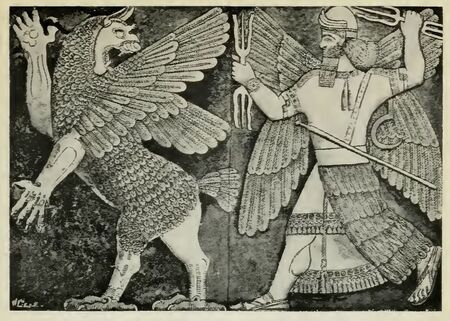
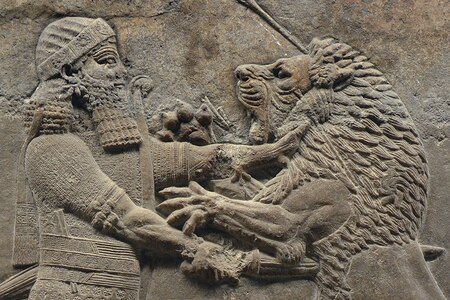
Warrior God (Marduk or Ninurta) striking Tiamat. Assyrian relief. 9th–7th centuries BCE. Ashurbanipal hunting lions. Relief from Nineveh. c. 645–635 BCE.
Space is the result of a heroic struggle, not human design. Order is literally born from the defeated enemy. It is conquered and wrenched from the flesh of chaos.
Ashurnasirpal II and the Tree of Life. Alabaster relief from the Northwest Palace at Nimrud. c. 865 BCE
The world in Mesopotamia is unstable, permeated by tragedy. As M. Giovino notes in his analysis of the Assyrian «Tree of Life,» the ritual purification performed by winged beings, sometimes by the king himself, should be understood not as a ceremony, but as a constant ritual to protect the sacred center of the cosmos from the infiltration of chaos.
Reconstruction of Babylon in the mid-6th century BCE (circa 550 BCE). Artist: Jr. Casals
The Great Ziggurat of Ur. Neo-Sumerian Period, rule of the III Dynasty of Ur. c. 21st century BCE (during the reign of Ur-Nammu).
The city-state of Mezhrechye represented a fortified fortress of a nascent civilization—massive walls encircling the city, and a ziggurat at the center—all embodying the idea of a fragile cosmos wrested from chaos.
III. Ancient Egypt
In the southwestern part of the fertile crescent, cut off from the surrounding world by mountains and the sea, an ancient Egyptian civilization arose. Located on the banks of the mighty Nile, bathed daily in the powerful sun, Egypt flourished. «One might think that Nature deliberately restrained herself, isolating this secure valley so that humanity could enjoy life unimpeded. It is hardly surprising that a great civilization arising from such a backdrop should be imbued with a sense of its own might…» The Egyptian cosmos (Ma’at) is inherently a self-renewing harmony. Chaos (Isfet) does not threaten; every night, Ra ritualistically triumphs over it in his celestial barge. The art of Ancient Egypt is not tragic—it embodies the ideal of eternal balance. The Pharaoh is not a combatant warrior, but a divine ruler whose authority is determined by the right of birth.
The Weighing of the Heart, Book of the Dead, Ani Papyrus, circa 1250 BCE
The Hymn to Ra, Book of the Dead, Ani Papyrus, c. 1250 BCE
Ma’at (order) — the immutable foundation of the universe, given intrinsically. It is not conquered but maintained through ritual and a righteous life.
Colossi of Pharaoh Ramses II. Facade of the Great Rock Temple of Ramses II. Abu Simbel, Nubia. c. 1264–1244 BCE
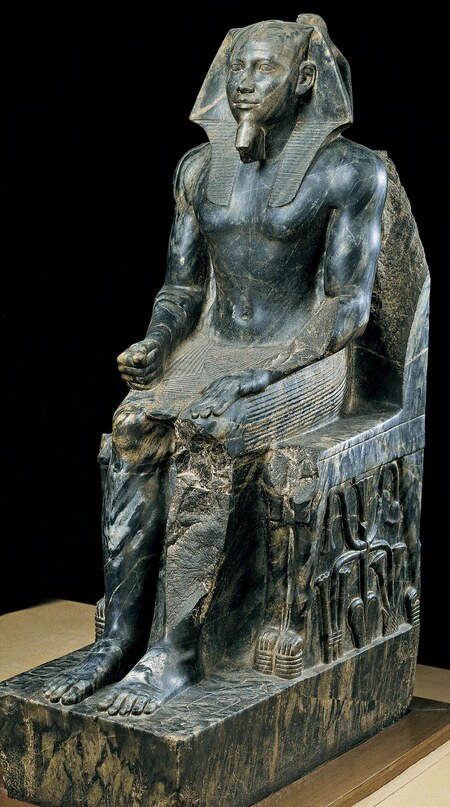
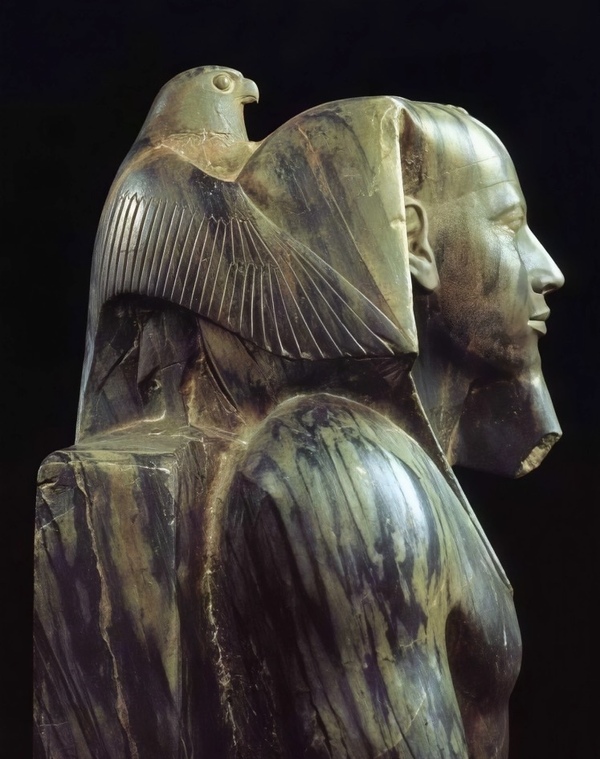
Statue of Pharaoh Khafre. c. 2520–2494 BCE
Pharaoh is not a mortal hero, but an earthly embodiment of Horus, the son of Ra. His essence is divine.
The Solar Barge of Ra and the Defeat of the Serpent Apophis. A fragment from the «Book of Amduat.» Circa 1550–1070 BCE.
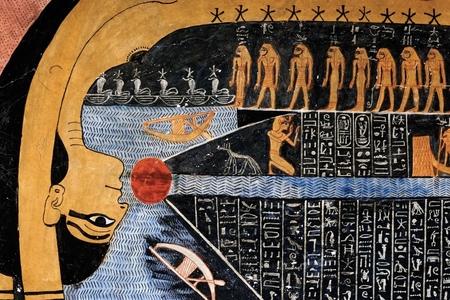
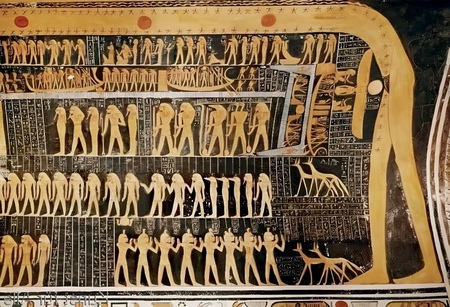
Ceiling fresco of the tomb of Ramses VI (KV9), depicting the goddess Nut. Circa 1145–1137 BCE.
The Ra Raft, daily conquering the serpent Apophis, and the goddess Nut, who births the sun anew every morning—this is the eternal renewal of the ordered world, where the victory over chaos is not final, but cyclically predetermined.
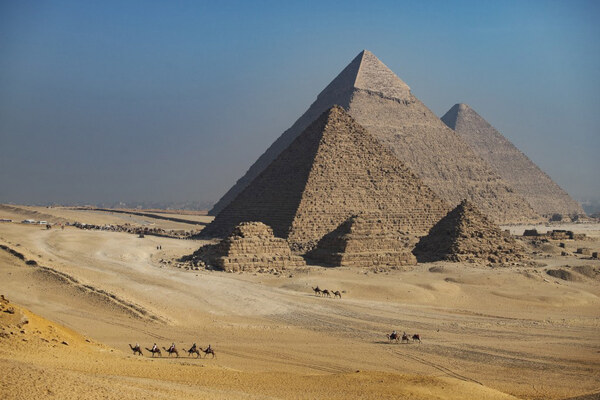
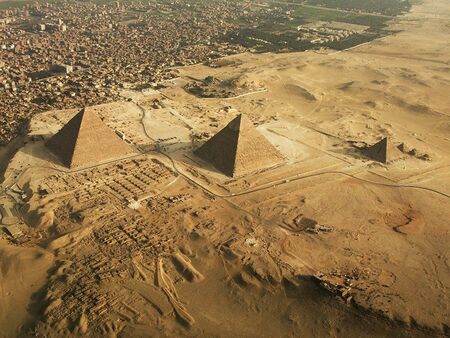
Giza Pyramids. Circa 2580–2510 BCE.