Двойственность образа сфинкса в искусстве Древней Греции VI–V веков до н. э
Concept
Sphinx—one of the most recognizable mythical creatures in ancient Greek art. It possesses both human and animal features: a female face, a lion’s body, and bird wings. This motif appears in various forms in sculpture and vase painting during the 6th and 5th centuries BCE [1].
The characterization of the sphinx changes depending on where it is found, even though sphinxes appear similar to one another. When we see a sphinx on a tomb or in a temple, it is typically motionless and imposing, as if guarding that place. However, in mythological scenes and on vases, it is depicted as an adversary to humanity. The confrontation with Oedipus is a good example of this.
Why does the sphinx stand motionless over the human in some works, yet attack them in others? How could a creature with the same recognizable appearance evoke such different impressions?
In ancient Greek culture, the image of the Sphinx held particular significance. It can be found on funerary monuments, in the context of rituals within ancient Greek sanctuaries, and on various pieces of ceramics [1, 3]. Although their depictions were generally similar, the meaning and function of the two types of sphinxes differed: some served as guardians, while others were hostile creatures.Therefore, I wished to closely examine the materials used during this historical period and discover how their perception changed depending on the geographic location of their discovery. In my research, I used examples of Greek sculpture and vase painting from the 6th–5th centuries BCE to identify sphinx imagery in various contexts, as well as the artistic techniques employed to convey notions of threat and protection.
Key question: How did the placement of the sphinx in ancient Greek art of the 6th–5th centuries BCE influence the perception of its image as a protector or a dangerous creature?
Research Hypothesis: The image of the sphinx in Ancient Greek art from the 6th–5th centuries BCE was determined not only by its external appearance but also by its placement within the space or composition of the work. The figure’s position, its surroundings, and its interaction with humans allowed the sphinx to be perceived as either a protector or a dangerous creature, even if its external features remained virtually unchanged.
For this study, artworks from ancient Greek sculpture and vase painting from the 6th–5th centuries BCE were selected, featuring the sphinx in various contexts. When comparing these pieces, particular attention is paid to the pose, the figure’s placement, and its interaction with humans and the surrounding environment. This will help determine which artistic techniques influenced the perception of the sphinx—whether as a guardian or a dangerous creature.
The research is divided into three chapters. The first chapter analyzes the sphinx as a protective figure, focusing specifically on its posture, silhouette, and placement on funerary and votive monuments. The second chapter examines the image of the sphinx as a dangerous entity in ancient Greek vase painting. Using scenes of attacks and encounters with Oedipus as examples, the analysis explores how movement, poses, gestures, gazes, and character placement convey threat and tension. The third chapter compares these two representations, identifying the artistic qualities and characteristics that contribute to their perception.
The sources for this study include artifacts from archaeological and art museum collections, data from museum catalogs, and scholarly works on the history of ancient Greek art and mythology. The selection of these exhibits was based on their dating and their relevance to the visual research theme.
Chapter 1. The Sphinx as a Guardian
The image of a defender isn’t always tied to active combat or attack. Sometimes, posture alone can convey a sufficient readiness to act.
In ancient Greek funerary sculptures, sphinxes were often depicted this way. Despite the lack of movement, these statues appear alert and poised for defense.
Let’s examine the artistic techniques used to achieve this effect and how it relates to the function of these sculptures.
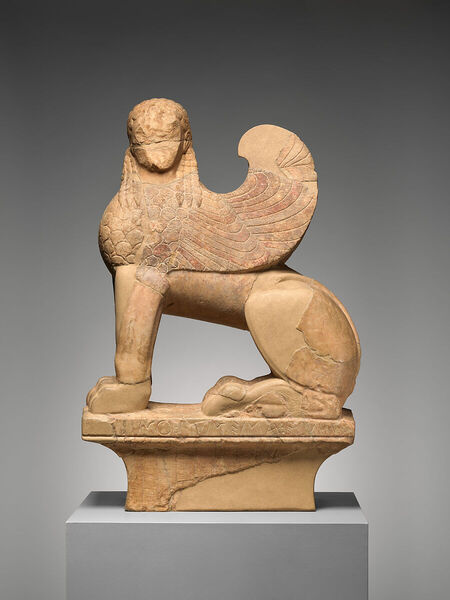
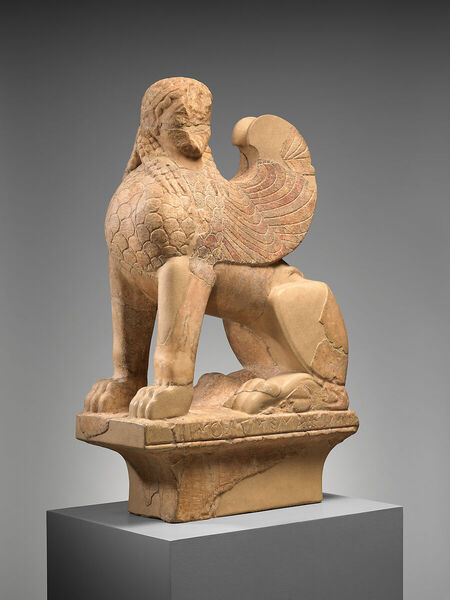
«Sphinx on a Capital, ” c. 580–575 BCE. Attica, marble.
The sphinx is depicted with its front paws extended forward, its head raised, and its wings spread wide. It appears resolute, as if preparing for battle.Yet, the sphinx is completely still. This simultaneous display of calm and determination creates a sense of vigilance. Because the statue is situated atop the tomb, it should be viewed as an image of a guardian protecting the burial site [2].
«Tomb Stele of a Youth and a Girl with a Sphinx,» c. 530 BCE. Attica, marble.
The Sphinx sits upon the stele, above the images of a youth and a maiden, creating a sense of guardianship over the deceased. The Sphinx has a calm expression, slightly bent legs, and a curled tail.All of this speaks to its readiness to act. Beyond its position, the Sphinx’s posture also emphasizes its role as a protector.
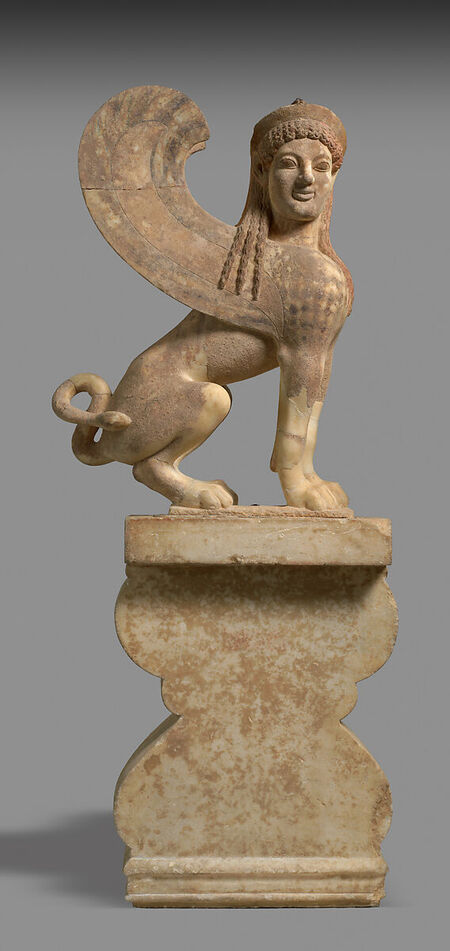
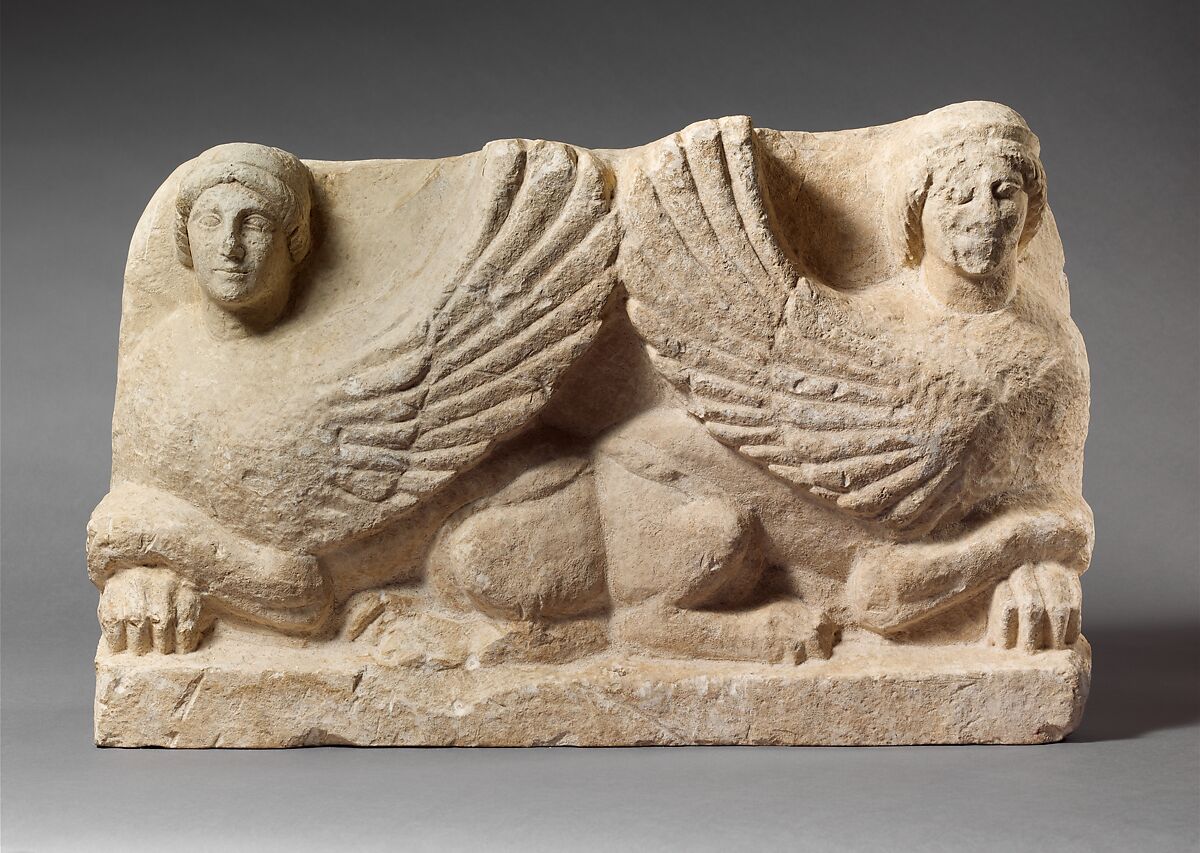
«Marble Sphinx on Capital, ” c. 580–575 BCE // „Tomb Stele of a Young Man and a Girl with a Sphinx, ” c. 530 BCE
The sculptures differ from one another in two main aspects: the proportions and the level of detail of both figures. The sphinx on the capital appears generally larger, with bigger paws and a more sharply defined body shape. In contrast, the sphinx on the funerary stele has a more slender body, with smooth lines on its wings and tail. Otherwise, both sphinxes are depicted in the same seated pose.Although the sphinxes looked different, both served a specific function in the funerary settings. This suggests that the specific details of the sphinx’s depiction were not critically important for its funerary role. What was important was the sphinx’s placement within the monument, as this created the impression that the sphinx was the guardian of that place.
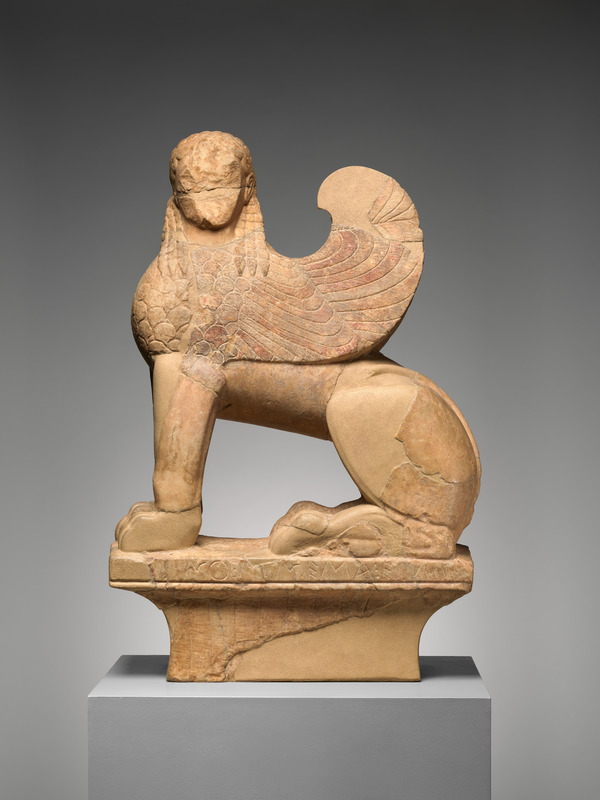
«Sphinx of the Naxosians.» Delphs, c. 560 BCE. Naxian marble.
The Naxos Sphinx resembles previous sculptures by sharing a seated posture. However, the Naxos Sphinx serves a different function than the sculptures mentioned previously. The Naxos Sphinx was erected in a religious site as an offering to Apollo by the residents of Naxos island [8].
This sphinx, unlike the two other cases examined, has remained virtually unchanged in its physical appearance, suggesting that other similar sphinx sculptures may have served different purposes.
Therefore, it is impossible to determine the intended function of such sculptures based solely on their posture and form.
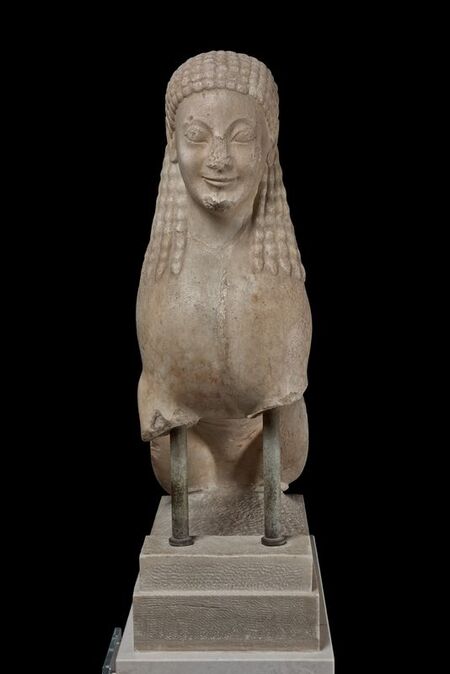
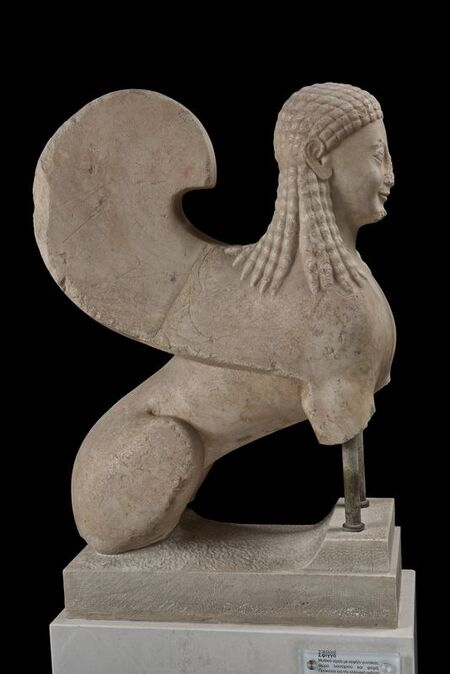
«Sphinx Statue.» Acropolis of Athens, circa 560–550 BCE. Island marble.
The features of the Sphinx on the Acropolis of Athens are similar to those of previously examined figures. This Sphinx is depicted in a state of repose, with its head raised high and its large wings spread wide.Although the purpose of this Sphinx differed from that of funerary Sphinxes, it was originally placed on a high column within the sanctuary [9] and was dedicated to the god or goddess to whom the sanctuary was devoted.Overall, the Sphinxes bore a strong resemblance to one another, regardless of their function. This Sphinx was not placed in a burial site but was associated with the sanctuary. This is yet another example of how a Sphinx’s function is determined not only by its appearance but also by its location.
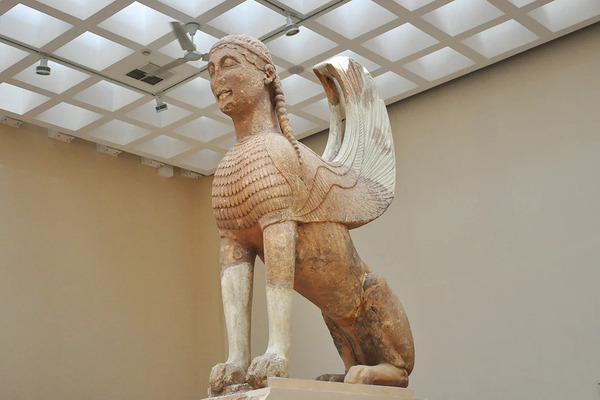
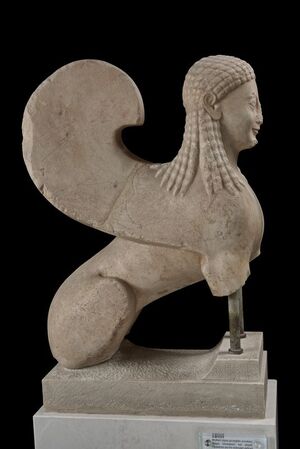
«Sphinx of Naxos, ” c. 560 BCE. Naxian marble. // „Sphinx Statue, ” c. 560–550 BCE. Island marble.
The Delphi and Athenian sphinxes from the Acropolis share similarities: both have heads held high, large wings folded behind them, and neither sculpture is depicted in motion. However, the Delphi sphinx is larger than the Acropolis sphinx; it also features greater feather detail, whereas the Acropolis sphinx has a more simplified rendering.
Historically, both sphinxes were placed on very tall columns in their respective religious sites so they could be visible to all visitors and seen from a distance against the backdrop of other buildings.
Although the sphinxes differ in appearance, they served a similar function. Positioned on elevated columns, their placement emphasized their significance as guardians—sharing an identical pose (seated with a raised head)—thereby creating the impression that they were watching over all that occurred around them.
Chapter Conclusion
The sphinx, in almost every piece of art, retains recognizable features: a lion’s body, a human head, large wings, and typically a static pose. Its meaning or symbolism is revealed through its placement or application.In funerary contexts, the sphinx symbolized burial. In religious sites, the sphinx was used as part of religious rituals. The sphinx could also convey the same protective significance found in the religious context of tombs.The sphinx’s appearance alone does not indicate its role. The meaning of the sphinx depends on many other factors, including the location where the sculpture was found and its placement relative to other parts of the building or monument it inhabits.
Chapter 2. The Sphinx as a Threat
In the first chapter, we observe that the sphinx is depicted in a static posture on funerary monuments and sanctuaries, unable to interact with humans.
However, in the narrative tradition of vase painting, there are depictions where the sphinx poses a threat. The sphinx’s role as a dangerous creature is emphasized through its movements, the placement of other figures, and the reaction of the surrounding figures to its actions.
We will examine how vase painters convey danger through their artistic techniques, and we do not necessarily need to depict an actual combat scene as an attack.
Unlike static sculptures, in scenes of attack, the sphinx reveals its dangerous nature through action.
Apollodor. A red-figure kylix, c. 500 BCE.
In Apollodorus’s kylix, the sphinx is presented as a predatory creature posing an immediate threat: the sphinx is flying, gripping the human tightly in its sharp claws. The human body is positioned at the bottom of the composition, while the sphinx’s wings dominate the frame—this arrangement emphasizes the human’s helplessness against the sphinx.Whereas the sphinx’s power in funerary sculptures was primarily protective, in this kylix, its power is directed against the human. The threat emanating from the sphinx is illustrated by the direction of its flight, the force of its grasp, and its physical superiority over the human.Thus, the sphinx maintains its typical appearance, but its function changes: it transforms from a protector into a source of dread.
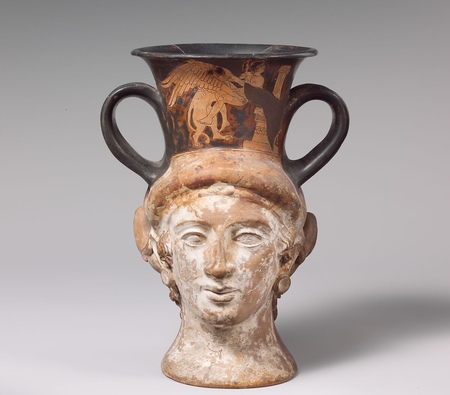
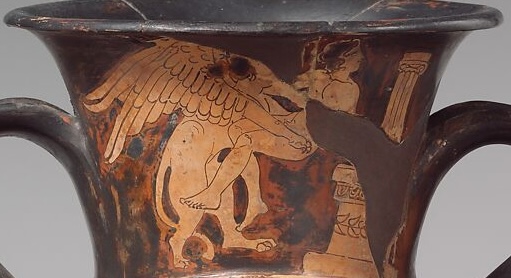
Terracotta amphora depicting a sphinx seizing a young man, late 5th century BCE. Attic, red-figure painting. Overall view and fragment of the painting.