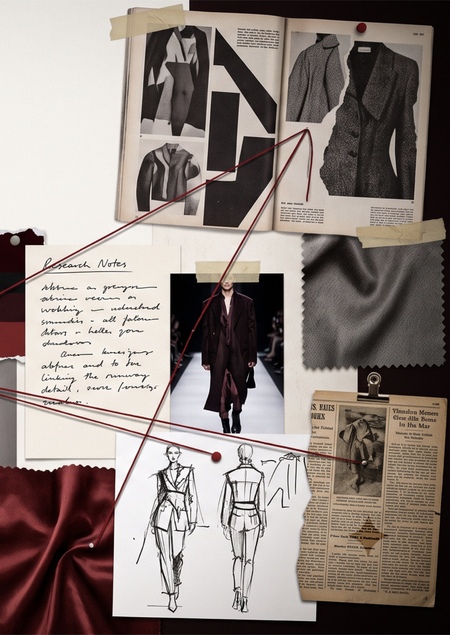
Fashion Detective is a digital media project that explores the origins of contemporary fashion trends and aesthetics. The project investigates where our familiar elements of clothing and visual phenomena originated, how they have evolved over time, and why they become relevant again.
Half-Yearmatic Plan
The plan covers the period from November to April. Publications are released approximately three times a week: a major analysis, a visual card, and a short-form piece. Each month is dedicated to a specific theme to ensure content diversity while maintaining a cohesive narrative.
November — The History of Things How everyday clothing gained its meaning. From corset to modern runway. The history of the heel: from practicality to status. How jeans became casual wear. «Clue» feature: the history of a single detail. December — Subcultures and Rebellion How music and protest change fashion. Punk: clothing as a challenge to society. The history of grunge aesthetics. Vivienne Westwood’s role in punk culture. How subcultures become commercial trends.
January — Symbols and Prints Why patterns and details acquire cultural significance. The history of the leopard print. How stripes changed meaning in clothing. Military uniforms and their influence on everyday fashion. «The DNA of Aesthetics»: what makes an image recognizable. February — Fashion in Film and Art How on-screen images influence real-life clothing. Costumes of the film «Marie Antoinette.» How cinema creates fashion aesthetics. The history of fashion illustration. The connection between designer collections and works of art.
March — Social Media Aesthetics How the internet reinterprets old visual codes. The origin of balletcore. Why 2000s aesthetics are making a comeback. How Pinterest shapes visual trends. What happens to an aesthetic when it becomes mainstream. April — Fashion as a Cultural Archive How clothing preserves history and reflects society. What clothes tell us about their time. How designers work with archives. Analyzing a single collection through historical sources. Final project: five trends with unexpected histories.
Ten Fashion Detective Content Samples
1. Case File No. 001. Corset: From Restriction to Self-Expression
Today, the corset can be seen on runways and in everyday fashion. However, previously, it was part of a complex system for shaping the silhouette. In Europe, corsets were widely used starting in the 16th century. Their construction changed depending on the era and prevailing ideals of the body. Later, designers began to reinterpret the corset as a standalone piece of clothing. Specifically, Vivienne Westwood incorporated historical forms into her collections, blending them with punk aesthetics and deconstruction. The key takeaway: one item can shift its meaning—from conforming to fashion norms to expressing individuality.
2. The Clue: Why did men start wearing heels?
Today, heels are more often associated with women’s footwear, but historically, this was not the case. In the 17th century, men from privileged social classes wore heeled shoes. They could emphasize the wearer’s status and position. Over time, Western men’s fashion became more restrained, and heels gradually became predominantly part of women’s wardrobes. Today, designers are once again experimenting with shoe silhouettes and conventional gender codes. Takeaway: even what seems like a natural rule of fashion can actually be the result of historical shifts.
3. The DNA of Aesthetics: Punk
Torn clothing, safety pins, leather, and deliberately rough combinations became recognizable elements of punk aesthetics. In 1970s Britain, punk was not only a musical genre but also a way to express protest against social norms. Clothing became a tool for provocation: familiar items were altered, damaged, and paired in unexpected ways. Vivienne Westwood played a crucial role in shaping the visual language of British punk. Over time, these aesthetic elements migrated into the collections of major fashion houses. The research question is: can clothing retain its rebellious meaning when it becomes part of mainstream fashion?
4. Print Investigation: Leopard
The leopard print regularly reappears in designers' collections. But why does it remain recognizable across decades? In the 20th century, the leopard pattern gained widespread popularity in mass fashion. It became a prominent visual element that could be associated with luxury, boldness, and provocation. Today, it is used in various ways: paired with minimalist clothing, incorporated into vibrant looks, or used as a single accent. Yet, the print’s meaning is not static. It depends on the era, the stylization, and the cultural context. The key takeaway: a familiar pattern can look completely different depending on how and why it is used.
5. How Cinema Revives Past Fashion
Film often serves as a source of inspiration for designers and viewers. Historical costumes can draw attention back to specific silhouettes, fabrics, and details. For instance, Sofia Coppola’s film Marie Antoinette employs the aesthetics of the 18th century, yet presents them through a contemporary visual language. Color, music, and stylization create their own interpretation of the historical era. As a result, the viewer sees not just a reconstruction of the past, but its new reading. In conclusion, fashion is resurrected not only through archives but also through how culture re-tells its story.
6. Archival Matters: Why the 1990s are Making a Comeback?
Minimalist silhouettes, straight-leg jeans, simple tank tops, and streamlined accessories frequently feature in contemporary collections. However, the revival of 1990s fashion does not necessitate a literal replication of the past. Designers select individual elements and recontextualize them with modern forms and materials. Archival photography, film, music, and social media play a crucial role in making the aesthetic of a specific era visible once again. The main takeaway is that modern trends often aren’t copies of what came before—they are new interpretations of it.
7. Balletcore: From Ballet Class to Street Fashion
Ballet flats, wrap-style sweaters, gaiters, and tulle have become recognizable elements of balletcore aesthetics. This trend draws from the visual language of ballet but translates its details into everyday wardrobes. Furthermore, the modern interpretation doesn’t necessarily replicate authentic ballet attire. Balletcore demonstrates how professional clothing can become a source of inspiration for mainstream fashion. Research question: Why do garments created for a specific activity begin to attract people beyond that context?
8. Where do designers find inspiration?
When we look at a new collection, it might seem like the designer simply conceived of an unconventional silhouette or selected an interesting fabric. But behind many collections lies extensive research. Inspiration can come from historical costume, a family archive, architecture, music, or the clothing of a specific subculture. It is crucial not only to find a reference but also to understand what is interesting about it—the form, the material, the symbolism, or the historical context. The designer can then reinterpret the discovered elements to create their own solution. In conclusion, a reference becomes an idea when the designer understands and transforms it, rather than merely copying it.
9. The Clue: Why did military attire become everyday wear?
Camouflage, functional pockets, durable fabrics, and loose-fitting jackets have long since moved beyond military uniforms. Some elements have been adopted into civilian clothing due to their practicality and the use of military gear in daily life. Later, designers began reinterpreting these details and incorporating them into collections. Military wear can be associated with protection, discipline, protest, or street culture—depending on the context. The key takeaway: the function of an item can change, but its original origin continues to influence perception.
10. Mini-Research: How to Transform a Reference into an Idea?
Finding a beautiful photograph is only the beginning of a creative search. For it to become the starting point of your own project, you must understand its origin. First, determine what caught your eye: the silhouette, the material, the color, or a specific detail. Next, investigate the era the image belongs to and the role the object played in its context. After that, seek connections to other phenomena—cinema, art, music, or contemporary collections. The final step is deciding which principle you want to re-examine in your own work. Assignment for the reader: select one saved photograph and find three facts about its origin. Perhaps this is where your next exploration will begin.