Следы
Откуда берутся знакомые нам образы
«Traces» is a media exploration into the origins of visual imagery familiar to us. It investigates how images, styles, and artistic techniques move from one era and medium to another, transforming and acquiring new meanings along the way. This media invites us to look at the world more closely and discover which visual solutions from the past underpin what seems ordinary to us today.
Основные форматы медиа — короткие видео, визуальные разборы и подборки.
Six-Month Thematic Plan
The «Traces» content is built around visual imagery familiar to the contemporary viewer. Each topic explores the origin of a specific technique or motif, how it has evolved over time, and the significance it has gained within a new cultural context. The thematic plan spans six months, covering various areas of visual culture—from art, design, and cinema to internet memes. The content samples feature major media formats: short videos, carousels, and interactive posts.
Month 1. A Journey Through Visual Imagery
Objective: to demonstrate how familiar contemporary images connect to past works of art and visual traditions.Publication Topics:
- Why some film shots resemble old paintings.
- How religious imagery appears in modern mass culture.
- Where advertising borrows artistic motifs from.
- How a single image transforms when moving from art to design.
- What modern photography and classical painting have in common.
- Video: one visual technique across three different eras.
- Poll: which contemporary images would you like to trace back to their origins?
Month 2. Origins of Contemporary Design
Objective: To explain how historical artistic movements shaped the visual language of contemporary graphic design.Publication Topics:
- Why modern design has such an affinity for geometry.
- Where sharp diagonals and large typography emerged in contemporary graphics.
- How paper collage evolved into a common digital design technique.
- Why many modern posters resemble the work of avant-garde artists.
- How historical art styles are being reincorporated into logos and packaging.
- Video: How to create a contemporary poster using graphic avant-garde techniques.
- A selection of modern design works featuring recognizable historical references.
Month 3. Art in Film and Animation
Objective: To teach students how to recognize artistic techniques in cinema and animation and to understand how they relate to art history.Publication Topics:
- Why the lighting in some films resembles painting.
- How the composition of a painting helps understand the framing of a film shot.
- Why impossible things happen in some cartoons, even in dreams.
- How photography has influenced composition in cinema.
- Where the visual techniques we are familiar with in movie posters originated.
- Video: one shot from a film — and the works of art it can be compared to.
- Poll: Which visual style of cinema interests you more to explore—painterly, surreal, graphic, or photographic?
Month 4. History of Everyday Visual Culture
Objective: To demonstrate how historical graphic techniques continue to influence advertising, typography, comics, and product design.Publication Topics:
- Why modern advertising sometimes looks like vintage posters.
- How comic book techniques have infiltrated film, advertising, and the internet.
- The origins of the vintage aesthetic in contemporary logos and packaging.
- How ornamentation from different eras surfaces in modern design.
- Why the same graphic techniques appear across posters from different decades.
- Video: How the visual language of the poster has evolved—from historical examples to contemporary advertising.
- A selection of everyday objects and imagery where traces of historical styles can be found.
Month 5. The Transformation of Visual Meanings
Goal: To investigate how the meaning of an artistic image shifts when placed within a different cultural context.Publication Topics:
- Why do halos and saintly poses appear in fashion shoots?
- How does a classical painting portrait transform into an advertising image?
- Why are contemporary brands turning to past aesthetics?
- How are works of art quoted in modern mass culture?
- What changes when a historical image is used outside its original context?
- Video: One artistic image—three different meanings.
- Survey: Where is the line between a quote, a reinterpretation, and simple resemblance?
Month 6. Art in Digital Culture
Goal: to demonstrate how works of art, historical techniques, and analog visual approaches are reinterpreted online and in the digital environment.Publication Topics:
- Why old paintings have become memes—and how their meaning has shifted.
- Where the fondness for analog textures emerged in digital collages.
- How historical artistic techniques are recreated using digital effects.
- Why artworks continue to be reinterpreted on the internet.
- How the same visual image transforms from original to meme.
- Video: the journey of a piece of art from a museum hall to an internet meme.
- Interactive Quiz: Can you identify the original from its modern visual version?
Content Samples
Instagram is the primary distribution channel, so all media samples will be tailored for it.
Content samples demonstrate how the media concept «Traces» is realized in Instagram publications. Each format serves a specific purpose: carousels allow for a detailed analysis of a visual phenomenon and a comparison of images from different eras, Reels provide a clear demonstration of visual technique transformation, and Stories engage the audience through polls, quizzes, and visual puzzles.
The samples cover topics from various modules of the six-month thematic plan and are arranged with a mix of formats. Their sequence is not a publication calendar—rather, it illustrates the diversity of content and methods for exploring the topics. Each sample includes the format, topic, post text or script, and a description of the visual accompaniment.
1. Carousel: «Why Does Film Sometimes Remind One of an Old Painting?»
Format: Carousel, 6 cards
Topic: Pictorial Compositions in Modern Cinema
Goal: To illustrate how compositional techniques from painting can be found in cinematography, and to teach the audience to examine film frames with greater attention.
Text and visual support for cards
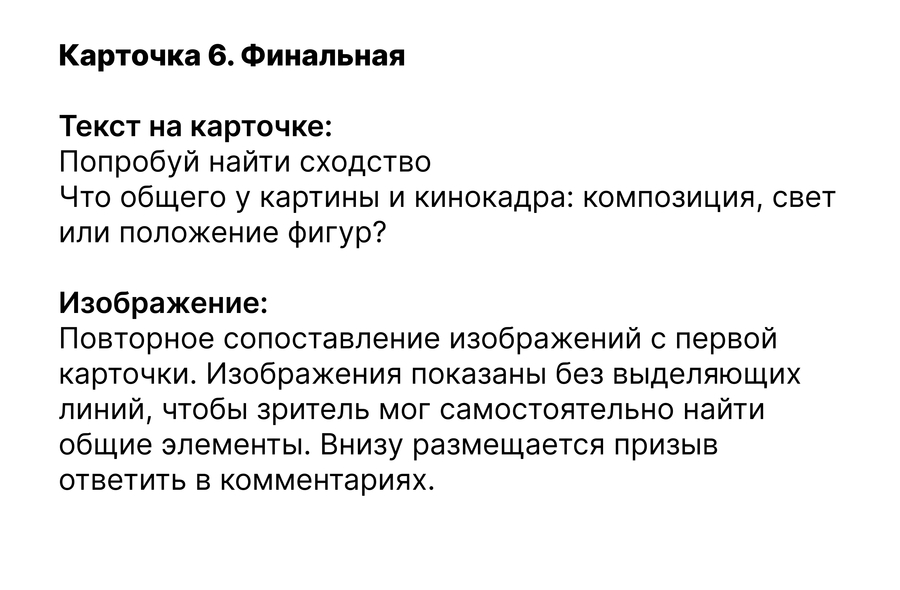
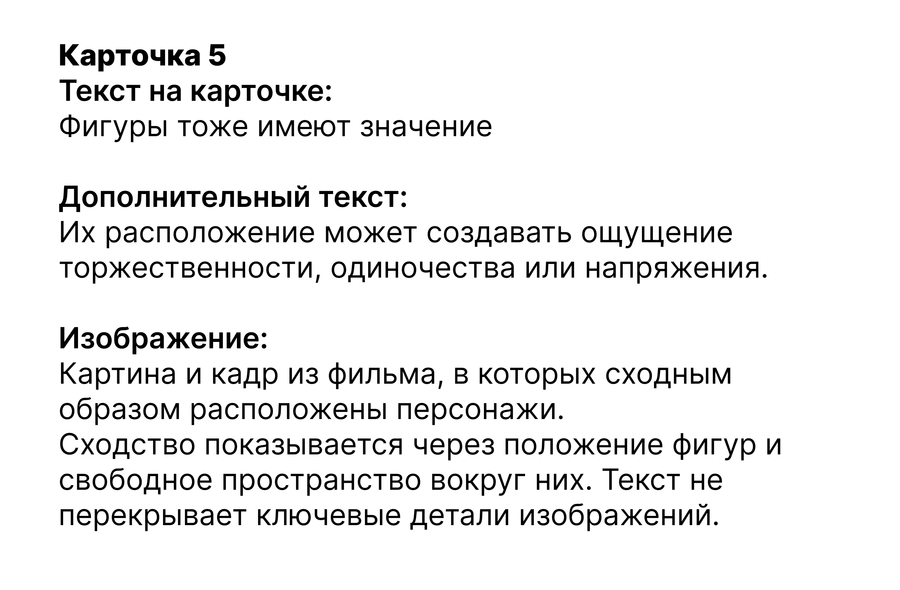
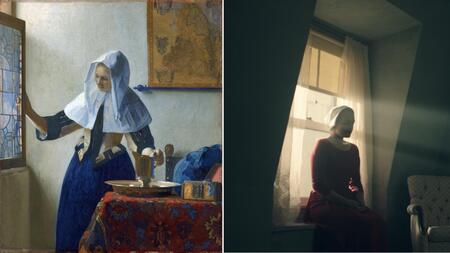
Article TextCinema exists in motion, but each individual frame can be considered a standalone image. At times, it turns out to be surprisingly similar to a work of painting.This similarity may manifest in the composition, the distribution of light and shadow, the placement of figures, or the choice of perspective. Such techniques help guide the viewer’s attention and evoke a specific mood.However, visual similarity does not always imply direct borrowing. Sometimes a director consciously references painting, and other times artists from different eras employ similar methods of image organization.Scroll through the carousel and compare: which elements resonate between the painting and the film frame?
2. Stories «Guess the Artwork from the Modern Version»
Format: A series of 3 Stories with a quiz
Theme: Quoting works of art in modern culture
Goal: To engage the audience in searching for artistic references and to demonstrate how a familiar composition can receive a new interpretation.
Stories Content
Story 1. Visual Puzzle
On-Screen Text:You might have seen this composition before. Which painting could it be referencing?Interaction:A sticker quiz with four response options. The options are generated after a specific contemporary image and its presumed original are selected.Image:A contemporary photograph, a commercial shot, or another visual image that reproduces recognizable elements from a specific work of art.Visual Design:The contemporary image fills the entire screen. The name of the original is not shown beforehand to maintain the element of mystery.
Story 2. Answer