Concept (Based on the first assignment)
«How Exhibitions Work”—a cultural and educational Telegram medium about how light, space, routing, and presentation methods affect the perception of art. Examples are drawn from museums and galleries across different countries.The goal is to teach the viewer how to notice curatorial decisions and articulate their impressions. Each issue reveals one technique through photography, a brief analysis, and a question for the reader.Eight issues per month. Unique Selling Proposition (USP): one issue—one new way to view an exhibition.Audience: the viewer who wants to understand exhibitions more deeply; the design student seeking principles for their own projects; the reader discovering international shows through photographs.Competitors: „What about exhibitions?”—an author’s take on event architecture; „ArtGuide”—cultural context and exhibition curation; Design Mate—design and architecture. Our focus is on consistent, short analyses of art presentation methods.
Thematic Plan
November 2026 — First Look at the Exhibition
Show eight ways space changes the encounter with art.
- How to place the sun in a museum
- Paintings don’t have to hang on a wall
- The painting that envelops
- When an exhibition doesn’t have a final version
- You can read a sculpture with your feet
- One object as the finale of the route
- Why does a work of art need a huge hangar?
- Stairs can also be exhibited
December 2026 — View connection
Moving from individual objects to architecture, adjacency, and the route.
- Underground museum, light—from the sky
- Can we display the relationships between objects?
- One work in general and close-up views
- What is visible from the adjacent gallery?
- How to read the label next to an object?
- How to compare two exhibition designs?
- A pause in the route: where can one stop?
- Survey: what do you notice before the artwork?
January 2027 — Light and Color
Consider how light and color change the perception of artwork.
- Directional light: Where emphasis is created
- Diffused light and the absence of harsh shadows
- A dark room: What can be inferred from a photo
- The white wall as a chosen background
- Color background and the contour of the artwork
- Highlights on glass: How to read a photograph
- Overhead lighting in two museum spaces
- Practice: Describing light without using the word «atmospheric»
February 2027 — Copywriting, Graphics, Navigation
Show how graphic design aids navigation and comprehension.1. Introductory text: what to learn before viewing 2. Label: what information comes first 3. Spacing between a caption and the artwork 4. Text and background contrast 5. Room number and visitor route 6. Exhibition plan as a standalone image 7. Poster versus actual exhibition view 8. Practice: comparing two museum captions
March 2027 — Material and Presentation Method
Examine supports, vitrines, and the boundaries between the work and its environment.
- Pedestal and sightline height
- Vitrine: object within another form
- Glass support and the visibility of fixtures
- The frame as the boundary of the image
- Solo and dense hangings
- Industrial interior adjacent to art
- Video in an exhibition: screen and viewer placement
- Practice: three ways to present a single object
April 2027 — Self-Analysis
- How to select a photograph for analysis
- How to describe exhibition solutions
- How to verify the source of a museum photograph
- One approach in two different cities
- General plan and details of the exposition
- Analyzing an exhibition using museum materials
- Reader’s analysis using the editorial template
- Conclusion: ten questions for any exposition
Publication 01
Tate Modern • London
How to Put the Sun in a Museum
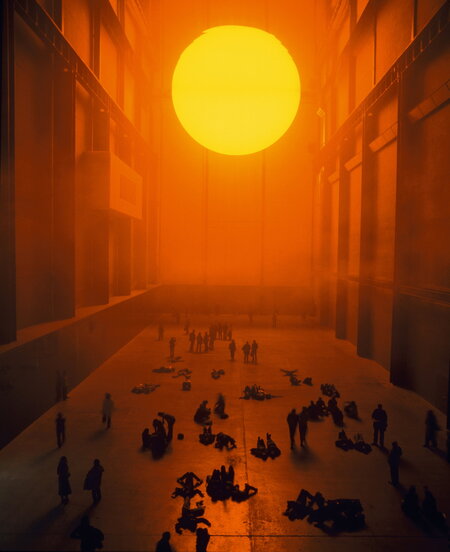
Olafur Eliasson, The weather project, 2003. Tate Modern, London.How to put the sun in a museumIn 2003, Olafur Eliasson transformed the Turbine Hall at Tate Modern into an environment mimicking a sunset. A semi-circular screen, a mirrored ceiling, and fog created the image of a massive sun. The reflections completed the disk into a full circle.Here, light doesn’t help viewers examine individual objects; it becomes the medium of the artwork itself. The photograph shows people and their reflections—the viewer ends up within the overall scene.Interestingly, the illusion’s mechanism was not completely concealed. According to the artist’s studio, visitors could see the structure from another angle. Knowing the trick doesn’t negate the impression; instead, it adds a second way of looking: first experiencing the effect, then understanding how it was made.For you, is it more important to preserve the illusion or to understand its mechanism?
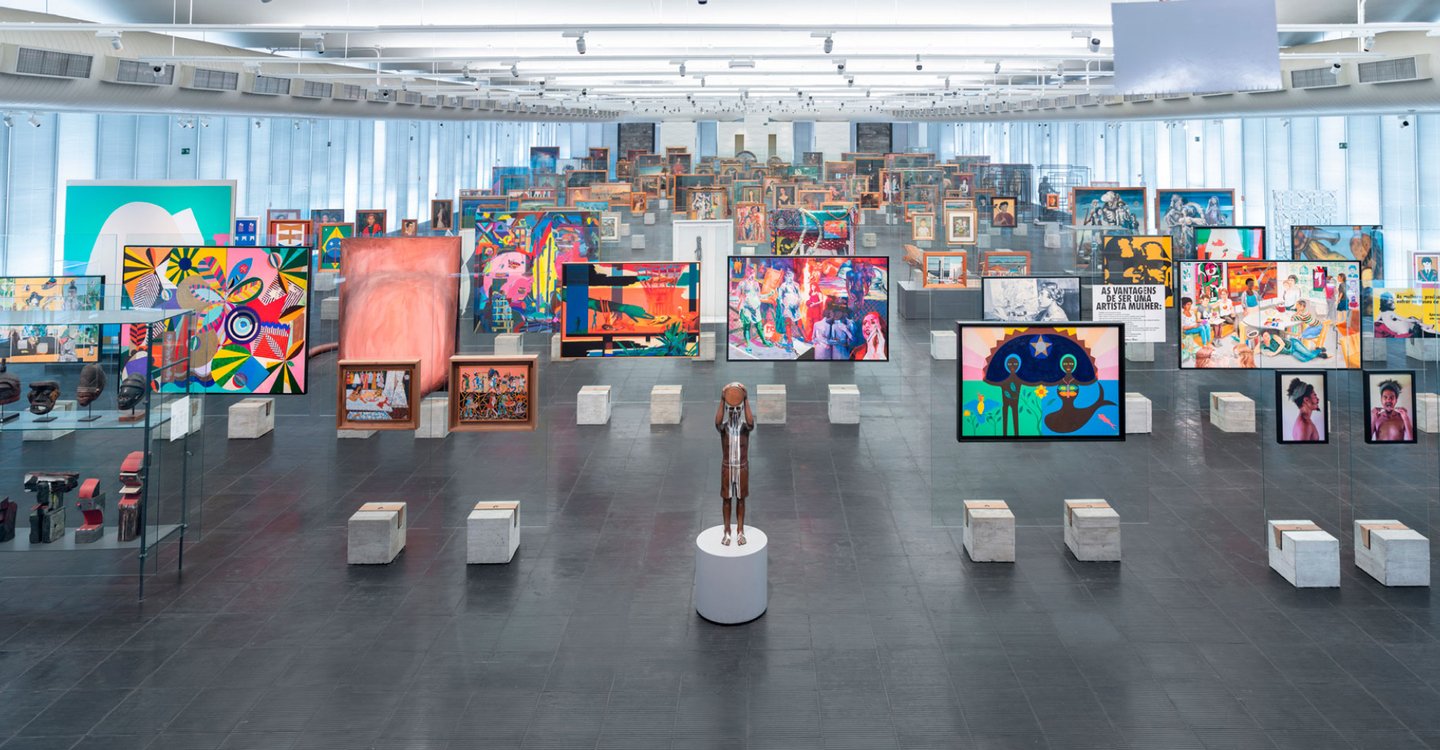
Publication 02 MASP • São Paulo Paintings don’t necessarily need to hang on a wall
Picture Gallery in Transformation, MASP, São Paulo. Glass supports: Lina Bo Bardi. Photo source: MASP.
Paintings don’t necessarily need to hang on a wallAt MASP, paintings are displayed on glass supports mounted in concrete bases. These «crystal easels» were designed by Lina Bo Bardi. They have been in use in the museum building since 1968 and were returned to the exhibition in 2015.Instead of a sequence of individual walls, an open field of works emerges before the viewer. You can choose your path, change your distance, and observe several pieces simultaneously. The museum itself links this spatial organization to a rejection of a single, predetermined route.Look at the photograph: the transparent glass doesn’t physically disappear, but visually recedes. The painting, its support, and neighboring works are perceived as different layers.A small experiment: choose one work with your eyes and trace which other images fall into your field of view next to it.
Publication 03 Musée de l’Orangerie • Paris The painting that surrounds
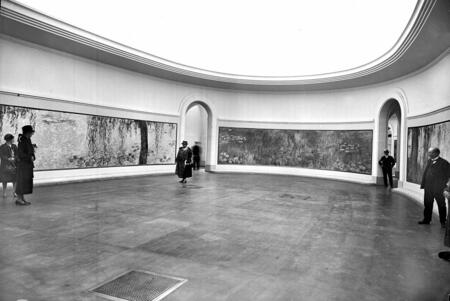
Claude Monet, «Water Lilies, ” Musée de l’Orangerie, Paris. View of the hall, 1930. Photo: Albert Harlingue / Roger-Viollet.
The painting that surrounds Monet’s „Water Lilies“ in the Orangerie is not just one piece on a single wall. Eight large compositions are displayed across two oval halls. The museum describes them as an almost continuous pictorial frieze that envelops the viewer.
The 1930 archival photograph shows how the image follows the curve of the wall. To continue viewing, one must turn and move. The canvas cannot be grasped with a single frontal glance, unlike a small framed painting.
Here, the architecture dictates the manner of encountering the painting. What matters are not only the water lilies and the reflections, but also the intervals between the panels, the height of the placement, and the overhead light.
Try mentally transplanting these same images into a straight corridor. Would the feeling of continuous space change?
Publication 04
Fondazione Prada • Milan
When an exhibition lacks a final version
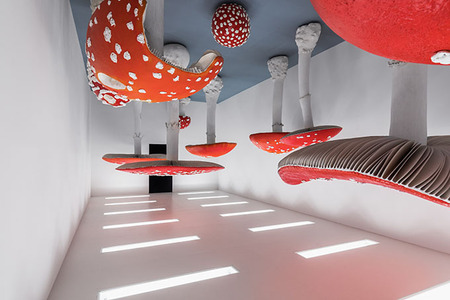
Carsten Höller, Upside Down Mushroom Room, 2000. Atlas, Milan. Photo: Delfino Sisto Legnani and Marco Cappelletti / Fondazione Prada.When an exhibition lacks a final versionAtlas at Fondazione Prada is conceived as a project that evolves over time—floor by floor. The Foundation describes the permanent exhibition as an unfinished process, open to new juxtapositions and interventions.The permanent exhibition can be updated. Even a familiar work takes on a different context if a new object appears nearby or the gallery’s arrangement changes.In this photograph of one of the Atlas variations, attention is distributed among the large forms, the ceiling, and the stripes of light on the floor.In the next museum, try looking not only at the individual artwork but also at its neighbors. What connects them for you—shape, scale, material, or a striking contrast?
Publication 05
Guggenheim Bilbao • Bilbao
The sculpture can be read with your feet
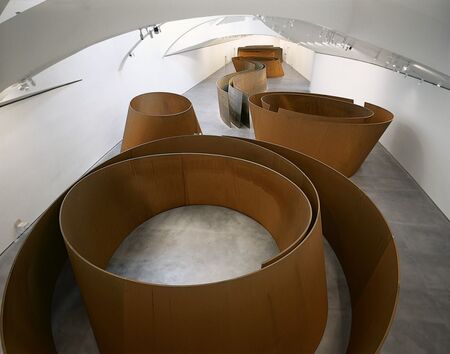
Richard Serra, The Matter of Time, 1994–2005. Bilbao. Photo Source: Guggenheim Bilbao Museoa.
Richard Serra’s The Matter of Time unites eight steel sculptures. According to the museum, their placement creates passages with varying proportions—narrow and wide, compressed and elongated. The entire hall is incorporated into the work.
From above, the composition looks almost like a diagram. At human level, it unfolds differently: the next turn cannot be perceived entirely in advance. Movement becomes a way of discovering the form.
As one walks around the sculptures, new passages open up, and the sightlines and distances change. Therefore, the route is part of the work itself—the form reveals itself through the viewer’s movement.
Look at the image and choose your presumed entrance. Where would you expect to slow down?
Publication 06
Neues Museum · Berlin
One Object as the Route Finale
Bust of Nefertiti, Neues Museum, Berlin. North Dome Hall. © Staatliche Museen zu Berlin / David von Becker.
The Nefertiti bust is displayed in the Northern Dome Hall of the Neues Museum. The museum explains this placement as the culmination of a carefully designed route: an encounter with a famous artwork is preceded by an introduction to its historical and artistic context.
This means the exhibit can function as a narrative. It has preparation, sequence, and a moment of focused attention. The significance lies not only in where the object is placed but also in what the viewer has seen beforehand.
In the photograph, the bust is highlighted by a display case and open space around it. The people in the foreground help emphasize the distance between the general hall and the individual object.
Think about a museum route that stuck with you. Was there a clear finale—or did the most important encounter happen unexpectedly?