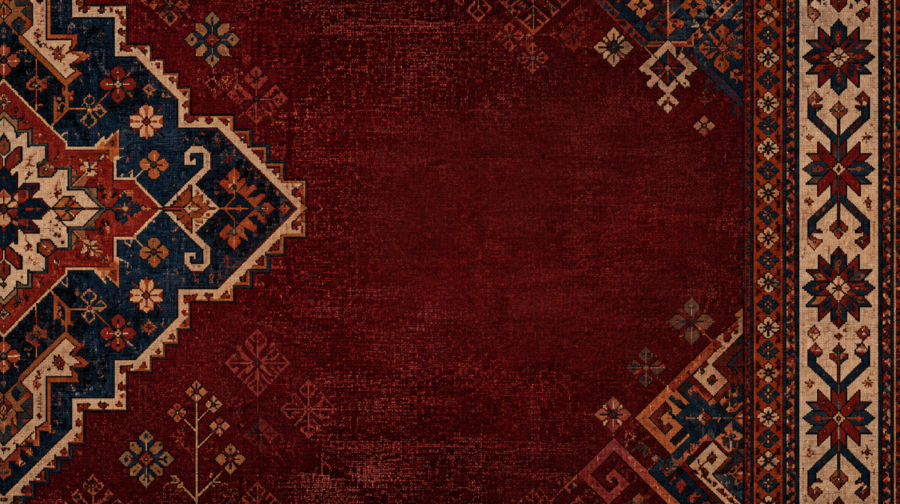
KNOT—an interactive media experience dedicated to the ornaments of traditional carpets, their structure, history, visual language, and creation methods. The project invites the user not just to view carpets, but to explore individual pattern elements, assemble motifs independently, compare regional traditions, and discover how decorative motifs evolve into complex compositions.
The core concept is that the carpet is viewed as a visual document that can be studied through imagery, history, and direct interaction with the pattern itself.
Furthermore, the meanings of the symbols are examined within a specific cultural context, rather than as universal meanings applicable to all carpets.
Six-Month Plan
KNOT focuses on larger research materials. Preparing publications requires studying historical samples, sourcing information, analyzing ornaments, and developing visual schematics.
The volume of publications changes over a six-month period. In the initial months, the media platform builds its core knowledge library, and closer to the interactive editor launch, the number of user-generated content increases.
November Symbol. — Ornamental Motifs — 4 December Region. — Carpet Traditions — 6 January Patterns. — Ornament Construction — 4 February Color. — Color and Composition — 6 March Design. — Materials and Technique — 8 April KNOT.LAB. — Interactive Editor — 8 Total 36
November. SYMBOL, 4 posts
Media introduces the audience to fundamental geometric and botanical motifs. Common forms, variations in their arrangement, and methods of interpretation are examined. Special attention is given to why an ornament’s meaning cannot be determined without historical context.
December. REGION, 6 publications
The materials focus on the carpet traditions of various regions. Users compare Persian, Caucasian, Anatolian, and Central Asian carpets. The publications illustrate the differences in composition, techniques, and decorative elements.
January. PATTERN, 4 publications
This month is dedicated to the principles of ornamentation. Readers will study symmetry, repetition, rhythm, borders, and central compositions. At the end of the month, participants will be challenged to create their own geometric pattern.
February. COLOR, 6 publications
KNOT explores the color palettes of traditional rugs and their impact on pattern perception. Users compare palettes, study contrast, and observe how background changes affect the legibility of decorative elements.
March. WEAVE, 8 publications
Media explores the materials and manufacturing methods of carpets. The publications focus on fabric structure, weaving patterns, pile and non-pile carpets, texture, and the characteristics of ornament transfer across various techniques.
April. KNOT.LAB, 8 publications
In the last month, an experimental pattern library will launch. Users will have the opportunity to create their own ornaments, select symmetry principles, and choose color schemes. Participants' works will form the basis for collective publications.
Ten content samples
Is it possible to determine a carpet’s origin from a single symbol?
Format: Telegram, interactive poll. A small fragment of a geometric ornament, devoid of information about the rug, is shown to the user. They are asked to guess whether the object’s origin can be determined based solely on this image. After voting, the complete rug and its attributional information—if confirmed by sources—are displayed. The material explains why similar motifs appear across different cultures and emphasizes the importance of considering manufacturing technique, composition, and historical context.
Why do Persian and Caucasian rugs look different?
Format: VKontakte, visual carousel.
Readers are presented with several specific rugs from museum collections. They are asked to compare the shapes of the ornaments, the character of the lines, and the arrangement of the elements.
After voting, KNOT explains the features of the selected samples, without reducing all rugs from a single region to one unified style. The material shows that regional traditions can vary while still sharing common artistic techniques.
Assemble the ornament from four elements
Format: Website, interactive editor.
Users are presented with four basic geometric shapes: rhombus, square, triangle, and star. The task is to create a repeating composition while adhering to one of the principles of symmetry.
Upon completion, the user receives an image of their own pattern and can compare it with the work of other participants. The breakdown explains how the repetition of simple forms allows for the creation of complex decorative compositions.
Why does one ornament appear on different rugs?
Format: DTF, educational article.
The author showcases several historical carpets that feature visually similar elements. The reader is tasked with identifying which details match and which differ.
After the comparison, KNOT explores possible reasons for the similarities: shared craft traditions, cultural contacts, the spread of motifs, and the independent use of simple geometric forms.
The material explains why external resemblance does not always imply identical origins.
One rug, three color palettes
Format: VKontakte, visual comparison.
The user is shown one ornament in three contemporary color palettes. The task is to select the palette in which the decorative elements are most clearly separated from the background.
After voting, KNOT explains how saturation, lightness, and contrast affect the perception of repeating forms.
It is also clarified that the altered palettes are a design experiment, not a historical reconstruction.
How is a carpet pattern created?
Format: Shorts, 30-second video.
00:00–00:05. A simple rhombus appears on screen.
00:05–00:12. The shape repeats multiple times horizontally.
00:12–00:20. A reflection is added, forming a symmetrical composition.
00:20–00:27. A border appears around the ornament.
00:27–00:30. The finished decorative pattern is shown, along with an invitation to create a personal version.
The video demonstrates the principle of constructing a composition from a simple geometric element.