Media Concept
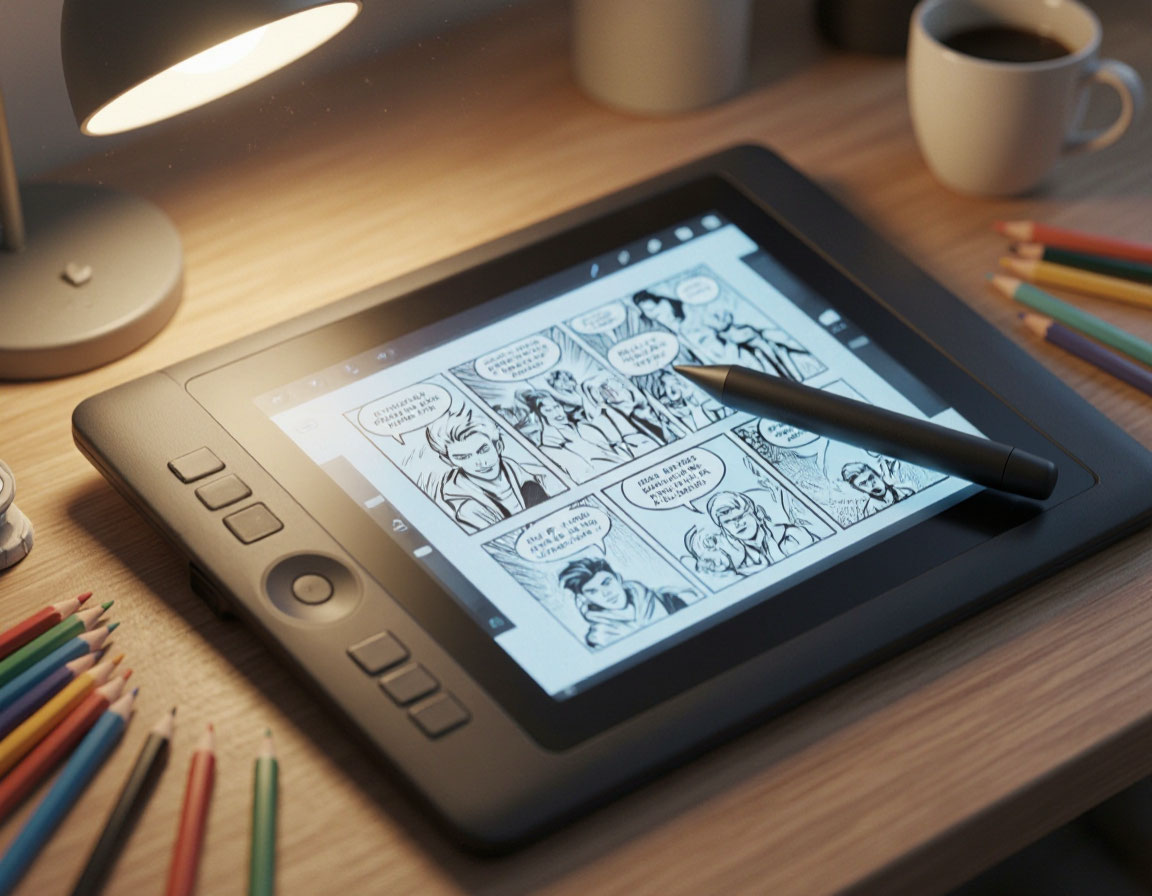
This media section is dedicated to the art of creating non-fiction comics and stories—graphic narratives that unpack significant social, scientific, and cultural themes by organically weaving storytelling with established facts. We demonstrate how visual storytelling can simplify and make complex subjects engaging—ranging from historical events and scientific breakthroughs to personal narratives. Our goal is to inspire writers and artists to use the comic format as a powerful narrative tool where factual accuracy and emotional depth work in harmony.
At the same time, we are exploring how to make such comics popular in the age of artificial intelligence—not by fully replacing AI, but through intelligent complementarity. We work with the audience and the creation of one’s own style, demonstrating where AI can accelerate routine tasks (drafts and references) and where human skill, authorial perspective, and responsibility for factual accuracy are irreplaceable. This approach allows us to maintain the creative identity and ethical depth of projects by using technology as an enhancer, not a substitute.
Thematic Outline
November: What is a Comic?
Why comics are popular and why people love them. Why some people read comics while others do not.
December: How to Write a Screenplay
How to conceive a plot and characters that will captivate the reader not just through the story, but through the character’s appearance.
January: AI as an Artist’s Assistant
Learning when to use AI to assist in creating backgrounds, references, and complex costumes, versus when to rely on one’s own hands and imagination.
February: Visuals
How to convey composition, depth, and emotion through space—without words, and sometimes without a central subject.
March: Promotion Without a Budget
How to promote your comics on social media and other platforms without paying for advertising.
April: Burnout and Fear
How to combat imposter syndrome, the fear of failure, and anxiety about strong competitors.
Content Samples
Why Comics Are More Than Just Pictures
Most people think comics are simply a collection of pretty images. But in reality, it is a form of literature. Rhythm, the pauses between panels, and the character of the protagonist are at work here. We see, feel, and read all of it simultaneously.
How to Make a Comic Popular
Comics gain popularity not from the author’s perfect style, but from how the artist conveys emotion. The reader must find themselves in the hero or experience the story’s conflict alongside them. If the narrative grips the audience—people will eagerly await a continuation, regardless of how perfectly or imperfectly the story’s visuals are rendered.
AI as a Tool, Not a Replacement
We are not against neural networks. They excel at handling routine tasks and complexities—finding references, generating backgrounds, and structuring compositions. However, it is the artists who create the narrative and the characters. AI is an excellent assistant, but it cannot replace the creative human.
Why Handmade Graphics Still Hold Value
AI networks produce perfect images in seconds. But they lack soul. And they are all absolutely too perfect. Handmade work reveals the author’s character and conveys emotion better. AI cannot feel the pain or joy of a character. But an artist does—because they are human, not a machine.
How to Convey Emotion Without Words
It often seems that a character’s emotions can only be conveyed through facial expressions or dialogue. However, this can be achieved through a combination of color, space, line, and framing. In many cases, you may not even need to show the character; you can design the space so that the viewer instinctively feels the character’s emotions.
The Tyranny of Perfection
Every second comic looks perfectly beautiful. Even issues with fingers or inconsistent background shifts between panels go unnoticed by the human eye when generated by AI—because the image is simply too gorgeous, and the gaze doesn’t know where to land. And that becomes tiresome. The human hand is capable of creating emphasis precisely where the narrative demands it, and that is what truly engages the reader and their eye.
How to Order a Comic
If you want a custom comic, don’t ask the artist to «draw something» or «write some story.» Instead, describe the character, the conflict, and the goal. The clearer the creative brief—even if it’s written in simple language—the better the result will be. Most importantly, this saves time for both you and the artist.
The Illustrator’s Greatest Fear
The fear of a blank page is familiar to everyone. It feels like you aren’t reaching the same artistic levels as others. Even rough sketches seem terrible compared to the initial work of others. But the truth is that comics are about communicating an idea. Start with a simple sketch. Even if it’s awful, you can always refine it and make it exactly how you envision it.
How to Cope with Failure Among Competitors
In social media, we see artists with incredibly unique styles, and it feels like everyone around us is a professional. But you are only seeing the final result, not the years of attempts and corrections. Compare yourself to who you were yesterday, not to someone else’s portfolio in your feed, and you will understand that your journey is unique.
Portfolio Matters More Than Likes
Your portfolio is not just a collection of pretty images. It illustrates your journey and how you approach problem-solving. Showcase the process—from sketch to final product. Clients appreciate seeing how the magic, or simply a great image they want, comes to life. Even if you use AI for background elements, show your personal contribution to adding details, developing the narrative, and designing characters.